
Reims – the city of coronations (Marne): history, visits, local life & real estate
TL;DR: Reims, a major city in the Grand Est region, combines extraordinary heritage (cathedral and Champagne cellars listed as UNESCO sites) with a sparkling art of living. Just 46 minutes from Paris-Est by TGV, the commune is home to nearly 180,000 inhabitants, a vibrant cultural life, and a still accessible real estate market for a large urban area. Here is the complete guide to understand the city of Reims and prepare your visit or relocation.

- Geography and location
- History and heritage
- Population and demographics
- Economy and employment
- Tourism and culture: must-sees
- Transport and access
- Local life: education, sports, events
- Real estate and urban planning
- FAQ
- Sources and useful links
Sommaire
Geography and location
Reims is the central city of the Marne department (51) and the Reims urban area, located in the heart of the Grand Est region. Situated 130 km northeast of Paris as the crow flies, the city stretches over a plateau cut by the Vesle river and bordered to the south by the Montagne de Reims, a Champagne terroir and regional natural park. Altitude: between 80 m and 135 m depending on the neighborhood (town hall at ~83 m). Area: approximately 47 km². Demonym: Rémois·ses. INSEE code: 51454; postal code: 51100.
Did you know? The ancient name of Reims was Durocortorum, capital of the Remi, a Gallic tribe allied with Caesar. The Roman remains – cryptoporticus, Gate of Mars – recall this two-thousand-year-old history.
History and heritage
It is impossible to talk about Reims without mentioning the coronations of the kings of France. While the tradition began in the early Middle Ages, the founding myth is the baptism of Clovis by Saint Remi (5th century), an episode that anchors the city in the national imagination. The current cathedral, mostly built in the 13th century in the Rayonnant Gothic style, hosted the coronation ceremonies up to Charles X in 1825. The cathedral complex – Palace of Tau – Basilica of Saint-Remi is listed as a UNESCO World Heritage Site (1991), along with the Hillsides, Houses and Champagne Cellars (2015), which notably include the Saint-Nicaise hill in Reims (Taittinger, Pommery cellars…), the Avenue de Champagne in Épernay, and the hills of Hautvillers and Aÿ.
World War I deeply marked the city: bombed, the cathedral was devastated by the fires of 1914. Reims was rebuilt in the 1920s-30s, adopting an Art Deco style – evidenced by the elegant Halles du Boulingrin or some buildings on rue de Vesle. This dual identity – symbolic capital and reconstructed city – explains the attachment of the people of Reims to their heritage, from Gothic stone to Freyssinet’s curved concrete.
UNESCO in two lines: Reims has two UNESCO listings. 1991: “Notre-Dame Cathedral, Palais du Tau and former Saint-Remi Abbey.” 2015: “Hillsides, Houses and Cellars of Champagne,” including the Saint-Nicaise hill (Reims).

Population and Demographics
With 178,478 inhabitants (municipal population 2022), Reims is one of the major French urban areas outside metropolitan regions. The density reaches approximately 3,800 inhabitants/km². The urban unit of Reims includes more than 214,000 inhabitants.
| Indicator (INSEE) | Value | Details |
|---|---|---|
| Municipal population | 178,478 (2022) | Commune of Reims |
| Area | ≈ 47.0 km² | Municipal territory |
| Density | ~ 3,796–3,805 inhabitants/km² | 2022 calculation |
| Demonym | Rémois, Rémoises | Local usage |
| INSEE / Postal code | 51454 / 51100 | Marne (51) |
From an urban sociology perspective, Reims has the profile of a young large university city (University of Reims Champagne-Ardenne, grandes écoles) and a housing stock mainly composed of apartments, concentrated in central neighborhoods and in post-war reconstruction complexes. Demographic dynamism occurs at the scale of the catchment area (suburbs and villages of the Greater Reims).
Economy and Employment
As the capital of Champagne along with Épernay, Reims hosts leading houses and groups (Taittinger, Vranken-Pommery Monopole, G.H. Mumm…), a network of artisan winemakers and service providers (wine tourism, logistics, packaging…). The food industry (Fossier biscuits, chocolatiers), logistics (motorway junction A4/A26/A34), healthcare (university hospital), higher education & research (URCA, NEOMA BS) and commercial services form other pillars of employment.
Two structural assets complete this base: the TGV platform (Champagne-Ardenne TGV station in Bezannes) which stimulates the business districts, and extensive business parks (Croix-Blandin, Farman, Bezannes). Heritage and business tourism (conferences, seminars) is growing with the rise of UNESCO and an ambitious cultural program.
Tourism and Culture: The Top 5 Must-See
- The Notre-Dame Cathedral (UNESCO). Gothic masterpiece (13th century), contemporary stained glass (Chagall, Imi Knoebel), gallery of kings… A must both outside and inside.
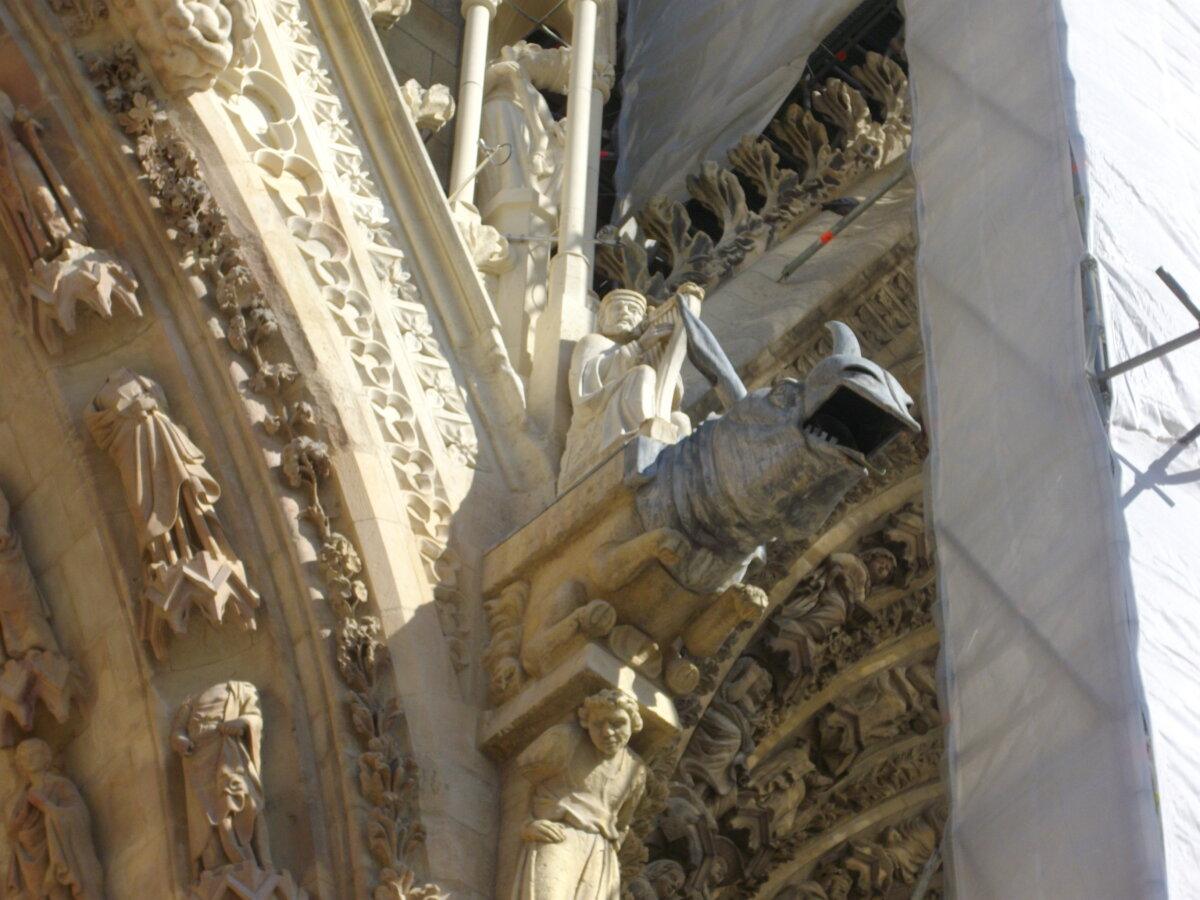 Stone lace: detail of the north portal of the cathedral (© Fab5669 / Wikimedia Commons, CC BY-SA 3.0).
 - The Palais du Tau. Former residence of the archbishops and coronation museum. (Check opening status depending on ongoing works.)
- The Saint-Remi Basilica and Museum (UNESCO). The Romanesque nave, the Gothic choir, the relics of Saint Remi; in the museum, the history of Reims, from the Remi tribe to the reconstruction.
- The Porte de Mars & the Cryptoporticus. Two witnesses of Durocortorum, Gallo-Roman Reims: the monumental arch and the vaulted gallery at the Forum square.
- The Champagne cellars and chalk pits (UNESCO 2015). In Reims, the Saint-Nicaise hill houses huge chalk pits: spectacular tours and tastings at Pommery, Taittinger, Veuve Clicquot, etc.

Transport and access
Getting to Reims
- Train: Reims is connected to Paris-Est in ~46 minutes by TGV/TERGV (Reims-Centre station). The Champagne-Ardenne TGV station (Bezannes) complements the offer on the Eastern European axis.
- Road: strategic motorway junction: A4 (Paris–Strasbourg), A26 (Calais–Troyes/Chaumont), and A34 (towards Charleville-Mézières).
- Air: Roissy-CDG and Orly accessible by train via Paris-Est; Vatry airport (Marne) offers seasonal connections.
Getting around the metropolitan area
The Citura network (tram + bus) serves the city and the Greater Reims: two tram lines A and B (center, campus, university hospital, Bezannes) and a network of express suburban lines, park-and-ride facilities, on-demand transport (TAD). The central stations (Gare Centre, Comédie, Opéra, Vesle) allow exploring the city on foot.
Local life: education, sports, events
Reims is a notable student city (University of Reims Champagne-Ardenne, NEOMA Business School, engineering and art schools), which energizes the Saint-Remi, Croix-Rouge, Clairmarais neighborhoods and the center. On the sports side, the Stade de Reims, a historic club, plays at the Auguste-Delaune stadium. The Flâneries Musicales enliven the summer, while the Johannite Festivals (early June) plunge the city back into the medieval atmosphere around the coronation.
Agenda (selection): Johannite Festivals (May-June), Regalia sound & light show on the cathedral (seasonal), markets under the Boulingrin Hall (Friday & Saturday), fairs and congresses in the cellars and heritage sites.
Real estate and urban planning
For a large urban area well connected to Paris, Reims remains affordable. In 2025, specialized sources indicate average levels around €2,600–2,700 / m² for an apartment and around €2,300–2,500 / m² for a house (variations depending on neighborhoods, condition, and features). The sought-after areas: historic center (cathedral, Boulingrin), Cérès–Boulingrin, Saint-Remi, Courlancy-Saint-André; family opportunities are also found towards Laon-Zola, Cormontreuil (bordering), and Bezannes (recent suburban housing).
From an urban planning perspective, the city combines medieval layouts, Art Deco reconstruction, and contemporary developments (Reims-Center business district, Bezannes ZAC, redevelopment of brownfields). To watch: projects around mobility (BHNS, express network), enhancement of the Champagne landscapes (UNESCO listed), and energy renovation of the interwar apartment buildings.
Key takeaways (real estate): rather liquid market, strong demand for the center and the beautiful Art Deco streets, even softer budgets in neighborhoods beyond the Vesle. Good rental yield on small student units near tram lines A/B.
Exploring the region? Also read our guides on Épernay (Avenue de Champagne, Houses and cellars) and Châlons-en-Champagne (historic center and canals).
FAQ – Reims in 5 questions
What to visit in Reims over a weekend? Day 1: cathedral, Palais du Tau (depending on opening), Saint-Remi basilica & museum. Day 2: Porte de Mars and cryptoporticus, Art Deco walk (Halles du Boulingrin, rue de Vesle), visit a Champagne cellar on Saint-Nicaise hill. What is the population of Reims? The municipality has about 178,500 inhabitants (2022); the urban unit exceeds 214,000 inhabitants. How to get to Reims from Paris? By TGV/TERGV from Paris-Est (fast trips around 46 min) or by A4 car (~1h30 depending on traffic). Connections exist via Champagne-Ardenne TGV (Bezannes). What are the pleasant neighborhoods to live in? Historic Center/Cathedral, Cérès–Boulingrin (Art Deco), Saint-Remi, Courlancy–Saint-André and, for families, Laon-Zola, Chemin-Vert/Jamin, Bezannes (new) depending on budget and mobility. What is the real estate price in Reims? In 2025, averages are around €2,600–2,700 / m² for apartments and €2,300–2,500 / m² for houses, with significant differences depending on micro-neighborhoods and property condition.
Sources and useful links
- INSEE – Legal population and indicators (municipality of Reims) ; 2022 comparative file.
- UNESCO – Notre-Dame Cathedral, Palais du Tau and former Saint-Remi Abbey (1991) ; Hillsides, Houses and Cellars of Champagne (2015).
- Reims Tourist Office – Visit & event info ; City of Reims (Regalia program and news).
- Transport – Citura (tram & bus) ; Network maps ; SNCF Connect (Paris <> Reims ~46 min).
- Real estate – MeilleursAgents (price/m² Reims) ; SeLoger (Reims prices).
- Encyclopedic references – Reims (Wikipedia) ; Reims Cathedral.