At the crossroads of the Vosges and Jura, Belfort occupies the famous “Gap of Belfort” connecting the Rhine and Rhône basins. A Vauban Fortress, symbol of resistance with the Lion of Bartholdi, an industrial and university hub, the City of the Lion combines formidable heritage, nature just steps away, and discreet dynamism. A complete dossier to discover history, tourist visits, living environment, and transport.

Sommaire
Belfort at a glance ⭐
| ✅ Strengths | ⚠️ Points to watch |
|---|---|
| Unique heritage (Lion, Vauban Citadel) Nearby nature (Ballon d’Alsace, Malsaucy) Smooth transport (TGV, soft mobility) Dense cultural life (Eurockéennes, FIMU) Dynamic economy (hydrogen, innovation) Affordable real estate vs major metropolises | Stable demography (no migration boom) Continental climate (harsh winters) Limited air access (Basel airport 100 km away) Specialized economic fabric (dependent on rail) Seasonal tourism (summer/festival peaks) Local market less dynamic than big cities |
Rating: 8/10 ⭐⭐⭐⭐⭐⭐⭐⭐
Recommended for: heritage tourists, remote workers seeking quality of life, lovers of hiking & history, families in urban transition, students in technology (UTBM).
Geography & location: the natural gateway between Rhine and Rhône
Belfort is situated in the heart of the Gap of Belfort, a threshold about twenty kilometers long that cuts through the terrain between the Vosges massif and the Jura plateau.
This strategic geographical configuration connects the Rhine Europe to the Saône-Rhône basin and has made the city a crossing point since Antiquity. The Savoureuse, a mountain river originating from the Ballon d’Alsace, irrigates the plain before joining the Allan then the Doubs; the city developed on its banks, protected by a rocky spur where the citadel clings.
Around, a landscape of hills, open forests, and calm waters (Malsaucy pond, Forges pond) soften the austerity of the stones. Within 20–40 minutes, the first Vosges viewpoints open clear panoramas on the ridges and, in clear weather, as far as the Alps.
This interface of reliefs and valleys, combined with a cross-border position (Switzerland and Germany very close), explains the density of rail and road axes, but also the mixed identity of Belfort, borrowing both from neighboring Alsace and Franche-Comté.
History & heritage: Vauban, Denfert-Rochereau and the Lion
The “Belfort lock” was very early covered with defensive works. Attached to France in 1648, the city was deeply remodeled by Vauban from 1675: pentagonal layout of the ramparts, diversion of the Savoureuse to reinforce hydraulic defense, aligned barracks and orthogonal grid in the old town.
In the 19th century, General Haxo reshaped and strengthened the citadel, then a Séré de Rivières fort belt was built after 1871. The founding episode remains the siege of 1870–1871: under the orders of Colonel Denfert-Rochereau, the garrison held out for 103 days against the Prussians.
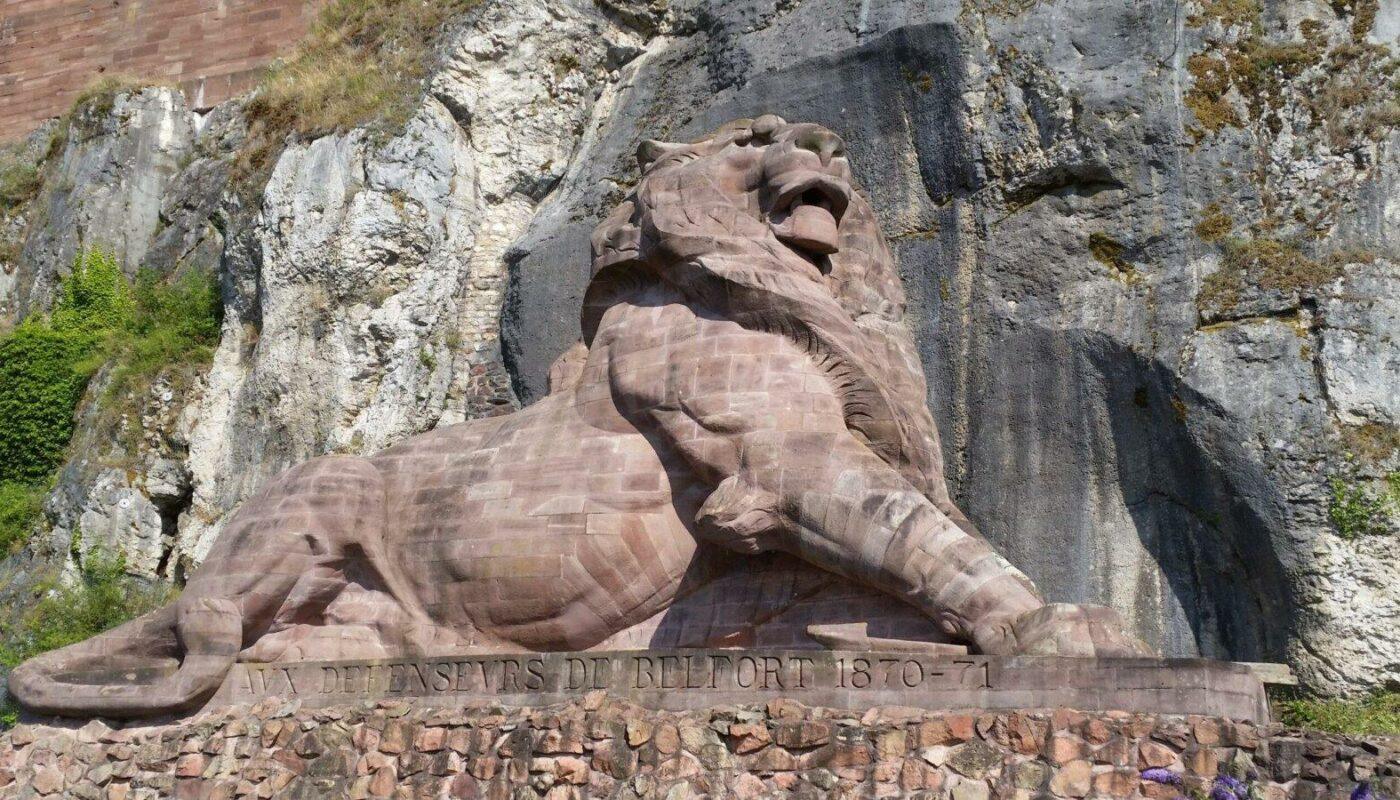
This historical resistance allowed France to keep the Belfort district and led to the creation of the Territory of Belfort department. To engrave this memory, the Alsatian Auguste Bartholdi sculpted the Lion of Belfort (1875–1880), a colossal high relief (about 22 m long and 11 m high) carved in pink sandstone, leaning against the cliff under the citadel.
More than an emblematic monument, the Lion is an attitude: a compact, dignified, resilient city that has made stone a way of living.
Beyond this triptych (Vauban–Haxo–Bartholdi), Belfort cultivates a homogeneous urban heritage, with colored facades in Vosges sandstone, squares opening perspectives on the Lion, and a network of forts (Miotte, Salbert, Justice) that tell the story of the border and the art of watching over the plain.
The living citadel now houses the History Museum and offers tours in the “great underground“: a useful visit to understand the local urbanism, where streets and glacis still interact.
 The Malsaucy pond, a leisure base and natural setting of the Eurockéennes.
Population & demography: a compact central city
According to the legal populations 2022 effective from January 1, 2025, the municipality of Belfort has 45,646 inhabitants. The city concentrates about one-third of the department’s population (140,082 inhabitants) and forms, with Montbéliard and Héricourt, an urban continuum linked by daily mobility.
The recent demography is marked by a slight decline, more related to residential mobility than to the natural balance, in a context of an aging urban area. On the housing side, the housing stock remains balanced (high share of primary residences, low vacancy but to be monitored in some old blocks).
This urban compactness is a strength: dense services at pedestrian scale, cultural facilities in the center, nearby nature.
Economy & employment: rail, energy, hydrogen, campus
Belfort is a historic industrial center. The SACM (origin of Alsthom, then Alstom) settled there at the end of the 19th century: locomotives, then electric traction and high-speed trains. Today, the Belfort site still contributes to locomotive and TGV traction sets programs (Avelia platforms), with heavy assembly expertise and engineering.
In energy, the Belfort site of GE (now part of GE Vernova for the gas division) designs and assembles high-power gas turbines for 50 Hz power plants, while the former Arabelle nuclear activity was taken over by EDF in 2024.
Around, a hydrogen ecosystem is developing: BelHYnov production station, hydrogen bus fleet operating on the urban network, R&D hub FCLAB, start-ups and suppliers contribute to a local sector visible nationally.
On the higher education side, the University of Technology of Belfort-Montbéliard (UTBM) attracts a steady flow of students (nearly 800 new entrants in 2025), feeding professions in engineering, energy, and digital.
The SME-ETI fabric mixes mechanics, automotive subcontracting (near Sochaux), maintenance, and applied digital. In short, Belfort holds its place in the “productive North Franche-Comté“, both heir (rail) and pioneer (hydrogen).
Tourism & culture: top 5 must-see places
The Citadel & the Lion of Bartholdi — Ramparts, underground passages, 360° panorama, and, at the foot of the cliff, the monumental Lion: the core visit, preferably in late afternoon for the low light on the sandstone. Allow time for the History Museum and the Brisach gate.
Old Town & Saint-Christophe Cathedral — An old center remodeled by Vauban, pastel facades, squares with neat alignments. The cathedral (18th–19th century) is one of the youngest in France by its elevation to cathedral status (1979). Inside, classical sobriety and a remarkable organ.
Malsaucy Pond — Beach, shore paths, water sports base: a nature breath 10 km away, hosting each summer the stage of the Eurockéennes. Outside the festival, it is a place for picnics, running, birdwatching.
Ballon d’Alsace — Summit at 1,247 m, emblematic viewpoint of the Southern Vosges. Family hikes, four-season activities and, in winter, a small ski resort. Bonus: summit meadows and blueberry moors in spring.
Crown forts (Miotte, Salbert, Justice) — Remains of the Séré de Rivières belt, often perched with views. Perfect to understand the city “from its lines” and grasp the defensive landscape.
On the museums side, the Maurice-Jardot Donation presents a fine collection of modern art (Braque, Chagall, Léger, Picasso…), currently housed in the Tour 41 during renovations. The cultural calendar is generous: FIMU (Pentecost), Eurockéennes (early July), exhibitions and local scene seasons.
 At the top of the Vauban ramparts, the view unfolds over the old town, the Savoureuse and the bastioned pentagon.
Local specifics: Franche-Comté cuisine and border DNA
Belfort tastes the flavors of Franche-Comté: comté, morbier, mont d’or (in season), cancoillotte, charcuterie and smoked products, Jura wines within driving distance. The table is simple and mountain-style, perfect after a walk on the Ballon d’Alsace.
On the plate as in urbanism, the city tells its influences: nearby Alsace (colors, roofs, a certain taste for detail), Comté for the stone, Switzerland for cross-border mobility.
 The Ballon d’Alsace, summit of the Southern Vosges (1,247 m), less than an hour from the ramparts.
Transport & access: TGV, TER, Optymo buses and soft mobility
Belfort has two complementary rail hubs: Belfort-Ville (center) and Belfort–Montbéliard TGV (Meroux-Moval, on the Rhine-Rhône high-speed line, commissioned in December 2011).
To Paris-Gare-de-Lyon, daily connections exist from about 2 h 30 (depending on trains and connections). The Belfort–Delle line was reopened at the end of 2018, reconnecting Switzerland (CFF) and allowing direct access to the TGV station.
By road, the A36 (Beaune–Mulhouse axis) puts Mulhouse and Basel within quick reach; the EuroAirport Basel-Mulhouse-Freiburg is the closest airport. On the daily mobility side, the Optymo network covers the urban area (urban and suburban lines, unified tickets North Franche-Comté) and stands out for the hydrogen bus experiment supported by a local production station.
Walking and cycling are gaining ground, helped by the compact center and developments along the Savoureuse.
Local life: education, sports, associations
Central city, Belfort concentrates high schools, higher education, and public services. The UTBM, the IUT, and specialized schools feed the associative life (robotics, energy, fablabs).
On the sports side, the football clubs ASM Belfort (National 2) and mountain societies animate weekends; the municipal offer (pools, ice rink, water bases) is dense given the city’s size. Neighborhood associations are active in the Glacis, the Résidences, and around the old town, with regular cultural agendas.
Major events: Eurockéennes & FIMU headlining
Two events shine well beyond the department. First, the Eurockéennes, created in 1989, which gather each summer on the Malsaucy peninsula up to more than one hundred thousand festival-goers in an iconic lakeside setting.
Then the FIMU (International University Music Festival), free and abundant, which takes over the entire city as a stage on Pentecost weekend: hundreds of concerts, surprising repertoires, delightful mixing.
Real estate & urbanism: compactness, rehabilitations and views on ramparts
The old center (Vauban pentagon) concentrates 19th century buildings with sandstone facades, regularly renovated since the 2000s (pedestrianizations, square requalification, station forecourt).
The Résidences and Glacis neighborhoods have benefited from urban renewal programs; the current challenge concerns energy renovation and requalification of old blocks to attract families and workers.
The proximity of parks (Savoureuse, Forges), quick access to Malsaucy, and views from some apartments of the Lion or the ramparts are among the quality assets. At the intercommunal level, land remains more affordable than in major metropolises, with a market driven by student rentals and employment trajectories in industry and technical services.
FAQ — Belfort in 7 questions
What is the best time to visit Belfort?
From May to October: mild weather, lively terraces, lush nature. For culture, aim for Pentecost (FIMU) and early July (Eurockéennes). Winter offers beautiful light on the Lion and snow outings at the Ballon d’Alsace.
Can you do everything on foot in Belfort?
In the center, yes: ramparts, museums, squares, shops are close. For Malsaucy or the peripheral forts, prefer bicycle, Optymo bus, or car.
How many inhabitants in Belfort?
45,646 inhabitants (municipal population 2022, effective January 1, 2025).
Which Franche-Comté specialties to taste?
Classic Comté: comté, morbier, cancoillotte, smoked products, Jura wines. In season, the hot box (mont d’or) is a safe bet.
How to get to Paris from Belfort?
TGV via Belfort-Montbéliard TGV (Rhine-Rhône high-speed line) with journeys from about 2 h 30 depending on connections. TER trains connect Belfort-Ville to the TGV station and to Delle (Switzerland).
What are the must-sees for a day in Belfort?
Citadel + Lion, old town & cathedral, walk along the Savoureuse; if you have a car, sunset at the Ballon d’Alsace.
Are there art museums in Belfort?
Yes: the Maurice-Jardot Donation (modern art) is presented at the Tour 41 during extension works.
Sources & useful links
- Belfort Museums — Citadel: musees.belfort.fr/citadelle
- Network of major Vauban sites — Belfort: sites-vauban.org
- Lion of Belfort — Presentation & dimensions: musees.belfort.fr
- INSEE — Territory of Belfort (2022 indicators): insee.fr
- INSEE — Municipal population 2022: autb.fr
- Gap of Belfort — Geography: wikipedia.org
- Savoureuse River — Geography: wikipedia.org
- Tourist Office — The Citadel & the Lion: belfort-tourisme.com
- Eurockéennes (official site): eurockeennes.fr
- FIMU (official site): fimu.com
- UTBM — University of Technology: utbm.fr
- GE Vernova — Energy & innovation: gevernova.com
- Alstom — History & roots in Belfort: wikipedia.org
- Ballons des Vosges Regional Natural Park: parc-ballons-vosges.fr
- Belfort-Montbéliard TGV Station: wikipedia.org
- Optymo Network — Bus & hydrogen: optymo.fr
💡 Transparency: This article may contain affiliate links. Commission if purchased, at no cost to you. 100% independent opinion. Prices and information verified on November 12, 2025. Content published by Territories & Urbanism Editorial Team.