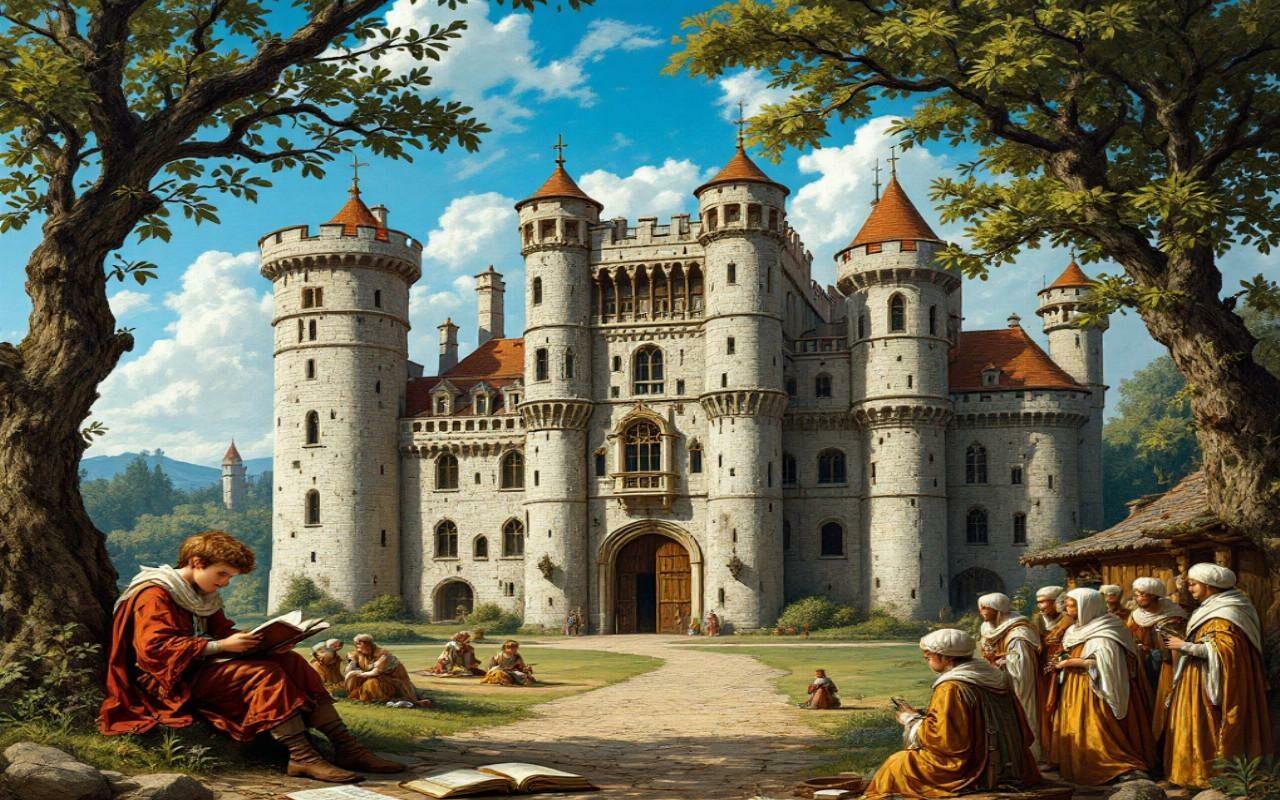
What were the pillars of medieval teaching?
The Church, guardian of knowledge and the scriptum
Before the advent of the great universities, the Church held the reins of education. In abbeys, monks copied manuscripts by hand, orchestrating each student around a parchment and a quill. It was not just about copying: they commented, translated, compared biblical texts and Greco-Latin philosophers. This activity, far from being a simple mechanical task, was a ritual that structured critical thinking. Liturgical chant served as a mnemonic key: learning a passage through a melody, a trick still used today.
Chivalry and training “at the tip of the sword”
When one thinks of the education of lords’ sons, one imagines a path marked by lessons in jousting and horsemanship. Yet, chivalric instruction combined martial arts and letters: knowing Latin remained a diplomatic asset, reading charters a privilege. Courtesy manuals, such as the “Book of the Art of Chivalry,” taught how to hold one’s lance, but also how to behave at the table, converse with a sovereign, or decipher a political treaty. In other words, one learned to defend one’s fief and negotiate peace.
The first urban schools and the secular rise
From the 12th century onwards, emerging cities required artisans and merchants to master reading, arithmetic, and the basics of law. Communal schools, often set up in a chapel or guild hall, taught the basics of the “trivium” (grammar, rhetoric, dialectic). Later, these institutions gave birth to some of the most prestigious universities, such as Bologna (1088) or Paris (1150), where theology was debated but also astronomy or medicine. The result: the gradual secularization of instruction led to exchanges between the ecclesiastical milieu and the emerging bourgeoisie, laying the foundations of modern education.
What methods and materials were used to learn?
The illuminated manuscript, collective memory and educational decoration
Impenetrable, the medieval book was more than a medium: it was a work of art. Illuminations, true visual diagrams, helped to understand biblical stories or astronomy lessons. Often, glosses were found in the margins, these comments scribbled by several generations of copyists. Like a contemporary forum, these annotations provoked a dialogue between anonymous people of the past.
Lecture, dictation and “disputatio”
The student listened to the master declaiming a text in Latin, sometimes chained to a lectern: this is called a “lecture magistrale.” Then came the dictation, where one repeated word for word what had been heard, a formidable exercise that sharpened memory and concentration. The icing on the cake, the disputatio invited controversy: each student proposed a thesis, the opponent had to refute it. One might think this practice was sterile, but it refined the art of argumentation and rhetoric, skills still valued today.
Trivium and quadrivium: the two faces of teaching
- Trivium: grammar, rhetoric, dialectic (pillars of discourse).
- Quadrivium: arithmetic, geometry, music, astronomy (foundations of the sciences).
The shadow of Boethius and Cassiodorus hovered over this knowledge. On one side, one learned to wield speech; on the other, one probed the laws of the universe. Contrary to popular belief, these disciplines were not compartmentalized: music, for example, was linked to the mathematical theory of proportions. In other words, a student could solve an astronomy problem thanks to their knowledge of geometry and musical rhythm.
From what age and how far did one progress?
Unlike our standardized system, entry to school varied according to social class and institution. Below is an outline of the ages and expected knowledge.
| Age | Institution | Main skills |
|---|---|---|
| 6–8 years | Parish or family school | Basic reading, writing, prayers, Latin alphabet |
| 9–12 years | Monastic or communal school | Dictation, Latin grammar, introduction to the Church Fathers |
| 13–16 years | Episcopal school or emerging university | Disputatio, complete trivium, notions of quadrivium |
| Over 16 years | Universities of Paris, Bologna, Oxford… | Specialization in canon law, theology, medicine, philosophy |
How did girls receive instruction?
In convents, between cloister and scriptoria
For many young noble girls, the convent became the privileged place of learning. They gained access to reading Latin, copied religious texts, and sometimes produced illuminations of remarkable finesse. The silence of the cloisters did not mean inactivity: Gregorian chant sessions and catechisms adapted to novices were organized.
Domestic education and knowledge transfers
In rural areas or among commoners, instruction was given at home, entrusted to a literate relative. The learning then focused on practical calculation (managing the vegetable garden, livestock) and sewing, with some oral emulations for transmitting popular songs and proverbs.
Learned women and occasional role models
“Hildegard of Bingen, visionary abbess, composed treatises on medicine and music long before the 17th century.”
Figures such as Héloïse, who corresponded with Abelard in Latin, show that the passion for knowledge sometimes crossed the walls. These models, though rare, left a lasting imprint on collective memory.
FAQ on education in the Middle Ages
- Why so much Latin?
Latin served as a lingua franca among scholars. Writing and debating in a common language facilitated exchanges between monasteries and universities.
- Did peasants know how to read?
Exceptionally, some blacksmiths or shopkeepers mastered a few letters. Reading remained, however, an urban or clerical privilege.
- What part of learning was practical?
Among the nobility, military training and riding exercises made up nearly a third of the program. Among artisans, apprenticeship offered total immersion in the trade.
- How did manuscripts circulate?
On donkey back or in carts, often via fairs. Patrons, kings or bishops, financed the scribes, sometimes giving rise to true princely libraries.
- Was education uniform from one village to another?
Not at all. A Burgundian priory did not have the same resources as a Norman parish school. Disparities were strong, as was the range of knowledge offered.