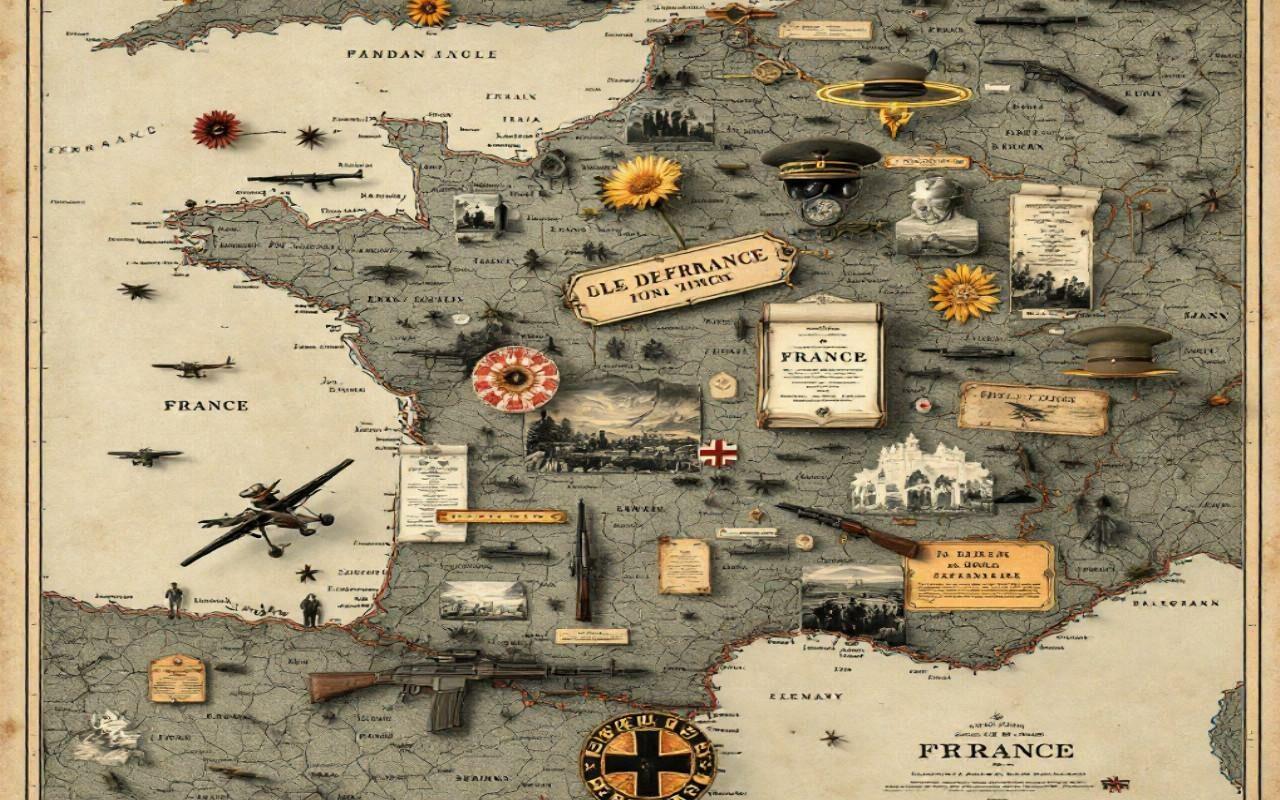
Context and stakes of the war on French soil
In the spring of 1914, no one would have imagined that the Champagne plains or the Lorraine hills would become sanctuaries of suffering. The German invasion, thought to be swift, forced the French army into a strategic retreat up to the Marne. Then, the front froze, cutting into France over more than 700 km. Every terrain, whether a hill or a forest, became a stake: retreating meant yielding a piece of homeland.
Between the emergence of new weapons (gas, nascent tanks) and ditches filled with muddy water, this theater of operations saw the birth of industrial warfare. Everything is measured in shells, meters gained, lives sacrificed. To grasp the significance of each confrontation, one must go beyond the numbers and dive into the stories of the Poilus, those men whose steel and scorched earth became their daily life.
The unavoidable battles
The First Battle of the Marne (September 5-12, 1914)
At the beginning of the conflict, the German armies advanced at forced march, aiming for Paris. In a strategic twist, General Joffre partially redirected his troops westward. Result: a clash in the heart of the Marne plain that stopped the enemy’s momentum. Imagine hand-to-hand combat in the vineyards, Parisian taxis loaded with fresh troops, and that breath of relief when, on September 12, the German retreat began.
- Duration: 8 days
- French losses: about 250,000 men
- German losses: nearly 220,000 men
- Stakes: protect the capital and avoid a rapid capitulation
What strikes is the suddenness of the turnaround. The French forces, exhausted, find in a few days the energy to regain the initiative. It is also here that positional warfare is cemented: by autumn, the front stabilizes and trench warfare is born in Champagne and Picardy.
The Battle of Verdun (February 21-December 18, 1916)
A true meat grinder, Verdun stretches over an 8 km front. The German objective is not purely territorial: it is the moral and physical exhaustion of the enemy. “They shall not pass!” proclaims Lieutenant Colonel Driant on the very day the first heavy shells fall. For ten months, French and German trenches are riddled with craters, turning the Verdun forest into a lunar landscape.
“Defending Verdun was defending the soul of France,” writes a Poilu.✨
In the end, more than 700,000 men are put out of action (dead, wounded, missing), including one third French. They fight for a hill (Côte 304), for a fort, for a trench a few meters long. The offensive falters, but Verdun’s legacy remains one of relentless resistance, crying out humanity amid hell.
The Battle of the Somme (July 1-November 18, 1916)
Following Verdun, Allies and Germans decide to relieve pressure in Picardy. On the morning of July 1, the largest artillery preparation of the war begins. Yet, when the hail of projectiles ceases, the real offensive reveals a plain. The German machine gun reigns supreme there, mowing down wave after wave of British and French assaults.
- First day: 20,000 British killed (tragic record)
- Overall toll: 1,200,000 casualties (all nationalities combined)
- Territorial gains: only a few square kilometers
However, the Somme offers tactical advances: coordinated use of infantry, first Mark I tanks, aerial observation flights. Cherry on the cake, the experience gained would feed the future offensives of 1918.
The Chemin des Dames Offensive (April 16-9, 1917)
“Nivelle gives the lightning,” promises an official slogan. The offensive aims to break through a front reputed to be impenetrable. Encouraged by the promise of a decisive gain in 48 hours, the soldiers launch their assault at dawn. In reality, the artillery fire increases destruction without breaking the German defenses, entrenched in caves dug into the hillside.
The result? A strategic half-failure and a wave of mutinies: when hope breaks, morale follows. Although this sector is still spoken of today as a symbol of sacrifice and suffering, it is above all a warning: tactical impatience can be costly.
The Second Battle of the Marne (July 15-August 6, 1918)
Animal warfare is over. In 1918, the French army, supported by the Americans, better masters the partnership between artillery, tanks, and infantry. When the Germans launch their final offensive in the Marne, they encounter a front on alert, reworked, capable of responding quickly.
- Duration: less than 3 weeks
- German losses: 168,000 men
- French advance: 20 to 30 km depth gained in a few days
What appears here is a reversal of dynamics. From besieged, the allies become beasts of burden, overturning enemy lines. Cherry on top, this offensive will be one of the milestones of the armistice of November 11, 1918.
Comparison of battles: key figures
| Battle | Dates | French losses | German losses | Territorial gains |
|---|---|---|---|---|
| 1st Marne | Sept. 5-12, 1914 | 250,000 | 220,000 | Front stabilized |
| Verdun | Feb. 21-Dec. 18, 1916 | 377,000 | 337,000 | About 4 km² gained/lost |
| Somme | July 1-Nov. 18, 1916 | 200,000 | 500,000 | 6 km² |
| Chemin des Dames | April 16-9, 1917 | 120,000 | 95,000 | Little or no breakthrough |
| 2nd Marne | July 15-Aug. 6, 1918 | 90,000 | 168,000 | 20 km in depth |
Strategic analysis and memorial legacy
Tactical approaches and innovations
Each battle brought its share of lessons. At the Somme, the importance of coordination is understood: massive artillery, emerging armored vehicles, and air-ground liaison. Verdun teaches resilience, the endurance of men in a static hell. As for the Marne of 1918, it embodies the nascent mechanized war, where synchronized offensive crushes defense by speed and surprise.
Jokes aside, these innovations often arise from the rawest pain. Tanks break down, chemical shells escape their designers… Each stage of the war forges modern military art, sometimes at an inconceivable price.
Collective memory and places of remembrance
It is enough to walk through the Douaumont ossuary or stop before the monument at the Notre-Dame-de-Lorette necropolis to measure the strength of memory. These places are not just frozen steles, but living spaces where intimate stories and official ceremonies mingle.
Memory trails, marked by milestones, cross the former minefields. Today, one can almost feel the echo of cries for help, resonating in the morning mist. It is here that war ceases to be an abstraction and becomes individual and collective history again.
FAQ
- Which battle was the deadliest for France?
Verdun remains the costliest in French lives, with over 377,000 casualties. A figure that speaks volumes about the intensity of the fighting and the harshness of the front.
- Why did the Battle of the Somme start at the same time as Verdun?
The idea was to relieve Verdun by forcing Germany to disperse its forces. Although the Somme did not break through the front, it partially achieved this strategic objective.
- What innovations appeared at Verdun?
Besides the massive use of high-powered shells, Verdun saw the rise of reconnaissance aviation and the organization of supplies at the front line.
- How can these battlefields be visited today?
Many marked routes and museums (Verdun Memorial, Péronne Historial, etc.) guide visitors. Audio guides, mobile apps, interactive exhibitions: everything is designed to bring history to the visitor’s footsteps.
- What strategic lessons can be drawn from these battles?
Inter-arm coordination, troop morale management, and tactical adaptation according to the terrain remain fundamental. Principles still taught in modern military schools.