What is the difference between a parachute jump and a tandem jump?
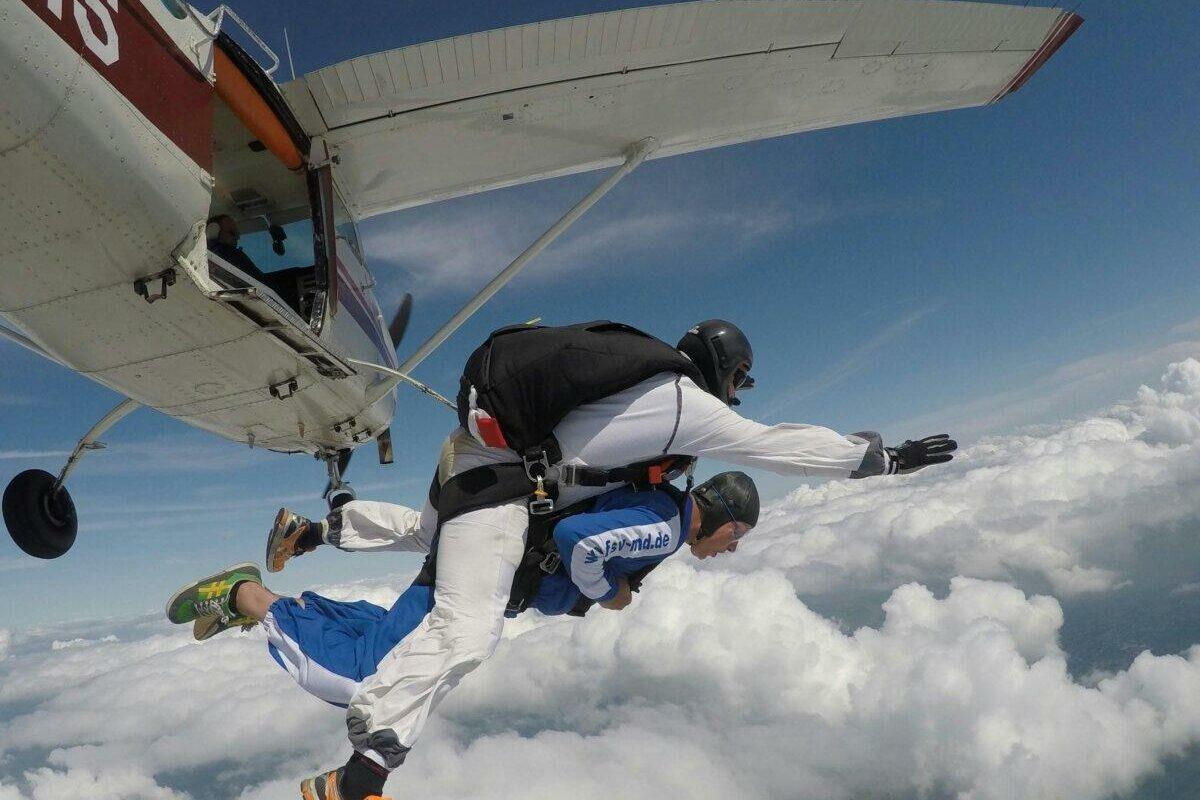
The term parachute jump is general. It can refer to several practices, from introductory jumps to more technical forms intended for trained practitioners. The tandem jump, on the other hand, is designed for a first experience. The passenger is connected to an instructor by a specific harness, allowing them to enjoy free fall without having to manage the jump technique.
In practice, this is the formula that reassures beginners the most. No hours of ground training are required. People mainly come seeking an intense but supervised discovery. The French Parachuting Federation even presents the tandem as a gateway to the sensations of free fall and canopy flight. On a classic tandem, the jump starts around 3,500 meters, with about 40 seconds of free fall followed by 5 to 10 minutes under an open parachute.
At XLR Parachutisme, the experience is described with very concrete references: a jump between 3,000 and 4,000 meters, free fall around 200 km/h, then a descent under canopy of about 5 to 8 minutes. In other words, everything goes very fast at the moment of the jump, then time seems to stretch once the parachute is open. This contrast is what surprises most during a first jump.
How does a tandem jump at Soulac-sur-Mer with XLR Parachutisme unfold?
The sequence of a tandem jump is almost as important as the jump itself. Arrival on site usually starts with administrative reception, followed by a briefing of about ten minutes. This is when the instructor explains the positions to adopt, safety instructions, and simple gestures that will help make the jump more serene.
Next comes the equipment, then the plane ascent. At Soulac-sur-Mer, XLR indicates an ascent of about 20 minutes. This phase is far from trivial: altitude is gained progressively, the coastline is observed, emotions rise, then the instructor’s last reminder comes just before the door opens. Many passengers say that it is at this moment, even more than during free fall, that they feel the intensity of the adventure.
The free fall then lasts around 45 seconds. The time can seem both very short and very dense. Then, around 1,500 meters, the main parachute opens. The pace changes completely: the noise decreases, the landscape regains space, and one enjoys a calmer flight over the ocean and estuary. Depending on the chosen formula, the landing can be at the airfield or on the beach of Soulac-sur-Mer, which gives a very different tone to the end of the experience.
This progressive sequence explains why tandem is so well suited for a first jump. The passenger does not have to “perform.” They live the moment, listen, breathe, follow simple instructions, and focus on the sensations. To extend the preparation, you can also consult this internal article on tips for a first parachute jump, useful for arriving more relaxed on the big day.
Why does Soulac-sur-Mer give another dimension to parachuting?
The location matters a lot. A tandem jump is not just about freefall: it is also experienced through what you see, what you feel, and the visual memory you take away. Soulac-sur-Mer has precisely this advantage. The town is located at the meeting point of Médoc, the Atlantic, and the Gironde estuary, in a coastal destination known for its large beaches, dunes, forests, and open horizon.
In this context, the experience becomes more than just a jump. From the plane, then under the canopy, the eye naturally catches the coastline, sandbanks, Médoc forest, and the very particular light of the area. This is also what makes the area interesting for visitors coming from Bordeaux about 1 hour 30 minutes away or Royan about 1 hour away. You can have a memorable jump without organizing a long logistical stay.
Another interesting element: Soulac-sur-Mer does not only evoke sport but also a destination. You can very well imagine a day or a weekend combining a tandem jump, a walk along the seafront, discovering the Médoc coastline, and a meal facing the ocean. For a gift, this dimension matters a lot because it transforms the activity into a true break.
What budget should you plan for a tandem jump?
Price is a central question, and rightly so. In fact, the price of a tandem jump varies mainly according to the geographic area, the altitude, photo/video options, and sometimes the type of landing. On the content published by XLR Parachutisme, there is a general range of €280 to €450 for a tandem jump, with an offer announced from €289.
| Item | Indicative Budget | What it covers |
|---|---|---|
| Tandem jump | From €289 | Supervision, equipment, plane ascent, jump, and landing |
| Video option | €95 | Recording the jump to keep a dynamic memory |
| Photo + video pack | €139 | More complete souvenir, often appreciated as a gift |
These amounts remain consistent with what is observed on the French tandem market. It is not a “cheap” activity, but it is not an inaccessible leisure either when compared to a weekend for two, a mid-range smartphone, or a memorable birthday gift. What you actually pay for are several things at once: the aircraft, fuel, equipment, technical supervision, the structure’s insurance, ground logistics, and the qualification level of the personnel.
Is tandem jumping risky?
Like any aerial activity, parachuting is never a “zero risk” activity. However, the right question is not to seek an unrealistic promise; it is rather to check how the activity is supervised. In France, parachuting is structured by regulatory texts and a federal framework. The regulations refer to the Sports Code and the Civil Aviation Code, while the French Parachuting Federation centralizes useful resources on practice conditions.
For a non-licensed practitioner, certain points must be carefully considered. The Sports Code notably specifies a minimum age of 15 years for practicing sport parachuting, as well as the necessity of a medical certificate of non-contraindication for the practitioners concerned. For minors, a written authorization from legal representatives is also required. Added to this are internal rules specific to each center, notably regarding weight, physical condition, or the day’s weather conditions.
In fact, a serious center is also recognized by simple signals: clarity of explanations, precise briefing, equipment presented without ambiguity, listening to questions, decision to postpone in case of bad weather, and absence of excessive speech. It is often this culture of seriousness that reassures a beginner the most. The challenge is not to trivialize the jump, but to understand that a well-supervised tandem relies on rigorous organization.
How to properly prepare for a first parachute jump?
Mental preparation plays a huge role. The people who handle their first jump best are not always the least stressed; they are often those who accept the emotion of the moment without fighting it. The day before, it is better to sleep well. On the day of the jump, it is recommended to eat light but enough, avoid alcohol, drink water, and arrive in comfortable clothing.
On this point, practical advice is very concrete: favor flexible clothing, avoid outfits that are too tight, choose closed shoes like sneakers, listen carefully to the briefing, and don’t try to control everything during the fall. The tandem is not an exam. It is precisely an experience designed to allow the passenger to let go and enjoy, first the adrenaline rush, then the serenity under the canopy.
Another good idea is not to overload your day. Many people plan too many things around the jump, while the experience deserves some space. Allowing time before and after, taking a few photos on the ground, then walking a bit along the seafront of Soulac-sur-Mer or simply debriefing over a coffee often helps to anchor the memory more deeply.
Why is a tandem jump an excellent gift idea?
Giving a tandem jump works well because you are not just giving an activity: you are offering a projection. There is the before, with the waiting and imagination. There is the during, with pure intensity. And there is the after, when the person talks about their jump for weeks. Few gifts have this ability to create a complete story.
In the case of XLR Parachuting, the argument is even stronger for someone who loves the Atlantic coast, Gironde, or experiences that go beyond the usual framework. Between a quickly forgotten object and an adventure lived in an identifiable place like Soulac-sur-Mer, the choice is quite clear. This is also why the photo and video options are so popular: they extend the emotion and allow sharing the experience with loved ones.
Useful sources to check conditions and practice framework
To go further, here are some reliable and non-competitive references:
- The official presentation of tandem jumping by the French Parachuting Federation
- The regulations section of the French Parachuting Federation
- The articles of the Sports Code applicable to jump sessions
- The official site of the Médoc Atlantique destination
FAQ on parachute jumping and tandem jumping
From what age can you do a tandem jump?
The French regulatory framework sets a minimum age of 15 years for practicing sport parachuting. For a minor, a written parental authorization is necessary, and the center may add its own practical conditions.
How long does the complete experience actually last?
The free fall lasts only a few tens of seconds, but the complete experience is longer: welcome, briefing, equipment, about 20 minutes ascent in the plane, jump, then 5 to 8 minutes descent under the canopy. So it should be considered as a half-day rather than a simple “45-second activity.”
Is tandem jumping suitable for someone who is afraid of heights?
Very often, yes. Fear of heights does not manifest in the same way in a plane as it does on the edge of a balcony or a ladder. Many beginners who are very anxious before departure later describe a sensation closer to immersion and speed than to classic vertigo.
Do you need to be very athletic to do a parachute jump?
No, not necessarily. Tandem is precisely designed to be accessible to people who do not practice parachuting. However, health and weight conditions set by the center must be respected, and any doubts should be reported before booking.
Is it better to choose the video option or the photo + video pack?
It all depends on the goal. The video captures the dynamics of the jump well, while the photo + video pack is better suited for those who want to both relive the moment and keep still images to share. For a gift, it is often the most complete option.
Why choose Soulac-sur-Mer rather than another site?
Because the visual setting matters enormously in the experience. Between the Atlantic Ocean, the Gironde estuary, Médoc beaches, and the coastal light, Soulac-sur-Mer provides a strong backdrop that truly changes the perception of the jump and the memory you keep of it.