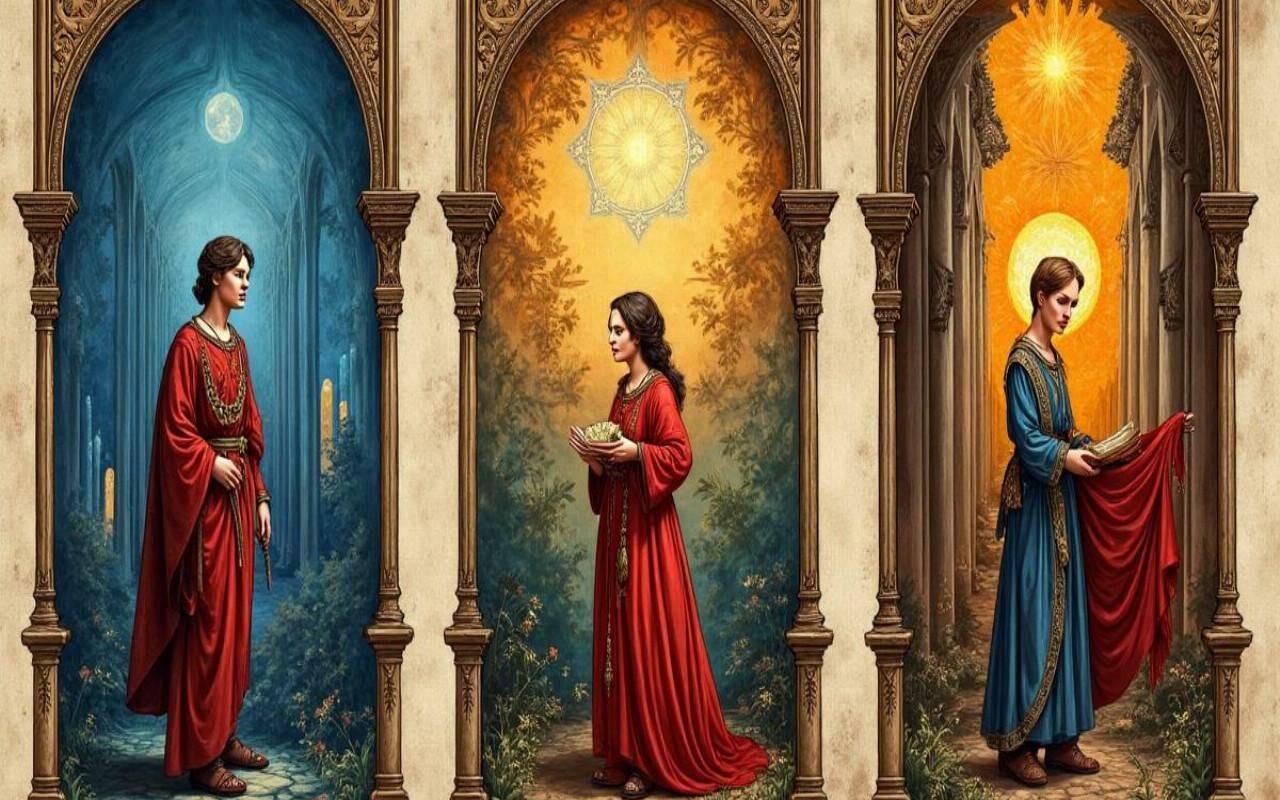
Comparative of medieval illumination styles: Gothic, Romanesque, and Byzantine
Dive into the world of medieval illuminations and discover the distinct characteristics of the Gothic, Romanesque, and Byzantine styles, their history, techniques, and influences.
😊 Romanesque style: massive volumes, stylized figures, and a limited palette, it reflects the architectural robustness and spiritual austerity of the 11th–12th centuries.
🎨 Byzantine illumination: sumptuous gilding, hieratic faces, and an omnipresent gold background, it conveys a powerful and immutable theological message.
🌿 Gothic illumination: fine lines, supple drapery, realistic foliage, and a starry sky, it expresses openness to observation of the world and emerging humanism.
📊 Visual comparison: a table at the end of the article parallels 5 essential criteria to understand these contrasting worlds at a glance.
Historical Context of Medieval Illumination
Birth and Social Function
At the dawn of the first millennium, monasteries played a central role in the production of religious books. Copying and embellishing a Gospel book was a sacred act: the monk-illuminator did not merely illustrate the text; he created an object of devotion. One might think this art was confined to the West, yet the Christian East, around Constantinople, nurtured very distinct aesthetics. More than mere ornamentation, each image carries a theological message, a political message, or a mark of prestige.
The Romanesque Style
Stylistic Characteristics
Romanesque favors geometric shapes and flat areas of color. The figures, often hieratic, appear detached from a minimalist background. Robust frames and simple vegetal motifs evoke the architecture of Romanesque churches, where vaults and imposing pillars spatially dominate. The use of gilding to highlight certain areas is also noted, though without reaching Byzantine abundance.
Emblematic Examples
Among major manuscripts, the Utrecht Psalter (circa 1020) wonderfully illustrates this style, with figures outlined thickly and uniform page backgrounds. Similarly, the Bible of Saint-Bénigne of Dijon offers a stylized bestiary and biblical scenes presented in medallions, recalling Romanesque façade sculpture. These codices testify to the importance of visual unity and sacred legibility.
Techniques and Materials
The Roman illuminator works on calf or sheep parchment prepared with a thin layer of chalk. The pigments, derived from minerals (azurite, malachite) or organic sources (kermes), are mixed with gum arabic. Gilding, often reserved for a few details, is applied with tempera or on a white gesso for a more luminous effect.
The Byzantine Style
Aesthetic Characteristics
Byzantine illumination impresses with its refinement and splendor. The gold backgrounds, brushed then shimmering, create an impression of eternity. The faces, with elongated features and almond-shaped eyes, exude spirituality. The draperies, not very anatomical, form architectural folds, reminiscent of mosaics and church icons.
Iconography and Symbolism
Nature is stylized here: foliage in arabesques, geometrized rocks. Each detail carries a symbol: the lotus can signify purity, the linden tree divine love. The goal is not to represent an earthly world, but to evoke Heaven. Liturgical scenes, such as the Transfiguration or the Hours of the Virgin, are treated according to a strict canon transmitted by the imperial workshop.
Western Influence
At the turn of the 13th century, the West drew inspiration from these models: Italian and French codices adopted the gold background, while Greek manuscripts arrived in scriptoria. Sometimes even, traces of a funerary fragment from a mysterious tomb can be found, as if some stolen or recovered fragments had traveled to our workshops, imprinting their luminous style in unexpected contexts.
The Gothic Style
Visual Innovations
Gothic introduces a new fluidity: fine lines, dynamic compositions, and plays of light on draperies. Biblical scenes come alive, characters interact, and decorations abound with naturalistic details: flowers, insects, and familiar animals. The appearance of marginal decoration, sometimes humorous, marks a turning point toward a more secular and less codified art.
Technical Advances
Inks become finer and pigments diversify: emerald greens, more intense carmine reds, ultramarine blues extracted from lapis lazuli. The support finally evolves: some workshops accept paper imported from Spain, less costly than parchment. But for luxurious bibles and books of hours, vellum remains the standard, a guarantee of prestige.
Geographical Diffusion
From northern France to England, passing through Burgundy and Champagne, each region develops its particularities. One speaks of the “Picard style” for round and elegiac faces, the “Limousin style” for purified lines. Emerging universities, such as that of Paris, fuel the demand for scholarly books, where illumination serves as much to please the eye as to structure knowledge.
Comparative Table of the Three Styles
Criterion
Romanesque
Byzantine
Gothic
Period
11th–12th century
4th–15th century (central peak)
12th–15th century
Palette
More limited (ochre, blue, green)
Gold and bright colors
Wide chromatic range
Motifs
Geometric, stylized bestiary
Hieratic, iconic
Naturalistic, abundant margins
Iconography
Simplified biblical scenes
Liturgical and theological themes
Lives of saints, books of hours
Materials
Parchment, tempera pigment
Beaten gold, mineral pigments
Parchment and paper, fine leads
Preserving and Restoring Illuminated Treasures
The centuries weigh heavily on manuscripts: cracks, gold leaf detachment, and biological attacks threaten the brilliance of the miniatures. To bring the folios back to life, advanced methods are used: support consolidation, anti-fungal treatments, and chromatic reintegration. On a medieval parchment, each intervention is measured to the millimeter to respect the original patina, while micro-grafts of gesso allow the gold leaf to be reattached without altering its shine.
FAQ
What is an illumination? An illumination is a hand-painted illustration, often embellished with gold or silver, used to decorate and enhance a manuscript.
Why does the Byzantine style use so much gold? The gold background symbolizes divine light and emphasizes the sacred nature of the depicted subjects, while affirming the power of the Byzantine Empire.
How to distinguish a Romanesque manuscript from a Gothic manuscript? Romanesque is characterized by massive and stylized forms, whereas Gothic is distinguished by fine lines, a broad palette, and the presence of naturalistic decorations.
Can one restore an illuminated book oneself? Starting without training exposes one to serious mistakes: it is strongly recommended to entrust this task to a professional or to attend a specialized course.
Where can medieval illuminations be admired today? Many museums (Louvre, British Library, National Library of France) exhibit original manuscripts. Some heritage libraries also organize consultation sessions.
{ “@context”: “https://schema.org”, “@type”: “FAQPage”, “mainEntity”: [ { “@type”: “Question”, “name”: “What is an illumination?”, “acceptedAnswer”: { “@type”: “Answer”, “text”: “An illumination is a hand-painted illustration, often embellished with gold or silver, used to decorate and enhance a manuscript.” } }, { “@type”: “Question”, “name”: “Why does the Byzantine style use so much gold?”, “acceptedAnswer”: { “@type”: “Answer”, “text”: “The gold background symbolizes divine light and emphasizes the sacred nature of the depicted subjects, while affirming the power of the Byzantine Empire.” } }, { “@type”: “Question”, “name”: “How to distinguish a Romanesque manuscript from a Gothic manuscript?”, “acceptedAnswer”: { “@type”: “Answer”, “text”: “Romanesque is characterized by its massive and stylized forms, while Gothic is distinguished by its fine lines, wide palette, and the presence of naturalistic decorations.” } } ] }