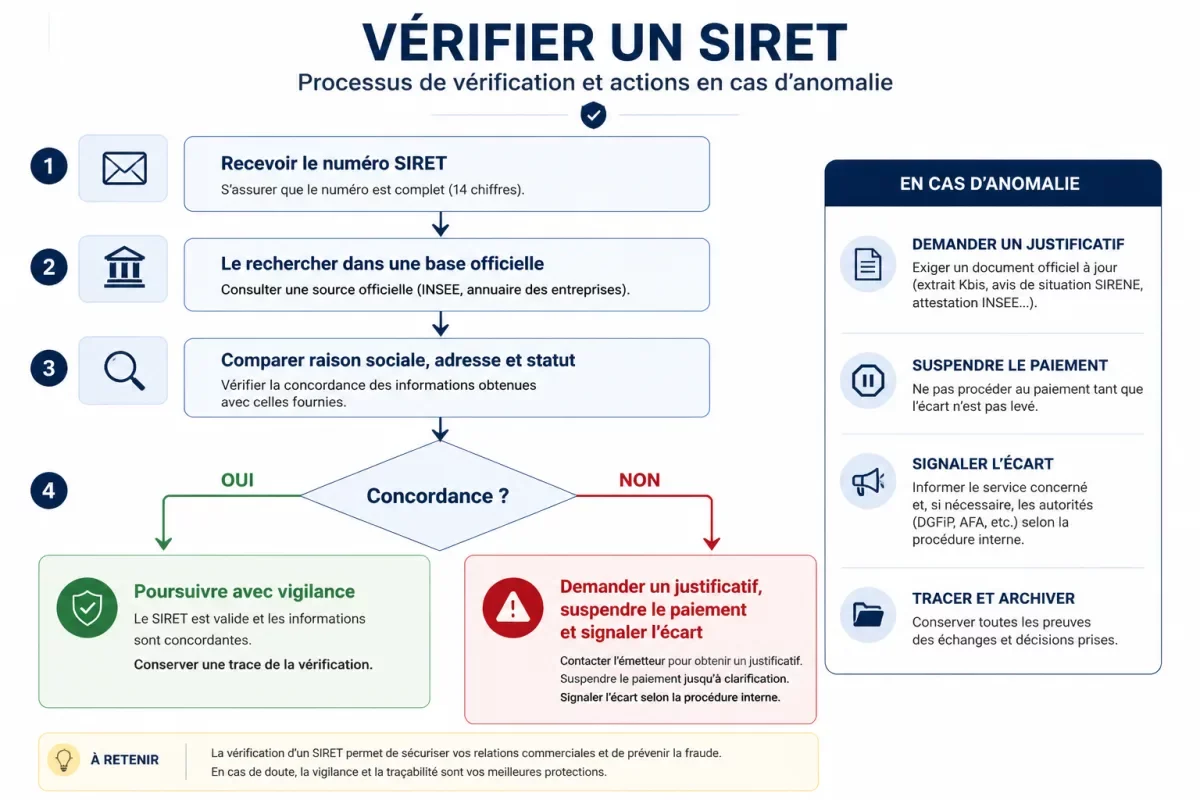
🔎 The useful check consists of cross-referencing the SIRET with the name, address, and legal status.
⚠️ An existing number can still hide identity theft or a wrong contact.
🧾 In case of discrepancy, you must suspend payment, request a correction, and keep evidence.
🛠️ Repeated checks can be automated, but anomalies must still be reviewed manually.
How to check a SIRET number for free and officially?
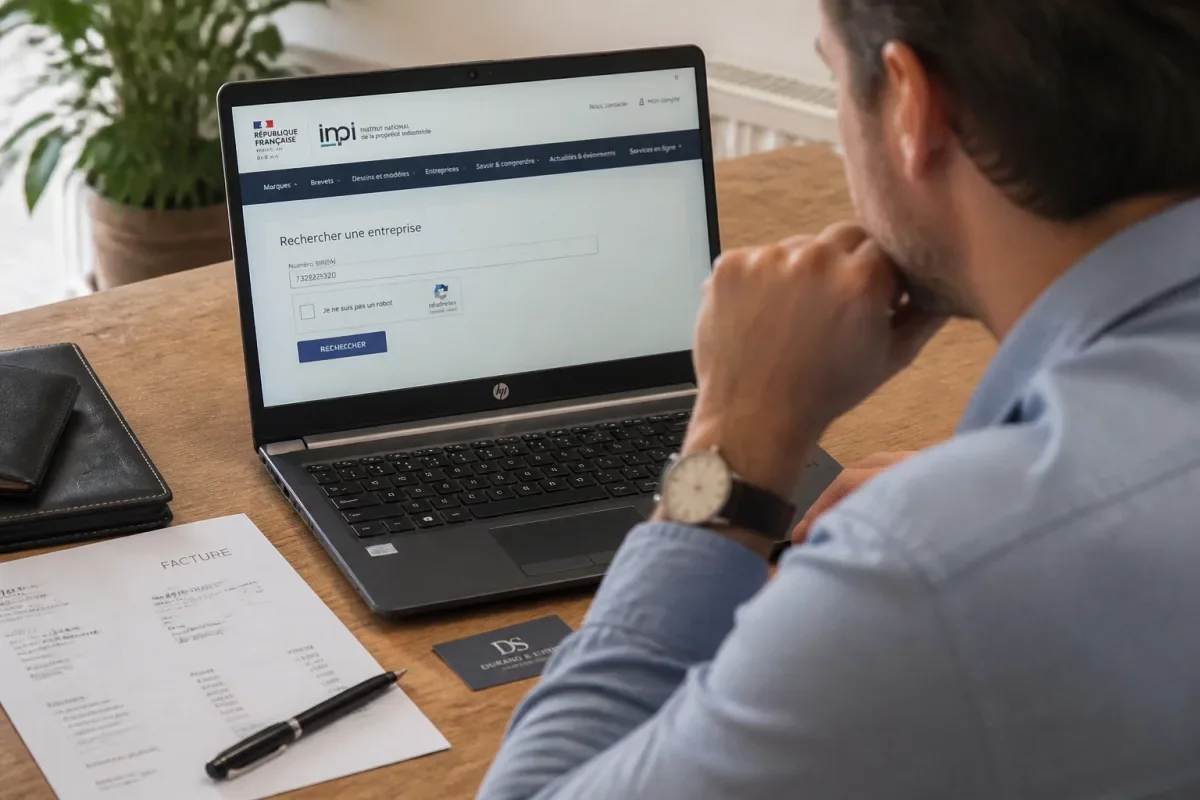
The most reliable method is to enter the SIRET or SIREN into an official public database, then compare the obtained data with those on the quote, invoice, or your contact’s website. The real test is not “does the number exist?”, but “do the details really match?”.
A quick check allows you to compare the number, name, and address before signing or paying.
In practice, two official tools come first: the Sirene directory managed by Insee and public services that aggregate companies’ legal data. They allow you to verify basic information for free such as the company name, address, registration date, and establishment status.
What the result should show you
The exact company name or establishment name.
The address linked to the SIRET, which must correspond to the real context.
The status: active, closed, or deregistered depending on the case.
The APE code, useful to locate the activity but insufficient alone to authenticate a contact.
The consistency of the SIREN and NIC, since SIRET = SIREN + NIC.
A valid SIRET does not prove the commercial reliability of a contact; it only proves their administrative existence.
What should be checked when the number already exists?
If the number is recognized, the work is just beginning. You must verify the match between the displayed identity and the official identity: same name, same address, same activity, and same status. A company can exist while using an outdated document, a secondary establishment, or a misleading presentation.
The SIRET is an establishment identifier. This means that the same SIREN can group several sites, each with its own SIRET. A move, a temporary closure, or an organizational change can therefore update the visible information. Hence the importance of always comparing several fields, not just one.
The matches to examine as a priority
Company name: no significant difference should remain.
Address: geographical discrepancy is often the first weak signal.
Status: a deregistered or closed establishment should not be used as support for a current invoice.
Creation date: useful to spot an inconsistent or too recent file regarding the commercial relationship.
Declared activity: it must remain compatible with what is being sold.
The most common trap is not a fake number, but a real number used by the wrong entity.
How to recognize a fraudulent or stolen SIRET number?
A fraudulent SIRET is not necessarily an invented number. The most credible fraud often involves reusing a real identifier in a false context: almost identical name, different address, suspicious email domain, overly urgent invoice, or last-minute IBAN change. The number alone is therefore never enough to dispel doubt.
Mismatch between the number and the company name on the documents provided.
Inconsistent address: different city, postal code, or country.
Closed or deregistered status while commercial activity continues.
Poorly formatted document, with errors, approximate logos, or incomplete legal mentions.
Payment pressure before verification or unusual confidentiality requests.
The most important thing remains the overall logic. Serious fraud rarely tries to deceive using only a fake SIRET; it relies on a set of details that appear coherent. That is why an effective check must cross-reference the number, commercial documents, contact address, and the reputation of the relationship.
What to do if the company or number do not match?
As soon as a discrepancy appears, slow down. Do not approve payment or order based on a suspicious document. Request a corrected version, cross-check the details with an official source, and keep records of the issue. If the transfer has already been made, act quickly, as the window for action is often short.
The right reflex is simple: verify the match, then act immediately if a discrepancy appears.
The safest reaction sequence
Block the decision if the match is not perfect.
Request an up-to-date supporting document, without relying solely on the details from the suspicious message.
Compare the received document with the official data of the establishment.
Archive screenshots, emails, invoice, and disputed number.
Report the situation to the competent contact if fraud seems likely.
This reflex protects both the buyer and the ordering party. In the most sensitive cases, a simple doubt justifies temporarily suspending the relationship. A legitimate transaction tolerates verification; a scam, on the other hand, almost always tries to prevent it.
Why are some pieces of information incomplete or missing?
An incomplete record does not automatically mean there is fraud. Some discrepancies come from update delays, very recent creation, or an administrative change still being processed. Others relate to regulations on the dissemination of certain data, which may limit what appears publicly.
It is also important to distinguish between the absence of a field and the presence of an inconsistency. Missing data can be normal; contradictory data is not. For example, an establishment may be perfectly real but have changed address or status without all commercial materials yet being aligned.
What not to overinterpret
A recent status is not necessarily suspicious.
An APE code does not prove the quality or solidity of a company.
A delayed update can create a temporary mismatch between two sources.
An incomplete address should be cross-checked before drawing any conclusion.
Can a SIRET be verified on a large scale in a professional context?
Yes, but it must be done methodically. In a KYC or KYB process, the SIRET serves as an entry point for economic identity verification, not a final verdict. Teams handling many suppliers or clients can rely on public datasets, internal tools, or API-type interfaces, provided they verify data freshness and reuse rules.
The most robust approach combines automation and human review. Automation detects basic discrepancies, sorts files, and speeds up sorting. Human review handles ambiguous cases: address changes, multi-establishments, inconsistent documents, or high-risk business relationships. It is this dual level that truly reduces false positives and overly quick validations.
A simple control framework to industrialize
Standardized collection of SIRET numbers from onboarding.
Automatic control of the consistency of the number and visible fields.
Reporting anomalies before payment, contracting, or account opening.
Logging of the verification date and result.
Manual review for sensitive or incomplete files.
Key takeaways
🔎 A SIRET is usefully verified by matching, not by simple existence.
🧾 The name, address, and status must correspond to the received documents.
⚠️ A valid number can be reused in fraud or identity theft.
⏸️ At the slightest doubt, it is better to suspend payment and commercial request.
⚙️ Volume controls benefit from being automated, then reviewed by humans.