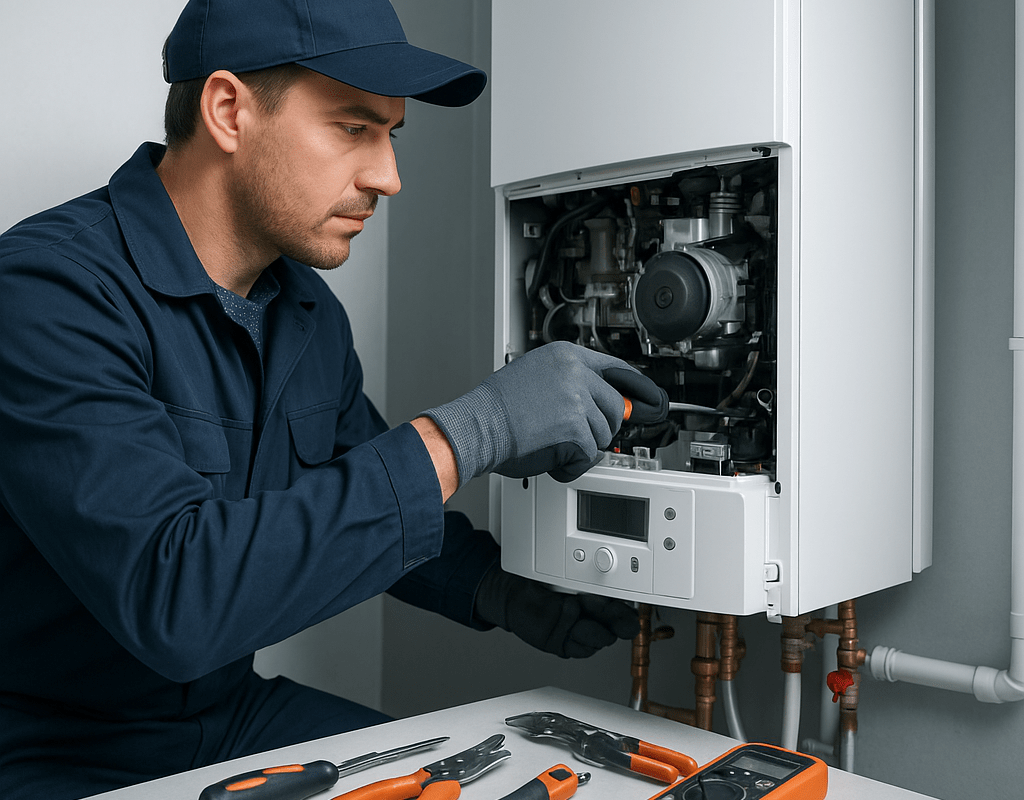
Why is maintenance of a condensing boiler essential?
Because a condensing boiler operates under more sensitive conditions than a simple conventional heating device. It recovers part of the heat contained in the fumes, which improves efficiency, but also makes the device more demanding regarding combustion, condensate evacuation, and the condition of heat exchangers. Regular maintenance limits breakdowns, maintains performance, and extends the overall lifespan.
In practice, this avoids small problems that turn into big expenses: burner clogging, blocked siphon, gas overconsumption, repeated starts, or even boiler safety shutdown. As a bonus, a well-adjusted device often runs more quietly and heats more evenly. If you want to put the topic into its technical context, the article on the condensing boiler and efficiency explains well why this type of equipment deserves precise monitoring.
Field feedback: it is often observed that the problem does not come from a major breakdown, but from a neglected detail. A heating technician working on the outskirts of Lille notes that after several months of summer shutdown, a simply partially blocked condensate siphon is sometimes enough to trigger a fault at restart.
It should also be noted that maintenance is not just about “cleaning”. It serves to verify that the boiler burns correctly, that the fumes evacuate without anomaly, and that the safety components fulfill their role. In other words, it is not a luxury, but a basic precaution.
How often should condensing boiler maintenance be done?
The simple rule is one visit per year. French regulations require annual maintenance for individual boilers, and you should not wait for the boiler to cough before taking care of it. Ideally, schedule the service before the heating season, when professionals’ schedules are not yet full.
For a gas condensing boiler, maintenance must be carried out every year by a qualified professional. The exact date may vary from year to year, but the key is to maintain an annual rhythm, with a certificate to prove it.
According to Service-Public.fr, the annual maintenance is the standard for individual boilers within this power range. It is also useful not to let several seasons pass without a check if the appliance has been used very little, or if the dwelling remains closed for long months. The certificate, meanwhile, must be kept with the housing documents.
- Before winter: to start on a healthy basis and avoid breakdowns at the first big cold.
- After a long inactivity: if the boiler has been dormant all summer, a restart check is wise.
- In case of occasional use: secondary residence, rented accommodation for a few months, house closed during the week.
- With documentary follow-up: note the date of the visit and keep the maintenance certificate.
If you are already in the replacement phase, it may also be useful to compare options before committing. The guide on the condensing boiler: what budget to plan helps to see if repeated repairs are starting to cost more than a renewal.
Maintenance, sweeping and periodic inspection: what is the difference?
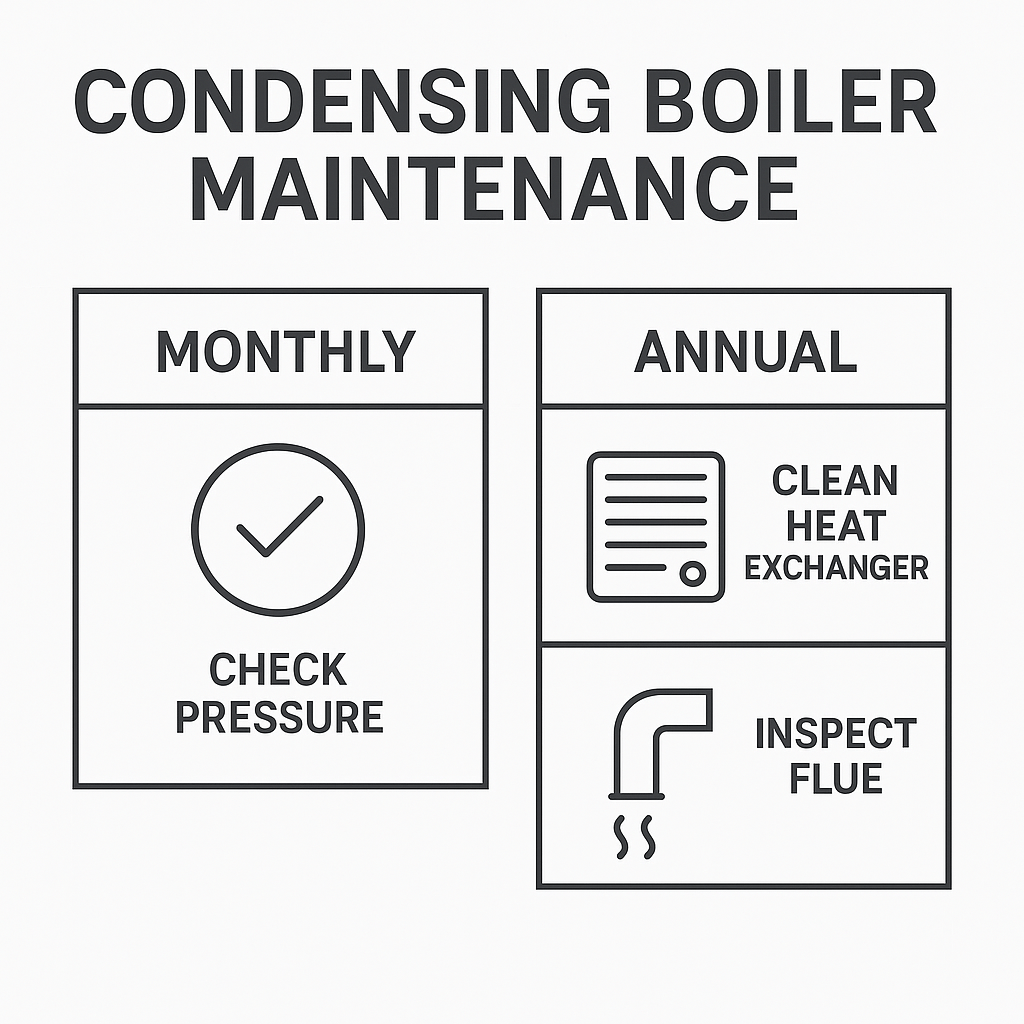
These three notions are often mixed up, although they do not cover the same thing. Maintenance concerns the boiler itself: cleaning, adjustments, operation tests, and safety checks. Sweeping concerns the smoke evacuation duct when it exists. Periodic inspection can apply to certain equipment or broader technical checks, without replacing the mandatory annual visit.
| Intervention | What it covers | Proof |
|---|---|---|
| Boiler maintenance | Cleaning, adjustments, combustion, safety, condensates | Maintenance certificate |
| Sweeping | Smoke evacuation duct, when present | Sweeping certificate |
| Technical inspection | Additional checks depending on the installation | Variable depending on the case |
The real trap is not complete forgetfulness. It is believing that a simple cleaning is enough. A condensing boiler is judged as much by its settings as by its visual appearance.
To understand why some parameters matter more than others, the article on the operation of a condensing boiler clearly explains the role of condensation, the heat exchanger, and smoke evacuation. When you see the mechanism, you better understand why neglecting maintenance ends up affecting comfort… and the bill.
How does a professional maintenance visit proceed?
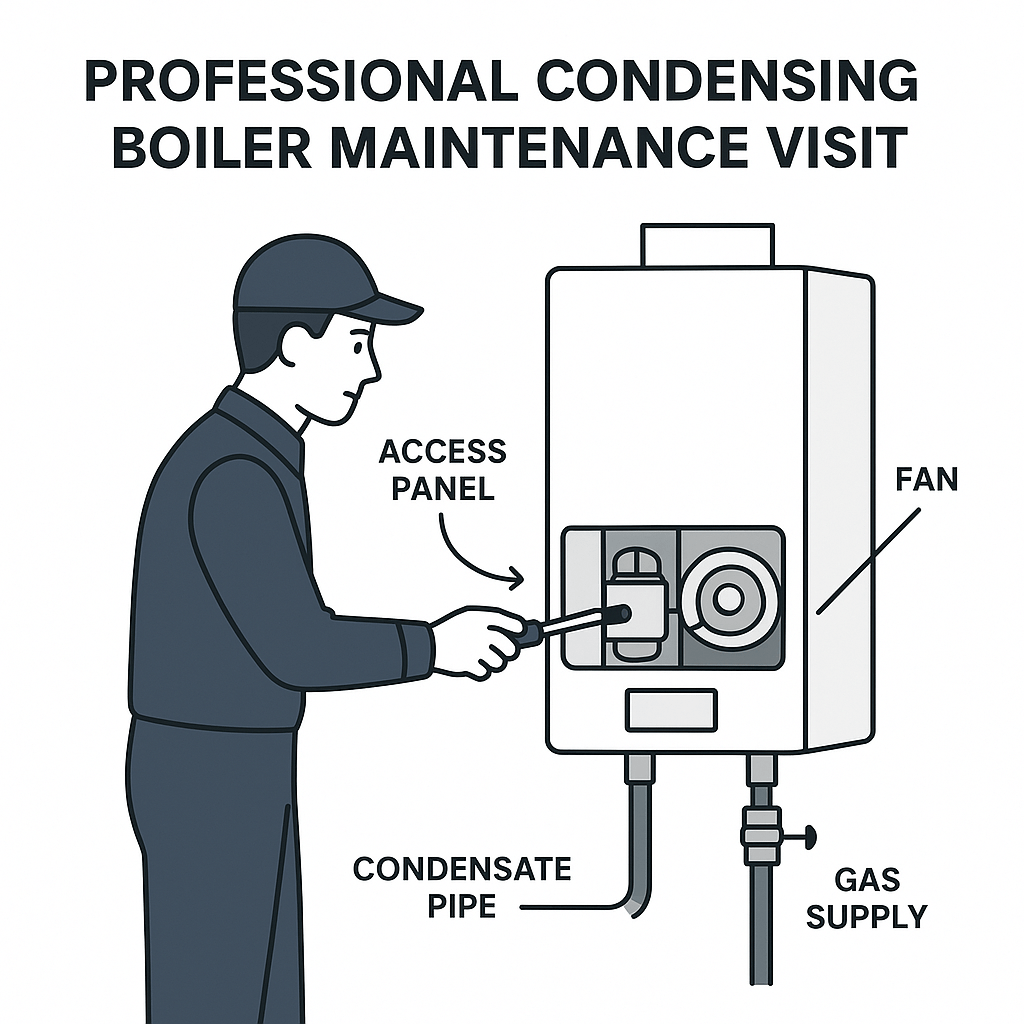
A serious visit always follows a simple logic: first safety, then cleaning, then adjustments and performance measurement. Depending on the condition of the equipment and the accessibility of the installation, the intervention often lasts between 30 and 60 minutes. On a recent boiler, this can be quick; on an older installation, it sometimes takes more time to check sensitive points.
Safety checks carried out by the heating engineer
The professional begins with a visual inspection of the general condition of the boiler, the connections, the ventilation of the room, and the immediate environment. They also check the circuit pressure, any possible leaks, and the proper functioning of safety devices. Here, there is no room for approximation: a tiny defect can block the entire system.
Cleaning the main components of the boiler
The burner, the heat exchanger, and accessible elements are cleaned to remove combustion deposits and dust. The siphon or condensate drainage circuit is also checked, as this is an often neglected area. A good cleaning is somewhat like resetting the engine.
Adjustments and performance measurements
The heating engineer measures combustion parameters to ensure the boiler burns correctly and without excess. If necessary, they adjust certain settings to stabilize operation and avoid gas overconsumption. This helps maintain efficiency consistent with the type of installed device, especially for a condensing boiler which heavily depends on the quality of the water return.
Certificate and recommendations after intervention
At the end, a maintenance certificate is issued. It mentions the checks performed, any anomalies found, and possible recommendations. Keep it with the other housing documents: in case of a request from the landlord, an incident, or an inspection, it serves as proof.
What simple actions can be taken between visits?
Between two maintenance visits, you can already do quite a few useful things without touching the internal components. The idea is not to play the weekend heating engineer, but to keep an eye on subtle signals: pressure, noise, smell, display, cleanliness of the room. These habits often prevent a small problem from becoming a very troublesome breakdown.
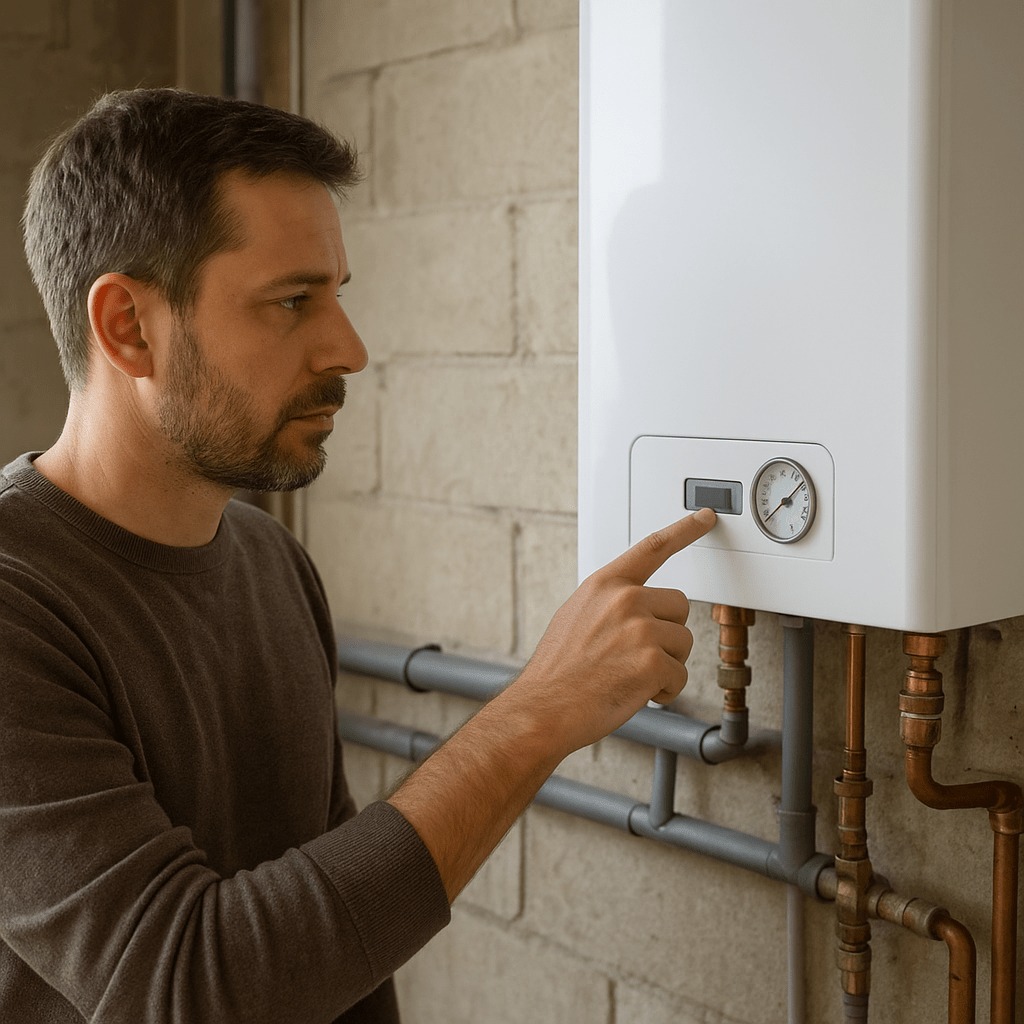
- Monitor the pressure and error messages displayed on the screen.
- Keep the area clear around the boiler to allow air circulation.
- Listen for abnormal noises: banging, whistling, overly frequent cycles.
- Spot water traces under the device or near the condensate siphon.
- Check the ventilation of the technical room without modifying internal settings.
The ADEME also reminds that a clean, ventilated, and clear heating room helps preserve the proper functioning of the equipment. In other words, a device suffocated by clutter in the basement or laundry room won’t perform miracles, even if it is recent.
A family living in a suburban house recounts that they avoided a breakdown thanks to a simple reflex: noting every unusual noise instead of ignoring it. After inspection, the heating engineer identified a gradual clogging of the siphon and less stable starting. Nothing spectacular, but more than enough to disrupt the entire heating system.
It is absolutely essential not to dismantle internal components yourself, nor to modify combustion settings. If you see a leak, a repeated error code, or an unusual temperature rise, the best reflex is to stop tinkering and call in a professional.
In which cases should you anticipate an intervention?
You should call sooner than expected as soon as behavior clearly changes: performance drop, frequent restarts, new noises, or irregular temperature rise. Such signs do not necessarily indicate a serious breakdown, but they show that the machine is out of its comfort zone. And a boiler that is overworking always ends up costing you.
If the device is old, inspections must be even more thorough. When repairs pile up, it is also better to consider whether a replacement solution would make more sense. Depending on the housing context, comparing a condensing boiler or heat pump can prevent investing in a machine at the end of its life.
- Repeated fault code: if the boiler goes into safety mode several times.
- Water traces: poorly evacuated condensation, leak, or partially clogged siphon.
- Increased consumption: without a change in usage, this is a bad sign.
- Long inactivity: after several months without heating, it is better to check before winter.
How much does condensing boiler maintenance cost?
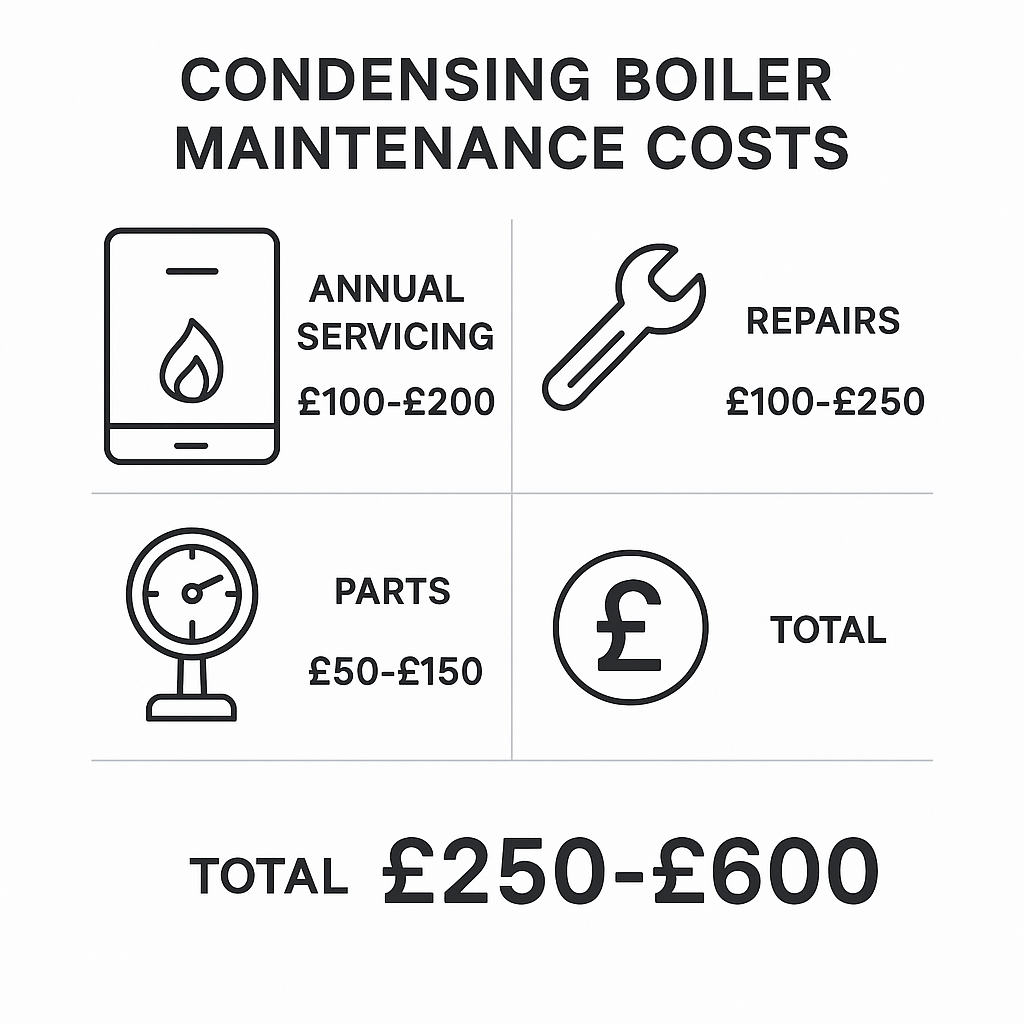
The price mainly depends on the type of service. A one-time visit usually costs less initially, but an annual contract can be more comfortable if it includes travel, minor adjustments, and sometimes a discount on repairs. In any case, it is better to compare what is included rather than just looking at the displayed price.
For a condensing boiler, the cost of a one-time maintenance visit often ranges from €90 to €180, while an annual contract is frequently between €120 and €220 depending on the region, accessibility, and included services.
| Plan | What is often included | Point of caution |
|---|---|---|
| One-time visit | Inspection, cleaning, adjustments, certificate | Travel and extras may be added |
| Annual contract | Scheduled maintenance, sometimes assistance or priority | Review exclusions and coverage limits |
| Additional repairs | Fault diagnosis, parts replacement, recommissioning | Labor costs can significantly increase the bill if the fault is complex |
When a repair becomes costly, it may be useful to consider the overall project rather than just the current bill. The content on installing a condensing boiler is relevant if you are comparing a serious upgrade with a series of small interventions that accumulate.
FAQ on condensing boiler maintenance
Who should pay for maintenance: tenant or owner?
In most cases, routine maintenance is the responsibility of the occupant of the dwelling, often the tenant. The owner remains responsible for major repairs and replacement of the device. The lease, inventory, or condominium regulations may specify certain special cases, so it is better to review them before deciding.
Is the maintenance certificate mandatory?
Yes, it serves as proof after the annual visit. It may be requested by the landlord, insurer, or in case of a claim, especially if a heating incident affects the dwelling. Keep it with other useful documents, ideally with invoices and any boiler manuals.
Can an inspection be postponed or skipped?
It is best to avoid exceeding the annual deadline. A postponement increases the risk of reduced efficiency, clogging, and safety failure. If you have forgotten, the right reflex is simple: make an appointment quickly, without waiting for the next cold season. For a tired boiler, a few more months can make a real difference.
How long does the inspection last?
Generally, an inspection lasts between 30 and 60 minutes. It depends on the condition of the boiler, the accessibility of the room, and whether there are any anomalies to check. If the installation is old or very clogged, the heating engineer may stay longer to ensure safety checks.
Can you clean the condensate trap yourself?
Surface cleaning around the device, yes. However, dismantling internal components or adjusting technical settings is not recommended. If the trap seems clogged or if the boiler malfunctions, it is better to let the professional handle it: on this point, a misguided DIY attempt often costs more than the intervention itself.