
In brief
⏱️ After a cancellation, time is against you: according to Service-Public.fr, cancellation takes effect 30 calendar days after notification in many cases.
🧾 To move quickly, prepare immediately 4 key documents: driver’s license, registration certificate, information statement, and bank details. Without a clean file, the quote drags and so does the contract.
🚗 If your profile is deemed too risky by the standard market, a temporary insurance can help for 1 to 90 days, time to secure a more stable solution.
📌 As a last resort, the CTO can impose third-party coverage. It’s not the most flexible solution, but it often prevents a total loss of coverage.
How to get reinsured quickly after a canceled car insurance?
The fastest way is to target a specialized insurer or a temporary insurance for a few days or weeks, time to finalize a more stable contract. If you have already faced several refusals, the CTO can impose third-party coverage on an insurer. The goal is simple: avoid a gap between two contracts.
The shortest path is often an insurer accustomed to canceled profiles, with a complete file and tightened guarantees at first. Temporary insurance can help, but the CTO remains the last resort when the standard market closes the door.
In practice, you should proceed in this order: first secure an insurance certificate, then negotiate the minimal acceptable coverage, and only afterwards consider expanding the guarantees. Wanting full coverage right away after a cancellation is sometimes like aiming for the moon with a cardboard ladder.
An important point: insurers look at the reason for the cancellation. A missed payment, frequent claims, or driving under the influence do not send the same risk signal. The heavier the reason, the more minimalistic the offered contract will often be, with a higher deductible or an annual payment required at subscription.
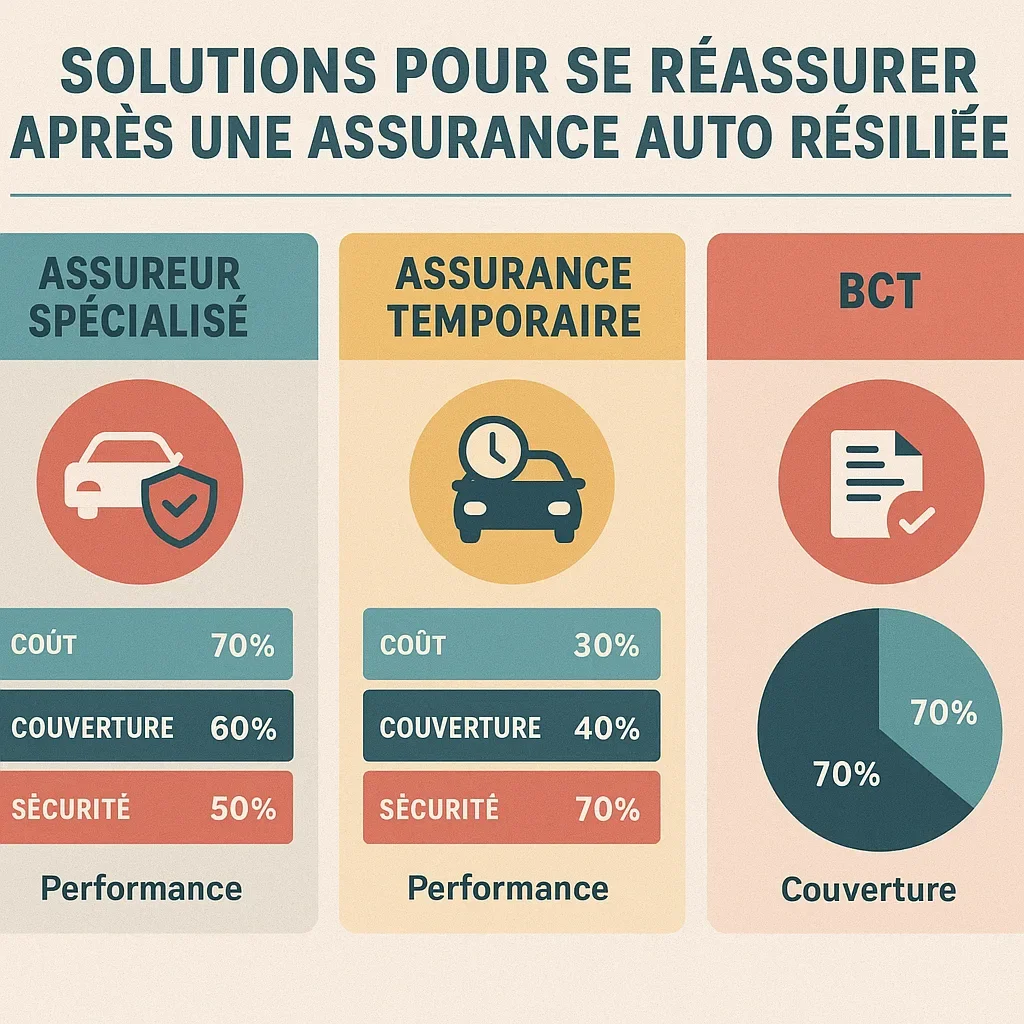
- Option 1: request a targeted quote from an insurer who accepts canceled profiles.
- Option 2: take temporary insurance to avoid any coverage gap.
- Option 3: seize the CTO if you have a written refusal and the standard search is going in circles.
What to do if all insurers refuse your file?
If refusals keep coming, you need to move away from the “I insist at random” logic and turn to the Central Pricing Office. The CPO does not sell insurance like a broker: it sets the rate at which a designated insurer must cover you for mandatory civil liability. It is the emergency exit when the market says no.
The CPO intervenes after a written refusal and imposes third-party coverage with an insurer. Its main purpose is to avoid leaving a driver without mandatory insurance. However, it does not necessarily open the doors to comprehensive coverage or comfort guarantees.
The procedure deserves to be done properly. You must attach the insurer’s refusal, information about the vehicle, the driver’s profile, and, depending on the case, the supporting documents requested by the file. The Central Pricing Office website details how it works and the steps to follow. It’s better to submit a complete file than a makeshift one, otherwise the delay will be unnecessarily extended.
In practice, the fastest accepted files are those that arrive with a recent information statement, the vehicle registration certificate, and proof of cancellation already prepared. When a document is missing, the wait is extended by several days, sometimes just for a foolishly forgotten formality.
The CPO remains useful in one specific case: when you need minimal insurance to keep driving, not when you are looking for the most flexible contract on the market. In other words, it is a continuity solution, not a seduction operation.
Terminated, penalized, non-payment: what are the differences for the insurer?
Not all risk profiles are equal. A penalized driver is not necessarily a terminated driver, and termination for non-payment does not carry the same weight as termination for repeated claims or driving under the influence. The insurer mainly seeks to assess the likelihood of a new incident, the risk of non-payment, and behavioral stability.
| Profile | What the insurer looks at | Common reaction |
|---|---|---|
| Terminated for non-payment | History of unpaid premiums, possible regularization, banking stability | More expensive contract, sometimes annual payment requested |
| Terminated for claims | Frequency of accidents, responsibility, bonus-malus | Third-party or extended third-party formula, increased deductible |
| Terminated for alcohol or drugs | Severity of facts, suspension or withdrawal of license | Stricter selection, few immediate options |
| Penalized but not terminated | High bonus-malus coefficient, vehicle use | Possible acceptance, but higher premium |
This distinction matters a lot because it changes the strategy to adopt. When the problem is only a high penalty, a comparator or a traditional insurer can still respond. When termination is linked to a more serious event, it often requires going through a specialized channel. That’s why mixing all profiles in the same basket is a bad idea.
It is also useful to remind that termination does not erase the past. A previous unpaid premium or a responsible claim remains visible in the history, and some insurers use this to apply a surcharge, a higher deductible, or more limited coverage. This is not a moral judgment, it is risk sorting, cold and mechanical.
What budget should be planned for a canceled car insurance?
The budget varies greatly depending on the reason for the cancellation, the type of vehicle, the driving area, the driver’s age, and the level of coverage. In practice, a third-party insurance remains the cheapest basic option, while a comprehensive insurance for a canceled profile can become much less clear, or even irrelevant if the vehicle’s value is low.
To keep control, you need to look at three sliders: the premium, the deductible, and the exclusions. A low premium with a huge deductible is not necessarily a good deal. Conversely, paying a little more for real liability coverage, with a certificate issued quickly, can avoid big troubles if a fender bender occurs tomorrow morning.
Another very concrete point: some specialized insurers require annual payment from the first year. This is not a whim, it is often their way of reducing the risk of non-payment. If you are under cash flow pressure, it is better to know this before signing, to avoid a new headache from the second month.
The right contract after a cancellation is not necessarily the cheapest. It is the one that gets the car back on the road quickly, without locking you into exclusions that are impossible to live with daily.
How to increase your chances of acceptance within 24 to 48 hours?
To go fast, you need to present a clear file and reduce the area of doubt. Specialized insurers appreciate clear requests, with a well-identified vehicle, a defined use, and a readable history. The more you make their job easier, the more chances you have to get a quick response, sometimes in less than two business days.
The best reflex is to prepare a single, clean file and request several quotes with the same information base. Otherwise, discrepancies between forms trigger unnecessary checks. And then, the delay resets to zero, which is frankly annoying when you just want to drive legally.
- Vehicle registration certificate, with exact registration and characteristics.
- Valid driving license.
- Recent information statement, to show the no-claims bonus and history.
- Proof of cancellation or letter from the former insurer.
- Bank details (RIB) to trigger the subscription and, if needed, the annual payment.
You should also avoid three classic mistakes: hiding the real reason for the cancellation, requesting too many coverages upfront, and waiting until the last day to start the procedures. A driver who anticipates has more room to compare, negotiate, and, if necessary, activate a temporary solution without pressure.
Good to know: if the cancellation is due to non-payment, regularizing the old debt can help improve your risk profile with some insurers, but it is not always enough to erase the negative signal. The past is not erased, it is just better explained.
FAQ: canceled car insurance
Can you insure your car the same day after a cancellation?
Yes, it is possible if your file is ready and an insurer accepts immediate subscription. Some send a provisional certificate the same day, which is enough to drive legally. The key point is to have your documents at hand before calling or requesting an online quote.
Is temporary insurance sufficient to go to work?
It can help, but it is not always ideal for prolonged daily use. Temporary insurance is mainly used to fill a short gap, between 1 and 90 days depending on the contracts. If you drive every day, you should aim for a more stable contract as soon as possible.
Does the BCT choose the plan for me?
No, the BCT mainly sets the premium and allows a designated insurer to cover you for the mandatory civil liability. It does not automatically offer you a premium contract. In short, it puts you back in compliance, but does not turn your file into a premium profile.
Do I have to pay the old unpaid amount before subscribing elsewhere?
It is not always mandatory, but it is often useful. Regularizing the old file can reassure some insurers and prevent the termination for non-payment from weighing too heavily. However, even if paid, the history remains visible in the subscription file.
Does termination for alcohol or drugs block all solutions?
No, but it greatly reduces the number of immediate options. Insurers then examine the license withdrawal, the date of the incidents, and the recent stability of the driver. In this case, it is often necessary to go through a specialist, or even a temporary solution before finding a long-term contract again.