
In brief
🚗 In France, lending your car is not prohibited, but coverage primarily depends on the contract: occasional lending, secondary driver, or exclusive driving clause.
⚠️ The sensitive point is often the deductible and the fate of the bonus-malus. A responsible accident can cost more than a simple round trip to the supermarket.
💡 The right reflex: open the special conditions, check who can drive, then confirm the limits with your insurer before lending the car, especially to a young driver.
Can you lend your car without being out of contract?
Yes, in most cases. In France, lending your vehicle is not prohibited in principle, but coverage depends on the insurance contract. This is exactly the point recalled by the Service-Public sheet on lending a vehicle: it is not the lending itself that poses a problem, but the way it is regulated.
Insurance follows the vehicle, not the person. If the contract allows lending the wheel, the guarantees can remain active for an occasional driver. However, an exclusive driving clause, a special deductible, or an exclusion of the young driver can reduce coverage, or even make it much less advantageous.
In practice, there are four main scenarios. This is where many drivers get it wrong, because the titles look similar but the consequences are very different:
- Authorized lending without extra cost: the contract accepts an occasional driver, with guarantees close to those of the usual driver.
- Authorized lending with increased deductible: the insurer covers, but the amount you have to pay after a claim goes up.
- Limited lending: some profiles are accepted, others not, for example a young license holder or an undesignated driver.
- Exclusive driving: you are the only authorized driver, or almost. Here, it’s better to read the entire line, not just the title.
The point to watch is that the insurer does not reason only in “yes/no” mode. They also look at the frequency of lending, the identity of the driver, their driving experience, and the type of use. A one-time loan to a close person does not have the same weight as regular use by the same person.
How to check if your car insurance lending the wheel covers you?
You need to read the special conditions of the contract, not just the commercial page. Look for the expressions “lending the wheel”, “secondary driver”, “occasional driver”, “main driver” and especially “exclusive driving”. These are the words that tell you if you are safe… or not.
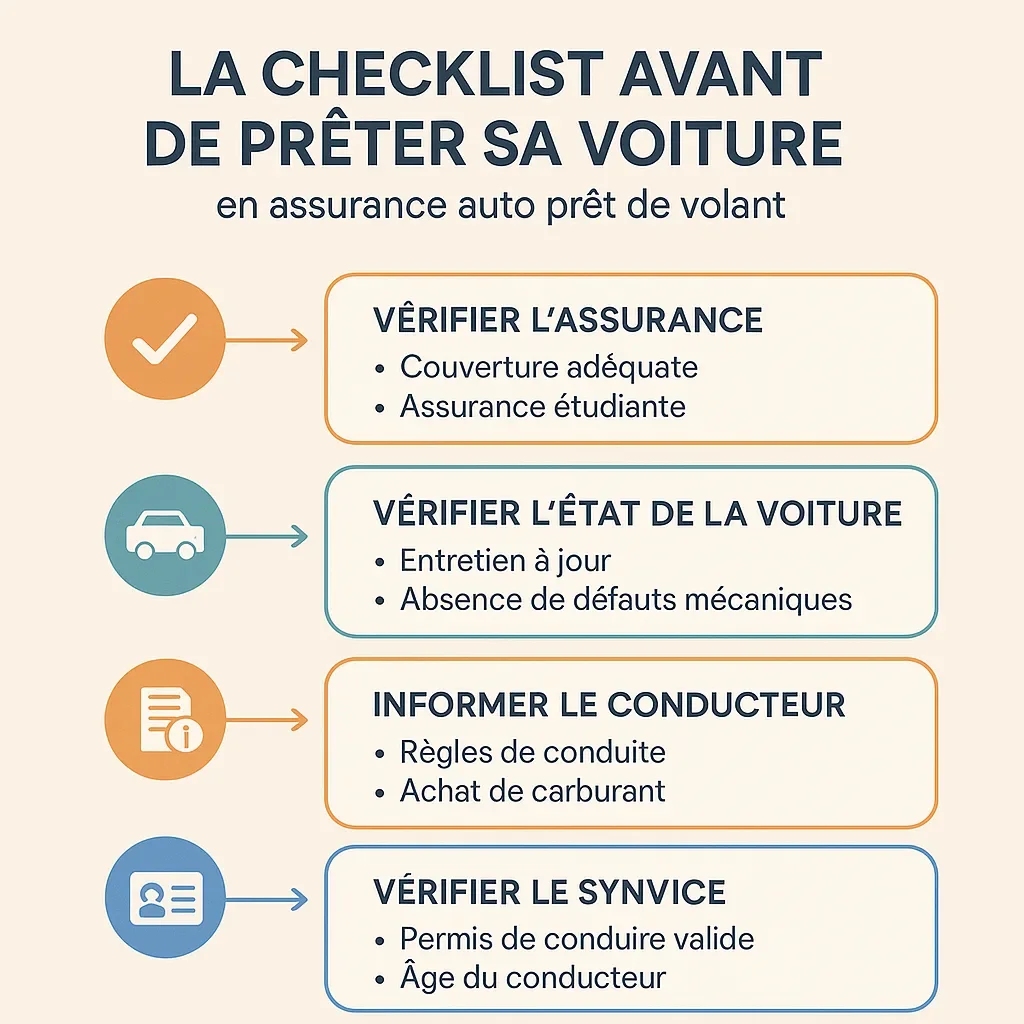
The right approach is to scrutinize the contract in four steps, without improvising:
- Check if the loan is authorized and within what limits.
- Read the deductible provided in case of an accident with another driver.
- Identify the drivers who must be declared if the loan becomes habitual.
- Confirm the absence of exclusions for young drivers or specific uses.
In other words, a seemingly “all drivers” contract can hide an unpleasant surprise at the time of a claim. Conversely, an exceptional loan to a friend can be perfectly covered if the contract clearly provides for it. The devil is in the fine print, as often.
To go further, the Insurance Code on Légifrance recalls the legal basis of car insurance, while insurers then apply their own contractual clauses. It is this mix between common rules and specific conditions that creates most misunderstandings.
0.50 to 3.50: this is the range of the bonus-malus coefficient in France. After a responsible accident, it is increased by 25% in the usual calculation, except for contractual exceptions or particular situations.
What happens if the borrower has an accident?
It all depends on what the contract covers, but also on who made the mistake. In case of an accident, civil liability first serves to compensate the victims, then the insurer examines the contract guarantees, the driver’s status, and any possible breach of a clause. Lending the steering wheel does not erase the financial consequences.
The most frequent scenario: damages caused to third parties are covered under civil liability, but the deductible, damages to the vehicle, and the bonus-malus may remain your responsibility. If the contract prohibits the loan, the insurer may also limit certain guarantees or exercise a contractual recourse.
Practically, three layers of protection must be distinguished:
- Damage to others: victims must not be left without compensation.
- Damage to your car: here, everything depends on the subscribed guarantees and loan clauses.
- The future cost of the contract: bonus-malus, deductible, sometimes price increase at renewal.
The classic trap is to believe that “if the driver had a license, everything will be fine.” In reality, a valid license is only the base. The insurer also looks at whether the use was authorized, if the person had to be declared, and if the loan was exceptional or became almost permanent.
In practice, disputes rarely arise during a true emergency breakdown. They tend to appear when the same person drives the car several times a week without being declared, or when the contract was signed online without reading the exclusive driving clause fully.
What is the difference between occasional loan, secondary driver, and exclusive driving clause?
This is not jargon to sound fancy: each formula changes the coverage. The occasional loan accepts a one-time driver, the secondary driver is a person who often uses the vehicle, and the exclusive driving clause reserves almost all driving to the subscriber. It is often here that the real logic of the contract is discovered.
| Formula | What it means | Main risk |
|---|---|---|
| Occasional loan | Occasional driving by a relative or friend | Higher deductible depending on the contract |
| Secondary driver | Person who often uses the car | Additional premium or mandatory declaration |
| Exclusive driving | The vehicle is reserved for the subscriber | Reduced coverage in case of an unplanned loan |
A family living in Toulouse once told us they discovered too late that the household car was declared under exclusive driving, while it was regularly used by their student son. This type of situation clearly illustrates the problem: it is not the “among relatives” use that matters, but the consistency between actual use and the contract.
Good to know: if the same driver often takes the wheel, it’s better to ask the insurer if they need to be registered as a secondary driver. This avoids pointless arguments afterwards, when nerves are already frayed.
3 years of probationary license, or 2 years after accompanied driving: this is the official framework for young drivers in France. This period is often closely monitored by insurers when they review a loan of the steering wheel.
Who can borrow the car without unpleasant surprises?
In practice, the simplest profiles remain occasional drivers, holders of a valid license and clearly covered by the contract. The further the situation deviates from this pattern, the higher the legal and financial risk. A young driver, a partner who drives daily, or an occasional friend should not be treated the same way.
Here are the most common cases, with their points of attention:
- A household member: often covered, but not automatically if the contract requires a single primary driver.
- A friend or neighbor: generally possible for occasional loans, provided the contract allows it.
- A young driver: watch out for exclusions, increased deductibles, and mandatory declaration.
- A regular driver: they often must be declared as secondary, otherwise the loan quickly resembles unauthorized use.
The right reflex is to think in terms of frequency of use. If someone drives once to help out, it’s an occasional loan. If this person takes the wheel every week, the contract should reflect that. That’s why an endorsement or modification of the insurance policy is sometimes the healthiest solution.
The real trap of lending the steering wheel is not the borrower’s license: it’s the contract you didn’t reread before handing over the keys.
How much does a poorly managed loan of the steering wheel cost?
The cost rarely appears on a single line. It can come from a higher deductible, a premium increase at renewal, a penalty after an at-fault accident, or, in some cases, limited coverage on vehicle damage. This is where the “free” loan becomes decidedly less pleasant.
Insurers do not all apply the same policy, but the mechanism is often as follows: the further the loaned driver is from the declared profile, the more sensitive the contract becomes. Some contracts tolerate an occasional loan without extra cost, others impose a specific deductible, sometimes very deterrent. So this is a point to check beforehand, not afterwards.
The bonus-malus system also deserves close attention. A responsible claim with a loaned driver can affect the contract’s coefficient, just as if you were behind the wheel. In the short term, the bill may seem manageable; in the medium term, it appears in the next premium, and then the cost stings a bit.
Good practices before handing over the keys
- Reread the special conditions of the contract, not just the commercial summary.
- Check the deductible in case of a claim with an occasional driver.
- Declare a regular driver if the loan repeats.
- Request written confirmation from the insurer if in doubt.
- Verify the validity of the license and driving experience if the driver is young.
Ultimately, car insurance for loaning the steering wheel is neither an automatic “yes” nor a general “no.” It’s a balance between law, contract, and common sense. If you anticipate it before lending the car, you avoid the classic cocktail: tense discussion, hefty deductible, and regret when signing the accident report.
FAQ — Car insurance and loaning the steering wheel
Can I lend my car to my young driver son?
Yes, sometimes, but not without verification. Young drivers are often associated with higher deductibles or specific restrictions in the contract. If your son drives regularly, it may be better to declare him as a secondary driver to avoid unpleasant surprises after a claim.
Who pays the deductible if my friend has an accident?
In principle, it is the contract holder who bears the deductible provided, unless there is a private agreement between you and your friend. The insurer applies the contract clauses. If the deductible is increased for loaning the steering wheel, it can be significantly higher than for usual driving.
My contract prohibits lending: do I still have the right to lend in an emergency?
Occasional lending may seem trivial, but if the contract excludes it, you are taking a real risk. The safest approach is to contact the insurer before lending the vehicle. In case of doubt, a simple call can prevent a denial of coverage or an unpleasant financial claim.
Is lending different if my car is used daily by my spouse?
Yes, clearly. This is no longer occasional lending, but regular use that often must be declared. If the spouse frequently drives the vehicle without being listed on the contract, the insurer may consider there to be a discrepancy between the actual use and the declared situation.
What if I lend my car abroad?
You need to check the geographical area covered by the contract and the international insurance card, depending on the country concerned. Coverage in France does not automatically mean identical coverage outside the territory. Again, it is better to confirm the trip with the insurer before leaving.