
In Brief
🧭 Life insurance remains one of the most flexible investments for long-term saving: the money is not locked in, even if the taxation becomes more favorable over time.
📄 Opening mainly requires standard documents: identity card, bank details (RIB), proof of address, and sometimes a questionnaire about your investor profile and the source of funds.
💶 Many contracts open with an initial payment between €100 and €500, but some online providers offer more flexible entry amounts. The real issue is often the fees.
🔎 Before signing, prioritize looking at the management fees, the available investment options, the beneficiary clause, and the 30-day withdrawal period.
Who Can Open a Life Insurance Policy?
In practice, a life insurance contract can be subscribed by an adult, by an emancipated minor, and, in some cases, by a non-emancipated minor with the consent of their legal representatives. There is no legal maximum age, but the insurer must verify the identity and legal capacity of the subscriber.
Legally, the rule is quite simple, and that’s a good thing. The Service-Public.fr file on subscribing to a life insurance contract reminds that an adult can open a contract without particular difficulty, while a minor goes through their parents or legal guardian. For a young person aged 16 to 18 who is emancipated, the logic changes: they can act alone, but the institution will carefully verify their situation.
It is also important to keep in mind that an insurer can refuse to open a contract if the file appears incomplete, inconsistent, or too risky in view of its compliance obligations. In other words, age is not everything: the source of the money, the quality of the documents, and the coherence of the project weigh as much as the identity of the subscriber.
How to open a life insurance policy step by step?
The opening generally takes place in 7 steps: define your objective, compare contracts, fill out the form, provide the requested documents, sign the form, make the first payment, and check the received documents. The tricky part is mainly reading the fees and the beneficiary clause, not the paperwork itself.
The process has become smoother than before, especially online, but you should not rush. The right approach is to start from your real objective: preparing a 5-year project, supplementing a retirement, transferring capital, or simply growing an emergency savings that is a bit too idle.
- Define your objective: security, return, retirement, or transfer.
- Choose the type of contract: single-support, multi-support, self-managed or managed.
- Compare fees: payment, management, arbitration, options.
- Gather documents: identity, bank details, address, sometimes additional proof.
- Fill out the questionnaire: investor profile, risk knowledge, source of funds.
- Sign the contract: electronically or at the agency.
- Make the first payment: in a lump sum or via scheduled payments.
The Ministry of Economy also reminds that a life insurance policy remains accessible at any time through a partial or total withdrawal, which distinguishes it from truly locked savings. In other words, you can open the contract without having to lock your money away forever. This is an important nuance, and it changes the perception of the product.
Where to open a life insurance policy: bank, insurer, or broker?
The right channel mainly depends on your level of autonomy and your tolerance for fees. A retail bank provides reassurance, an online insurer speeds up subscription, and a broker can offer more choices. The devil, as often, lies in the fees and the quality of the offered investment options.
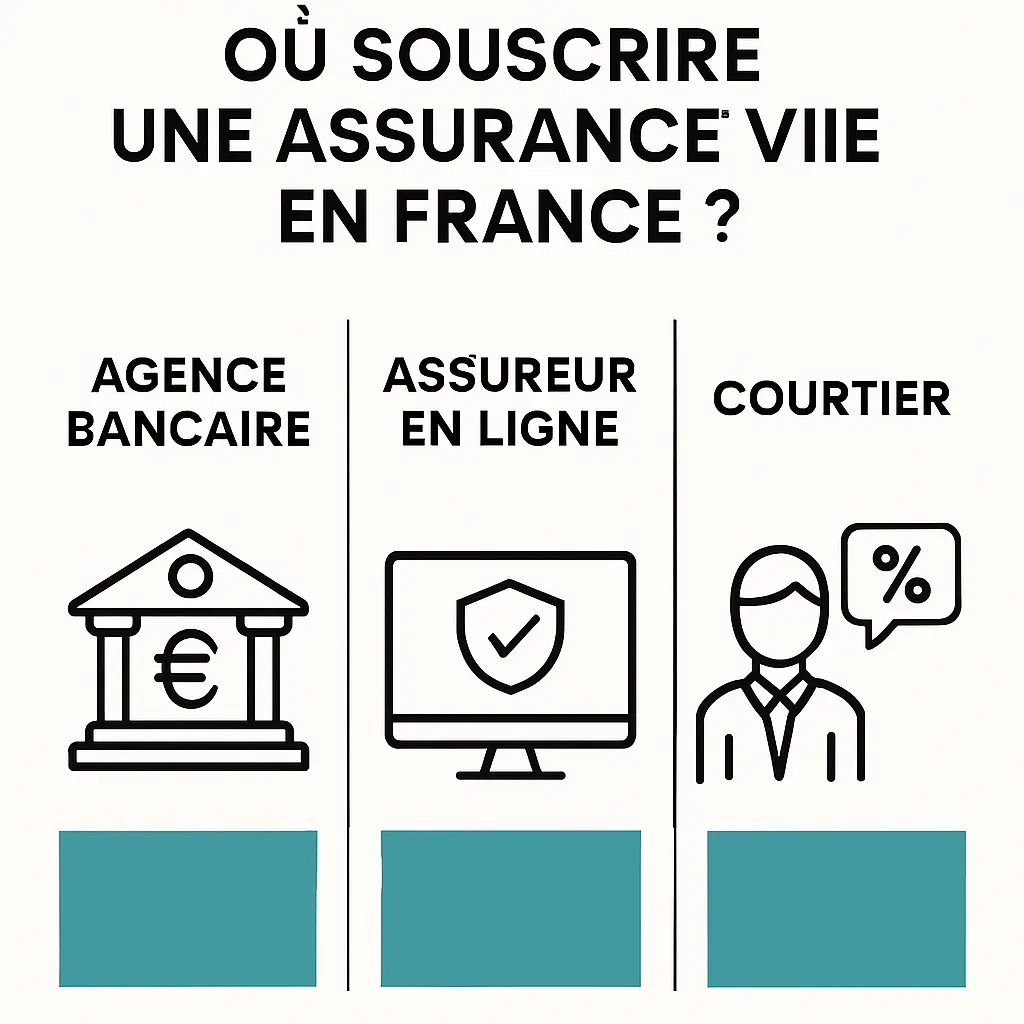
| Channel | Strengths | Points of caution | Suitable profile |
|---|---|---|---|
| Retail bank (e.g., Caisse d’Épargne) | Physical support, relationship of trust, simplicity for those who want direct contact. | Sometimes more standardized offer, less competitive fees, shorter range of investment options. | Cautious saver, not comfortable with online management. |
| Online insurer (e.g., BoursoBank) | Quick subscription, often lighter fees, easy access to documents and arbitrations. | More distant advice, greater autonomy, variable assistance depending on the provider. | Autonomous client, comfortable with digital management. |
| Broker | Wide range of contracts, comparative vision, useful for spotting fee and investment option differences. | You need to read the conditions carefully and verify the actual service behind the commercial promise. | Comparing saver, intermediate or dynamic profile. |
In practice, it is observed that subscribers who hesitate between several contracts often benefit from going through a broker or a serious comparison before committing. An independent agent notes that the most attractive offers displayed sometimes hide less visible management fees, but much heavier over ten years. This is where detailed analysis becomes useful, otherwise you sign blindly.
For further information, the Ministry of Economy’s website on the benefits of life insurance clearly reminds the logic of long-term investment, fund availability, and transmission. This is useful to stay on course, especially when comparing contracts that look similar on the surface but differ greatly in their mechanics.
How much do you need to open a life insurance policy?
There is no single rule, and that is precisely what makes the subject a bit tricky. Some offers start at a few hundred euros, others lower, sometimes with scheduled payments to smooth out the saving effort. The real criterion is not just the entry ticket, but the contract’s ability to remain profitable once fees are applied.
In other words, opening a life insurance policy with a small budget is not absurd. The most important thing is to be able to fund the contract regularly, even with modest amounts, and to avoid investment options that are too expensive and eat into performance. A simple start often beats an overly ambitious launch that fizzles out after three months.
- Initial payment: to be checked contract by contract, as it varies from one institution to another.
- Scheduled payments: practical for saving without thinking about it every month.
- Recurring fees: they weigh more on small amounts than on large assets.
- Investment horizon: the longer it is, the more the life insurance logic makes sense.
A good life insurance contract is not judged by the sales brochure, but by the balance between fees, investment options, and management flexibility.
What fees and clauses should be checked before signing?
Before opening a contract, you need to read the fine print, even if it’s not the most glamorous part of the process. Fees and the beneficiary clause have a direct impact on the profitability, transfer, and flexibility of the contract. This is often where the real differences appear between two offers that seemed identical at first glance.
- Subscription fees: these are fees charged on each contribution, sometimes 0%, sometimes higher.
- Management fees: these recur annually and weigh on net performance.
- Arbitration fees: to watch if you plan to frequently change the allocation of your savings.
- Option fees: some contracts charge for securing gains or for managed portfolios.
- Beneficiary clause: it must be precise, up to date, and consistent with your family situation.
The classic trap is to look only at the displayed return without analyzing what remains after fees are deducted. A contract with low fees, well diversified and easy to manage can outperform a more expensive “premium” offer, especially if you invest over several years. That’s why taxation, fees, and contract structure must be considered together, not separately.
Can you open a life insurance policy for a minor or with a small budget?
Yes, and it is even one of the most misunderstood uses of the product. A child can be a beneficiary or subscriber depending on their legal status, provided that the signature is made by their legal representatives when necessary. For a small budget, the key is to choose a flexible contract, with scheduled payments compatible with your actual saving capacity.
In practice, families often use life insurance as a long-term envelope to prepare for education, build a starter capital, or gradually transfer wealth. A family who moved in 2022 to a medium-sized town even said they chose this format because it allowed them to fund the contract “without pain,” a little every month, instead of locking up a large sum at once. This is where regularity beats brute force.
It should be noted that the most flexible contracts are not necessarily the most profitable, and that a small budget poorly supports fixed fees that are too high. It is better to make a modest but regular payment on a clear contract than to fall for a nice commercial promise that ends up costing dearly down to the last cent.
FAQ — Opening a life insurance policy
How long does it take to open a contract?
Online, subscription can be quick if your file is complete, sometimes within a few days. At an agency, it often takes a little longer, especially if documents are missing or if the contract requires manual validation.
Can you open multiple life insurance policies?
Yes, there is no legal limit on the number of contracts. It is sometimes even useful to separate objectives: one contract for retirement, another for a medium-term project, a third for inheritance.
Should you invest immediately in unit-linked funds?
Not necessarily. Unit-linked funds can offer more potential, but they carry a risk of capital loss. Many savers start with a cautious allocation, then adjust according to their horizon and risk tolerance.
Can you withdraw money before 8 years?
Yes. The contract remains accessible, but the taxation of gains is generally less favorable before the 8-year threshold. The best practice is to check the tax impact before making a significant withdrawal, especially if the contract is relatively new.
Can the beneficiary clause be changed after opening?
In most cases, yes, as long as it has not been accepted under conditions that lock the wording. It is good practice to review it regularly, especially after a marriage, birth, divorce, or change in asset situation.