
Why Camping Appeals So Much to the French: What Their Way of Going on Vacation Reveals
The French people’s favorite camping is not just a simple backup plan for tight vacations. On the contrary, it reveals a very deliberate way of traveling: wanting to keep control over their budget, pace, living environment, and increasingly, the level of comfort. In other words, if the reason why the French prefer camping comes up so often in searches, it is because this type of stay meets several expectations at once.
This success says a lot about the times. Vacationers want to endure their holidays less and shape them more to their image. They seek nature, practical services, friendliness, but also real leeway to choose between tent, mobile home, nature camping, or more equipped accommodation. The icing on the cake: the sector has learned to upgrade without losing its DNA.
Sommaire
In brief
🏕️ Camping remains a stay appreciated by the French because it combines controlled budget, freedom, and disconnection, without sacrificing leisure.
🌿 The demand no longer concerns only tents or bare pitches: the mobile home and rental accommodations are driving the offer towards more comfort.
👨👩👧👦 Families, couples, and seniors do not expect the same things, but they all share the idea of a stay that is simple to organize.
📈 The 2023-2025 figures show a robust model: strong image, long-term loyalty, and consistently high attendance in the French market.
Why does camping appeal so much to the French?
Camping appeals because it meets a very rare combination: clear pricing, contact with nature, friendliness, and freedom of organization. It is no longer just an economical accommodation. It has become a way of going on vacation that gives the impression of better controlling one’s stay, while maintaining a reassuring social and family framework.
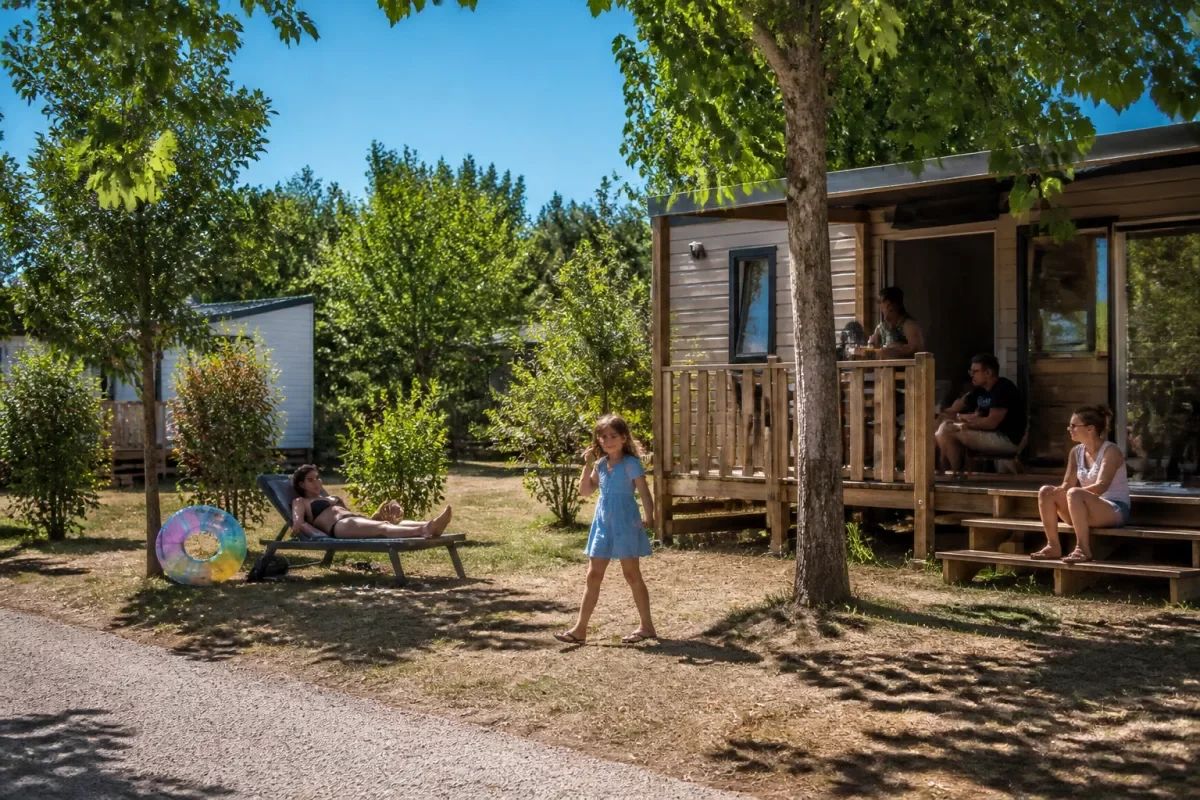
Opinion polls converge quite well on this point. In 2025, camping enjoys a positive image among 79% of the French, including 22% with a very good image. This is not insignificant. It means that camping is no longer seen as a niche choice, but as a legitimate, modern, and even quite consensual option.
To understand what is at stake, one must go beyond the cliché of the vacationer who just looks for the lowest price. Camping also attracts households who want a better balance between what they pay and what they actually get: space, facilities, activities, sometimes a swimming pool, and the ability to live outdoors without feeling isolated.
What vacationers really look for
If camping appeals so much, it is because it addresses very concrete needs. The French do not all look for the same thing, but they often return to the same equation: less constraint, more control, and a stay that remains accessible without giving the impression of cutting corners on the experience.
A better controlled budget without giving up on holidays
Price remains a powerful driver. In 2025, 29% of French people spontaneously cite value for money as the main advantage of camping, and 83% believe it will be increasingly sought after for economic reasons. It’s not just a matter of purchasing power: it’s a logic of rational choice.
In other words, camping reassures because it makes the cost of holidays more transparent. A family can choose between a bare pitch, mobile home, or chalet, and adjust their budget without giving up the trip. Camping then becomes a kind of slider: you adjust the level of comfort instead of cancelling the holiday.
- Controlled price on accommodation, especially in low season.
- Ability to cook, thus limiting expenses on site.
- Modular offer according to the desired level of comfort.
- Shared family budget when several people travel together.
Return to nature and the outdoors
Camping is also appealing because it brings fresh air back into holidays. This return to nature is not just a postcard setting: it corresponds to a real desire to break away from daily life, screens, fixed schedules, and standardized accommodations. The outdoor experience remains a very strong marker of nature camping.
The French are looking less for a destination than a feeling: opening the door in the morning, hearing neighbors without feeling trapped, being able to walk to the beach, lake, or trails without having to get back in the car each time. This slight relaxation of pace weighs heavily on the overall satisfaction of the stay.
Camping is not only attractive because it costs less. It is attractive because it gives the feeling of taking back control of one’s holiday.
The freedom of organization and the collective spirit
Here is probably the most underestimated point: at the campsite, everyone feels like they live their holiday their own way. Late breakfast, lunch on the terrace, impromptu outing, children’s activities, evening with neighbors… The setting is collective, but the organization remains flexible. It is exactly this mix that hits the mark.
This flexibility is very popular with families and groups of friends. You can share moments without being stuck to each other all the time. You can also live at your own pace, which becomes precious when you finally want to disconnect from work and daily demands.
On the ground, a reception agent at a campsite in Vendée observes that mobile home bookings often start with a search for calm even before looking for comfort level. A family arriving in September also reports having chosen this period to enjoy the activities without the crowds or oppressive heat.
How has camping changed its face?
The success of camping also lies in its transformation. It is no longer just a site for tents or caravans. Outdoor hospitality has broadened its range: rental accommodations, services, water parks, kids’ clubs, catering, bike rentals, wifi, and sometimes even spas. Camping has modernized without losing its image of freedom.
From rustic stay to comfortable mobile home
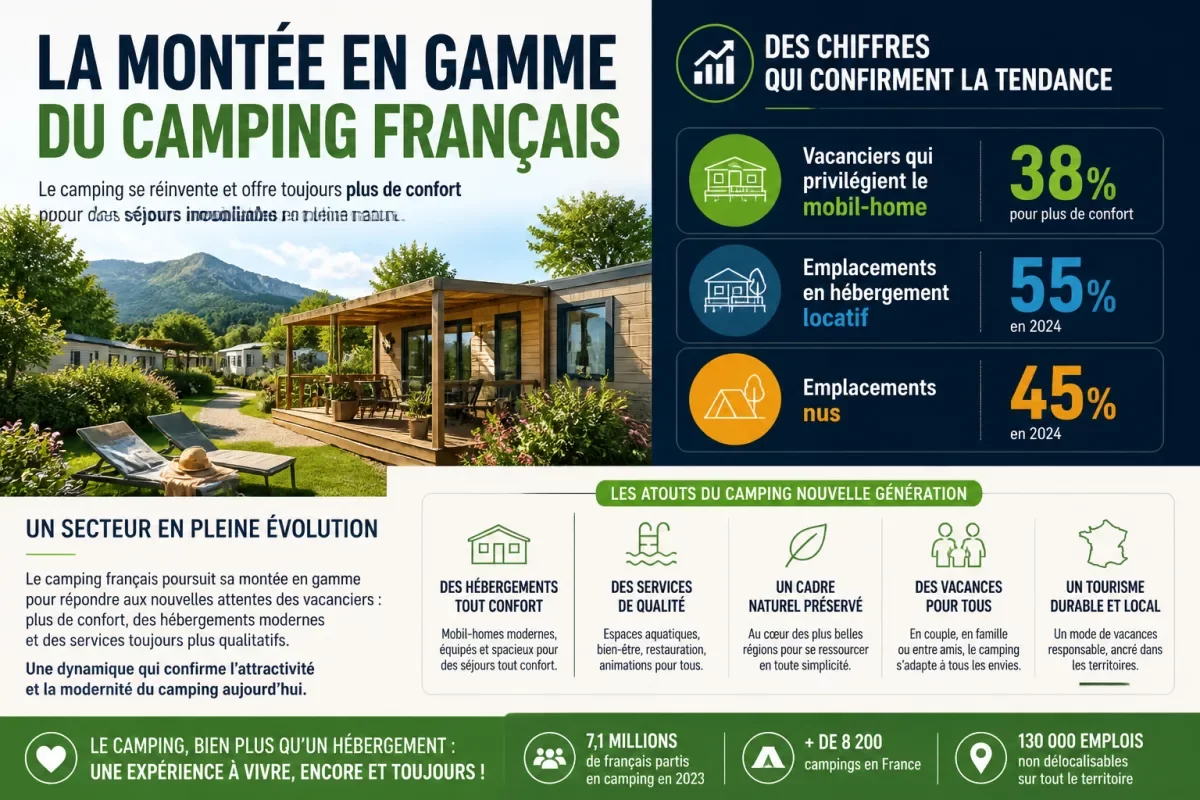
The mobile home has clearly changed the game. According to available sector data, 38% of campers prefer it for more comfort. And the offer has followed: in 2024, 55% of pitches are rental accommodations, compared to 45% bare pitches. The message is clear: a large part of holidaymakers want camping, but in an easier-to-live version.
This upgrade does not mean tents are disappearing. It rather shows that the market has understood a simple thing: many French people like the camping spirit, but not necessarily its old constraints. The success of the mobile home confirms that camping has shifted from the realm of deprivation to that of intelligent compromise.
The real turning point for camping is that it is no longer opposed to comfort: it has integrated it into its model.
Preferred formats according to profiles
Camping does not attract the same holidaymakers for the same reasons. This is actually one of its great strengths: it knows how to speak to different audiences without losing its coherence. Families find services and activities, couples find peace and quiet, seniors enjoy more flexible off-season stays, and groups of friends find a friendly and budget-friendly solution to share.
| Profile | Main Expectation | Often Chosen Format |
|---|---|---|
| Families | Entertainment, perceived safety, children’s activities | Mobile home or 4-star campsite |
| Couples | Quiet, natural setting, privacy | Nature campsite or chalet |
| Seniors | Comfort, accessibility, relaxed pace | Equipped rental off-season |
| Groups of friends | Shared budget, autonomy, conviviality | Pitch or large rental accommodation |
It is observed in the field that the highest-rated campsites are rarely those that promise the most, but those that reduce friction: smooth reception, clean sanitary facilities, sufficient space, simple circulation. This seemingly trivial detail weighs heavily on the real satisfaction of vacationers.
Why does camping remain competitive compared to other accommodations?
Compared to hotels, seasonal rentals, or peer-to-peer platforms, camping retains very solid advantages. It combines a logic of space, a more flexible collective life, and a service offer that is often clearer. For many families, it is a credible alternative to classic rentals, especially when it adds a pool, entertainment, and on-site dining.
Comparing camping, rental, and hotel
Camping is not only cheaper in some cases. It also offers something that other accommodations struggle to reproduce: the freedom to move around, to cook, to let children live outside, and to choose one’s level of involvement in the life of the place. It is this autonomy that makes the difference.
| Criterion | Camping | Hotel / classic rental |
|---|---|---|
| Budget | Often more flexible | Often more rigid |
| Conviviality | Very strong, sometimes central | More discreet |
| Autonomy | High | Variable depending on the accommodation |
| Comfort | Very variable depending on the range | More homogeneous |
However, it should be nuanced: not all campsites play in the same league. A 4 or 5-star establishment does not offer the same experience as a small nature campsite. This is precisely why the French increasingly compare services, cleanliness, location, and atmosphere before booking.
For those looking for more exotic ideas, one can also take a look at a selection of exotic addresses, useful to see how much the offer has diversified.
What demand says about the new expectations of the French
The success of camping reveals a deeper evolution: the French want holidays that are more flexible, more accessible, and less standardized. They accept simplicity provided it is chosen, not endured. This is the whole difference between an “economical” stay and a stay considered smart.
More flexible and more accessible holidays
This search for flexibility also explains the development of online bookings, short stays, off-season departures, and profiles that spread their holidays according to their budget. Camping works particularly well when the vacationer wants to keep control over the length of the stay, the intensity of activities, and the level of spending.
The fact that 65.1% of campers have been loyal to this type of holiday for more than ten years shows that we are not just talking about a passing trend. We are talking about a deeply rooted habit, almost cultural, that crosses generations without much erosion.
A stronger aspiration for authenticity
Camping is also appealing because it gives an impression of authenticity that the French increasingly seek. Staying near the sea, countryside, or mountains, without going through a standardized hotel, is to find a form of holiday that is more concrete, more local, sometimes more family-oriented. The preferred destinations of campers clearly show this: 34.3% for the sea, 28.4% for the countryside, and 24.4% for the mountains.
This territorial overview is informative. Camping is not just a seaside affair: it also spreads into the hinterland, valleys, lakes, and more rural areas. This diversity partly explains why it remains so resilient. Vacationers find very different places there, but always with a common promise: to breathe more.
From an environmental standpoint, the topic is also gaining importance. Campsites that commit to water management, sorting, energy, or soft mobility respond to a growing awareness, which is reflected in the considerations put forward by ADEME. Camping is not naturally virtuous, but it can become so more easily than a completely closed and highly energy-consuming model.
For a broader framework on vacation behaviors, tourist uses, and household trade-offs, the benchmarks published by INSEE remain useful. And for the systems that govern the practical life of vacationers, Service-Public.fr provides reference information.
Limits and nuances not to forget
Camping is appealing, yes, but not everywhere nor for everyone. The very positive image masks real differences between establishments: cleanliness, noise level, quality of sanitary facilities, condition of accommodations, access to services, distance from the beach or shops. In short, the “camping” label does not say it all.
- The weather can turn a pleasant stay into an average experience.
- Comfort varies enormously between a simple site and a 5-star one.
- The crowd remains a real issue in high season, especially on the coast.
- Accessibility can be limited for certain audiences depending on the facilities.
- The noise level is not always compatible with a search for absolute rest.
French people therefore prefer camping when they find a winning compromise. If the establishment is clean, well located, and sufficiently equipped, it becomes a very competitive solution. If it is poorly maintained or too dense, the charm quickly fades. That is why concrete criteria matter more than the overall image.
The real lesson is here: camping is no longer just a form of popular vacation; it is a mirror of current expectations. The French want choice, flexibility, clear prices, outdoor vacations, and a feeling of “real” holidays. Camping ticks this box better than many other formats.
To remember
🏕️ Camping remains popular because it combines budget, freedom, and nature in a single stay.
💶 Success no longer rests solely on price: the value for money becomes central.
🛏️ The rise of the mobile home shows that the French want camping, but with more comfort.
👨👩👧👦 Families, couples, and seniors do not expect the same things, but all seek flexibility.
📍 Demand reveals a strong desire for accessible, local, and less standardized vacations.
FAQ
Why is camping so popular in France?
Because it meets several expectations at once: easier-to-manage prices, a friendly setting, proximity to nature, and freedom of organization. In times of pressure on purchasing power, this balance weighs heavily in vacation choices.
What is the French people’s favorite camping?
There is no single preferred model. Families often favor well-equipped campsites with mobile homes, while others look for a nature campsite or a simpler site. Preference mainly depends on comfort, location, and available budget.
Why do people like camping?
Because they find a livelier and more flexible form of vacation there. Camping allows cooking, spending more time outdoors, and enjoying a collective atmosphere without being locked into a too rigid format.
Why choose camping rather than a hotel?
Camping often offers more space, greater autonomy, and a friendlier experience, especially for families. It can also cost less for comparable services, particularly when looking for a long stay or a well-equipped rental accommodation.
Does camping also appeal off-season?
Yes, and it is even one of the most interesting signals in the market. Off-season, holidaymakers find more tranquility, often lower prices, and a more relaxed atmosphere. Seniors and flexible families see a real advantage in this.