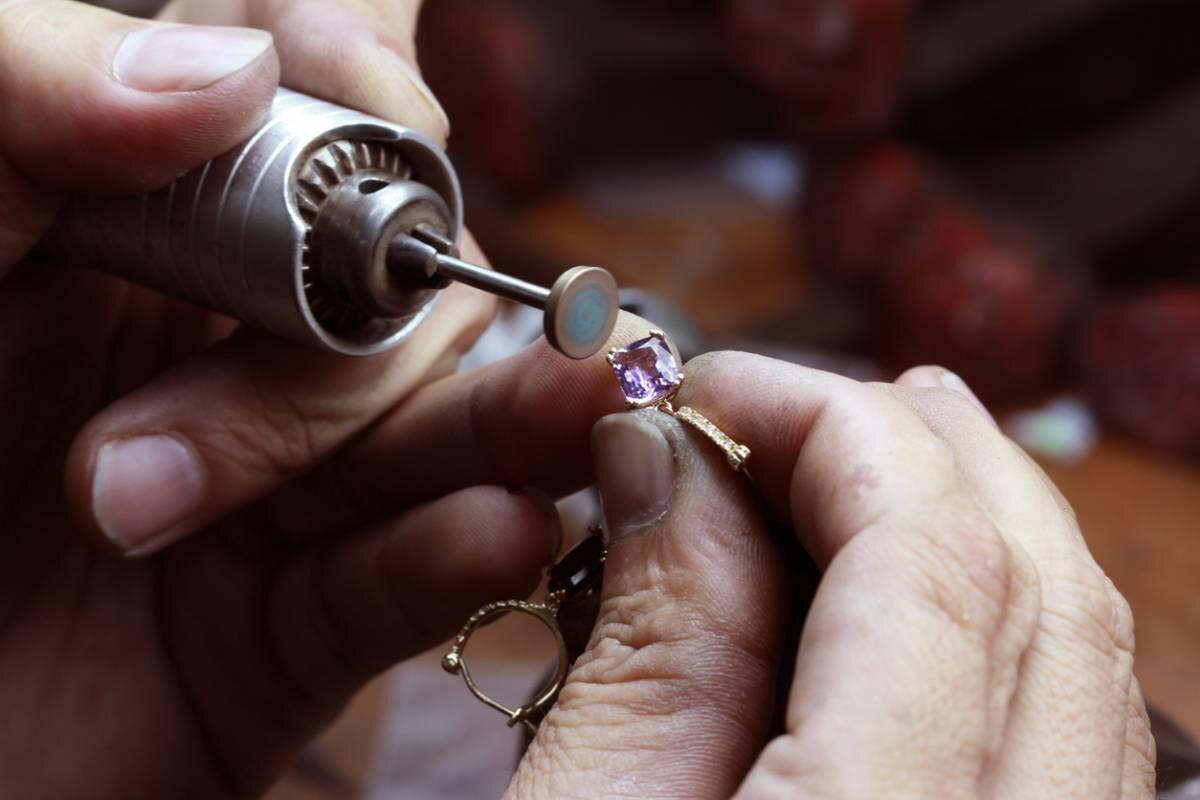
A jewelry house from the Haut-Jura founded in 1946
Since 1946, Trabbia Vuillermoz has been perpetuating in the Haut-Jura a demanding jewelry art, contrary to standardized circuits. Over the decades, the house has established itself as a reference, deeply rooted in a territory where precision craftsmanship is part of the local identity. This family transmission gives each creation an authentic uniqueness.
The Jura is not only a tourist destination: it is also a land of expertise. Jewelry here has built its reputation not on the image of a great capital, but on the rigor of the gesture, mastery of volumes, and the quality of the selected stones. Lovers of exceptional jewelry as well as gem connoisseurs recognize in this house an authenticity that has become rare in the French jewelry landscape.
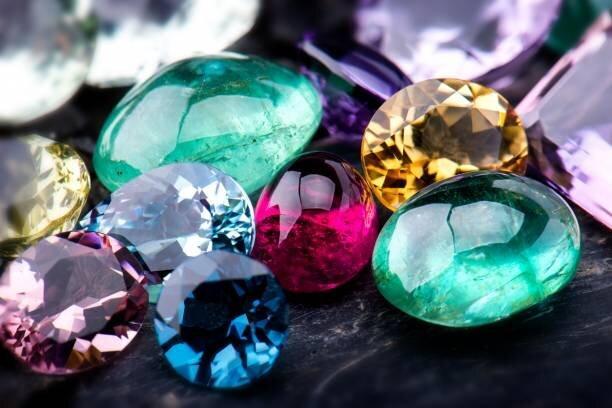
Lapidary work, an inherited and highly technical know-how
Lapidary cutting is at the heart of the house’s identity. Before becoming a jewel, a stone follows a demanding path, where every decision influences its brilliance, balance, and value:
- Observation and sorting of the rough: analysis of color, transparency, inclusions, internal stresses, and crystal orientation;
- Orientation of the stone: seeking the best material yield and the best lighting according to the intended shape;
- Sawing or cleaving if necessary: separating the rough to eliminate a fragile area or prepare the future gem;
- Preforming: initial shaping of the stone, creating the general volume and preparing the girdle;
- Doping and faceting: fixing the stone on a support, progressively cutting the pavilion facets, then the crown and table;
- Polishing: finishing each facet to achieve the brilliance, sharpness of edges, and the expected optical quality.
Each step requires mastery that only long-trained artisans can claim. Diamond work perfectly illustrates this demand. The cutting of a diamond tolerates no approximation: the slightest error in proportion, symmetry, or angle alters the light circulation, thus the brilliance, fire, and scintillation. The stones worked at Trabbia Vuillermoz benefit from this expert eye, from the study of the raw material to the final implementation in jewelry.
For colored stones as well as diamonds, the goal is not only to shape: it is to reveal. Reveal a hue, balance a silhouette, respect the crystal, and make the most of the material without betraying it. This approach requires a fine knowledge of gemology, cleavage planes, hardness, toughness, and the optical behavior of each gem. This is where the difference between a simple cut stone and a truly well-cut stone becomes immediately perceptible.
The lapidary of the Jura is part of a strong regional tradition. Tools, gestures, sense of observation, patience in polishing: all contribute to producing creations whose quality can be measured both with the naked eye and under a loupe. This artisanal rigor, transmitted within the house for decades, makes each jewel a piece in its own right.
Offering a unique jewelry creation for the moments that matter
Some moments in life deserve a jewel worthy of them. Engagements, weddings, births, milestone birthdays, or family celebrations: all moments that call for a carefully crafted piece, full of meaning and intended to last.
This is precisely what a handcrafted jewelry store like this offers: not a standardized piece of jewelry, but a creation designed for a person, a story, an emotion.
Choosing a recognized artisan also ensures that each stone has been selected with care, that the cut respects the right proportions, and that the metal has been worked with the same attention as the diamonds or colored stones. Custom creations allow for the integration of specific wishes — a particular gem, a unique shape, a style of setting, an engraving — so that the jewelry truly becomes unique.
An exceptional piece of jewelry is not improvised. It is born from a region, from lapidary expertise, from a house that has made cutting, stone selection, and jewelry excellence its core business for generations. In the Jura, this tradition remains alive, carried by artisans who refuse to compromise on quality. Giving or treating oneself to such a creation is choosing a piece of jewelry destined to transcend time and generations.