Why choose Montenegro?
Montenegro is appealing because it offers a lot of variety on a small surface: sea, mountains, lakes, ancient villages, and national parks. It’s an ideal destination if you like short road trips, contrasting landscapes, and stays where you can combine swimming, hiking, and heritage without crossing an entire country.
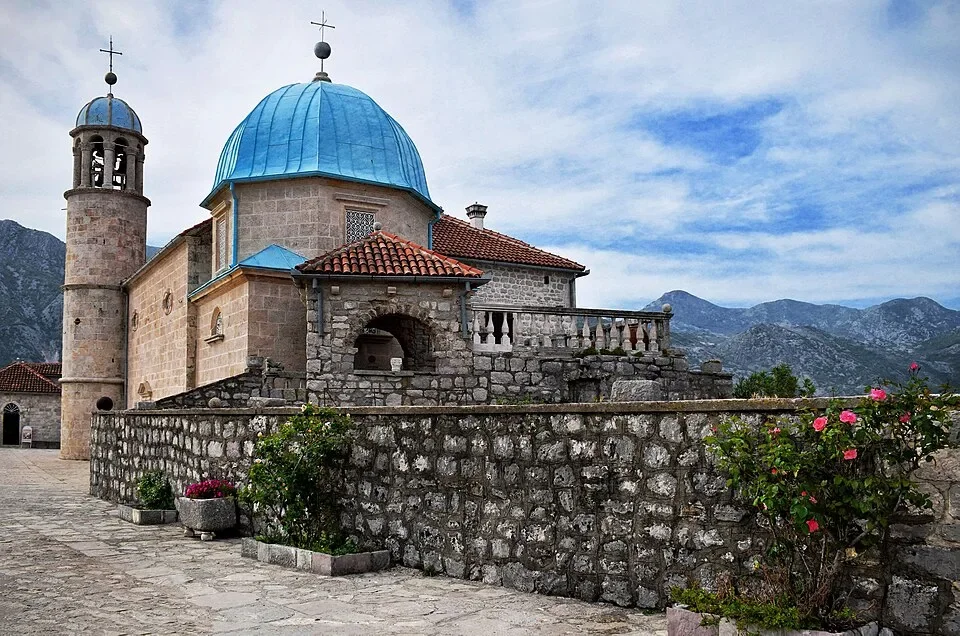
The country suits three profiles very well: travelers who want a first glimpse of the Balkans, couples looking for a mix of sea and character villages, and nature lovers who prefer panoramic roads to overly beach-focused stays. In other words, Montenegro is compact but not at all monotonous.
- For a short stay: the coast and Kotor already provide an excellent overview.
- For a road trip: the combination of coast + mountains works very well.
- For a nature trip: Durmitor and Lake Skadar alone are worth several days.
- For a quieter stay: the villages and hinterland hold very good surprises.
When to go to Montenegro?
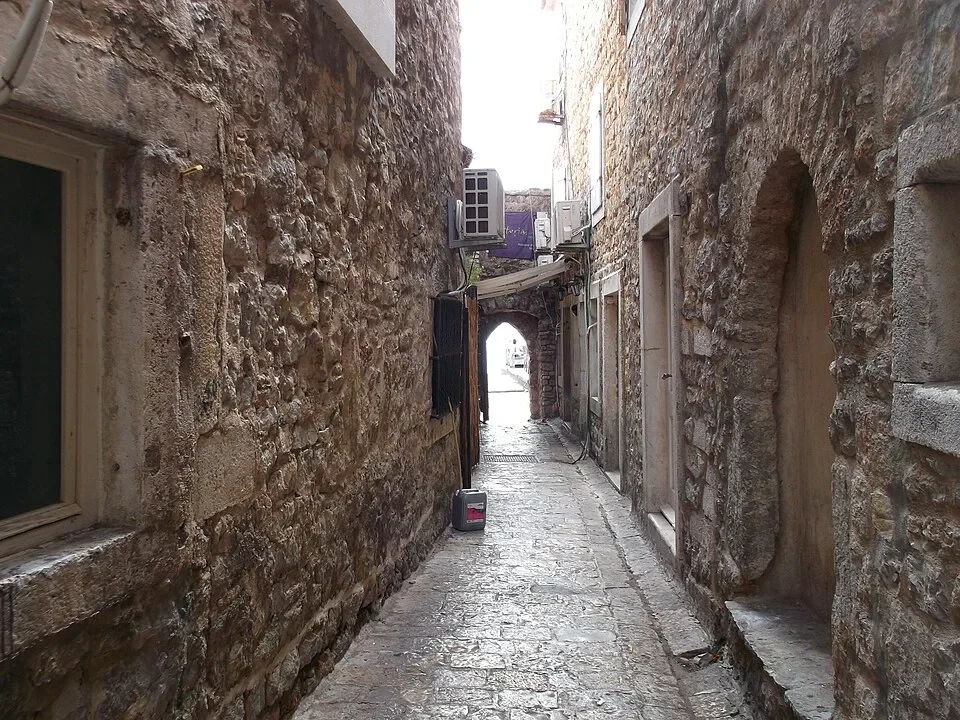
The best time depends on your program. For the sea and coastal visits, May-June and September are often the most pleasant. For hiking and parks, summer remains practical at altitude, but the shoulder seasons offer more comfort. In July-August, the coast is warmer, more expensive, and more crowded.
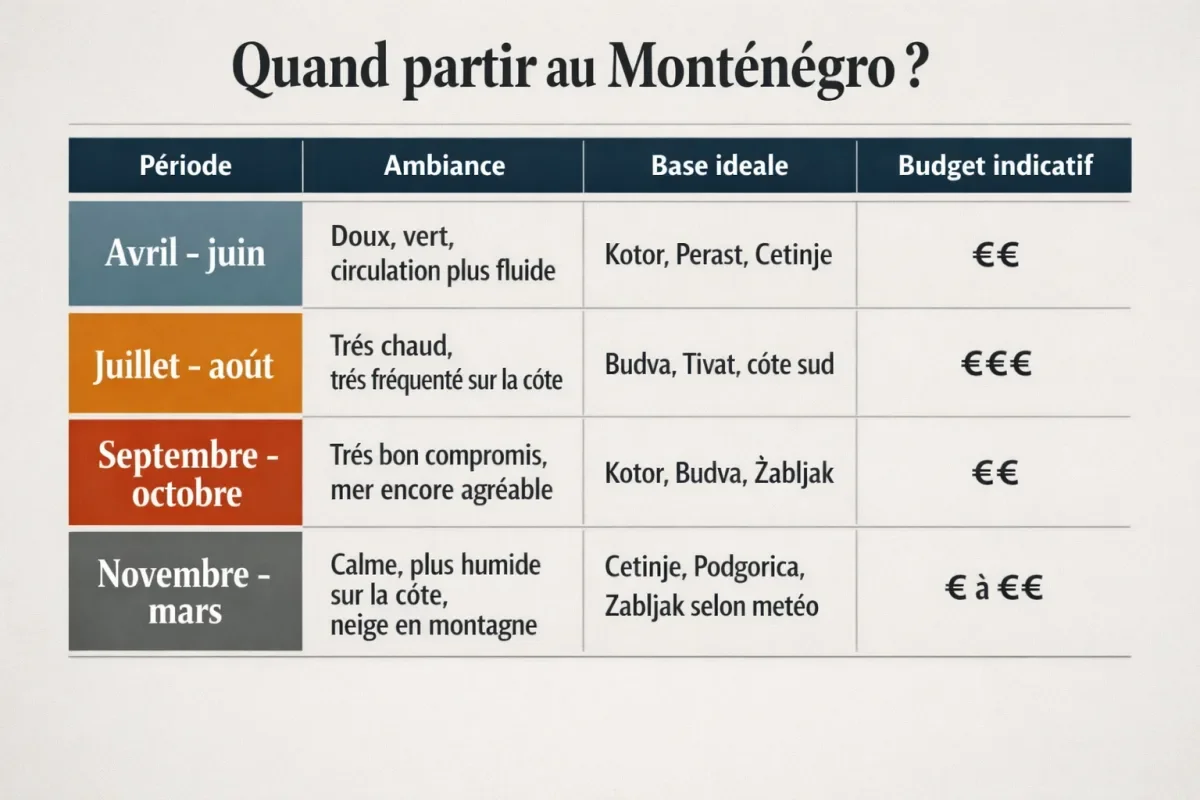
| Period | Atmosphere | Ideal base | Indicative budget |
|---|---|---|---|
| April – June | Mild, green, smoother traffic | Kotor, Perast, Cetinje | €€ |
| July – August | Very hot, very busy on the coast | Budva, Tivat, south coast | €€€ |
| September – October | Very good compromise, sea still pleasant | Kotor, Budva, Žabljak | €€ |
| November – March | Quiet, more humid on the coast, snow in the mountains | Cetinje, Podgorica, Žabljak depending on weather | € to €€ |
Here is the simple logic to remember: if your priority is swimming, the coast dominates from May to September; if you aim for hiking and great panoramas, the shoulder seasons are often more comfortable; if you like winter landscapes, Durmitor can become a whole different world. Montenegro truly changes its face according to the calendar.
What to see in Montenegro?
If you need to prioritize visits, start with the Bay of Kotor, then add the Budva coast, a mountainous block around Durmitor, and a detour to Lake Skadar. Then, depending on the time available, complete with Cetinje, Lovćen, and some characterful villages. This is the best balance between must-sees and realistic travel time.
The Bay of Kotor
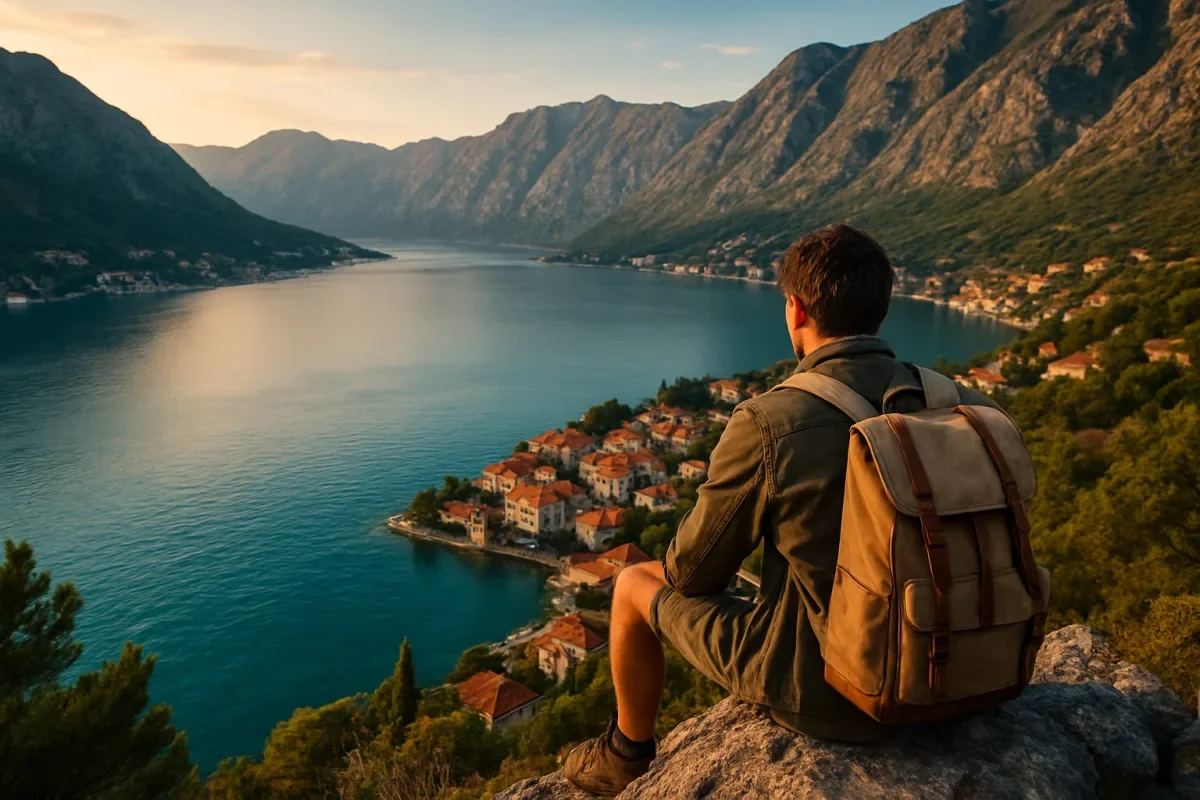
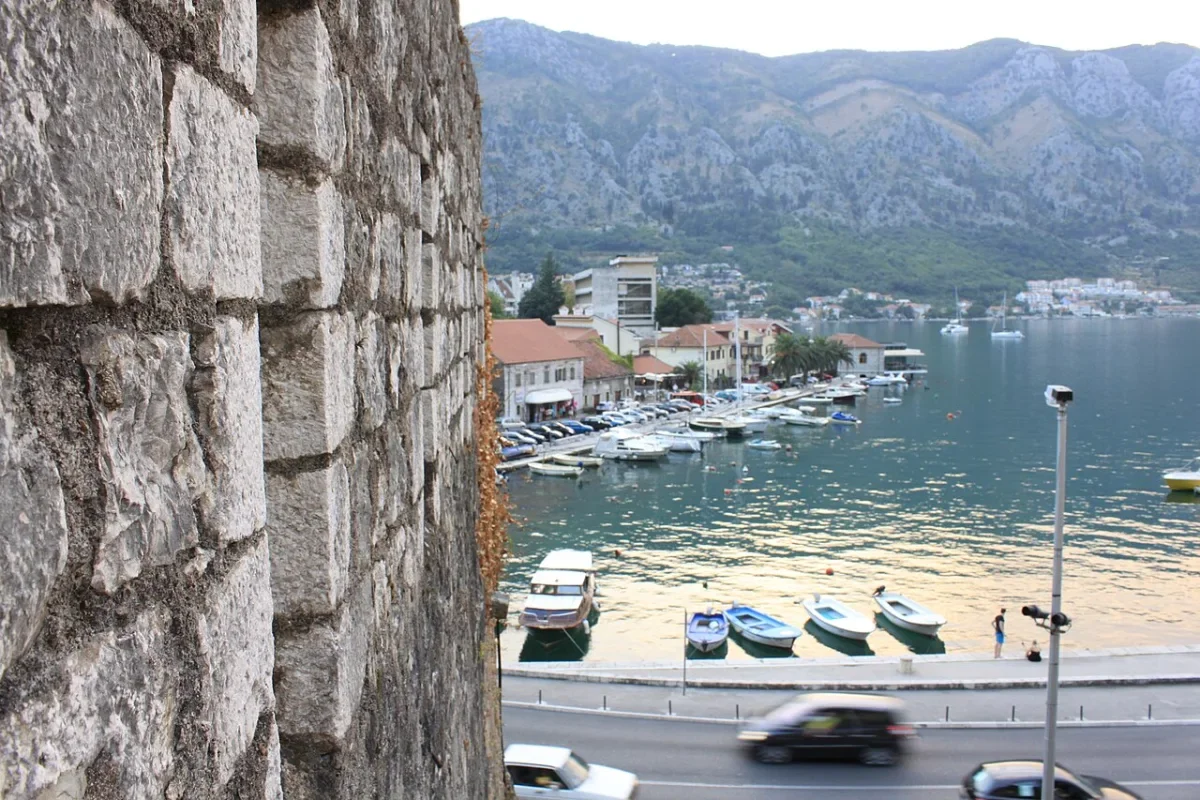
The Bay of Kotor is the postcard image of the country, but it’s not just beautiful: it is also a territory very dense in viewpoints, villages, and scenic roads. It is often called a “fjord,” but it is rather a recessed bay, which changes everything geologically. The relief is spectacular, almost theatrical.
Kotor and Perast
Kotor deserves at least half a day, or even a full day if you like to stroll through the alleys, climb the ramparts, and enjoy the terraces in the calm of the morning. Perast, smaller and more elegant, almost works as its counterpart: less crowd, more softness, and an atmosphere that makes you want to slow down.
- In Kotor: ramparts, old town, ascent to the fortress, evening atmosphere.
- In Perast: walk along the water, baroque churches, view of the islets.
- Nearby: overlooking viewpoints and small roads quieter than the main coast.
Budva and the Adriatic coast
Budva plays the seaside resort card. This is where you find the most activity, easy-to-access beaches, and a real resort life in summer. If you are looking for absolute silence, this is not necessarily the first choice. If you want to alternate swimming, restaurants, and evenings, on the other hand, it is a very practical base.
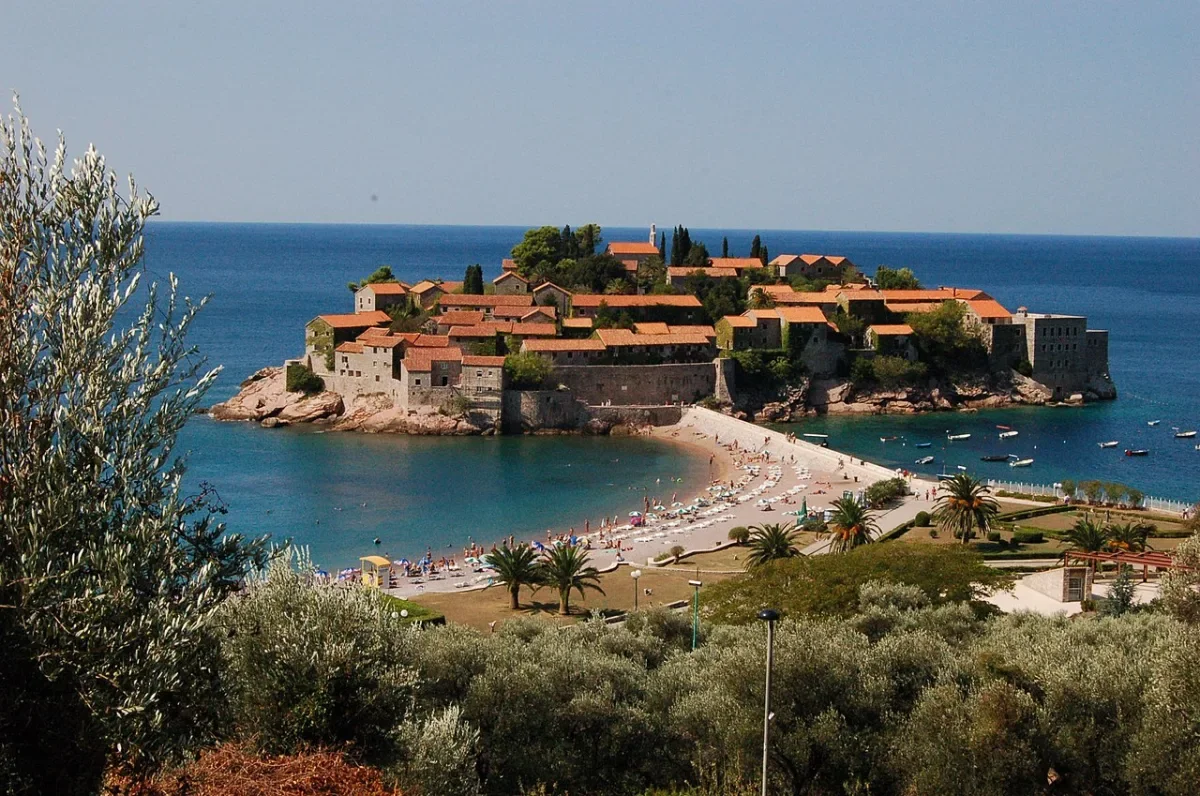
On the coast, the real issue is not only “what to see,” but also “when to go.” In July-August, the atmosphere is noticeably denser around Budva, with traffic, full parking lots, and rising prices. In May-June or September, the experience is often smoother, quite simply.
Durmitor National Park
Durmitor National Park completely changes the pace of the stay. You leave the Mediterranean for alpine reliefs, cooler forests, glacial lakes, and mountain roads that set the tone. It is one of the best places in the country to walk, breathe, and break the coastal routine.
If you like accessible walks, the surroundings of Black Lake are a good introduction. If you are looking for something more sporty, the gorges and some trails in the massif give a true mountain dimension to the trip. Be careful though: travel times seem short on the map, but the mountains never let themselves be rushed.
Lake Skadar
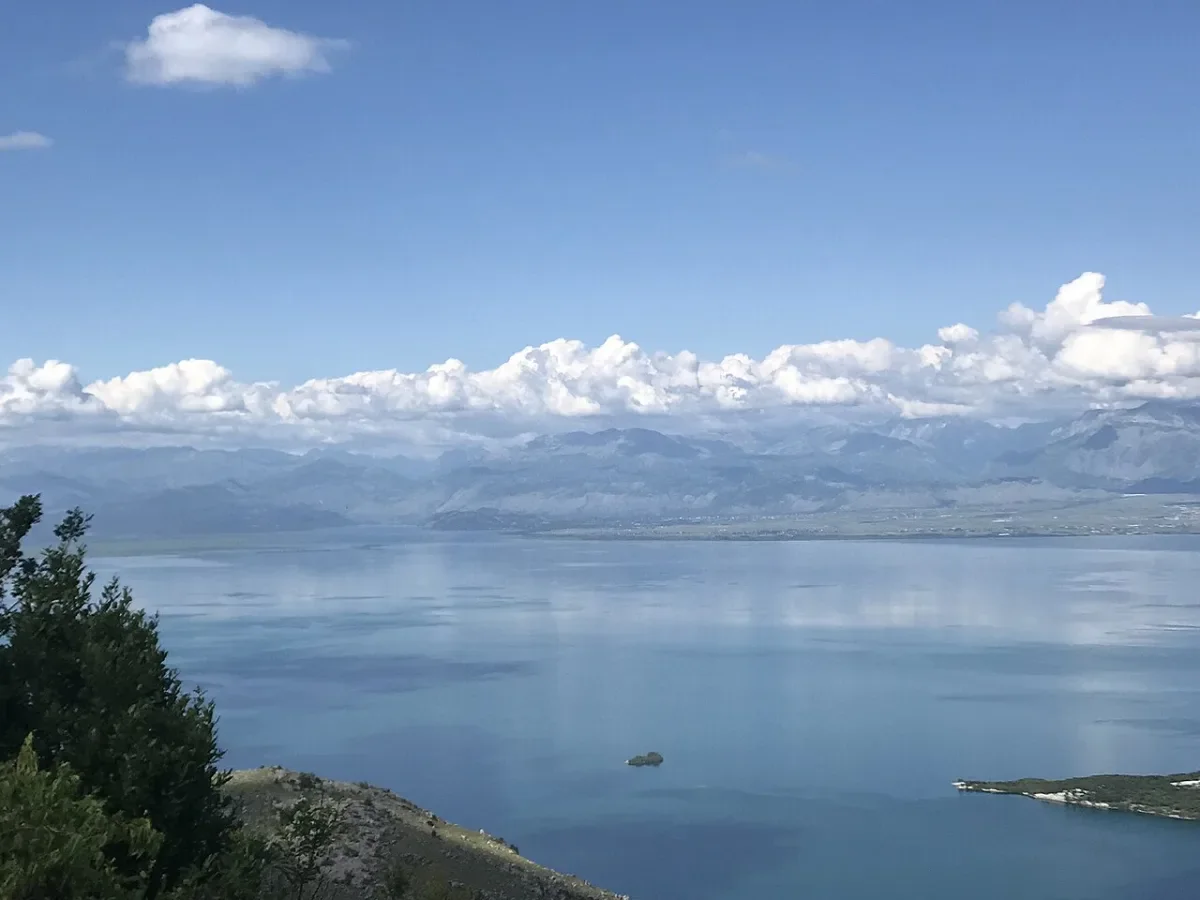
Lake Skadar brings a different breath: wetter, gentler, and wilder as well. It is an excellent choice for birdwatching, taking a boat trip, and enjoying a backdrop of reeds, calm water, and small villages. It is also one of the best examples of peaceful nature in Montenegro.
Cetinje, Lovćen and the Hinterland
Cetinje and Lovćen offer a more cultural and historical perspective of the country. Cetinje retains the imprint of the former royal capital, while Lovćen unfolds its mountain roads and panoramas over the sea, the bay, and the hinterland. It is the right detour to understand Montenegro beyond its coastal facade.
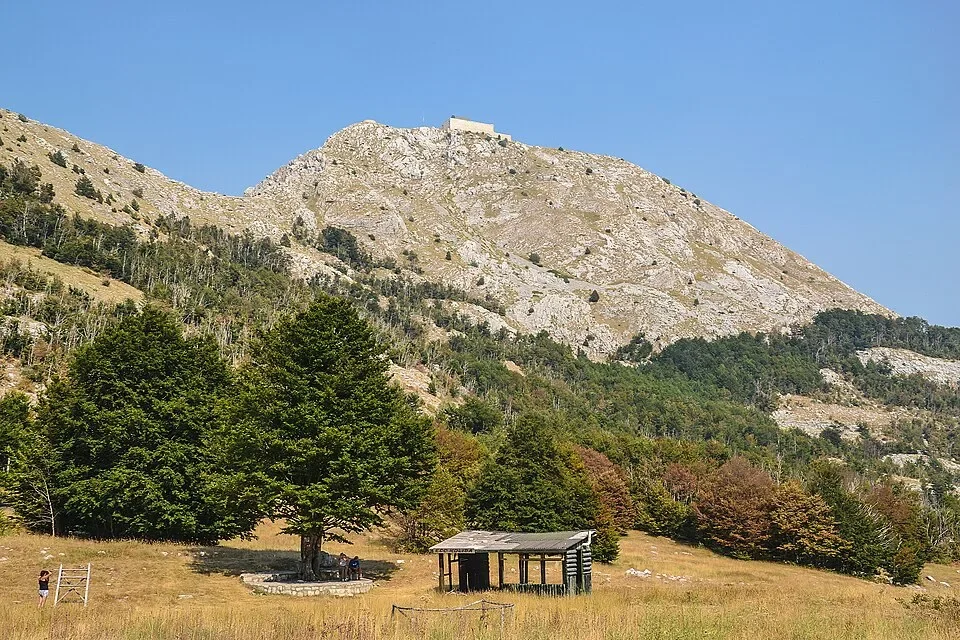
If you have an extra day, this hinterland block is often more worthwhile than a second day at the beach. You gain breath, altitude, and perspective. And frankly, the contrast with Budva or Kotor is exactly what makes a Montenegrin itinerary truly interesting.
The Ostrog Monastery
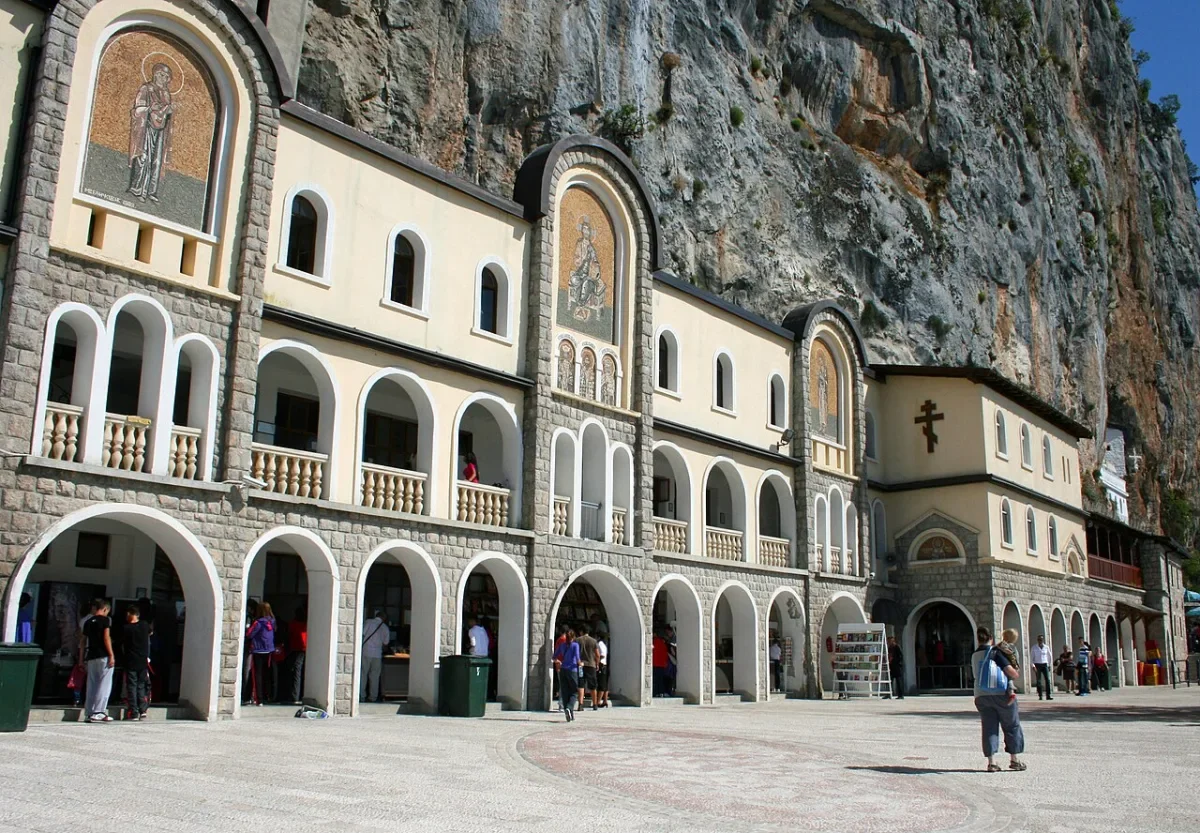
Ostrog is one of the most impressive places in the country, if only for its cliffside location. Even without being interested in religious monuments, one quickly understands why the site leaves a mark on travelers: there is something almost unreal about this architecture clinging to the rock.
Checklist of must-sees for a first discovery:
- Kotor and its ramparts
- Perast and its islets
- Budva for the coast and beaches
- Durmitor for the mountains
- Lake Skadar for nature
- Cetinje and Lovćen for heritage and panoramas
How to build a travel itinerary in Montenegro?
The right itinerary mainly depends on your length of stay and your willingness to drive. For a first trip, it is better to limit your bases to two or three anchor points: one coastal stop, one mountain stop, possibly a night around Lake Skadar. It is smoother, more realistic, and much more enjoyable.
| Duration | Recommended itinerary | Average driving time | Ideal profile |
|---|---|---|---|
| 3 days | Kotor, Perast, Budva | 30 to 60 min per transfer | First glimpse, long weekend |
| 7 days | Kotor, Budva, Durmitor, Skadar | 2 to 4 hours on major connections | Balanced sea + mountain trip |
| 10 days | Kotor, Budva, Cetinje, Lovćen, Skadar, Durmitor | 2 to 4.5 hours depending on the route | Complete and varied road trip |
3-day itinerary
Express version, but very effective: base yourself in Kotor, explore the old town and the viewpoints of the Boka Bay, then move on to Perast and Budva. Travel times remain short, but you have to accept not wanting to “do it all.” The real interest of this format is density, not quantity.
7-day itinerary
In one week, you can build a nice balance between coast and mountains. For example: 2 nights in Kotor, 2 nights in Budva or nearby, 2 nights in Žabljak for Durmitor, then one night near Lake Skadar or close to Cetinje. This is often the best format for a first trip to Montenegro.
10-Day Itinerary
With ten days, you can finally breathe. You can add Lovćen, Ostrog, more time at Skadar, and some longer breaks on the coast. The great advantage of this format is that it allows some flexibility for the weather, traffic, and spontaneous favorites. And in Montenegro, favorites come quickly.
What budget should you plan for a trip to Montenegro?
The budget remains reasonable on a European scale, but it varies greatly depending on the season and the area chosen. The coast explodes in summer, while the interior of the country maintains more flexible rates. The most sensitive expense is not always the meal: it is often accommodation, followed by car rental in high season.
| Profile | Accommodation / night | Meals / day | Transport | Total budget / day |
|---|---|---|---|---|
| Tight budget | €25 to €50 | €15 to €25 | Bus + walking | €50 to €90 |
| Comfort budget | €60 to €120 | €25 to €40 | Rental car | €110 to €190 |
| Premium budget | €150 and up | €40 to €80 | Car + private transfers | €220 and up |
What drives up the cost are mainly three things: the period, proximity to the sea, and the level of comfort requested. Well-located accommodation in Kotor or Budva in August will logically cost more than a guesthouse in the mountains or a room booked early in June. That’s why you should think “base” before thinking “room photo.”
Should you rent a car in Montenegro?
Yes, if you really want to explore the country without depending on bus schedules. A car becomes almost indispensable to connect the coast, Lovćen, Skadar, and Durmitor in a single loop. However, for a stay centered on Kotor or Budva, you can do without one if you accept staying very local.
Field note: the biggest trap is not the distance, it’s the traffic around Kotor and Budva in July-August. A 25-kilometer road can become a real little ordeal if you leave at the wrong time. The best reflex is to drive early in the morning, avoid beach arrival peaks, and book parking when possible.
- Advantages of the car: freedom, access to viewpoints, time savings outside big cities.
- Limitations: paid parking, heavy traffic on the coast, sometimes tiring mountain roads.
- Practical advice: always check insurance conditions and border crossing rules if your road trip extends into neighboring countries.
Where to stay in Montenegro?
The choice of base completely changes the experience. On the coast, you are closest to the beaches, restaurants, and the most famous sites. Inland, you gain calm, coolness, and often better value for money. The right accommodation is not necessarily the fanciest, it’s the one that fits your itinerary.
For a first stay, Kotor is an ultra convenient base, especially if you like walking tours. Budva is livelier and more seaside. Tivat works well if you arrive by plane and are looking for something simple. Žabljak serves very well as a base camp for Durmitor National Park. And around Lake Skadar, quieter addresses close to nature are preferred.
- Coast: Kotor for heritage, Budva for nightlife, Perast for charm, Tivat for logistics.
- Mountain: Žabljak for Durmitor, Cetinje for a more central starting point.
- Lake Skadar: villages and small guesthouses for a nature atmosphere.
Formalities, safety, and practical advice
Montenegro remains easy to organize, but you shouldn’t go in with a “it’ll be fine” attitude. Entry formalities depend on your nationality, road conditions can change with the season, and payment habits vary by area. In short: a little checking beforehand avoids wasting time on site.
Documents and entry into the territory
Depending on your nationality, a passport or identity card may be required, with rules that sometimes change. The best reflex is to check official information before booking or crossing a border. If you combine several Balkan countries, you also need to check the entry conditions for each, not just Montenegro.
Currency, Payments, and Language
The euro is used throughout the country, which frankly makes life easier. Bank cards are generally accepted in hotels, restaurants, and shops in tourist areas, but cash remains useful, especially in small villages, parking lots, certain buses, and family-run accommodations. As for language, English is often sufficient in tourism, but a few polite words are always appreciated.
Safety and Good Practices
The main point of caution concerns the road: curves, heavy traffic on certain coastal sections, and sometimes tight parking. In the mountains, you need to watch the weather, the level of equipment, and daylight hours. On natural sites, avoid underestimating distances, because a “short” trail or road on the map can take much more time in reality.
- Book early if you travel in July-August, especially on the coast.
- Allow extra time for driving and parking.
- Keep some cash for small expenses.
- Adapt your schedule to the weather, especially in the mountains.
- Check local traffic rules and park opening hours.
FAQ about Traveling to Montenegro
Is Montenegro expensive?
Not necessarily. The country remains affordable, especially outside the high season and away from the seaside. Prices mainly rise in Kotor and Budva in summer. With a guesthouse, simple meals, and well-planned travel, the budget can stay very reasonable for Europe.
Should you rent a car?
Yes, if you want to see several facets of the country in one trip. Without a car, you can visit a coastal base and a few nearby sites, but you will lose flexibility. For a road trip including Durmitor, Skadar, and Lovćen, renting becomes really useful.
How many days are needed to visit the country?
Three days are enough for a quick overview of Kotor and the coast. Seven days already offer a well-balanced itinerary. Ten days allow you to combine sea, mountains, villages, and nature without rushing. This is the most comfortable format for a serious first discovery.
Is Montenegro suitable for a first trip to the Balkans?
Yes, definitely. The country is compact, quite easy to understand, and very readable for a first trip to the region. It gives an excellent overview of the Balkans without multiplying borders or complex transfers. It’s a reassuring destination to start with.
Can you combine beach and hiking in the same trip?
Yes, and it is even one of the country’s great attractions. In a few days, you can go from swimming in Budva to hiking in Durmitor, then finish by the shore of Lake Skadar. All this, provided you build a coherent and realistic itinerary.
In the end, a trip to Montenegro is successful when you accept its true nature: a compact, contrasting country, sometimes very lively on the coast, sometimes almost silent in the mountains, but always rich in landscapes and little discoveries. The right balance is the one that leaves room for scenic routes, unexpected breaks, and villages you hadn’t necessarily planned to visit at first.