
Who can sign a mobility lease?
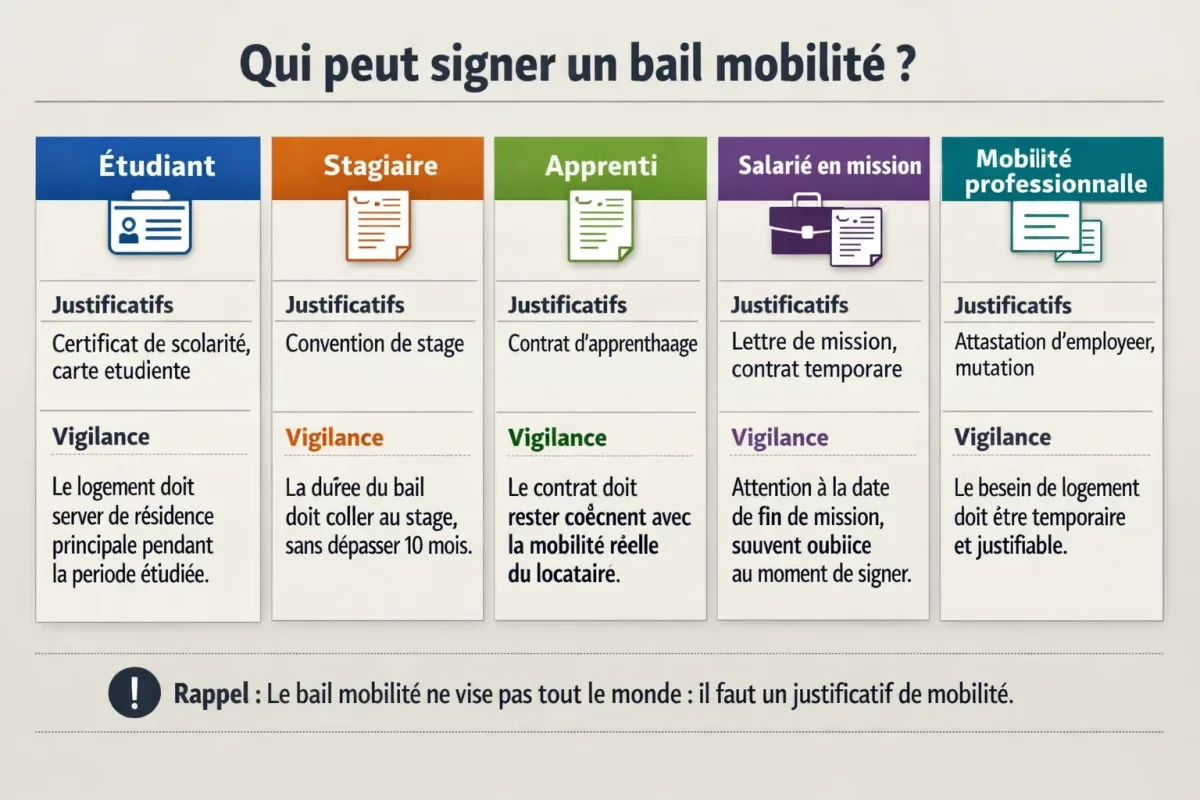
The mobility lease is not for everyone. It targets tenants who can justify a specific temporary situation. This is the key difference with a classic furnished rental: the contract is not open to all profiles, and the landlord must be able to verify eligibility before signing.
The most commonly concerned profiles are as follows:
- 🎓 Higher education students, including those on university exchange or academic mobility.
- 🧳 Interns, with an internship agreement as proof.
- 🛠️ Apprentices and alternates, when their presence in another city is temporary.
- 💼 Employees on temporary assignment, on business trips or temporary position changes.
- 🚀 People in professional training, in civic service or in mobility related to their activity.
In practice, the landlord can request proof: student card, internship agreement, apprenticeship contract, employer certificate, mission order, or equivalent document. This is not a decorative formality. It is the entry key to the system, and it is better to be strict from the start to avoid disputes later.
Eligibility Conditions Table
| Profile | Common proof | Point of caution |
| Student | Enrollment certificate, student card | The accommodation must serve as the main residence during the studied period. |
| Intern | Internship agreement | The lease duration must match the internship, not exceeding 10 months. |
| Apprentice | Apprenticeship contract | The contract must remain consistent with the tenant’s actual mobility. |
| Employee on assignment | Mission letter, temporary contract | Be careful about the mission end date, often forgotten at signing. |
| Professional mobility | Employer certificate, transfer | The housing need must be temporary and justifiable. |
What is the duration of a mobility lease?
The mobility lease duration is between 1 and 10 months. The contract is fixed-term, which means it automatically ends on the scheduled date. There is no automatic renewal as in classic furnished rentals, and this is precisely what makes it a very flexible tool for short stays.
The important point is that the duration must be consistent with the tenant’s situation. A 6-month internship? The mobility lease fits perfectly. A 3-month assignment? Same. However, if the occupancy is to last more than a year or if the need is not clearly temporary, another type of contract must be considered.
In some cases, an amendment can adjust the end date, provided the total legal limit of 10 months is not exceeded. But the central idea remains the same: no automatic renewal, no lease that automatically restarts for another year. This framework avoids grey areas and endless discussions.
- 📅 Minimum duration: 1 month.
- 📅 Maximum duration: 10 months.
- 🧾 End of contract: automatic at expiration.
- 🔁 Renewal: no tacit renewal.
How does a mobility lease contract work on a daily basis?
In practice, the mobility lease contract remains easy to manage, but it must be properly framed. The landlord cannot request a mobility lease security deposit, which eases entry into the accommodation. In return, rental security often relies on the quality of the application, good organization of documents, and, in some cases, on a guarantee such as Visale.
The rent is freely set, subject to local rent control rules if the accommodation is located in a concerned area. Charges are generally provided as a flat rate, which avoids lengthy adjustments and complicated calculations. In short: it is clearer for everyone, provided the clause is read to the end.
An inventory of fixtures at entry and exit is essential. Without it, things quickly become complicated: key return, damages, missing furniture, disagreement on charges… To top it off, a precise inventory of furniture protects both the landlord and the tenant. On a short lease, every detail counts.
Points to lock down in the contract
- 📌 the exact duration and end date;
- 📌 the tenant’s identity and proof of mobility;
- 📌 the amount of rent and charges;
- 📌 the inventory of furniture;
- 📌 the entry condition report;
- 📌 the terms for key return and leaving the accommodation.
Regarding rental guarantees, the Visale guarantee is often the simplest solution to implement when the file allows it. Depending on the case, a guarantor can also be considered, but the contract must remain consistent with the applicable legal framework. The real useful reflex? Check in black and white what is planned before signing, not after.
How to choose between a mobility lease and a classic furnished rental?
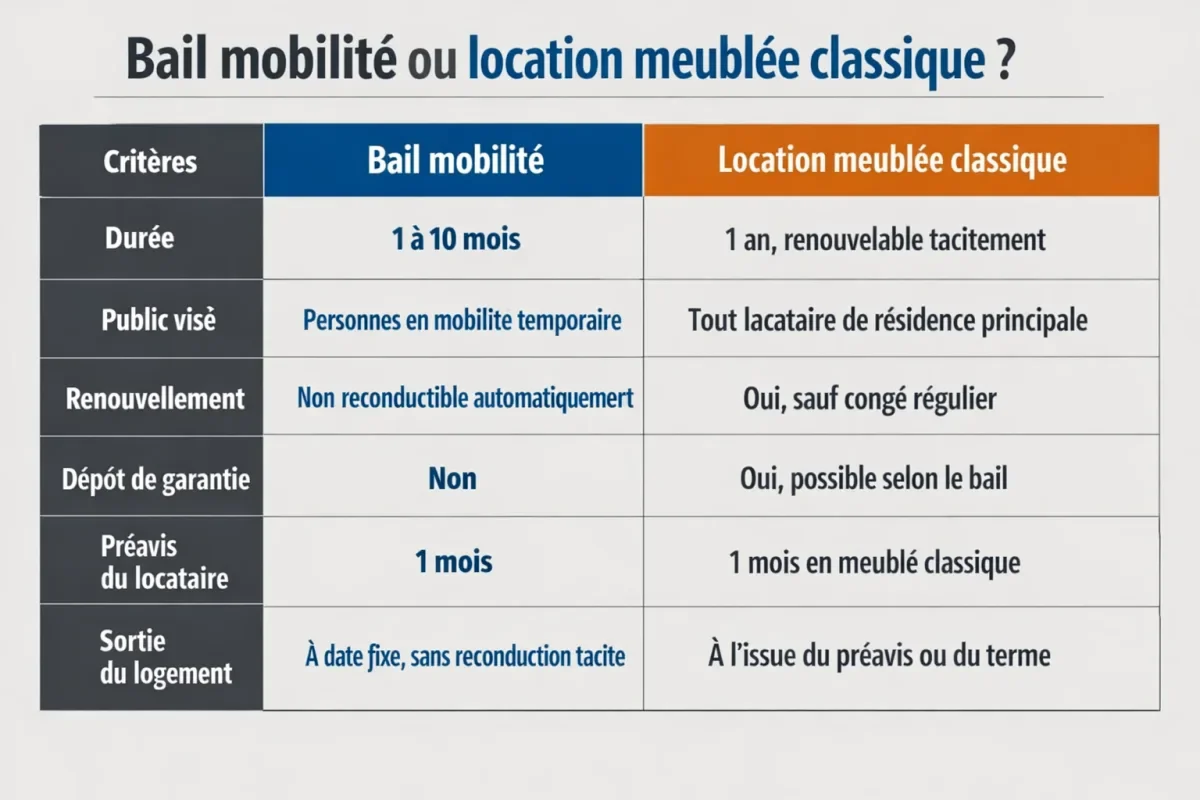
The right contract mainly depends on the length of stay and the level of stability sought. If the need is temporary and clearly dated, the furnished mobility lease is often the most suitable. If the tenant wants to settle long-term, the classic furnished rental is more logical, as it offers more comfortable continuity and a more standard framework.
The mobility lease is therefore ideal for a “tailor-made” stay, while the classic furnished rental is better suited for a longer-term installation. This is where the comparison becomes useful: it avoids signing a contract that is too short for a long need, or on the contrary too rigid for a temporary presence.
| Criterion | Mobility lease | Classic furnished rental |
| Duration | 1 to 10 months | 1 year, tacitly renewable |
| Target audience | People in temporary mobility | Any tenant of a main residence |
| Renewal | Not automatically renewable | Yes, unless regular notice |
| Security deposit | No | Yes, possible depending on the lease |
| Tenant’s notice period | 1 month | 1 month in classic furnished rental |
| Leaving the accommodation | At a fixed date, without tacit renewal | At the end of the notice period or term |
If you hesitate between the two, remember a simple rule: the mobility lease is meant to cover a temporary need, whereas the classic furnished rental is intended to house someone more permanently. Like a tailored suit, the mobility lease is very effective… but only for the right legal fit.
And what about the student lease in all this?
The student mobility lease is not a separate contract in the usual sense: it is simply the use of the mobility lease for a student. Not to be confused with the classic student lease, often concluded for 9 months. Here too, the nuance matters, because a student on an internship may fall under the mobility lease, whereas a student settled for the year may prefer a common law furnished lease.
In which cases is the mobility lease a good idea — and when to avoid it?
The mobility lease is relevant whenever there is a real short and known timeframe in advance. This is the case for a student on a 6-month internship, an apprentice sent to another city, or an employee on a temporary assignment. The contract simplifies access to housing and avoids overcommitting to a rental engagement.
On the other hand, it becomes less suitable when the need is vague, long, or likely to exceed 10 months. If the person wants to settle for several years, it is better to opt for a classic furnished rental. Otherwise, there is a risk of crafting a contract that does not fit the tenant’s actual project.
Concrete examples
- ✅ Student on a 6-month internship: the mobility lease is a natural solution.
- ✅ Employee on a 4-month assignment: practical, quick to set up, no security deposit.
- ✅ Apprentice changing region: very suitable if the mobility is temporary.
- ⚠️ Family looking to settle for 2 years: mobility lease unsuitable, better to choose a classic furnished lease.
- ⚠️ Project without a clear end date: risk of poor legal framing.
What are the advantages and limitations of the mobility lease?
For the tenant, the big advantage is obvious: flexibility. You enter the housing without excessive blockage, without a security deposit, with a clear contract and a known end date. For a mobile profile, it is frankly comfortable. It avoids the burden of a long-term rental when you already know you will not stay.
For the landlord, the interest is twofold: the housing can be offered to a solvent and temporary audience, and the contract allows securing the duration of occupation. On the other hand, one must accept a faster turnover, precise formalism, and rigorous management of entries and exits. The mobility lease is not a “small quiet lease”: it is a technical lease, but very effective if well drafted.
- 👍 Tenant advantages: speed, flexibility, reduced entry cost.
- 👍 Landlord advantages: framed temporary occupation, reduced vacancy, adapted target.
- 👀 Limitations: no tacit renewal, restricted audience, vigilance on supporting documents.
- 🧩 Sensitive point: the contract drafting must be clean, otherwise disputes arise quickly.
What to check before signing
Before validating a mobility lease contract, a simple but serious check must be done. Official texts, notably those relayed by Service-Public, ANIL and Legifrance, remind that the housing must be furnished, decent and suitable for temporary occupation. The paperwork must tell the same story as the reality of the housing, otherwise it gets stuck.
Tenant checklist
- 📄 mobility proof ready to be submitted;
- 🏠 furnished housing with complete furniture;
- 📆 start and end dates consistent with the assignment or studies;
- 💡 clearly written charges and rent;
- 🔑 inventory of fixtures planned at entry and exit;
- 🛡️ identified guarantee solution if the landlord requests one.
Landlord checklist
- 🧾 verify that the tenant fits one of the authorized profiles;
- 🪑 check the list of mandatory furniture;
- ✍️ draft a lease with a duration compliant with the legal framework;
- 🚫 do not provide for a security deposit;
- 📌 specify charges and inventory;
- 📷 keep proof of the housing condition at departure.
FAQ on the mobility lease
Can you leave a mobility lease before the end?
Yes. The tenant can leave at any time with one month’s notice. The contract does not require staying until the last day if the situation changes.
Is the mobility lease renewable?
Not by tacit renewal. It can possibly be adjusted by an amendment within the maximum limit of 10 months, but it does not automatically restart.
Can a security deposit be requested?
No, the security deposit is excluded. This is one of the major differences with the classic furnished rental.
Is a Visale guarantee mandatory?
No, but it is often used to reassure the landlord. Depending on the file, other guarantees may be provided, provided the contract framework is respected.
What is the difference with a one-year furnished lease?
The classic furnished lease usually lasts one year and is tacitly renewed. The mobility lease, on the other hand, is temporary, limited to 10 months, and reserved for certain profiles.
How to know if a tenant is eligible?
You need to verify their status and request proof: internship, studies, apprenticeship, temporary assignment, professional mobility, or civic service depending on the situation.
Can the mobility lease be suitable for a shared rental?
Yes, but a properly drafted contract is necessary, especially regarding the distribution of charges, responsibilities, and leaving the accommodation. This is a case to be handled precisely, not hastily.