
Camping Leader in France: What Major Brands Reveal About the Real Balance of Power
The keyword leader camping France seems simple, but the outdoor hospitality sector cannot be boxed into a single category. Depending on whether you look at the number of campsites, accommodation capacity, commercial strength, or brand image, the top of the ranking quickly changes face.
And this is precisely where the topic becomes interesting: the camping brands in France do not all move forward with the same model. Some win by volume, others by upgrading, and others still by their presence in booking engines. In short, there are leaders in presence, leaders in value, and leaders in image.
Sommaire
In brief
🔎 There is no single champion: leadership depends on the chosen criterion.
🏕️ Camping chains structure a still very fragmented market.
📈 Premium camping weighs increasingly in the brand hierarchy.
🧭 The real balance of power opposes camping networks that are easy to read against a crowd of independents.
Who is the real leader in camping in France?
There is no single leader in camping in France. Flower Campings stands out in number of sites, Yelloh! Village is very strong in capacity, Capfun scores points with its own park, and Sandaya is gaining ground in the premium segment. The “leader” therefore depends on the thermometer chosen.
In outdoor hospitality, camping is no longer just about bare pitches and tents. Large networks now sell a broader promise: standardized welcome, online booking, family services, entertainment, fully equipped accommodations, and a more consistent experience from one site to another. It is this shift that disrupts the ranking.
In other words, talking about the leader camping France without specifying the criterion is like comparing apples, pears, and mobile homes. One brand may dominate the number of sites, another the accommodation capacity, a third the marketing power. That is why it is necessary to first define what is being measured before naming a winner.
How to truly measure a leader in camping in France?
To compare camping brands in France without error, at least four criteria must be crossed: territorial coverage, capacity, park integration, and notoriety. On paper, it is more tedious than a simple ranking. But it is the only way to avoid conclusions that are too quick and often misleading.
- Number of campsites: measures the network’s size and visibility.
- Number of pitches: indicates the real capacity to host and sell.
- Level of range: distinguishes a mass player from a premium player.
- Economic model: owned park, franchise, partners, hybrid mix.
- Digital presence: referencing, direct booking, brand clarity.
This last point is often underestimated. Yet, in the French camping market, online booking acts as a concentration accelerator. A clear, well-identified, and well-referenced brand more easily captures demand than a poorly distributed independent site. The field confirms it: the battle is also played in search results, not just on holiday roads.
On the ground, a campsite manager on the Atlantic coast notices that families no longer book “blindly.” They compare two or three brands, look at the hospitality promise, then decide based on the pool, the kids’ club, and the type of accommodation. This shift favors networks capable of offering a consistent experience.
The true leader is not the one with the most sites, but the one who turns each stay into repeatable value.
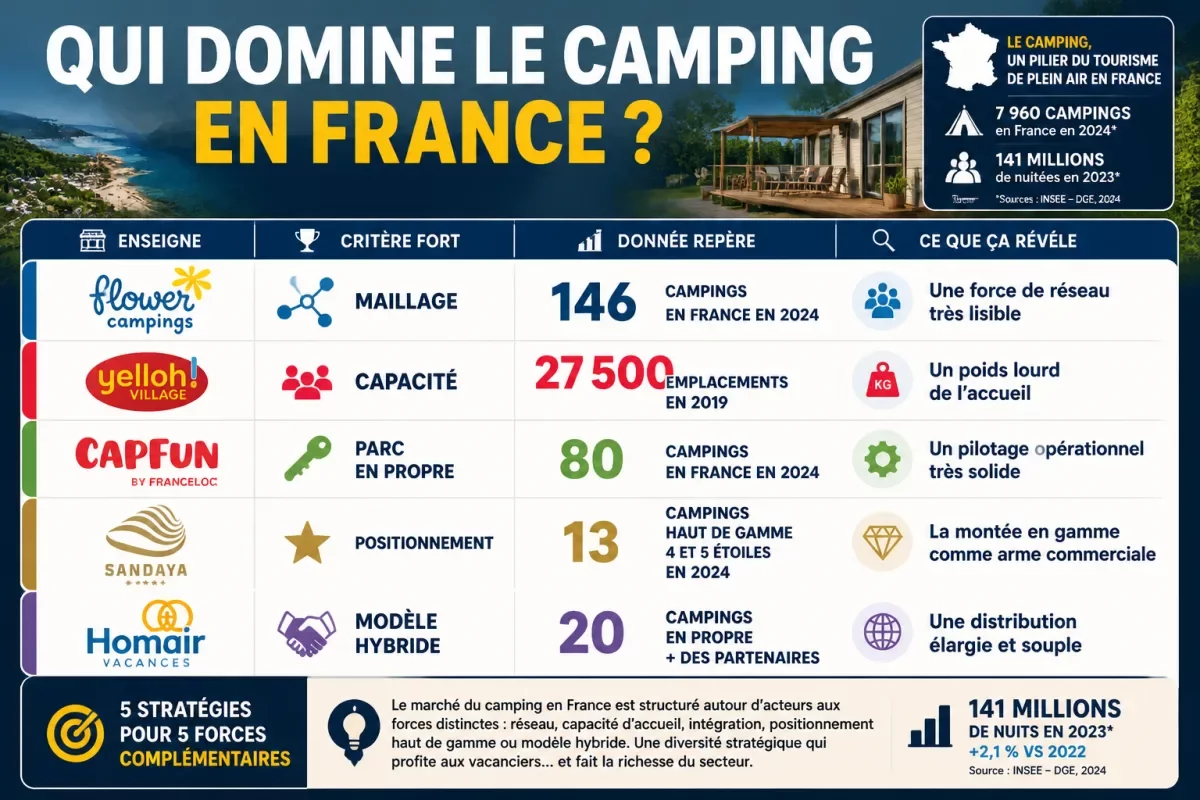
| Brand | Strong criterion | Reference data | What it reveals |
|---|---|---|---|
| Flower Campings | Network coverage | 146 campsites in France in 2024 | A very clear network strength |
| Yelloh! Village | Capacity | 27,500 pitches in 2019 | A heavyweight in hospitality |
| Capfun | Owned parks | 80 campsites in France in 2024 | A very solid operational management |
| Sandaya | Positioning | 13 high-end 4 and 5-star campsites in 2024 | Upgrading as a commercial weapon |
| Homair Vacances | Hybrid model | 20 owned campsites + partners | A broad and flexible distribution |
The table clearly shows the trap: you don’t “win” the French camping market with a single indicator. Flower appears very strong in network coverage, Yelloh! Village impresses with capacity, Capfun with park control, Sandaya with upgrading. Leadership here is a multi-faceted issue.
Capfun, Flower, Yelloh! Village, Sandaya: who really counts?
When it comes to volume, Flower Campings has serious arguments: the network claims 146 campsites in France in 2024 and a very visible presence for holidaymakers. When it comes to capacity, Yelloh! Village remains a giant with 27,500 pitches in 2019. When it comes to integration, Capfun stands out with 80 owned campsites in 2024.
Capfun, the strength of owned parks
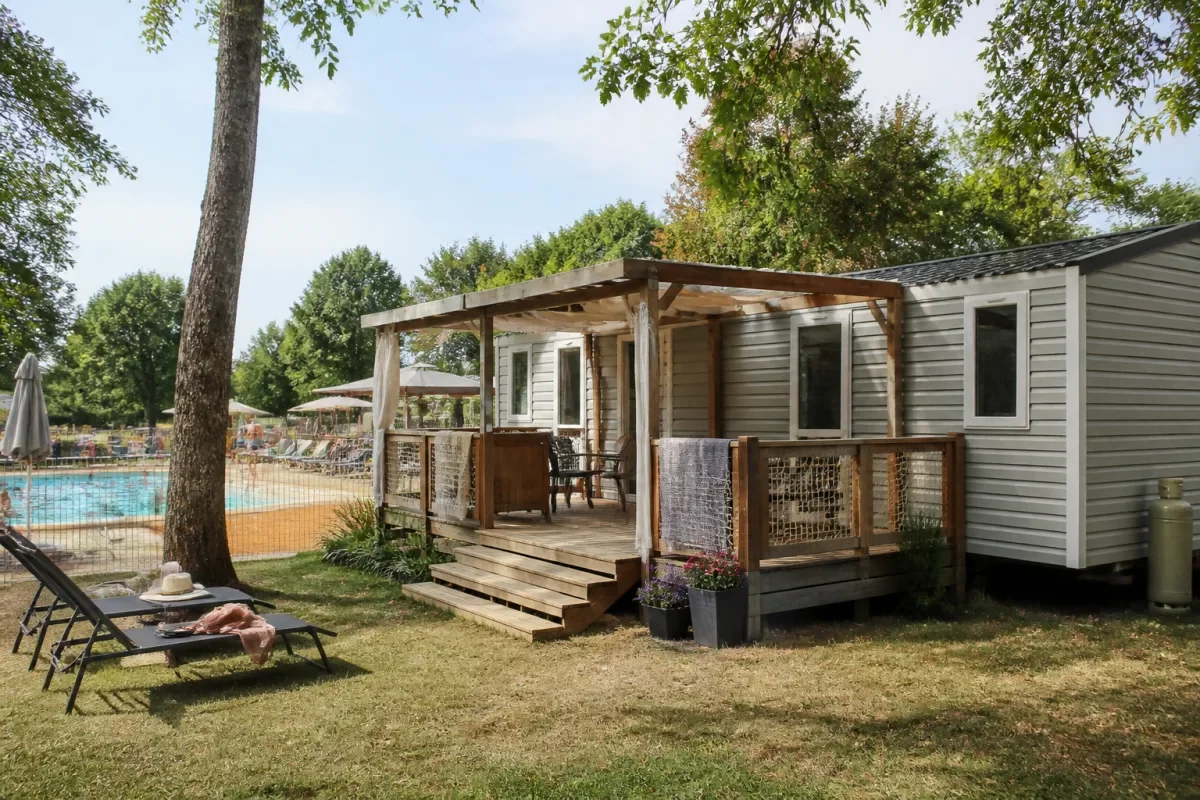
Capfun clearly illustrates a very French market logic: controlling operations, standardizing the offer, and pushing a clear family identity. This model has a huge advantage because it allows fine control over the customer experience. In return, it requires constant operational discipline. In a sector where online ratings count almost as much as location, this is no small detail.
Flower Campings, the strength of network coverage
Flower Campings plays another card: a very dense, visible, and reassuring web. The network celebrates its 20th anniversary in 2024 and features 3, 4, and 5-star campsites, allowing it to appeal to several profiles of holidaymakers. Its strategic interest is clarity: when a brand becomes familiar, it reduces friction at purchase.
Yelloh! Village, the premium family reference
Yelloh! Village remains one of the strongest names when it comes to premium family experience. In 2019, the network housed 27,500 pitches, making it a major player by capacity. Its real strength lies in a dual promise: high comfort and a sufficiently consistent image to reassure even before arrival on site.
This range logic also explains why some brands become “desirable” even though they are not necessarily the most numerous. To see how this upgrading translates into holidaymakers’ choices, one can also look at these 10 scenic addresses: they clearly illustrate the shift of camping towards an almost hotel-like experience.
Sandaya, the rise of the premium segment
Sandaya is pushing hard in the high-end segment. In 2024, the brand has 13 four and five-star campsites in France. It is less a mass model than a desirability model: the goal is not just to fill up, but to attract customers willing to pay for more comfort, more services, and more consistency.
On the ground, it is observed that holidaymakers no longer just talk about “camping,” but about “level of service.” An agent based in a coastal area explains that families now make choices between several premium brands as they would between chain hotels: swimming pool, dining, kids’ club, quality of accommodations.
French camping is no longer just a market for pitches; it is a market of brands, services, and perception.
Homair follows a more hybrid logic, with 20 campsites owned and partners, which gives it commercial flexibility. Siblu, meanwhile, remains a very visible name for families, even if its strength is more evident in specialization than in the sheer number of sites. In any case, the real challenge is not to be everywhere, but to be credible where demand is strongest.
Has premium camping reshuffled the cards?
Yes, clearly. Premium camping has transformed the sector’s hierarchy because it shifts the value from just the overnight stay to the overall experience. When the holidaymaker looks for a well-equipped mobile home, a water park, or entertainment designed for children, the brand becomes more important than just the pitch. And the big brands understood this very early on.
France welcomed 102 million foreign visitors in 2025 and generated €77.5 billion in tourism revenue. In this context, premium camping benefits from an obvious momentum effect: the most demanded destinations remain the most touristic, and networks capable of standardizing comfort better capture this clientele.
- Comfort becomes a frontline argument.
- Average spend rises with fully equipped accommodations.
- Loyalty relies more on the brand than on chance.
- Direct booking favors well-known brands.
The balance of power thus shifts less towards a monopoly and more towards natural selection. Brands that reassure, simplify, and move upmarket take the lead. Others remain locally visible but struggle more to impose a national narrative.
Where are the most powerful networks concentrated?
The French camping market is highly concentrated in the South, which is no coincidence. Coastal areas and highly touristic regions offer both demand, longer stays, and clientele more sensitive to brands. In 2019, Occitanie had 213 chain and group campsites, ahead of Nouvelle-Aquitaine with 207.
This geography also explains why leadership is never totally abstract. A brand can dominate the national reading without being the strongest everywhere. In the Alps, on the Mediterranean, or on the Atlantic coast, balances change quickly. The network that dominates a high-demand area is not always the one with the nicest logo, but the one with the best alignment between location, range, and distribution.
Why isn’t the market just about the number of sites?
Because a network can have fewer addresses but more value per stay. This is even one of the sector’s main drivers: capacity, moving upmarket, and occupancy rate often weigh more than just the total number of campsites. In other words, a “smaller” player can appear economically more powerful than a larger but less profitable network.
The message is simple: the camping battle is no longer just a battle of coverage, it is a battle of value. Independents are not disappearing, far from it. But chains and groups are increasingly organizing the visible part of the market, the one that vacationers compare, book, and recommend. That is why the term leader camping France must always be specified before being asserted.
So, who can really be called a leader?
If we talk about networks, Flower Campings is among the most powerful. If we talk about capacity, Yelloh! Village remains a heavyweight. If we talk about operational mastery, Capfun makes a strong impact. If we talk about a premium image, Sandaya and Yelloh! Village are very well positioned. The true champion is therefore not unique: it depends on the angle of analysis.
The correct interpretation is this: the French camping market is not dominated by a single name, but by several coexisting logics of domination. Some rely on volume, others on comfort, and others still on the brand. And it is precisely this mix that makes the sector lively, but also much more strategic than it seems.
To remember
- 🔹 The leader camping France changes depending on the chosen criterion.
- 🔹 Flower, Yelloh! Village, Capfun, and Sandaya do not dominate in the same way.
- 🔹 Premium camping enhances brand image and accommodation capacity.
- 🔹 The market remains fragmented, but economic concentration is progressing.
- 🔹 The South of France concentrates a major share of the most powerful networks.
FAQ
What is the largest camping group in France?
There is no single answer because it all depends on the criterion. In terms of number of campsites, Flower Campings stands out very high with 146 sites in France in 2024. In capacity, Yelloh! Village already had 27,500 pitches in 2019. And in owned parks, Capfun counts 80 campsites in 2024.
Is Capfun the leader of camping in France?
Capfun is a major player, but not necessarily the absolute leader on all fronts. It mainly weighs in through its owned parks and its integrated management logic. However, if leadership is measured by network size or total capacity, other brands may come ahead.
Why is Yelloh! Village often perceived as premium?
Because the brand associates a high-end family image, numerous pitches, and a very clear promise of comfort. The network had 27,500 pitches in 2019, which gives it real commercial weight. Its strength is the coherence between the message and the on-site experience.
Do independents still have their place against large brands?
Yes, definitely. In 2019, campsites affiliated with chains and groups represented only 13% of French campsites, which means independents remain very numerous. They often hold on thanks to a strong location, a marked local identity, or a very well-calibrated quality-price ratio.
Does premium camping really change the market hierarchy?
Yes, because it encourages vacationers to compare brands as much as destinations. When comfort, services, and accommodation weigh more, brands capable of industrializing quality take the advantage. It is a fundamental evolution, not just a fad.
Reference sources: the barometer of camping chains and groups published by OT Campings, the official presentation of Flower Campings, and the brand page of Toocamp.