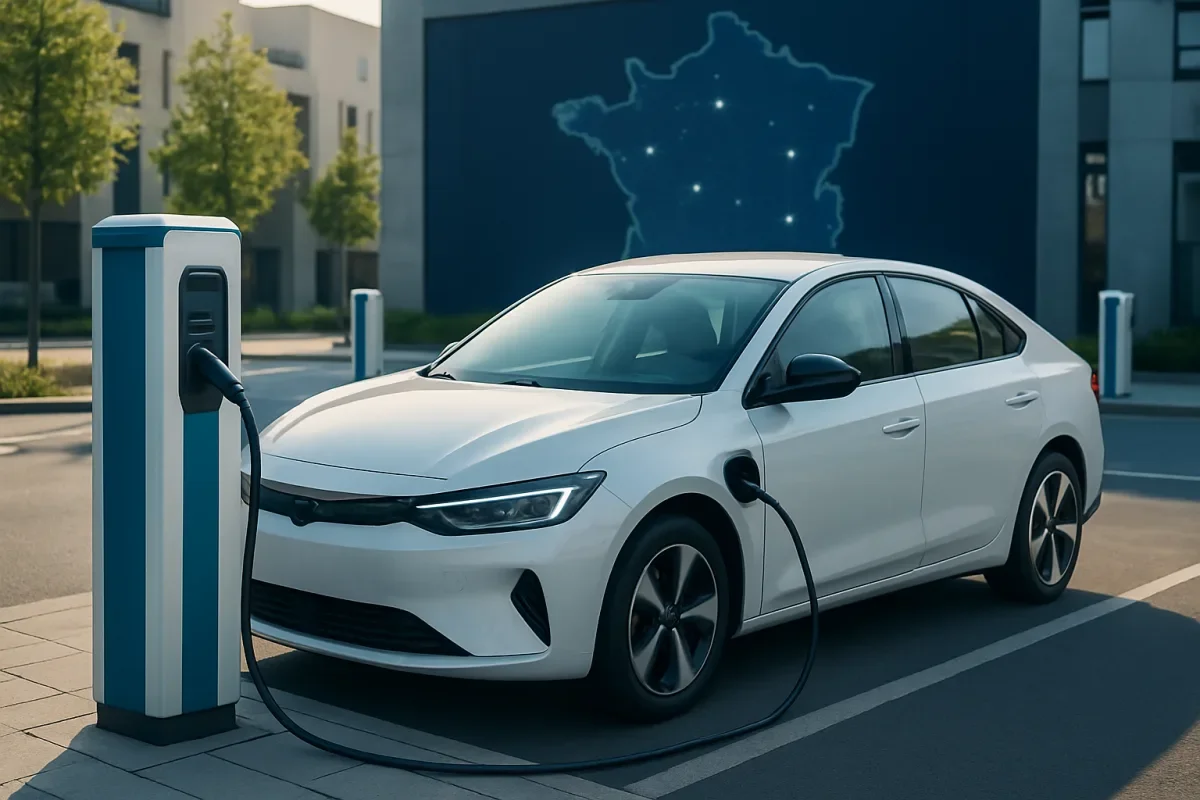
Why look for free charging stations?
Free charging mainly helps reduce the cost of daily trips without disrupting your habits. It is particularly useful for short stops, errands, urban appointments, and occasional trips. However, free access has a downside: it is rarely unlimited and almost never without conditions.
Reduce your mobility budget
For paid public charging, the price per kWh often varies enough to make a difference on a partial charge. As a rough estimate, 20 kWh billed at €0.39 per kWh already amounts to €7.80. With free charging, the savings are immediate, especially if you often recharge small amounts.
- For short trips: free charging complements well home or work charging.
- For long trips: it helps lower the cost of an intermediate stop.
- For urban drivers: it sometimes offsets parking that is already necessary.
Gain in convenience
Free charging is interesting when it fits into an existing activity. Charging during errands, lunch, or a visit avoids turning charging into an autonomous constraint. This is also why hybrid places — shops, hotels, town halls, public parking — dominate searches for free stations by city.
Where to find free charging stations in France?
The most common locations are where the station serves as an attraction tool or an additional service. Supermarkets, public parking lots, some hotels, and several local authorities still offer free charging points, but free access almost always depends on a simple rule: purchase, park, stay overnight on site, or limit charging time.
Supermarkets and shopping centers
This is the first reflex to have, as these sites use charging as a loyalty lever. Free access may be total for a given duration, reserved for customers, or conditioned on a receipt. Stations are often AC, sometimes 7.4 kW or 11 kW, which suits a 30 to 120-minute errand.
Public parking lots, town halls and park-and-ride lots
Local authorities still maintain free charging stations in some municipal parking lots, near town halls, or in park-and-ride lots. The logic is more urban than commercial: to support short-term parking and encourage visits to the center. Here, the free use may depend on a disc, a time slot, or a local badge.
Hotels, residences and tourist accommodations
Hotels are a good option for charging without paying, especially when the station is included in the stay. Free use is not automatic: it may be reserved for guests, charged per night, or managed by a reception. This is a very practical solution when traveling, as it turns the overnight stay into a long charging window.
Downtown, visits and tourist areas
In downtown areas, free charging stations are often designed to promote vehicle turnover. They can be found near an office, a central square, or a public parking lot. The duration is sometimes short, but sufficient to visit a museum, have lunch, or do some shopping. It is an excellent option for a top-up charge.
Dealerships, business zones and work sites
Car dealerships, some companies open to the public, and some business zones still offer free charging, at least for visitors. These points are convenient if you have an appointment, are doing a test drive, or need to wait on site. The weak point remains availability: it depends on opening hours and access control.
- Supermarkets: useful during shopping, but often time-limited.
- Town halls and public parking lots: interesting for downtown and short trips.
- Hotels: very relevant for overnight charging.
- Dealerships and companies: occasional good deals, but stricter hours.
How to use a map of free charging stations?
A good interactive map helps filter quickly, not just display points on a map. You need to search by city, department or region, then restrict results to free stations, by plug type and power. The goal is to find a point truly compatible with your car, your cable, and your schedule.
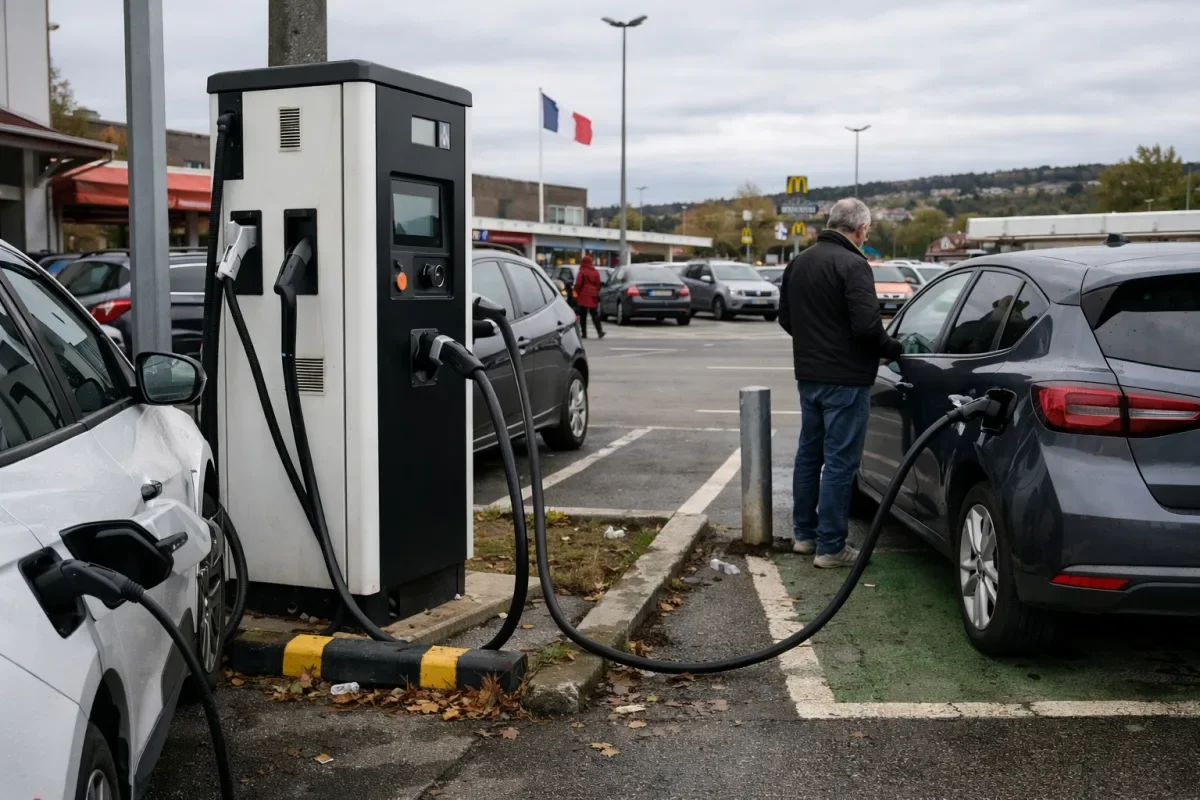
Useful filters to activate as a priority
- Location: city, department or region to target free stations by city.
- Type of place: supermarket, public parking, hotel, dealership, shopping center.
- Power: 3.7 kW, 7.4 kW, 11 kW, 22 kW or more.
- Connector: mainly Type 2 AC plug, sometimes CCS or CHAdeMO DC.
- Conditions: fully free, conditional on purchase, badge, with or without free parking.
The simple method to avoid mistakes
- Read the charging point sheet and look for mention of free use.
- Check if the parking is paid even if the electricity is not.
- Check the hours: a free station closed at 7 p.m. is not very helpful.
- Look at recent reviews to spot out-of-service or saturated stations.
- Call the site reception if needed, especially for a hotel, town hall or dealership.
On the ground, the best results often come from a search by intended use: “charge during shopping,” “charge during lunch,” “free parking with station.” This logic is more effective than simply hunting for the closest station, because it also takes into account the actual duration of your stop.
How to know if a station is really free?
The answer lies in a reflex: distinguish the price of energy from the total cost of the stop. A station may be free to use but located in a paid parking lot, free for only 30 minutes, or reserved for customers. So you need to check pricing, parking, and any service fees before plugging in.
The Most Common Pitfalls
- Free duration too short: the charging station is free, but the session ends quickly.
- Purchase condition: electricity is offered only if you consume on site.
- Hidden fees: parking, overtime, activation or paid badge.
- Misleading availability: the station exists, but it is out of service or occupied.
- Free access reserved: for customers, residents, subscribers or guests only.
Good Practices Before Leaving
- Read the sign at the parking entrance or near the station.
- Compare the card sheet with the information displayed on site.
- Plan an alternative 10 or 15 minutes away if the station is already taken.
- Do not confuse free charging with free parking.
In practice, the best verification remains the accumulation of three matching signals: an up-to-date sheet, a recent notice, and a clearly displayed rule on site. If one of these elements is missing, the free access should be considered uncertain, even if the station appears available on the map.
Power, Compatibility and Charging Time: What to Check
A free charging station is only useful if it matches your vehicle. The power in kW, the type of plug, and the maximum power accepted by the car determine the actual charging time. A station more powerful than your car does not speed up everything: it is the charging curve and AC or DC that set the final pace.
Understanding the Main Charging Speeds
- Slow charging: around 3.7 kW, useful for several hours of parking.
- Accelerated charging: often 7.4 kW, 11 kW or 22 kW AC, suitable for errands or visits.
- Fast charging: in DC, it can recharge much faster, but free access is rarer.
By way of example, a 7.4 kW station can recover about 20 to 25 km of range per hour depending on the vehicle, temperature, and battery condition. At 11 kW, charging is faster, but only if the car accepts this power. Beyond that, the charging curve often slows down as the battery fills up.
Compatibility: The Three Points to Check
- The connector: Type 2 for AC, CCS for fast charging on many recent models.
- The cable: some stations require your own Type 2 cable.
- The vehicle’s max power: no need to aim for 22 kW if your car caps at 7.4 kW.
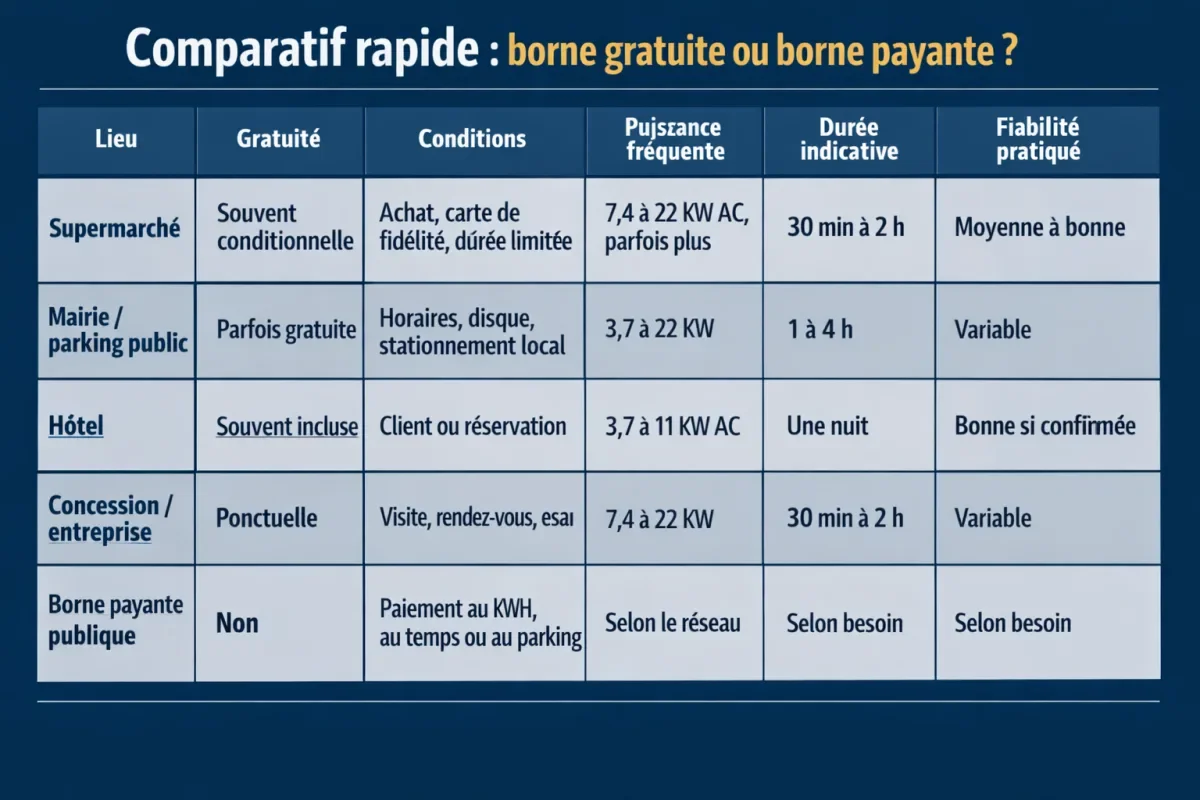
Quick Comparison: Free Station or Paid Station?
The free station is often slower, more local, and more conditional than a paid station. The paid station, on the other hand, is easier to plan, more available on certain routes, and faster on DC networks. The right choice therefore depends on the context: daily commute, urban visit, hotel overnight stay, or impromptu stop.
| Location | Free Access | Conditions | Common Power | Indicative Duration | Practical Reliability |
|---|---|---|---|---|---|
| Supermarket | Often conditional | Purchase, loyalty card, limited duration | 7.4 to 22 kW AC, sometimes more | 30 min to 2 h | Average to good |
| Town hall / public parking | Sometimes free | Hours, parking disc, local parking | 3.7 to 22 kW | 1 to 4 h | Variable |
| Hotel | Often included | Customer or reservation | 3.7 to 11 kW AC | One night | Good if confirmed |
| Dealer / company | Occasional | Visit, appointment, test drive | 7.4 to 22 kW | 30 min to 2 h | Variable |
| Public paid station | No | Payment per kWh, time or parking | Depends on the network | As needed | Often simpler |
What are the best habits for charging easily without paying?
The most effective is to recharge when you had already planned to stop. Shopping, having lunch, visiting a city center, or staying at a hotel turns charging into a secondary service. This logic reduces cost, stress, and time lost searching for a spot or an available charger.
- Plan breaks around shops and public parking lots.
- Keep a plan B nearby in case the charger is occupied.
- Check the hours before an evening or Sunday departure.
- Avoid “forced” charging if free charging requires too long a detour.
- Compare the real cost: free electricity does not always mean zero cost.
FAQ about free charging stations
Where can I find a free charger near me?
Start by filtering a charging map by city or department, then activate the free option. Then target supermarkets, public parking lots, hotels, and dealerships. On-site verification remains essential, as free charging can change depending on the time, day, or site policy.
Do I need a badge or an app?
Sometimes yes, even when charging is free. Some sites use a badge to activate the charger, track the duration, or limit access to customers. Other chargers are simply self-service. The safest is to check the listing before leaving and prepare the requested payment method or ID.
Is free charging really without fees?
Not always. Electricity may be free but parking may still be charged, or the stop may be time-limited. Some chargers also impose activation fees or purchase conditions. To talk about charging without paying, you have to look at the total stop cost, not just the price per kWh.
Can you charge for free on the highway?
It is very rare. On highways, chargers are generally paid and designed for speed. Free charging mainly exists off the main route: hotels, shopping centers, town halls, public parking lots, or dealerships. If your trip goes via the highway, it’s better to consider free charging as an occasional opportunity, not as a main strategy.
How long does it take to charge without paying?
It all depends on the available power, the cable, and the vehicle. At 3.7 kW, it often takes several hours. At 7.4 kW or 11 kW, a shopping or lunch break may be enough to regain useful range. With fast charging, the gain is greater, but free charging is less common there.
Are free chargers compatible with all vehicles?
No. Compatibility depends on the connector, the cable, and the power accepted by your car. Many free AC chargers use the Type 2 plug, but some vehicles need a specific cable or only accept limited power. So you need to check the technical sheet before relying on a charging session.