Understanding automotive LPG before searching for a station
LPG fuel, often called LPGc in technical sheets, refers to a mixture of liquefied petroleum gas used as automotive fuel. It is mainly intended for vehicles equipped with a dedicated or dual-fuel tank. Its benefit is simple: a cost per kilometer often more stable than gasoline and a distribution still well present on major routes.
What is LPG fuel?
In an LPG station car, the gas is stored in a reinforced tank and injected into the engine via an adapted system. Refueling is done with a specific nozzle, and automatic shut-off occurs when the allowable level is reached. It is a fossil fuel, but it remains appreciated for daily use and its refueling flexibility when the station is well chosen.
Why choose LPG for travel?
The first advantage is practical: for many drivers, automotive LPG in France allows driving at lower cost on regular trips, especially in urban outskirts. The other benefit is logistical: historical networks maintain stations in cities, on ring roads and on certain motorways, which facilitates long trips if the route is planned.
Where to find LPG stations in France?
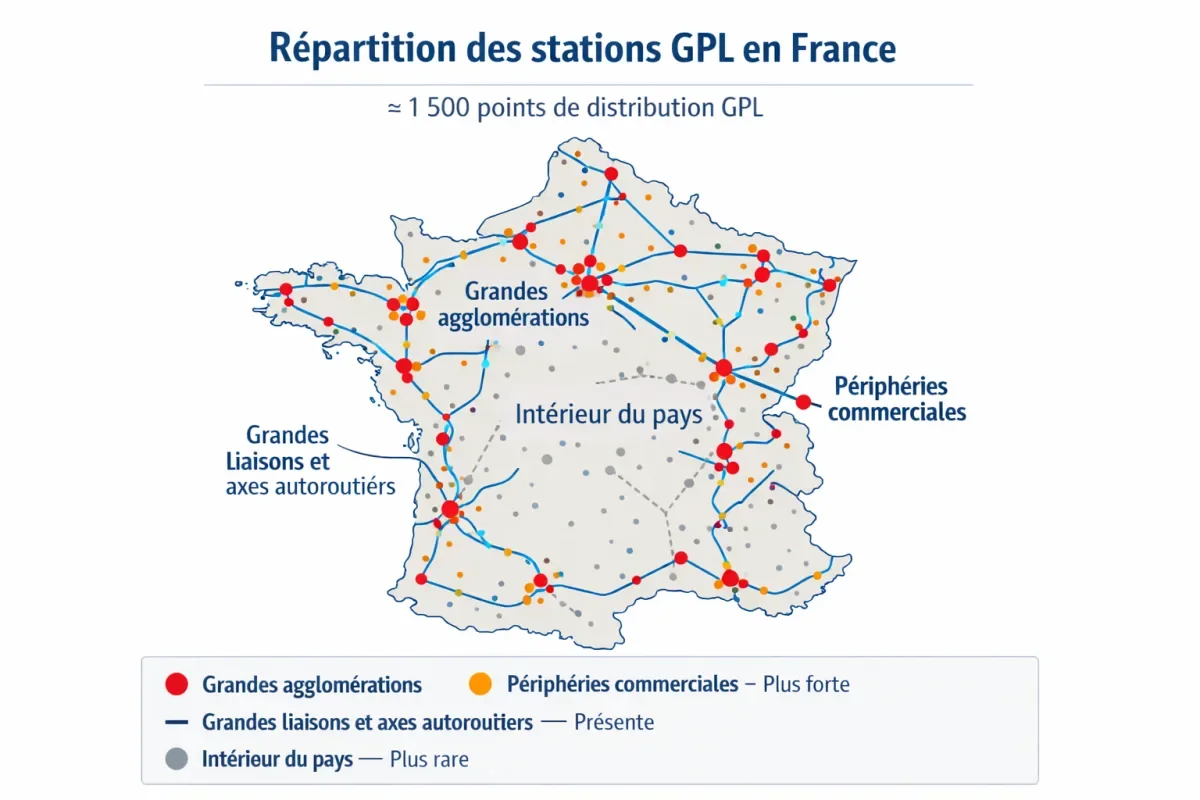
Coverage is not uniform. LPG stations in France are easier to find in large urban areas, commercial outskirts and along certain motorway corridors. In rural areas, the supply becomes scarce, making searching by department and road axis much more useful than a simple national search.
Distribution of stations by regions and major urban areas
Without fixing figures that change from one directory to another, a useful order of magnitude can be retained: specialized surveys mention about 1,500 LPG distribution points in France, with a higher density around metropolises, commercial outskirts and major connections. Conversely, some inland areas require more anticipation.
Stations in downtown, suburbs, and on highways
In downtown areas, access is often easier for daily use, but hours may be more limited. In the suburbs, stations are frequently less busy and sometimes better priced. On highways, the logic is different: you often pay for convenience, but you secure a long trip without leaving the main route.
How to check if a station is open and supplied
The best map does not replace a last-minute check. A LPG station open 24/7 may not be continuously supplied, and some pumps are temporarily disabled for maintenance. Before making a significant detour, you should cross-check the posted hours, the pump status, and, if possible, call the station if there is any doubt.
How to use the map to locate the nearest station?
A good LPG France map should allow you to find the nearest LPG station to me in a few seconds, then compare the results based on concrete criteria. The most effective approach is to start from the location, then apply filters for availability, price, and services before confirming the route.
- Search by city: useful for daily travel or filling up before entering an urban area.
- Search by postal code: practical if you know a specific area without knowing the exact municipality.
- Search by department: ideal for a broader trip, especially in rural areas or when going on vacation.
Useful filters: hours, prices, services, and payment methods
The most useful filters are those that avoid unpleasant surprises: station open now, card payment, access for light or heavy vehicles, and presence of continuous service. On a vacation trip, the filter “LPG station open 24/7” quickly becomes a priority, especially if you cross a sparsely populated area or arrive late.
Reading a station sheet in a few seconds
A well-constructed station sheet must display five key elements: address, hours, LPG fuel price, payment methods, and available services. The idea is not to read everything but to quickly eliminate incompatible options. If the sheet mentions a necessary adapter, restricted access, or partial closure, it is better to choose another station.
| City / area | Station | Price | Hours | Distance |
|---|---|---|---|---|
| Dense downtown | Urban network station | Often higher | Variable range | 2 to 5 km |
| Commercial suburbs | Supermarket or mixed network station | Often more competitive | Wide range | 5 to 15 km |
| Highway rest area | Highway LPG station | Generally higher | Sometimes 24/7 | Depending on the route |
LPG price: what to compare before filling up
The LPG fuel price varies according to location, network, update frequency, and service level. On an urban trip, the gap between two nearby stations can be small or moderate; on highways, it often becomes more marked. To compare properly, you need to look at the displayed price, but also the time lost leaving the main route.
Why prices vary depending on the area and brand
An isolated station, a fast route station, and a supermarket station do not absorb the same costs or volumes. This explains why LPG prices are not uniform. High-traffic stations may display higher prices, while peripheral points, better supplied and more competitive, are sometimes more attractive.
How to Spot a Good Price Without Mistakes
You need to compare equivalent trips: same town, same type of station, same service. A lower price 15 minutes out of the way is not necessarily a good deal if you consume fuel to get there. The right benchmark is the overall cost: price per liter, extra distance, and reliability of the opening hours.
Filling Up with LPG Safely
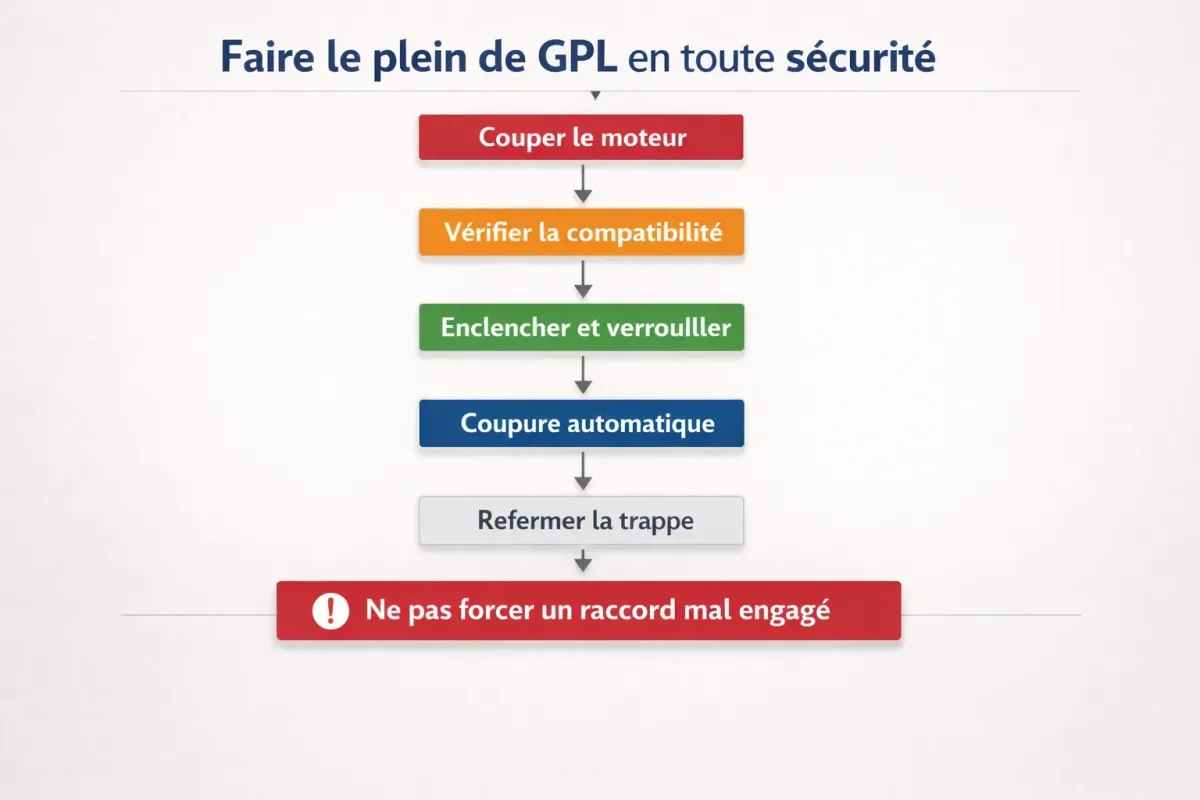
Filling up with LPG is not complicated, but it requires a strict procedure. The nozzle must be properly locked, the connection area clean, and the station’s instructions followed. The filling stops automatically before the tank is full. In case of doubt, it is better to ask for help than to force a poorly engaged connection.
The Refueling Steps
Start by turning off the engine and securing the vehicle. Then check that the nozzle is compatible with the station, sometimes with the help of an adapter. Once the nozzle is engaged, monitor the locking and then let the automatic cut-off do its job. Finally, check that the cap and the flap are properly closed before driving off.
Errors to Avoid When Filling Up
The most common errors are simple: bad connection, attempting to force it, forgetting to lock, or not knowing the payment method. You should also avoid filling up in a hurry, especially if the station is unfamiliar. A well-signposted LPG service station is generally smoother than an improvised or poorly documented station.
Data, Updates, and Map Reliability
A useful map is not only well designed: it must be up to date. Prices and hours sometimes change during the day, while the actual availability of a pump can change after a delivery, a breakdown, or a temporary closure. That is why a good tool cross-checks several sources and displays a clear update date.
The most reliable databases are generally the station sheets from networks, specialized directories, and public fuel datasets. Their value is complementary: the first are closer to the field, the second help with comparison, and the third provide a reference base. However, no source guarantees absolute real-time availability.
For a driver, the rule remains pragmatic: if the station is far or if the detour is significant, it is better to call or choose a plan B. The map should serve to reduce risk, not eliminate it.
What to Do If No LPG Station Is Available Nearby?
When the area is poorly covered, you need to think in terms of trips rather than radius around you. Then locate the next highway LPG station, check the most credible alternative in the arrival city, and keep a sufficient fuel margin. This method avoids driving under constraint, especially in rural areas or during holidays.
Preparing Your Trip in Advance
Before a long departure, it is useful to locate at least two LPG stations in France along the route and one as backup off the main axis. This simple redundancy often suffices to cover unforeseen events: closed station, unavailable pump, or reduced opening hours. For daily use, the same principle applies to the usual station and a neighborhood alternative.
Backup Solutions and Alternatives
The most logical backup solution remains the nearest station, even if it is not your favorite. If you drive a dual-fuel LPG car, temporarily switching to the other fuel can also help depending on the model. For a trip without margin, the safest is still to refill the LPG tank before entering a poorly served area.
FAQ on LPG Stations in France
How Many LPG Stations Are There in France?
Specialized directories and fuel networks list a volume around 1,500 distribution points, with variations depending on updates and the definition used. The right reflex is not to memorize an exact number, but to check the coverage of your trip before leaving.
Can you refuel 24/7?
Yes, some LPG stations open 24/7 allow it, especially on highway rest areas or sites equipped with self-service payment terminals. But 24/7 does not mean guaranteed availability at every moment: a pump may be under maintenance or temporarily unavailable without visible notice on the map.
Is LPG compatible with all vehicles?
No. Automotive LPG in France mainly concerns vehicles originally designed for this fuel or approved bi-fuel models. An LPG station car must use a compatible tank, circuit, and injection system. Before any conversion or use, you must check the registration certificate, approval, and type of installation.
How to know if a station still accepts LPG?
The most reliable method is to cross-check the station sheet, displayed hours, and, if possible, a quick call when the detour is significant. A station may keep the LPG mention without offering the service continuously. If the nozzle, payment, and access are not clearly indicated, it is better to choose another option.