
In brief
🚗 e-accident report if the accident is material, with up to two vehicles and no injuries: this is the simplest way for a quick declaration.
⏱️ The deadline is generally 5 working days, but only 2 working days in case of theft. It is better to declare as soon as the facts are stable and documented.
📸 Photos, registration certificate, driver’s license, third party contact details, report: the more complete your file is, the less the insurer will ask you for back-and-forths. Cherry on the cake, you keep a clear record of the exchange.
How to make an online car claim declaration?
The most effective method is to describe the facts without interpretation, attach useful evidence, then send the declaration through the channel provided by your insurer. For a simple material fender bender, the e-accident report is often enough; for a more unclear case, it is better to go through the client area or call assistance to frame the information from the start.
In practice, an online car claim declaration is done in four steps: identify the claim, provide the date and place, add photos and third party contact details, then submit the file. If you have an e-accident report, fill it out on site as soon as possible before details become unclear.
Here is the most common process, the no-hassle version:
- 1. Check safety: any injuries, warning triangle if necessary, photos before moving vehicles if the situation allows.
- 2. Choose the right medium: e-accident report, online form, mobile app, or call depending on the case.
- 3. Enter the facts: date, time, exact address, circumstances, testimonies, license plates.
- 4. Add the documents: clear photos, driver’s license, registration certificate, identity statement if requested, police report in case of theft.
- 5. Send and keep proof: file number, acknowledgment of receipt, PDF copy or screenshot.
The important point is consistency. A well-written file, without grey areas, will be easier to process than a hastily sent declaration with poorly filled boxes. And yes, insurers notice that immediately.
Which channel to choose according to the type of claim?
The right channel mainly depends on the severity and complexity: the e-report for a simple material accident, the client area for a standard file to be submitted with documents, and the phone if the claim is outside the scope or requires immediate instructions. The goal is not to go as fast as possible, but to go to the right place.
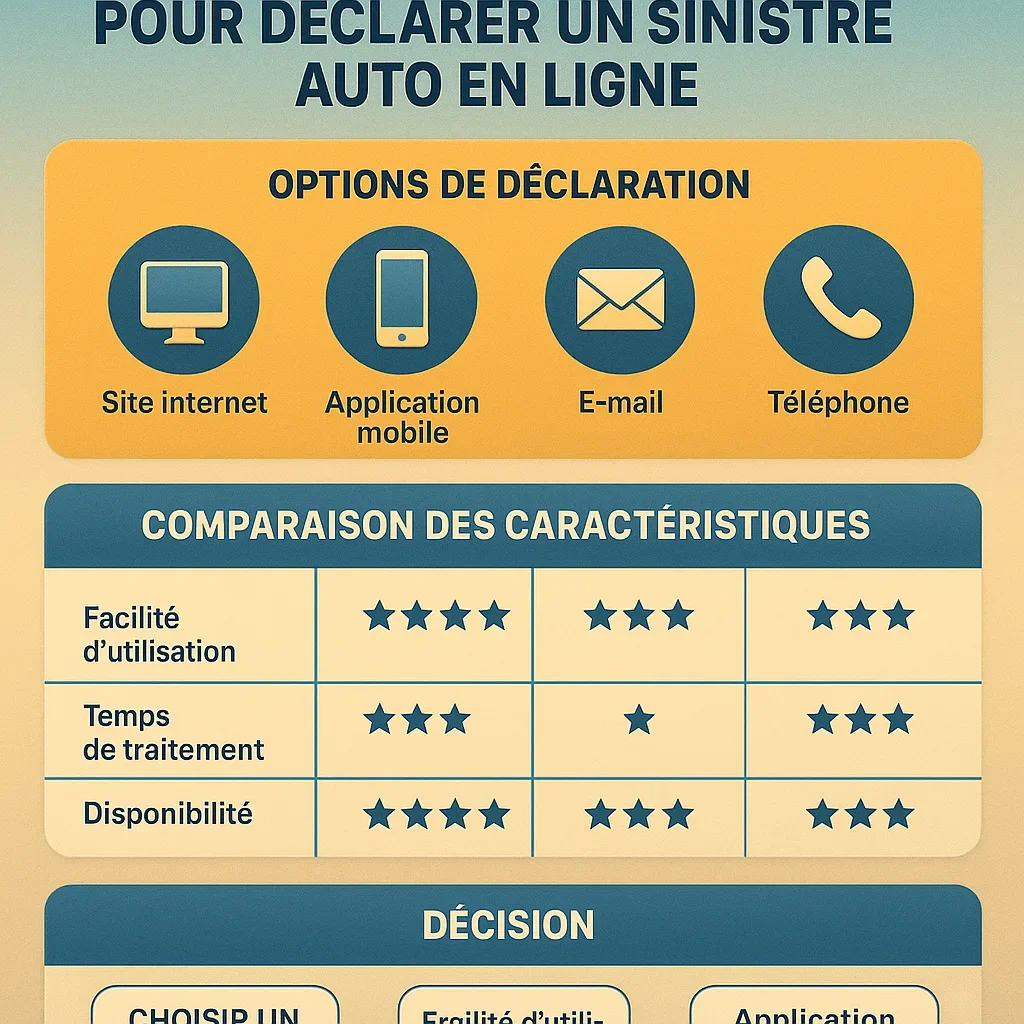
The Public Service on the e-car report recalls the basic framework, while France Insurers details the use of the mobile application. In other words, technology is here to simplify, not to force a bad choice.
| Channel | When to use it | Main advantage | Limit to know |
|---|---|---|---|
| e-car report | Material accident, maximum two vehicles, no injuries | Fast, convenient, close to the paper report | Unsuitable if a third party refuses, if there are injuries, or if the scene is too complicated |
| Client area / insurer app | Broken glass, vandalism, theft, accident with documents to attach | Document submission and file tracking | Requires a well-prepared file |
| Phone / assistance | Emergency, doubt, injuries, immobilized vehicle | Immediate instructions and initiation of assistance | It is then necessary to keep a written record |
| Mail / paper | Exceptional cases or digital failure | Backup solution | Often slower processing |
The right reflex is not to choose the most modern tool, but the channel that exactly fits the claim. For a simple file, the e-report saves time; for a complicated file, the phone can prevent a mistake.
What deadlines must be met to report a car claim?
In France, the standard deadline is 5 working days for most car claims and 2 working days in case of theft, according to the framework recalled by the Public Service and insurers. In short, waiting “a little” is not a good idea: the countdown starts very quickly after the incident.
The deadline is not just an administrative constraint. It allows the insurer to verify the circumstances, request the right documents, and, if necessary, initiate the expert assessment. The longer you wait, the more traces disappear: vehicle positions, available witnesses, photos of the road or damages, everything becomes less clear.
- Material accident: report quickly, even if you do not yet have all the documents.
- Theft: file the complaint without delay, then provide the reference number for the file.
- Damage involving a third party: secure the contact details of the driver and their insurer before they are lost.
- Claim abroad: notify assistance as soon as possible, as the required documents may vary.
It should be noted that practical deadlines may also depend on your contract and the chosen channel. A well-designed customer area can speed up submission, but it never extends the legal deadline. That is why it is better to declare first, then complete if necessary.
What documents should be prepared before sending the file?
A clean file relies on a few simple but essential documents. The goal is not to include everything, but to be able to clearly explain the claim, with readable evidence. Insurers like facts, not assumptions, and they appreciate an orderly file even more.
- The amicable report or the completed e-report
- The vehicle registration certificate
- The driver’s license of the driver
- The contract number or the references of the insured vehicle
- Clear photos of the damages, the license plate, the scene, and, if possible, signs or road markings
- The contact details of the third party and their insurer, if another driver is involved
- The complaint filing in case of theft, break-in, or serious vandalism
- Witness statements, if you have any and they are usable
In the field, an insurance agent observes that the smoothest files are those where photos have been taken from several angles: license plate, damages, vehicle positions, and signage. Conversely, a photo that is too dark or blurry often requires requesting additional information.
Good to know: if you have doubts about a document, send what you already have. A partial but sincere file is better than a declaration stuck because you were waiting for “the right photo” for three days.
What happens after sending the claim?
Once the file is sent, the insurer usually acknowledges receipt, checks the consistency of the elements, and then informs you of the next steps: assessment, additional documents, or direct coverage depending on the guarantee. This is when the deductible and, in some cases, the bonus-malus come into play. In other words, the outcome depends as much on the contract as on the circumstances.
A responsible accident can lead to a malus, whereas a glass breakage, a theft, or certain damages caused by a third party often follow different rules. The deductible remains the amount that may be your responsibility depending on the coverage. It’s therefore better to reread the notice before assuming that “everything will be reimbursed.”
- Acknowledgment of receipt: keep it carefully, it is your proof of submission.
- Assessment: it may be requested if the damage is significant or if the file lacks clarity.
- Additional documents: respond quickly, as the file often remains pending until receipt.
- Compensation: it comes after the file is validated and, depending on the case, after assessment or amicable agreement.
In practice, the fastest files are also those where the insured responds promptly to the insurer’s messages. Joking aside, saving a few hours on additional documents can avoid several days of delay.
What mistakes complicate an online car claim declaration?
The most frequent mistakes do not come from the software but from haste. We want to go fast, forget some information, swap two boxes, then the file is sent with a small inconsistency that triggers a correction request. Nothing dramatic, but it prolongs everything.
- Waiting too long before declaring, especially after a theft.
- Forgetting useful photos, even though they are often decisive.
- Filling out an e-constat hastily without reviewing the circumstances.
- Minimizing or exaggerating the damage: in both cases, the file loses credibility.
- Choosing the wrong channel for a complex claim or with injured parties.
Special cases require even more method:
- If the third party refuses to sign: fill out your part, take photos, note the license plate and, if possible, the name of a witness.
- If the car is stolen: filing a police report is a priority, as it structures the entire file.
- If there are injured parties: emergency comes before declaration, and you must follow the instructions of the emergency services.
- If the accident occurs abroad: contact assistance quickly, as documents and local practices vary from country to country.
In other words, the best declaration is often the one prepared calmly, even in a stressful moment. This is where the online car claim declaration shows its real value: centralizing, dating, and tracking, without having to do all the paperwork by hand.
FAQ — Online car claim declaration
Can you declare a car claim online without an e-constat?
Yes. The e-constat is convenient, but it is not mandatory in all cases. You can use your insurer’s client area, a mobile application, or a classic online form if the claim allows it.
What to do if the other driver refuses to sign?
Do not block the entire procedure because of that. Fill out your part accurately, take photos, note the license plate, and if possible, identify a witness. The declaration remains useful even without a crossed signature.
Are photos enough to speed up compensation?
They help a lot, but they do not always replace other documents. Clear photos taken from several angles mainly help limit requests for additional documents and make the assessment faster if it is necessary.
Can you send the declaration from your smartphone?
Yes, and it is often the easiest way. Applications and client areas are designed for this, provided you have a good connection and the documents at hand. A readable scan or a clean photo already makes a big difference.
What if the accident occurred abroad?
Notify assistance as soon as possible, then follow your insurer’s instructions. The required documents may vary depending on the country, the language of the report, and local regulations. Also keep the contact details of any third party involved.
Can a late declaration be refused?
It can at least be complicated, especially if the legal deadline is exceeded without justification. Even when the file is not rejected, the insurer may request additional evidence or delay the review. It is therefore better to declare quickly, then complete later if necessary.