
In Brief
⚡ Temporary car insurance = short-term coverage, designed for occasional needs, not for daily use.
🧳 It is often used for a vehicle purchase, a car loan, an import, or an exceptional trip.
⚠️ The key points to watch are: liability coverage, validity period, and profile restrictions imposed by the insurer.
💡 As soon as the use becomes regular, the annual contract often regains the advantage in terms of price and coverage.
In Which Cases Is Temporary Car Insurance Really Useful?
It is mainly used when the need to drive is limited in time: buying a vehicle to bring it home, a temporary loan of a car, import from abroad, waiting for annual insurance, or a short stay. This contract avoids paying for full coverage for just a few days or weeks.
The benefit is simple: instead of signing an annual contract for a car that will only be driven for a weekend or a month, you buy protection tailored to the actual need. It is useful for a used vehicle purchase, a borrowed car, a motorhome before departure, or a car imported from Belgium or Spain that needs to be legally repatriated.
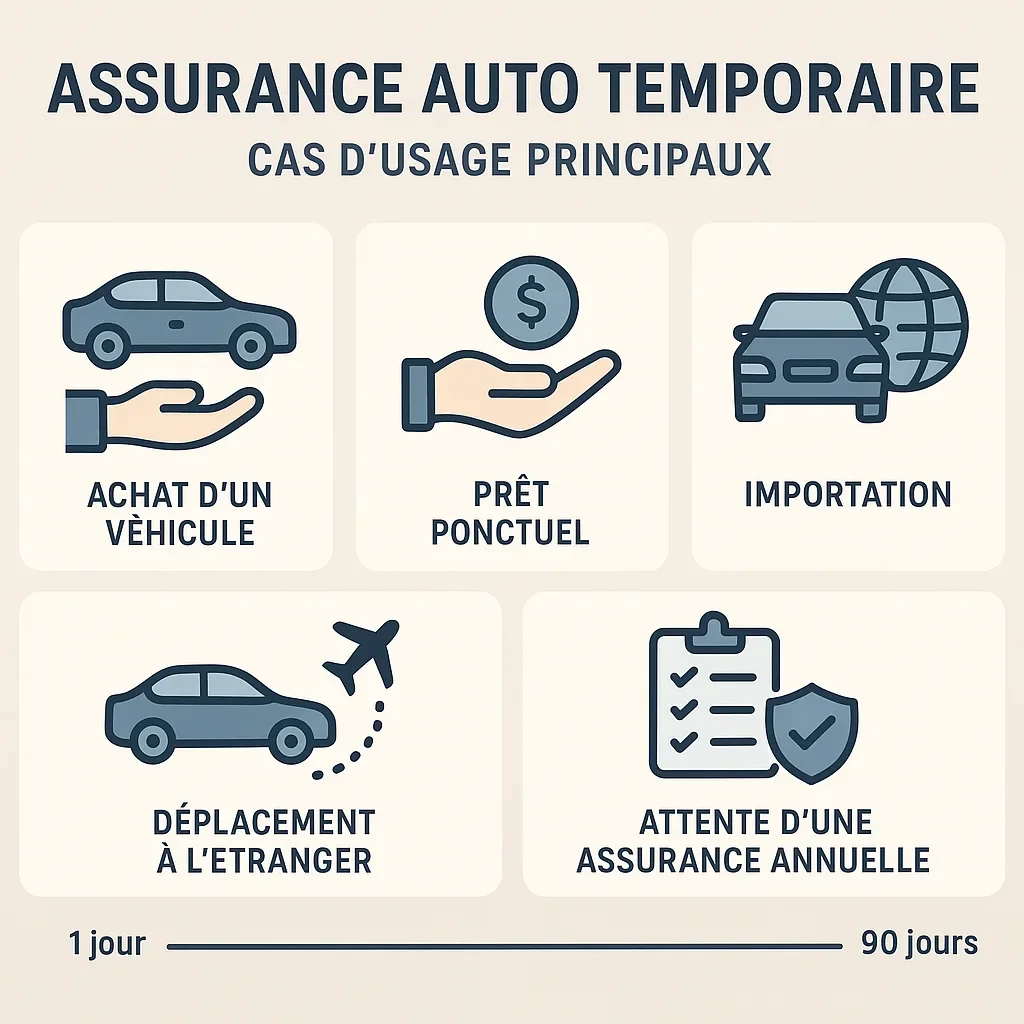
In practice, requests often come at the last minute. A family picking up a car in Lille, a buyer leaving with a temporarily registered vehicle, or a driver who must cross the Spanish border to return home: in all these cases, temporary car insurance avoids last-minute blockages.
- Private sale purchase: time to register and secure the vehicle.
- Car loan: for a short trip, a week of vacation, or a return from the provinces.
- Import: when the vehicle must be driven before being insured long-term.
- Export or transit: for a specific trip, often cross-border.
- Waiting for an annual contract: if the main contract is not yet active.
It is observed in the field that many subscriptions occur after a purchase signed on Friday, with the need to drive starting the weekend. An insurance agent near a major border notes that files related to vehicle repatriation increase quickly as soon as individuals buy outside their region.
How Does Temporary Car Insurance Work?
It works like a mini autonomous insurance, with a predefined duration, often from 1 to 90 days. The driver provides their information, chooses the period, pays the premium, then receives a certificate valid for that window. In practice, the price rises quickly if the profile or vehicle is risky.
The principle is simpler than it seems. The insurer verifies the driver’s identity, license validity, vehicle characteristics, and desired period, then issues limited-time coverage. Depending on the offers, you often need to be at least 21 years old and have 2 to 3 years of driving experience, as very young profiles are considered riskier.
In practice, the driver usually has to present:
- a piece of identification;
- the driver’s license;
- the registration certificate or an equivalent document depending on the case;
- sometimes proof related to the vehicle, especially in case of import or loan.
It should be noted that the certificate does not always provide access to all the guarantees of a standard contract. 0 km assistance, all-accident damage coverage, or glass breakage are not systematic. In other words, you need to read the conditions before opening your wallet, otherwise the cold shower comes quickly.
What does it cover, and what are its limits?
The foundation, almost always, is civil liability: it covers damage caused to others, not those suffered by your own car. This is the minimum legal base. To check the general framework of the insurance obligation, you can consult the Service-Public.fr search on mandatory car insurance and the corresponding texts on Légifrance.
The real trap is to believe that a short-term contract works like a compressed annual contract. In reality, the insurer filters risks more and often limits uses: some vehicles that are too powerful, too old, too new, or too expensive may be refused. Likewise, professional use, goods transport, or trips abroad are not always included.
- Most often covered: damage caused to third parties.
- Not automatic: theft, fire, glass breakage, assistance.
- Limited: duration, country, type of trip, vehicle power.
- To check: age conditions, license seniority, exclusions.
How much does temporary car insurance cost?
Pricing mainly depends on three things: the duration, the driver’s profile, and the type of vehicle. For a few days, the bill is often in the range of a few tens of euros, but it can rise if the car is powerful, if the driver is young, or if the trip goes beyond the usual framework.
The smart approach is to compare the total price, not just the price per day. Temporary insurance at €45 for 3 days can be very relevant for repatriating a car, but it quickly becomes less logical if the vehicle has to be driven every day for several weeks. That is why the actual duration of use matters more than the simple displayed “low price.”
Before subscribing, especially look at:
- the guarantee limits;
- the deductibles in case of a claim;
- the geographical area covered;
- the exclusions related to the driver or the vehicle;
- the cost of an extension if the need lasts longer than expected.
Temporary insurance or annual contract: which to choose?
The right choice mainly depends on the frequency of use. For a few days or a specific trip, temporary insurance remains the most logical. As soon as the car is driven regularly, an annual contract almost always becomes more cost-effective and better guaranteed, especially for daily peace of mind.
The temporary contract is a transitional tool. It meets a short, visible, almost mechanical need. The annual contract takes over as soon as the car enters a normal routine. That is where comparison becomes useful, because you move away from the logic of emergency coverage to that of lasting protection.
| Situation | Temporary insurance | Annual contract | The most logical |
|---|---|---|---|
| Purchase of a car to be repatriated | Yes, very suitable | Possible but excessive | Temporary |
| Car used every day | Not very relevant | Yes, durable coverage | Annual |
| Vehicle loan for 48 hours | Yes, practical | Often too heavy | Temporary |
| Use over several months | Possible but costly | Generally more cost-effective | Annual |
Temporary car insurance is a transitional tool, not a magic wildcard. It works very well as a stopgap, but as soon as usage becomes regular, the annual contract quickly takes over.
In practice, the real good trade-off is played on two axes: how many days the car will be driven and at what level of risk. The longer the need lasts, the more the short-term contract loses its advantage. The more common the vehicle, the more the comparison with an annual plan becomes unavoidable.
What mistakes should be avoided before subscribing?
The first mistake is to focus only on the duration and forget the exclusions. The second is to underestimate the profile conditions. A driver who thinks “I’ll take two days, it will be fine” may find themselves blocked if their age, license seniority, or the vehicle registration do not meet the insurer’s criteria.
The third mistake, very common, is to confuse minimal coverage with comfortable coverage. Temporary insurance often protects third parties, but not necessarily your car. If you have to take the road with a valuable vehicle, it’s better to check the guarantees instead of crossing your fingers. Spoiler: fingers don’t serve as airbags.
- Not checking if the country of circulation is included.
- Forgetting that assistance may be absent.
- Thinking that a car loan automatically covers all drivers.
- Signing without looking at the deductible and limits.
FAQ — temporary car insurance
Can you subscribe to temporary car insurance the same day?
Yes, it is even one of its major advantages. Many contracts can be activated quickly, sometimes within the day, provided you have the right documents and a compatible profile. It’s very convenient when a purchase, vehicle return, or departure is imminent.
Is it valid for a trip abroad?
Sometimes yes, but not automatically. You need to check the geographical area covered, as some contracts are limited to France or certain European countries. For a trip to Belgium, Spain, or another country, it’s better to ask for the exact list of included territories.
Can you extend temporary car insurance?
Often, you have to subscribe to a new contract or a new period, as the extension is not always automatic. It depends on the insurer and the driver’s profile. If the need lasts longer than expected, switching to an annual contract quickly becomes the simplest solution.
What documents should be prepared before subscribing?
Generally, at minimum, you need an identity document, a valid license, and information about the vehicle. Depending on the case, the registration certificate, proof of ownership, or elements related to import may be required. It’s better to prepare them before the simulation to avoid back-and-forth.
Is temporary insurance suitable for a young driver?
Not always. Many insurers impose a minimum age and license seniority, precisely because the risk is considered higher. As a result, a young driver may be refused or pay more if the contract is accepted.