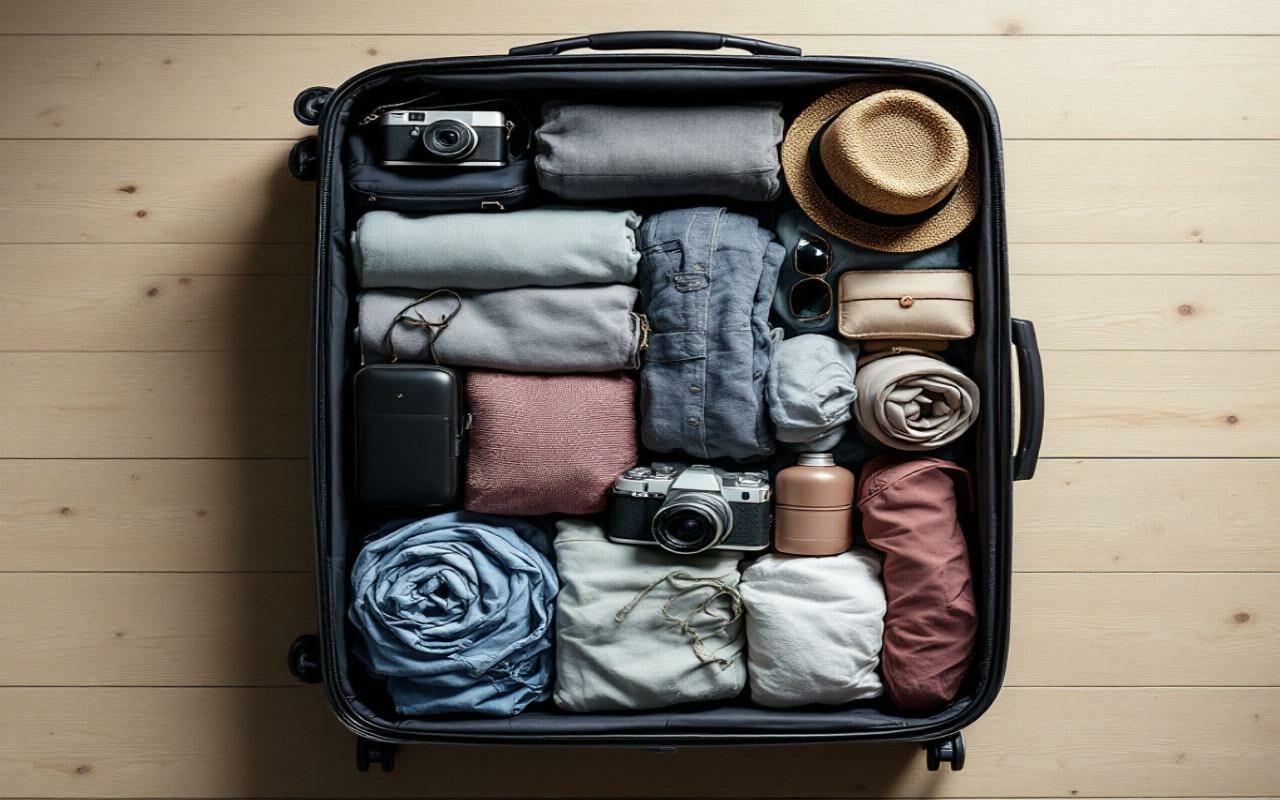
Why traveling light revolutionizes your experience
Beyond the obvious comfort – less carrying, more freedom – getting into the habit of limiting your baggage weight reveals a whole philosophy of minimalist travel. You gain mobility: you follow a flexible itinerary, walk a tightrope in narrow alleys, slip onto a local bus without being hostage to your trolley. Cherry on the cake, you also save on airline baggage fees, a nice little bonus for frequent getaways. Like a plunge into the essentials, this approach sweeps away the superfluous to offer you a streamlined, more intense, and – we admit – almost liberating experience.
10 tips for traveling light and optimizing your suitcase 📦
1. Choose luggage suited to your profile
A 30 L backpack can be enough for a week-long road trip, while a 40 L cabin suitcase will suit busy city dwellers better. The secret is to match the luggage volume to your style: minimalist or very organized. Rather than opting for the maxi tote that reassures, prefer a lightweight, ergonomic model with an optimal weight-to-capacity ratio. For example, a hard-shell bag weighing 3 kg empty is often too much; a soft suitcase of 2 kg is a winner. Avoid congestion, prevent price hikes at the counter, and stay agile in all terrains.
2. Favor modular and technical clothing
Forget the mountain of T-shirts: two long-sleeve shirts, three “sweat-friendly” T-shirts, and convertible shorts that become pants are more than enough. Quick-drying fabrics and odor-resistant fibers wick away moisture and reduce the number of washes. Take the time to compare materials (nylon ripstop, merino, recycled polyester) to find the right comfort/durability balance. You can even include a schematic list to quickly visualize:
- Merino T-shirt: odor-resistant, quick-drying
- Stretch nylon shirt: good fit, breathability
- Convertible pants: 2 in 1, ultra-practical
- Lightweight windbreaker: compressible into its own pocket
That’s the kind of armor that follows you without acting like a brick bag.
3. Master the art of folding and rolling
Unsure between two methods? Rolling each garment on itself saves up to 30% of space and limits unwanted wrinkles. Some tricks require a bit of practice, but the result is stunning: a rolled T-shirt stands upright, two pairs of socks settle in a corner, and you stack without fearing damage. For shirts, favor the “envelope” technique: lay the shirt flat, fold it manually into a rectangle, then wrap it in microfiber towels. The balance between compactness and shape retention becomes almost a martial art.
4. Rely on packing cubes to stay on track
These little zippered pouches are like portable drawers: you categorize clothes by type or day, and it’s a jackpot when playing the rushed tourist. You can stack a “top” packing cube and a “bottom” one to create two compartments in your suitcase, or even slip them into side pockets. Their featherweight and modularity also allow you to remove an entire cube if you buy souvenirs along the way. Finally, we recommend choosing semi-transparent cubes: you spot the contents without playing guessing games.
5. Intelligently recycle your containers
Mini bottles of shower gel and sunscreen bought in stores barely fulfill their role. As for samples, they often end up running on beaches. Opt for small reusable bottles (30–50 mL) for your liquids, label them with a permanent marker, and you can even clip them outside the bag to save time at airport security. Cherry on the cherry, these mini-bottles are ideal for holding a bit of liquid detergent: enough to rig a mini washing machine at the bottom of the hotel sink.
6. Target only the strictly necessary electronics
Smartphone or dedicated camera? Universal charger or multi-plug? Rather than piling up cables and adapters, think about the essentials. If your phone has a good lens, skip the camera. A single USB-C charger can power your phone, external battery, and Bluetooth headset, and a 10,000 mAh Power Bank is often enough for several days without an outlet. You can even opt for a lightweight Kevlar cable, more durable than low-end models, and takes up less space.
7. Bring a compact first aid kit
Instead of carrying a full paramedic bag, assemble a small “zone kit”: a few assorted bandages, an elastic bandage, a pair of folding scissors, antiseptic gel, and basic medications (painkillers, anti-diarrheal, antihistamines). All of this should fit into a small soft toiletry bag, to slip into the top part of your bag. You will feel invincible without feeling the extra 300 g.
8. Keep your essentials in a small security pouch
Passport, bank card, international driver’s license, tickets in waterproof plastic: entrust them to a neck document holder or a waist pouch. This technique frees your mind, avoids risky handling in crowded transport, and saves crucial seconds at customs. Some models even have an RFID compartment: anti-skimming protection is not a gimmick, especially in high-traffic areas.
9. Plan a wardrobe pivot based on the weather
You’re going for two weeks, but the weather swings between 5 °C in the morning and 30 °C in the afternoon? Build a capsule wardrobe: a light sweatshirt, three t-shirts, a technical base layer, convertible pants. And rely on layering to create new outfits for every occasion. Rather than bringing a down jacket, bet on a compressible down vest, which packs down to the size of a bracelet.
10. Let go of “just in case” items
The best advice, probably the hardest to apply: question every item packed. “Did I use it on my last trip?” If the answer is no, leave it behind. A mobile phone can replace a flashlight, a plastic bag can substitute for a laundry bag. In reality, “just in case” items often represent 30% of the total weight. Being aware of this margin makes your suitcase lighter as if by magic.
“Traveling light is learning to live with the essentials and to appreciate what you have on hand rather than what you left behind.” – Modernized Nomad
Comparison Table: Cabin Luggage Options
| Model | Volume | Empty Weight | Indicative Price |
|---|---|---|---|
| Soft suitcase 40 L | 40 L | 1.8 kg | €60 |
| Hard shell 45 L | 45 L | 3.2 kg | €120 |
| Backpack 35 L | 35 L | 1.2 kg | €80 |
FAQ on Traveling Light
How can I check my suitcase weight before departure?
A portable luggage scale (under €10), manual or digital, saves you from a bad surprise at the counter. If it’s not handy, weigh yourself first with the suitcase, then without: the difference is the luggage weight.
Can you really do without solid shampoo?
Solid shampoo eliminates the risk of leaks and does not count in the “liquids” category of your toiletry bag. It suits most hair types and often lasts twice as long as a regular bottle.
Is it possible to wash clothes while traveling without a laundry service?
Absolutely. A bit of organic detergent in stick or tablet form + an elastic band to hang the clothes = clean clothes in 3 hours in your room. Some hotels even offer an express laundry service at a low price.
What is the least restrictive cabin luggage limit?
Each airline sets its own rules, but 55 × 40 × 20 cm and 7–10 kg remain the most common standard. Always check exact dimensions before traveling.
How should I store my important documents for more security?
An RFID and waterproof pouch worn crossbody or around the neck saves you from keeping your wallet in your back pocket. This light and discreet precaution deters pickpockets and protects your banking data.