
Orléans — Loire City & Joan of Arc Capital of Loiret
TL;DR. On the banks of the Loire, Orléans (Centre-Val de Loire) combines the history of Joan of Arc, Gothic heritage, and the art of living on the quays. Easy to access from Paris (≈1h), the municipality (INSEE 45234) attracts as much for its museums, parks, and events as for its still moderate real estate prices. Here is the 2025 local guide: geography, history, demographics, economy, transport, places to visit, and neighborhood advice.
Sommaire
Geography & Location
Orléans is the prefecture of the Loiret department, at the heart of the Centre-Val de Loire region. The Loire city stretches on both sides of the Loire river, about 120 km southwest of Paris (right bank: historic center; left bank: Saint-Marceau, Val, La Source). It is the natural gateway to three major landscapes: the Beauce to the north, the Sologne to the south, and the Orléans forest to the east.
Reference data: area 27.48 km², altitude ~90 m (min) to ~124 m (max), postal codes 45000 (right bank) and 45100 (left bank), INSEE 45234, demonym: Orléanais·es (source: Wikipedia).UNESCO. The segment of the Loire Valley between Sully-sur-Loire and Chalonnes-sur-Loire, which includes Orléans, is listed as a World Heritage site for its emblematic cultural landscapes.
History & Heritage
Historical capital of the Orléanais, Orléans is inseparable from Joan of Arc. From October 12, 1428, to May 8, 1429, the city endured an English siege that became a turning point in the Hundred Years’ War: the arrival of the Maid galvanized the French troops and allowed the lifting of the siege (source). Since then, Orléans commemorates the event every year during the Joan of Arc Festivals (late April – May 8: parades, ceremonies, performances).
The city’s visual symbol is the Sainte-Croix Cathedral (Gothic/Neo-Gothic), whose construction spans from the 13th to the 19th century: first stone laid in 1287, revival by Henry IV in 1601, solemn completion on May 8, 1829 (anniversary of the liberation) — basilica since 1855 (Wikipedia; DRAC).
Other milestones: the municipal Renaissance (Groslot Hotel), post-war reconstructions (Jeanne-d’Arc street, arcades of rue Royale), and the planned urbanization of La Source in the 1960s (campus, CNRS, BRGM, hospital) which doubled the city southwards (Wikipedia Orléans-la-Source).
Population & Demographics (INSEE)
Orléans is the second most populous municipality in Centre-Val de Loire (after Tours).
| Indicator | Value | Source |
|---|---|---|
| Municipal population (2021, legal) | 116,617 inhabitants | INSEE |
| Total population (2021) | 119,065 inhabitants | INSEE |
| Municipal population (2022) | 116,344 inhabitants | INSEE 2022 |
| Area | 27.48 km² | Wikipedia |
| Density (2021) | ≈ 4,244 inhabitants/km² | Calculation based on INSEE data |
| Demonym | Orléanais / Orléanaises | Wikipedia |
| Postal codes | 45000 (N), 45100 (S) | Wikipedia |
To remember — A dense and young municipality (large student population), at the center of a significant urban attraction area and a dynamic intercommunal structure Orléans Métropole.
Economy & Employment
Orléans Métropole displays a diverse economy:
- Pharmacy & health: a sector of excellence (production, bioproduction, pharmaceutical logistics) — 2024 metropolitan overview (Orléans Métropole).
- Cosmetics: rooted in the Cosmetic Valley (laboratories and factories in the urban area).
- Logistics & e-commerce: major platforms on the Loire axis and A10/A71/A19 highways.
- Geosciences & environment: national headquarters of the BRGM, 3 avenue Claude-Guillemin (Orléans-La Source) (BRGM).
- Research/higher education: University of Orléans, OSUC (Observatory of the Sciences of the Universe) under CNRS/University supervision (OSUC; CNRS-INSU).
The advanced tertiary sector (headquarters, administrations, services, conferences) is strengthened by the CO’Met complex (expo park, convention center, arena ~10,000 seats) inaugurated in 2023 (GL events; Populous).
Tourism & Culture — Top 5 places to visit
Between wild Loire, half-timbered facades, and museum institutions, Orléans’ tourist offer will delight both history enthusiasts and riverside strollers. The Tourist Office publishes ideas and agendas all year round (OT Orléans).
- Sainte-Croix Cathedral
 A Gothic masterpiece, from the medieval choir to the classical and neo-Gothic elevations. Source: Wikipedia.
 - Hôtel Groslot
.jpg) Former Renaissance consular house, ceremonial salon and gardens. Photo: Wikimedia Commons.
Former Renaissance consular house, ceremonial salon and gardens. Photo: Wikimedia Commons. - House of Joan of Arc
 House-museum dedicated to the Maid and the memory of the siege (1429). Information.
 - La Source Floral Park
 Large landscaped park where the Loiret river originates; greenhouses, irises, peacocks, family games.
 - Loire Riverbanks & George V Bridge
.jpg) Strolls along the quays, open-air cafes and the Loire Festival (from September 24 to 28, 2025). Official site.
Strolls along the quays, open-air cafes and the Loire Festival (from September 24 to 28, 2025). Official site.
Also not to be missed: the Fine Arts Museum (paintings, pastels; Velázquez, Watteau…), Saint-Aignan Church, Charlemagne Island, street art, the arcades of Rue Royale.

Transport & Access
Getting there and getting around
- Train: the Rémi Express line connects Orléans/Les Aubrais to Paris-Austerlitz in ~58 min to 1h06 depending on trains and stations (sources: TER Rémi; SNCF Connect).
- Road: junctions A10 (Paris-Bordeaux), A71 (Orléans-Clermont-Ferrand), A19 (Eastern bypass).
- Tram & TAO bus: two tram lines A (N↔S) and B (E↔W) cover the metro area, complemented by a dense bus network. Winter services 2025-2026 in effect (TAO; Line B).
- By bike: Orléans is a stop on La Loire à Vélo, the western section of the EuroVelo 6 (Nevers → Atlantic). Routes, maps and services: La Loire à Vélo; France Vélo Tourisme.
Local life (education, sports, events)
Education & campus
The Orléans-La Source campus concentrates university (IUT, Polytech, sciences), CNRS labs, OSUC, BRGM and specialized schools (OSUC; BRGM).
Sports & facilities
- CO’Met: multi-purpose arena ~10,000 seats, indoor international competitions, concerts (details).
- Basketball: Orléans Loiret Basket (Pro B), record attendances at CO’Met (7,041 average in 2024-25) (OLB).
- Football: US Orléans (National), stade de la Source ~6,800-7,500 seats (Wikipedia; USO).
Key Events
- Joan of Arc Festivals: late April – May 8, commemoration of 1429 (2025 program: dedicated site; City).
- Festival de Loire (biennial): September 24→28, 2025, largest gathering of boatmen in Europe (quays, parades, pyro-symphony) — official info.
Real Estate & Urban Planning
Price per m² (September 2025): average for the municipality ~€2,558/m² all property types combined, with variations depending on neighborhoods (Bourgogne/old town > average; Blossières < average) (Meilleurs Agents; e.g. Bourgogne; Blossières). Notarial statistics confirm a still balanced market in 2024-25 (Notaires de France).
Neighborhood landmarks — City center (rue Jeanne-d’Arc, place du Martroi): historic charm and high prices; Saint-Marc & Madeleine: urban residential; left bank (Saint-Marceau): lively and family-friendly; La Source: large residences, campus, small houses on the Orée de Sologne side; Northeast (Argonne, Blossières): affordable budgets, redevelopment.
Urban Planning
Creation of Orléans-La Source (1960s) on lands of Saint-Cyr-en-Val, planned by architect Louis Arretche (city-campus, green spaces), establishment of CNRS, hospital and BRGM (Wikipedia Orléans-la-Source). The old town has undergone rehabilitations (rue Royale, street grid, views of the cathedral).
Practical Information & Key Figures
- Municipality: Orléans (INSEE 45234) — INSEE profile
- Region: Centre-Val de Loire — Department: Loiret
- Area: 27.48 km² — Altitude: 90-124 m
- Postal codes: 45000, 45100 — Demonym: Orléanais·es
- Tourist Office: tourisme-orleansmetropole.com
Useful Internal Links
Sources and References
- INSEE — Orléans Population ; 2022 data
- Wikipedia — Orléans ; Cathedral ; Siege of Orléans
- City & Metropolis — Loire Festival 2025 ; Economic Overview
- Transport — TER Rémi Orléans–Paris ; TAO Orléans ; The Loire by Bike / EuroVelo 6
- Real Estate — Best Agents ; Notaries of France
- Culture & Tourism — Tourist Office ; Museum of Fine Arts
FAQ — Orléans
What to visit in Orléans over a weekend?
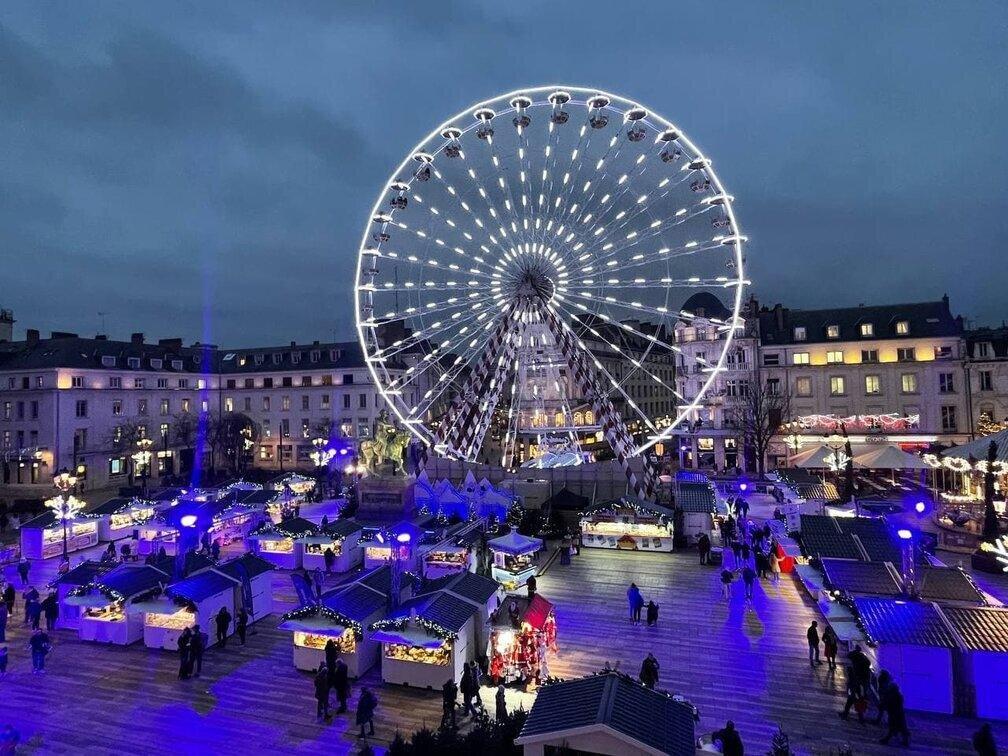
The Sainte-Croix Cathedral, the Groslot Hotel, Jeanne d’Arc street up to Martroi square and its statue of Jeanne d’Arc, the Loire quays, the Jeanne d’Arc House and the Museum of Fine Arts. With children: Charlemagne island and the Floral Park of the Source.
What is the population of Orléans?
The municipality has 116,617 inhabitants (legal municipal population 2021 — INSEE) and 116,344 inhabitants in the 2022 vintage.
How to get to Orléans from Paris?
By Rémi Express train Paris-Austerlitz ⇄ Orléans/Les Aubrais in about 58 min to 1h06 depending on the train; by car via the A10 then A71 (Orléans exits).
Which neighborhoods are pleasant?
City center (history, shops), Saint-Marc/Barrière-Saint-Marc (residential), Saint-Marceau (lively left bank), Dunois/Madeleine, certain areas of La Source (near park/campus). For softer budgets: Argonne, Blossières, Madeleine north side.
What is the price of real estate in Orléans?
In September 2025, the average is around €2,558/m² (significant variations depending on neighborhoods and types). Notaries and portals confirm a market still adjusting in 2024-25.
When does the Loire Festival take place?
From September 24 to 28, 2025 (biennial). Free, on the quays of Orléans.
Where to see traces of Jeanne d’Arc?
The cathedral (where she prayed), the equestrian statue at Martroi square, the Jeanne d’Arc House (museum), and thematic tours during the Joan of Arc Festivals.
Conclusion — Orléans today and tomorrow
Orléans combines rare assets: a vibrant heritage center, vast Loire spaces, an efficient transport network (high-speed train from Paris, tram A/B, bike), an active employment ecosystem (pharma, logistics, geosciences), and a leading cultural agenda (Joan of Arc Festivals, Loire Festival). The metropolitan strategy (redevelopments, mobility, campus) strengthens the residential attractiveness of the city and its Loire agglomeration. For a weekend, studies, a real estate project, or an investment, the Joan of Arc capital deserves more than a detour: it must be experienced.