In brief
- The air-to-air heat pump blows hot or cool air into rooms; the air-to-water heat pump heats a hydraulic circuit.
- A house already equipped with water radiators or underfloor heating often leans towards air-to-water.
- A house without central heating can find in air-to-air a simpler and quicker solution to install.
- Comfort, noise, actual consumption, and outdoor temperature count as much as the listed price.
- For a proper decision, you need to look at insulation, starting temperature, and sizing.
How to distinguish an air-to-water heat pump from an air-to-air heat pump?
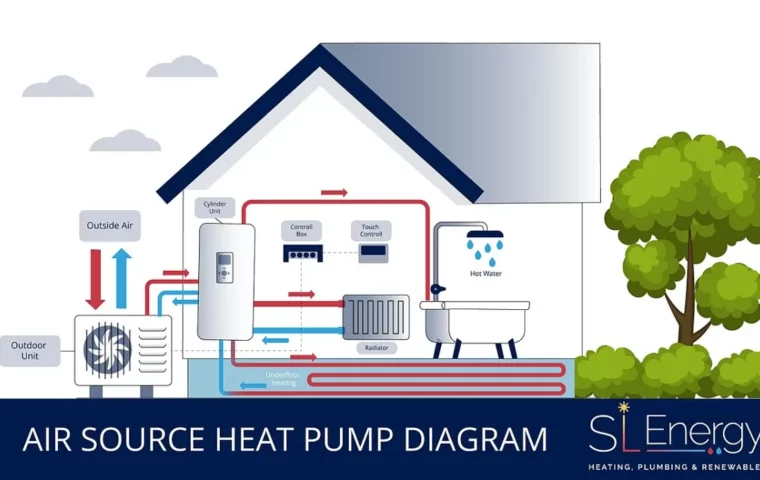
The difference lies in the mode of heat diffusion. The air-to-air heat pump directly heats the air, room by room, via indoor units. The air-to-water heat pump heats water that circulates in radiators, underfloor heating, or a hot water tank. Same aerothermal principle, but very different use.

In a well-designed house, the air-to-water heat pump plays the card of “new generation” central heating. It naturally integrates into a water network and can control the starting temperature with a water law, that is, a setting that adjusts heating according to the outside weather. It is precisely this fine control that makes the difference in seriously renovated homes.
The air-to-air heat pump goes straight to the point. It heats quickly, can cool in summer if reversible, and avoids heavy plumbing. However, it does not provide domestic hot water in most cases, and the comfort sensation depends more on blowing, the location of the units, and air circulation in the house.
“An efficient heating system is not the one that promises the most, but the one that works under good conditions.”
Air-to-water vs air-to-air heat pump: what is the essential comparison?
The short answer: air-to-air often wins on simplicity and installation price, while air-to-water scores points on overall comfort, compatibility with central heating, and domestic hot water production. The real trade-off is on the work to be planned, the level of insulation, and the daily use of the house.
| Criterion | Air-to-air heat pump | Air-to-water heat pump |
|---|---|---|
| Purchase and installation price | Often more affordable, especially for a small area or 1 to 3 rooms | Higher, particularly if the hydraulic network needs to be created or modified |
| Comfort | Quick warmth, but noticeable blowing | More homogeneous warmth, very pleasant with underfloor heating |
| Work | Generally limited | More technical, especially without existing central heating |
| DHW | No standard domestic hot water production | Possible with integrated or separate DHW tank |
| Cooling | Yes, very often in reversible version | Possible depending on models, but less “air conditioning” in use |
| Actual performance | Good if the house is well insulated and well distributed | Very good with low-temperature emitters and good regulation |
| Maintenance and noise | Outdoor unit + indoor units to monitor | More discreet units inside, but heavier installation |
The key word to keep in mind is the Heat Pump COP. It indicates the ratio between heat produced and electricity consumed under given conditions. A COP of 4 means, simply put, 1 kWh of electricity for 4 kWh of heat. But in real life, the SCOP matters more, as it reflects performance over the entire season, not just on a test bench.
“The COP looks nice on a technical sheet. The SCOP, however, tells the real story of your bill.”
In other words, a system that is very efficient on paper can prove ordinary if the house is poorly insulated, if the supply temperature is too high, or if the device is oversized. Conversely, a more modest heat pump can become an excellent deal in a thermally coherent house, with suitable emitters.
Which solution best suits your house?
The right choice almost always follows the logic of the building. A well-insulated new house can operate with either technology, a renovation with water radiators often leans towards air-to-water, and a house without a hydraulic network often finds air-to-air simpler to live with. It’s the house that commands, not the marketing label.
Well-insulated new house
In a well-insulated house, the heating demand drops significantly. If you have underfloor heating, the air-to-water heat pump becomes extremely coherent, as it works at low temperature with excellent stability. If you also want to cool the bedrooms in summer, a reversible air-to-air heat pump can be appealing, especially on a compact surface.
Concrete example: for a new 100 m² house with an estimated heating consumption of 3,500 kWh of heat per year, a heat pump with a SCOP of 4 would consume about 875 kWh of electricity for heating. With a rate around €0.25 per kWh, this comes to roughly €220 per year excluding subscription and domestic hot water. This is a simple assumption, but it shows why insulation weighs so much in the balance.
In this scenario, air-to-air can be very relevant if the house is open, if the rooms are not heavily partitioned, and if the initial budget is tight. Air-to-water regains the advantage if you prioritize diffuse comfort, underfloor heating, and the possibility of producing domestic hot water with a single system.
House under renovation with water radiators
Here, the air-to-water heat pump is often the natural candidate. Why? Because it connects to an existing central heating system. If the water radiators are adequately sized to operate at low temperature, the transition can be clean, efficient, and without turning the house into a giant construction site.
Real case #1: 120 m² house, properly insulated during renovation, with steel radiators compatible with low temperature. An old gas boiler consumed about 18,000 kWh LHV per year for heating and hot water. After switching to a well-adjusted air-to-water heat pump, the annual electricity consumption can drop to around 4,500 to 5,500 kWh depending on the SCOP, representing a notable bill reduction, especially if electricity is controlled and the dwelling was initially leaky.
The key point to watch is the starting temperature. If the radiators require 60 °C or more to heat properly, the heat pump loses its appeal. In this case, you either need to improve insulation, change some emitters, or accept supplementary heating. The water law then becomes your best ally, as it prevents heating the water more than necessary.
At the end of the installation, comfort is often perceived as softer than with an old boiler, provided there is good hydraulic balancing. The feeling in winter depends less on the brand than on the quality of regulation, flow rate, and proper commissioning. Joking aside, a poorly adjusted heat pump is like a sports car stuck in first gear.
House without central heating
If your home does not have a hydraulic network, air-to-air avoids major work. It is often the simplest short-term solution: a few indoor units, one outdoor unit, and that’s it. For a single-story house or a home with well-distributed rooms, installation can be quick and relatively clean.
Real case no. 2: a 90 m² house without water radiators, previously heated by electric convectors. A multi-split air-to-air heat pump can reduce the heating bill if the house is already properly insulated, with a potential gain of 30 to 60% depending on the old system replaced. It’s not magic: if the building leaks heat, the pump does not perform miracles. It compensates; it does not fix huge thermal losses.
The downside is the perceived comfort. Some people tolerate the airflow poorly, especially if the units are poorly placed or if the ventilation speed is too high. You also have to think about the indoor layout: in a large house, the farthest bedrooms may remain less uniform in temperature.
Poorly insulated or very energy-consuming house
In this case, the choice between air-to-water and air-to-air heat pumps takes a back seat. The real priority is insulation work: attic, walls, ground floors, joinery, airtightness. Without this, the heat pump can become overworked, run too often, and lose efficiency. This is where the classic trap occurs: buying a high-performance machine for a house that lets heat escape everywhere.
For a thermal sieve, an oversized or poorly adapted heat pump will bring neither lasting comfort nor clean savings. The energy spent will quickly rise if the machine has to operate at a high starting temperature or almost permanently as supplementary heating. In this case, it is often wiser to phase the work: first the losses, then the heating system.
How to compare comfort, noise, and real performance?
On paper, two machines may seem close. In real life, thermal comfort, noise, regulation, and responsiveness make all the difference. An air-to-water heat pump scores points for gentle heat and compatibility with low-temperature emitters; an air-to-air heat pump wins on reversibility and simplicity, but the perception of blown air remains a real deciding factor.
Thermal comfort depends first on how the heat is distributed. With underfloor heating, the air-to-water heat pump gives a very stable sensation, without drafts. With water radiators, it maintains this logic of enveloping heat, provided the starting temperature is well controlled. The air-to-air heats faster and can be very effective in mid-season, but some people feel dryness or too much air circulation.
Noise deserves real attention. The outdoor unit exists in both cases, but air-to-air adds indoor units that can be heard if they blow hard. In daily use, this is not necessarily annoying, except in a very quiet bedroom or living room. RGE installers often recommend carefully placing and adjusting speeds from the start, because a bad location costs every day.
Extreme cold and efficiency: the colder the outside temperature, the lower the heat pump efficiency. Manufacturers announce performance under specific test conditions; in the field, local climate and insulation change the equation. In cold zones, you must check available power, operating range, and possible supplementary heating. The idea is not to dramatize but to avoid promises that are too good to be true.
According to ADEME, the performance of a heat pump strongly depends on the quality of insulation and system adjustment, not just the device itself.
How much does an air-to-water or air-to-air heat pump cost, installation included?
The budget is not limited to the price of the machine. You must include installation, any necessary network adaptations, commissioning, maintenance, and consumption over several years. This is where a serious comparison becomes more useful than an attractive quote displayed in large characters. The total cost of ownership tells a more honest story.
Price of an air-to-air heat pump
For a simple configuration, the cost often remains lower than that of an air-to-water heat pump. Typical price ranges are often around €4,000 to €8,000 for a simple installation or a small multisplit, and more if several rooms are equipped. Installation is generally less intrusive, which limits the overall bill.
Real case #3: a house of 80 to 100 m² without central heating, previously equipped with old electric radiators, can see its annual bill significantly reduced with a properly sized air-to-air heat pump. But the actual savings will depend on the number of heated rooms, the use of bedrooms, insulation quality, and local climate. In short, efficiency is not just read in the catalog; it is verified on site.
Price of an air-to-water heat pump
The range is generally higher. Expect often between €9,000 and €16,000 for a standard installation, and more if the hydraulic network needs to be redone, if a domestic hot water tank is integrated, or if emitters need modification. The underfloor heating is often the best partner for an air-to-water heat pump, but a renovation with radiators can also work very well.
Long-term expenses must also be read with caution. A properly sized heat pump, regularly maintained, can last many years. Conversely, a poor initial choice can generate overconsumption, short cycles, more wear, and average comfort. Cherry on the cake: proper sizing often improves both the bill and the lifespan.
What should be included in the calculation
- The purchase cost of the heat pump, but also that of accessories and controls.
- The installation cost: indoor units, refrigerant lines, hydraulic connections, possible DHW tank.
- The estimated annual consumption according to the SCOP and insulation quality.
- Maintenance, essential to keep stable performance over time.
- Any induced works: low-temperature radiators, underfloor heating, electrical adaptation, balancing.
What financial aids and conditions to check before signing?
Aids can make a real difference, but they evolve regularly. MaPrimeRénov’, energy savings certificates, and certain local aids can lighten the budget, especially if the works are consistent with a measurable energy gain. However, eligibility rules are precise: you generally have to go through a qualified professional, often RGE, and meet technical and administrative criteria.
France Rénov’ and ANAH also remind a simple point: aid should not be the only driver of decision. If the system is poorly adapted to the house, a subsidy will not compensate for poor comfort or a disappointing bill. It is better to aim for a clean project, sized for the dwelling, rather than a subsidized makeshift solution.
Good to know: aids depend on the type of housing, income level, nature of the works, and compliance with minimum performance standards. Before signing, it is therefore useful to request several quotes, check the proposed power, announced SCOP, compatible supply temperature, and whether or not a DHW tank is included if you aim for domestic hot water.
How to choose quickly without making a mistake?
If you want a simple verdict, start from your house before starting from the machine. An air-to-air heat pump is often the right choice if you are looking for a quick, reversible, and rather economical installation solution. An air-to-water heat pump becomes more logical if you already have central heating, if you also want domestic hot water, or if you want more homogeneous heat.
- You want to heat and cool without major work: the air-to-air heat pump has the advantage.
- You have water radiators or underfloor heating: the air-to-water heat pump is often more coherent.
- Your initial budget is limited: compare the overall cost, not just the initial quote.
- You want to produce domestic hot water: air-to-water is generally the most suitable.
- Your house is poorly insulated: first address heat loss, otherwise the heat pump will quickly struggle.
In other words, the best solution is not the one that ticks the most marketing boxes, but the one that best fits the existing setup. If you change systems without considering the emitters, the supply temperature, the climate, and the actual needs of the rooms, you risk paying for a premium device with an average result.
“The ideal heating is often the one you forget, because it does its job without being noticed.”
Key points to remember
- The air-to-air heat pump heats the air directly, the air-to-water heat pump feeds a water circuit.
- With water radiators or underfloor heating, air-to-water is often the most logical solution.
- Without a hydraulic network, air-to-air avoids heavy work and reduces the entry cost.
- Comfort depends on insulation, supply temperature, noise, and sizing.
- The SCOP, not just the COP alone, gives a more reliable idea of performance over a full season.
- Subsidies can help, but they never replace a good technical choice.
In the end, which heat pump to choose for your home?
If your house already has central heating or if you want a solution capable of also providing domestic hot water production, the air-to-water heat pump generally remains the most coherent option. It performs even better with low-temperature emitters, such as underfloor heating or properly sized radiators.
If you are looking for a simpler installation, quicker to install, with often a lower initial budget and a real interest in summer cooling, the air-to-air heat pump can do the job very well, especially in a well-insulated house. The right choice is therefore not “air-to-water versus air-to-air” in absolute terms, but “which solution best fits your house, your work, and your usage?”.
FAQ: air-to-water or air-to-air heat pump
Which solution is the most economical to buy?
In most cases, the air-to-air heat pump costs less to install, especially if the home does not have central heating. But the real budget is judged over time: comfort, consumption, maintenance, and possible additional work can change the initial gap. A low quote is not necessarily a good deal.
Which heats a whole house better?
The air-to-water heat pump often heats a whole house better when it feeds a well-sized hydraulic network, with low-temperature radiators or underfloor heating. The air-to-air can also heat the entire house, but it is more sensitive to room layout, air circulation, and occupants’ perception.
Can a boiler be replaced by an air-to-water heat pump?
Yes, this is even a classic case, provided that the radiators or underfloor heating are compatible with lower temperatures. You need to check insulation, required power, supply temperature, and quality of regulation. Without these points, the transition can be disappointing or even costly in use.
Can an air-to-air heat pump be enough for the whole house?
Yes, in some well-insulated, well-ventilated, and not too large houses. However, for a multi-level or very compartmentalized house, multiple units are needed, which increases cost and can degrade aesthetics or acoustic comfort. Again, the housing configuration makes the difference.
Should the air-to-water heat pump be favored if domestic hot water is desired?
Yes, generally. The air-to-water heat pump can produce domestic hot water with a dedicated or integrated tank, making it a more complete solution. The air-to-air focuses on heating and air conditioning. If your goal includes DHW, air-to-water clearly takes the lead.