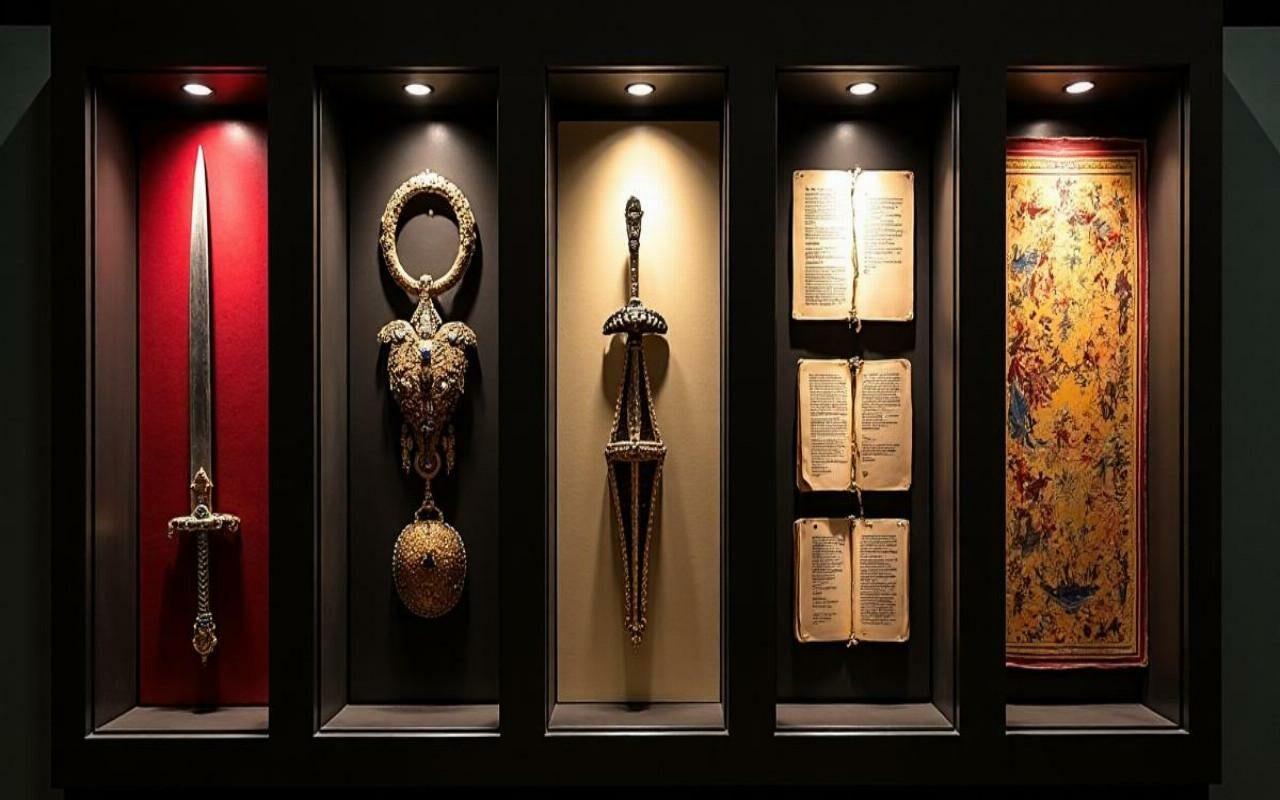
1. The Codex of Metto: the forgotten brilliance of illuminations
Forgotten for centuries in the crypt of an ancient Tuscan priory, the Codex of Metto impresses with the finesse of its illuminations. Each folio reveals a chromatic explosion made possible thanks to Afghan lapis lazuli and gilded metal, imported via unsuspected trade routes in the 13th century. The illustrations, blending biblical scenes and vegetal motifs, testify to a dialogue between Byzantine art and the emerging Gothic tradition.
By cross-referencing the marginal inscriptions, a researcher from the University of Cambridge re-evaluated the dating: rather around 1250 than 1300, which places the codex in the lineage of the first varnished works before the great Italian flourishing. An analysis by infrared spectrometry, presented at the annual British Library conference, even highlighted traces of an egg yolk-based binder, a rare technique in Northern Italy at that time.
| Color | Geographical source | Application technique |
|---|---|---|
| Lapis lazuli blue | Afghanistan | Refined on a grindstone |
| Gold | Navarre | Gold leaf applied with gum arabic |
| Cinnabar red | Spain | Cooked powder then sifted |
More than a simple object, this codex constitutes a bridge between the cultural and commercial exchanges of East and West. On each page, one perceives the distant echo of caravans and the meticulous labor of monastic workshops, reminding us that the Middle Ages were not simply a period of obscurity, but indeed an age of unsuspected connections.
2. The Jericho Compass: a revolutionary navigation instrument
Recovered embedded in the hull of a Venetian galley sunk shortly after 1187, the Jericho Compass at first glance seemed to be just a patinated brass object. Yet, its central pivot mechanism, protected by a glass dome, predates by several decades the first Chinese mention of the magnetized needle. Experts have demonstrated that it served not only for direction but also to measure latitude by observing the inclination of the magnetic north.
“This is proof of an astonishing technical mastery that disrupts our chronology of medieval inventions,” stated Professor Elena Martelli during a conference at the Maritime Institute of Rome.
Inscriptions in Old Syriac, barely legible, mention a blacksmith workshop on the eastern shore of the Mediterranean. Some can be interpreted as an allusion to the great battles of the Middle Ages fought at sea, where the precision of such an instrument changed the game. Sailors soon bequeathed this secret to Genoese cartographers, transforming navigation and accelerating the era of explorations.
- Magnetized pivot made of hardened steel
- Protective dome of blown glass
- Graduations to measure inclination
One can imagine the pride of the first sailors who, at the dawn of a perilous voyage, oriented their ships with newfound confidence. The Jericho compass embodies this fusion of metallurgical know-how and maritime pragmatism.
3. Isadore’s Spear: the sacred relic whose power is whispered about
According to tradition, Isadore’s Spear is said to have pierced the side of an obscure saint now forgotten. It is also called the “Spear of the Stars” because of its enamel decorations studded with blue stars. Discovered beneath a slab in the sanctuary of a small village in Dordogne, it was carefully removed and entrusted to a local brotherhood.
Carbon-14 dating places the assembly of iron and bronze around 1220. But it is especially its iconography that intrigues: Nordic runes mixed with Byzantine motifs and excerpts of thorny Latin praise. In a 15th-century manuscript, it is described as capable of “delivering the doubter and driving away the shadow.” Several pilgrims also reported accounts of unexplained healings after approaching it.
Recent X-ray diffraction analyses revealed an unusual cobalt content, previously only found in forges east of the Rhine. This distant origin calls into question our view of medieval metal trade.
“Between legend and reality, Isadore’s Spear remains a mystery: as much ritual as warrior,” notes historian François Delmas.
Beyond its mystical aura, the spear testifies to a world where faith and craftsmanship merged, creating objects at the crossroads of the sacred and the profane.
4. The Polychrome Mirror of Aquitaine: a masterpiece of medieval glassmaking
In the heart of Aquitaine, a monastic workshop uncovered in 1923 yielded this spherical colored glass mirror. Polychrome, it bears finely chiseled gold inlays, evoking a stylized sun surrounded by vegetal arabesques. The fusion and polishing techniques used recall the sophistication of the medieval monastic orders who often held the monopoly on fine glassmaking.
Its concave shape suggests an esoteric use: more than a toiletry object, this mirror could have been used during rituals of divination or liturgy. Traces of scented waxes, identified as a mixture of benzoin and pine resin, were found on its edges. Several documents from the priory’s library mention a “speculum arcanae,” whose description is found in an inventory from 1387.
- Diameter: 22 cm
- Glass thickness: 1.5 cm
- 24-carat gold inclusions
This mirror highlights the surprising alliance between glass art and spiritual practices. It illustrates the quest for true brilliance, a metaphor for hidden knowledge cherished by the intellectual circles of the time.
5. The Seal of the Order of Saint-Benaric: Trace of a Hidden Power
Forged around 1265, this official seal stands out for its complex iconography: a shield strewn with stars, surrounded by an inscription in Old French that is almost illegible. It comes from a Cistercian abbey whose very existence was erased during the Revolution. Yet, the recent discovery of the seal reminds us of the discreet but real role of these communities.
| Element | Description |
|---|---|
| Alloy | Lead (60%) and tin (40%) |
| Diameter | 3.2 cm |
| Inscription | « SIGILLVM SCS BENARIC » |
Anchored in a strict hierarchical model, monastic orders used these seals to authenticate charters, correspondence, and privileges. That of Saint-Benaric reveals a discreet influence in diplomatic negotiations between local lords and bishops. Recent excavations have uncovered previously unseen sealed letters, confirming that the abbot of Saint-Benaric played a role as a political mediator.
Through this small metal ring, an entire network of alliances and information reemerges, demonstrating that in the Middle Ages, power often spread through secret channels rather than on battlefields.
FAQ
How have these artifacts been preserved until today?
Many escaped looting thanks to their burial or the negligence of invaders. The conservation conditions—dry underground areas or crypts—often allowed the stabilization of organic and metallic materials.
What scientific methods allow dating these objects?
Dating by carbon-14, pigment analysis by spectrometry, and the study of inscriptions with an electron microscope are combined. Each technique provides clues about the geographical origin and period.
Are there other medieval artifacts as little known?
Yes, several pieces continue to await rediscovery, such as certain illuminated manuscripts forgotten in isolated convents or scientific instruments left in disused cathedral towers.
Where can these five artifacts be seen today?
They are distributed among regional museums, university libraries, and private collections. The Codex of Metto and the Compass of Jericho are the subject of traveling temporary exhibitions.
{
“@context”: “https://schema.org”,
“@type”: “WebPage”,
“about”: {
“@type”: “Thing”,
“name”: “Forgotten Artifacts of the Middle Ages”
},
“keywords”: [“medieval artifacts”, “illuminations”, “compass”, “relic”, “monastic”]
}
{
“@context”: “https://schema.org”,
“@type”: “Article”,
“headline”: “The 5 Forgotten Artifacts of the Middle Ages That Defy Time”,
“description”: “Exploration of five little-known medieval treasures: illuminated manuscript, ancestral compass, sacred lance, esoteric mirror, and monastic seal that have endured through the centuries.”,
“keywords”: [“codex”, “compass”, “lance”, “mirror”, “seal”],
“mainEntity”: {
“@type”: “FAQPage”,
“mainEntity”: [
{
“@type”: “Question”,
“name”: “How have these artifacts been preserved until today?”,
“acceptedAnswer”: {
“@type”: “Answer”,
“text”: “Many escaped looting thanks to their burial or the invaders’ negligence. The preservation conditions—dry underground locations or crypts—often helped stabilize organic and metallic materials.”
}
},
{
“@type”: “Question”,
“name”: “What scientific methods are used to date these objects?”,
“acceptedAnswer”: {
“@type”: “Answer”,
“text”: “We combine carbon-14 dating, pigment analysis by spectrometry, and the study of inscriptions with an electron microscope. Each technique provides clues about the geographic origin and period.”
}
},
{
“@type”: “Question”,
“name”: “Are there other little-known medieval artifacts?”,
“acceptedAnswer”: {
“@type”: “Answer”,
“text”: “Yes, several pieces continue to await rediscovery, such as certain illuminated manuscripts forgotten in isolated convents or scientific instruments left in abandoned cathedral towers.”
}
},
{
“@type”: “Question”,
“name”: “Where can these five artifacts be seen today?”,
“acceptedAnswer”: {
“@type”: “Answer”,
“text”: “They are distributed among regional museums, university libraries, and private collections. The Metto Codex and the Jericho Compass are featured in traveling temporary exhibitions.”
}
}
]
}
}