
In Brief
🧭 A good home insurance comparison is first read through the guarantees, the deductibles, the indemnity limits, and the exclusions, not just the premium.
🏠 The housing status changes everything: tenant, owner-occupier, or PNO (non-occupying owner) do not have the same needs or obligations.
⚠️ The painful differences often appear at the time of a claim: 5 working days to report most damages, 2 days in case of theft, and a legal deductible of €380 for natural disasters.
📌 Before signing, also check the claims service, the cancellation after one year, and whether the options fit your lifestyle. The “perfect” contract on paper can be average in practice.
How to Compare Home Insurance Without Making Mistakes?
To compare home insurance, you need to put on the same level the premium, the deductibles, the indemnity limits, the exclusions, and the assistance. The cheapest contract is not necessarily the most cost-effective if water damage leaves €500 at your expense or caps the furniture coverage too low.
The first filter is your actual situation. A tenant of a studio in Paris does not have the same expectations as an owner-occupier in Bordeaux, nor as a landlord in PNO in Lille. Needs vary depending on the size, the value of the furniture, the presence of a cellar, a garage, or an outbuilding, and even depending on the neighborhood or the floor.
It should be noted that the legal framework is not the same either. The site Service-Public.fr on home insurance reminds that tenants generally must insure their dwelling and provide a certificate. On their side, cancellation is facilitated after one year via the Hamon law, as detailed by Service-Public.fr on insurance contract cancellation.
In other words, even before looking at promotions, you need to ask three simple questions: what do I want to protect, what amount can I absorb in case of trouble, and what level of service do I expect at the time of the claim? This sorting avoids “shiny” but shaky contracts.
Guarantees to Check as a Priority
Basic guarantees alone are not enough. What matters is their depth. A home insurance policy can cover the usual basics — fire, water damage, theft, glass breakage, civil liability — while significantly limiting compensation or imposing fairly strict access conditions. This is where the details make all the difference.
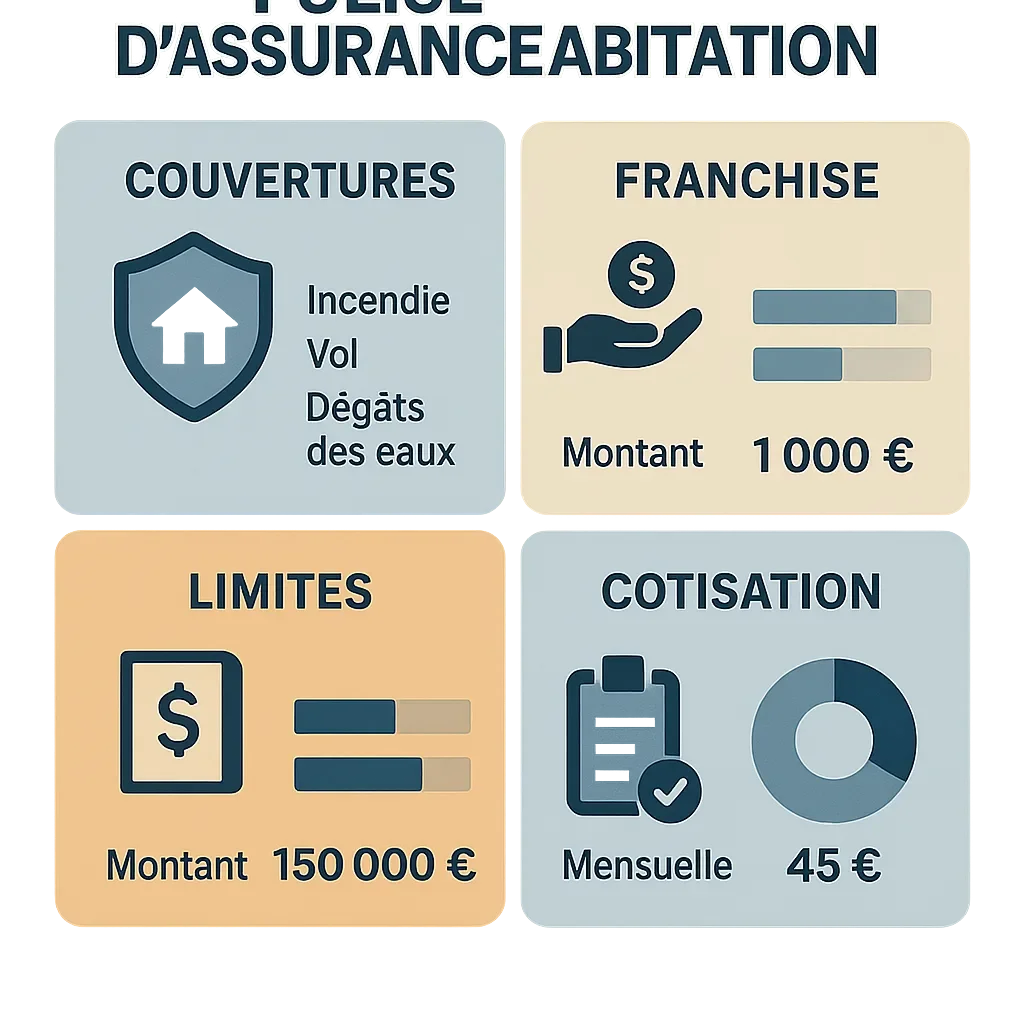
The smartest approach is to compare each guarantee as an independent block. Here are the points that deserve a spotlight:
| Criterion | What to Check | Common Pitfall |
|---|---|---|
| Water Damage | Leak detection, infiltration, repair of goods, coverage of drying costs | A covered leak, but not the ancillary costs or restoration |
| Theft / Vandalism | Conditions of break-in, ground floor, basement, outbuildings, valuables | Guarantee active only if certain locks or closures are required |
| Civil Liability | Damage caused to a neighbor, a third party, or the condominium | Insufficient ceiling for a widespread claim |
| Glass Breakage | Windows, veranda, bay windows, sometimes cooktops or mirrors | Too restrictive a definition of glazed surfaces |
| Assistance | Emergency intervention, rehousing, safeguarding belongings, repairs | Service advertised 24/7 but limited to certain cases |
The right reflex is to match these guarantees to your daily life. An old apartment in Lyon with tricky plumbing does not expose you to the same risks as a new house on the outskirts of Nantes. The same goes for a furnished accommodation or an apartment where you telework with expensive equipment.
Deductibles, Ceilings, Exclusions: How to Read Them Without Getting Tricked?
Two similar contracts can be very different as soon as a claim occurs. The right choice is made by looking at what is actually covered, the deductible amount, the limits per guarantee, and the quality of claims management. In other words, you compare actual use, not just the price line.
The deductible is the amount you have to pay yourself. If it is too high, a small breakage becomes almost pointless to declare. The compensation ceiling sets the maximum limit paid by the insurer. And exclusions are the less glamorous part of the contract but often the most decisive. Joking aside, this is where the worst surprises hide best.
You also need to watch out for waiting periods, that is, the period during which the guarantee exists on paper but is not yet active. This point sometimes appears in “cheap” offers, especially on some entry-level contracts. If you move quickly or need to insure a home immediately, this detail can block you at the worst moment.
In France, the natural disaster mechanism requires particular vigilance. The legal deductible is generally €380 for a home, with a specific regime depending on the type of claim. In a drought-rehydration episode, this line can weigh much more than a monthly premium difference of a few euros.
At this stage, a useful comparison looks less like a price hunt and more like a mini audit of the contract. This is where tools like the Insurance Code on Légifrance make sense: the contract is a promise, but the legal wording sets the real limits.
Choosing the right contract according to your housing and profile
A home insurance comparison is only valuable if it fits the insured profile. The “universal” contract does not exist. It is better to have a well-tailored plan than an overly broad package paid for nothing. Here are some simple guidelines to avoid overpaying or underinsuring:
- Tenant of a studio: first look at civil liability, water damage, theft, and furniture protection, even if its value remains moderate.
- Family in a house: the veranda, garden, garage, outbuildings, and emergency assistance quickly become important.
- Non-occupying owner (PNO): check the vacancy of the housing, landlord liability, and coverage of claims that may occur without an occupant present.
- Shared housing: check who is named on the contract, what happens if a roommate leaves, and how each person’s personal belongings are covered.
- Secondary residence: monitoring the home, theft during absence periods, and any outbuildings become sensitive points.
In practice, it is observed on the ground that quality differences are mainly seen when the housing deviates from the standard scenario. A family settled in a house on the outskirts of Bordeaux often reports discovering too late the importance of temporary relocation after a claim. Conversely, a student in shared housing in Lyon sometimes realizes that a too “premium” contract makes them pay for guarantees they will never use.
To give a rough idea, the comparison becomes even more useful when the home contains valuable equipment: work computer, camera, electric bike, jewelry, or musical instruments. In an apartment in Lille or a house in Montpellier, these items are not protected in the same way if the furniture ceiling is too low or if valuables are capped separately.
The claims service is often worth more than a €5 difference
The moment when the insurer really becomes visible is after the claim. And this is where a difference of a few euros per month turns into a very concrete difference. The quality of the claims service, response time, clarity of communication, and ease of filing the claim often matter more than a small welcome discount.
Sometimes it is said that all are equal, but in practice this is not the case. The contracts that stand out are often those that offer a simple declaration, clear follow-up, and a reachable contact person. A good commercial promise does not replace a smooth compensation process when it is necessary to restore a home quickly.
There are also practical guidelines to keep in mind: most contracts require a claim declaration within 5 working days, or within 2 days in case of theft. For a natural disaster, the deadline is different and starts after the publication of the decree. These deadlines must be checked in the contract conditions, not assumed.
Finally, the life of the contract also matters. Once the first year has passed, cancellation is generally possible at any time, which allows for a smarter comparison over time. If you find better on the market, you are not condemned to remain stuck in an average plan.
Errors to Avoid Before Signing
The most common trap is to stop at the monthly payment. You compare two rates, see a difference of 2 or 3 euros, and forget that a more expensive contract may include useful assistance, better compensation for furniture, or less aggressive exclusions. Conversely, the cheapest contract can become troublesome from the first incident.
Another frequent mistake: not reviewing the options. Some are essential in one specific case, then totally unnecessary in another. No need to pay for a pool guarantee when living in an apartment on the fourth floor, but it would be a shame to overlook the replacement value when equipping a house with a lot of appliances.
The last misstep is to believe that a comparison tool does the work for you. It helps, of course. But good judgment always requires checking the fine print, exclusions, exact deductible, and the claims handling logic. There are many offers, but the contract that suits you best is often the one that fits your daily life best, not the one that displays the loudest promotion.
Joking aside, the right home insurance is not the one that promises everything. It’s the one that compensates quickly, clearly, and without unpleasant surprises at the worst moment.
FAQ on Home Insurance Comparison
Should I always choose the cheapest offer?
No, because a small monthly saving can hide a high deductible or a too low limit. If you have furniture, computer equipment, or valuables, the difference often plays out at the claim, not at subscription. The right reflex remains to compare the total cost of the risk.
Does the comparison change depending on whether I am a tenant or an owner?
Yes, significantly. The tenant mainly seeks coverage for rental risks and their liability, while the owner-occupier looks more at the building, outbuildings, and sometimes broader options. For a landlord with non-occupied property insurance (PNO), the vacancy of the property and the owner’s liability carry even more weight.
Are valuables automatically covered?
Not always, and that’s where surprises happen. Jewelry, artworks, electric bikes, musical instruments, or photographic equipment may be subject to a sub-limit or specific declaration. If their value exceeds a few hundred or thousand euros, you need to check the exact line in the contract.
Does home insurance cover damage caused by a neighbor?
Often yes, via liability insurance or agreements between insurers, but you need to look at the specific case. If water damage comes from a neighboring apartment, coverage depends on the origin of the damage, proof, and the guarantees involved. The useful reflex: declare quickly and keep photos.
Is it useful to compare before moving?
Yes, because the risk level changes with the dwelling. A ground floor, a basement, a house with a garden, or a renovated apartment are not compared in the same way. Moving is often the best time to adjust coverage to the new reality of the property.
Is cancellation after one year really simple?
In practice, yes, especially since the Hamon law, but you must follow the procedure provided by the contract. The new insurer can often handle the steps if the contract is eligible. Before canceling, especially check the effective date of the new contract to avoid a coverage gap.