In a living room, the TV stand plays a much more important role than one might imagine. It supports the screen, of course, but it also structures the entire main wall, organizes multimedia equipment, and contributes to the overall ambiance of the room. When well chosen, it facilitates movement, clarifies storage, and enhances the style of the living area. Conversely, a model that is too small, too bulky, or poorly designed can quickly unbalance the whole.
This choice therefore deserves some method. Between the growing screen sizes, the needs for cables, boxes or consoles, and the desire for a warmer interior, you have to find the right compromise between aesthetics and use. To explore different styles, materials, and formats, you can consult more information here.
The subject is all the more interesting when looking for a wooden piece of furniture. Wood remains one of the most appreciated materials in the living room because it immediately brings texture, relief, and a sense of durability. Still, you have to choose the right length, the right height, the right type of storage, and the style that will truly match the rest of the furniture.
Sommaire
Why the TV stand remains a central piece of the living room
We often first think of the sofa or the coffee table, but in practice, the gaze very often returns to the TV wall. It is a focal point. The furniture that accompanies it must therefore do two things at once: remain practical daily and provide real visual coherence to the room. This is especially true in living rooms where the television, speakers, decoration, and sometimes even a dining area coexist in the same zone.
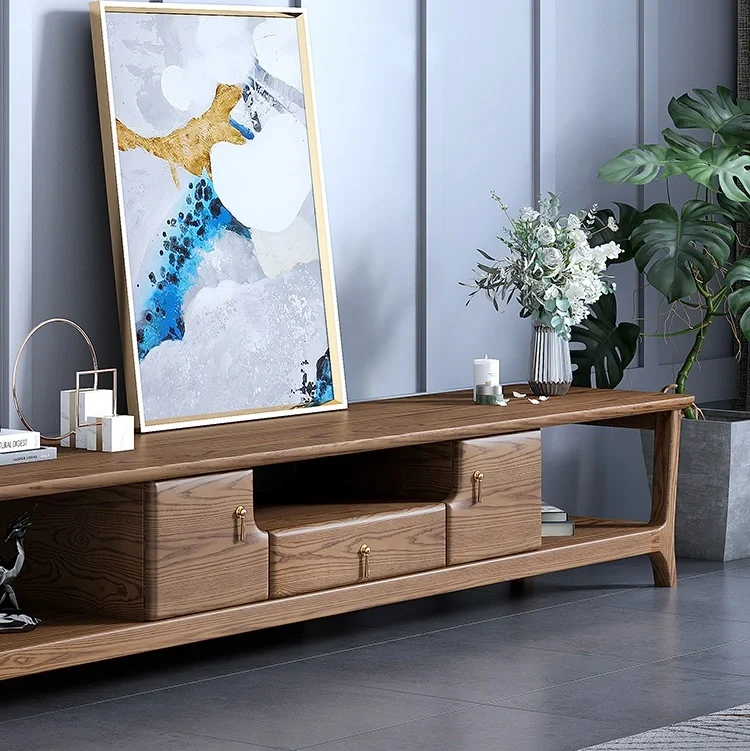
Wood works very well for this use. It warms up the sometimes very technical lines of the audiovisual world. It also avoids the too cold effect that some fully black, lacquered, or metallic furniture can produce. At Made in Meubles, the dedicated category highlights this logic of balance between aesthetics, durability, and practicality, with a collection where wood occupies a dominant place.
The right dimensions: the first criterion to check
Before any style consideration, you have to look at the measurements. A well-proportioned TV stand makes the living room more harmonious. As a general rule, it is recommended to choose a piece of furniture slightly wider than the screen. This creates a more visually stable ensemble and leaves some space for a few decorative objects or small equipment.
Here are some simple benchmarks:
| Screen size | Approximate screen width | Recommended furniture width |
|---|---|---|
| 43 inches | 95 to 100 cm | 120 to 140 cm |
| 55 inches | 122 to 125 cm | 150 to 180 cm |
| 65 inches | 144 to 146 cm | 170 to 200 cm |
| 75 inches | 166 to 168 cm | 190 cm and above |
Height matters just as much. In most living rooms, a TV stand around 45 to 60 cm high allows maintaining a comfortable viewing position once seated. Regarding depth, a range of 35 to 45 cm suffices in most cases. This leaves room for a box, a console, some cables, and sometimes accessories, without unnecessarily taking up passage space.
Wood, mango wood, black, industrial, Scandinavian: which style for which living room?
The Made in Meubles category page allows you to quickly identify the main families offered. There are currently 109 TV stands, including 93 wooden models and 64 in mango wood. The collection also includes design, black, industrial, or Scandinavian models. This variety is useful because a TV stand does not fulfill the same visual function depending on the type of interior.
The wooden TV stand remains the most versatile. It fits just as well in a contemporary living room as in a more authentic atmosphere. Mango wood, with its livelier grain and golden shades, suits those looking for a warm and somewhat more unique finish. The industrial style, which often combines raw wood and black metal, works well in a living room with character. The Scandinavian style, lighter, is ideal in a bright space where you want to preserve a sense of softness.
In other words, the right piece of furniture is not just the one that “pleases” on a product sheet. It is the one that extends the visual language already present in the room: sofa color, coffee table material, natural light, presence or absence of other bulky furniture.
Storage often makes the real difference
A successful TV stand is not just a support. It must also absorb part of the visual clutter of the living room. Cables, remote controls, internet boxes, controllers, chargers, or small everyday objects accumulate quickly. This is where niches, doors, drawers, and cable passages come into play.
Open niches are useful for equipment that must remain accessible or ventilated. Closed doors, on the other hand, allow for a cleaner facade. In an apartment in Lille with a compact living room, a piece of furniture 140 to 160 cm wide with 2 doors and a central niche may suffice. In a family house in Seclin, a format of 180 to 200 cm will often be more relevant to distribute uses and better structure the TV wall.
You also have to think about maintenance. Slightly raised feet facilitate vacuuming. A too openwork facade requires more dusting. These are details, but they are what make the furniture pleasant over time.
What budget to plan for a durable TV stand?
The price varies according to length, wood species, level of finish, and storage complexity. On the Made in Meubles category, starting prices begin around €100 to €199.99, but they remain few. The core of the offer is mainly between €400 and €699.99, with 77 references out of 109 in this price range. This gives a good order of magnitude for a main piece of furniture intended for the living room.
- €100 to €299: rather for a small format, a secondary room, or an occasional need.
- €400 to €699: the most coherent range for a decorative, spacious, and durable TV stand.
- €700 and above: larger formats, more marked finishes, or pieces with strong personality.
In a sustainable furnishing logic, this budget must be considered in relation to the duration of use. A TV stand often remains in the same place for several years. It sometimes accompanies several evolutions of the living room, even a screen change. It is therefore better to aim for a model just right in dimensions and storage rather than a too economical purchase to replace quickly.
How to integrate it harmoniously into the living room
The TV stand must dialogue with the rest of the room. If it is very present, it is better to avoid adding too many bulky elements around. Conversely, a low and simple model can be enhanced by a frame, a lamp, a few books, or a structuring plant. Good layout is based on this simple idea: give rhythm without overloading.
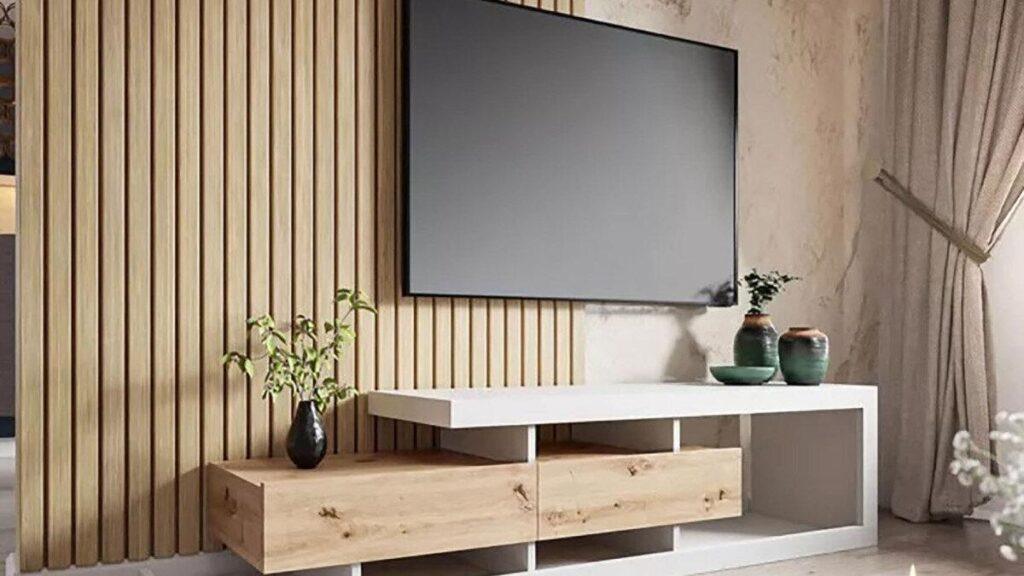
The wall behind the furniture also matters. A slightly deeper shade, a textured covering, or a wood decor can be enough to better define the space. On its magazine, Made in Meubles also offers an article dedicated to decorative wood panels to structure a wall, an interesting lead to give more relief to the TV corner without multiplying furniture.
In a rather neutral interior, the TV stand can become the piece that brings the extra soul. This is one of the reasons why wooden models often stand out more than a completely smooth piece: they create a presence without falling into an overly demonstrative effect.
What the Made in Meubles universe brings in addition
The “Who are we?” page clearly explains the brand’s positioning. Made in Meubles tells a story born around Paul and Valérie Demars, a couple from Lille, with a culture of cabinetmaking, field commerce, and an assumed attachment to noble materials. The brand also recalls important milestones, such as the creation in 1996, the opening of a depot in Seclin in 1997, then a showroom in Villebon-sur-Yvette in 2016.
This story is not trivial. It explains why the TV stand collection highlights so much solid wood, mango wood, the work of materials, and even irregularity as a signature. For the buyer, this changes the reading of the product: it is not just a functional piece of furniture, but a piece designed to last visually as much as in use.
Durability, air quality, and end of life: the right reflexes
Choosing durable furniture also means thinking about its immediate environment. When renovating a wall behind the television or adding decorative panels, it is useful to look at the indoor air emission labeling of decoration and construction products. The ministry reminds that the scale goes from A+ to C, which can help to make a more serene decision during a global furnishing project.
For furniture and decoration, the ADEME also recommends limiting pollutant sources in the house and staying attentive to material choices. Regular ventilation after installation remains a simple and useful reflex.
Finally, a piece of furniture or old multimedia equipment should not end up just anywhere. The public tool Where to drop off your items? helps identify donation, take-back, or drop-off solutions near you. This is an interesting approach when replacing both the furniture and the devices that accompany it.
FAQ
What width to choose for a living room TV stand?
It is better to choose a piece of furniture slightly wider than the screen, ideally with 10 to 20 cm of overhang on each side to keep a more balanced look.
Is mango wood a good choice for a TV stand?
Yes. It is a wood appreciated for its dense, warm, and textured appearance. It suits living rooms seeking character without sacrificing versatility.
Should you favor a low TV stand?
In most cases, yes. A low TV stand visually lightens the wall, facilitates viewing comfort, and easily fits into a modern living room.
What budget seems most realistic for a durable TV stand?
For a main piece of furniture in the living room, a budget between €400 and €700 often corresponds to a good balance between style, storage, and durability.
How to avoid the effect of an overly cluttered wall around the television?
You have to limit heavy volumes, keep some visual breathing space, and choose either a strong piece of furniture with a sober decor or a simpler piece with a slightly enhanced wall.
Can you choose a TV stand solely based on style?
Better to avoid it. Dimensions, depth, storage, and circulation in the room remain at least as important as appearance.