
In brief
📌 The partial surrender does not close the contract: it only withdraws a fraction of the savings, which allows you to keep the tax seniority.
💸 In 2026, only the gains contained in the withdrawal are taxed. The capital withdrawn itself is not taxed.
🧾 After 8 years, the annual allowance of €4,600 for a single person or €9,200 for a couple can significantly reduce the bill.
📈 According to France Assureurs (2024), life insurance accounts for around €1,900 billion in assets in France. Needless to say, the partial surrender mechanism concerns many people.
How is a partial surrender of life insurance taxed in 2026?
In 2026, a partial surrender of life insurance is taxed only on the portion of gains contained in the withdrawal, never on the capital paid in. To this base are added social contributions of 17.2%, then income tax depending on the contract’s age and the chosen regime.
The logic is simple, but you have to read it correctly: when you withdraw €5,000, the administration does not consider that all €5,000 are gains. The insurer allocates the withdrawal between capital and capital gains proportionally to the contract’s value. It is this share of gains that serves as the basis for taxation.
In practice, the partial surrender does not reset the counter. The contract remains active, its opening date does not change, and it is this seniority that then governs the tax treatment. That is why a contract opened in 2015 does not incur the same tax bill as a contract opened in 2024, even for an identical withdrawal.
The official framework is summarized by the Service-Public.fr fact sheet on life insurance contracts. For general tax bases, the individuals section of the Ministry of Economy remains a good guide.
How much tax do you pay depending on the contract’s age?
Before 8 years, the basic rule remains the 12.8% flat tax (PFU) on gains, plus 17.2% social contributions. After 8 years, the annual allowance of €4,600 or €9,200 can reduce the tax to zero on part of the withdrawal.
The tipping point is indeed the contract’s seniority. Before 8 years, taxation is harsher; after 8 years, it becomes much softer, especially if the withdrawal remains moderate. However, be careful: the allowance is not magic that erases everything. It applies to the portion of gains included in the surrender, not on the gross amount withdrawn.
| Situation | Taxation on the gains portion | Key points |
|---|---|---|
| Contract less than 8 years old | 12.8% tax by default, or income tax scale by choice, + 17.2% social contributions | No specific allowance on the withdrawal |
| Contract over 8 years old, premiums paid below the threshold | Annual allowance of €4,600 / €9,200, then taxation at 7.5% on the eligible portion, + social contributions | The threshold is assessed across all contracts combined |
| Contract over 8 years old, high premiums | Rate of 7.5% up to €150,000 in premiums, then 12.8% beyond that for the concerned portion, + social contributions | The breakdown depends on payments and their dates |
In other words, two people can make the same partial withdrawal and pay very different amounts. One may remain under the annual allowance and owe no income tax; the other may exceed the premium threshold and fall into a less favorable treatment. Hence the importance of simulating before requesting the payment.
How to calculate the taxable portion of a partial withdrawal?
The calculation starts from the ratio between the amount withdrawn and the total value of the contract. This ratio is then applied to the latent gains to isolate the taxable fraction, then the correct tax regime is added. For a well-funded contract, the formula can make a real difference.
The mechanism is simpler than it seems. Imagine a contract worth €20,000, with €18,000 in contributions and €2,000 in gains. If you withdraw €5,000, the portion of gains included in this withdrawal is in principle €500: 5,000 × 2,000 / 20,000. It is this base that is taxed, not the full €5,000.
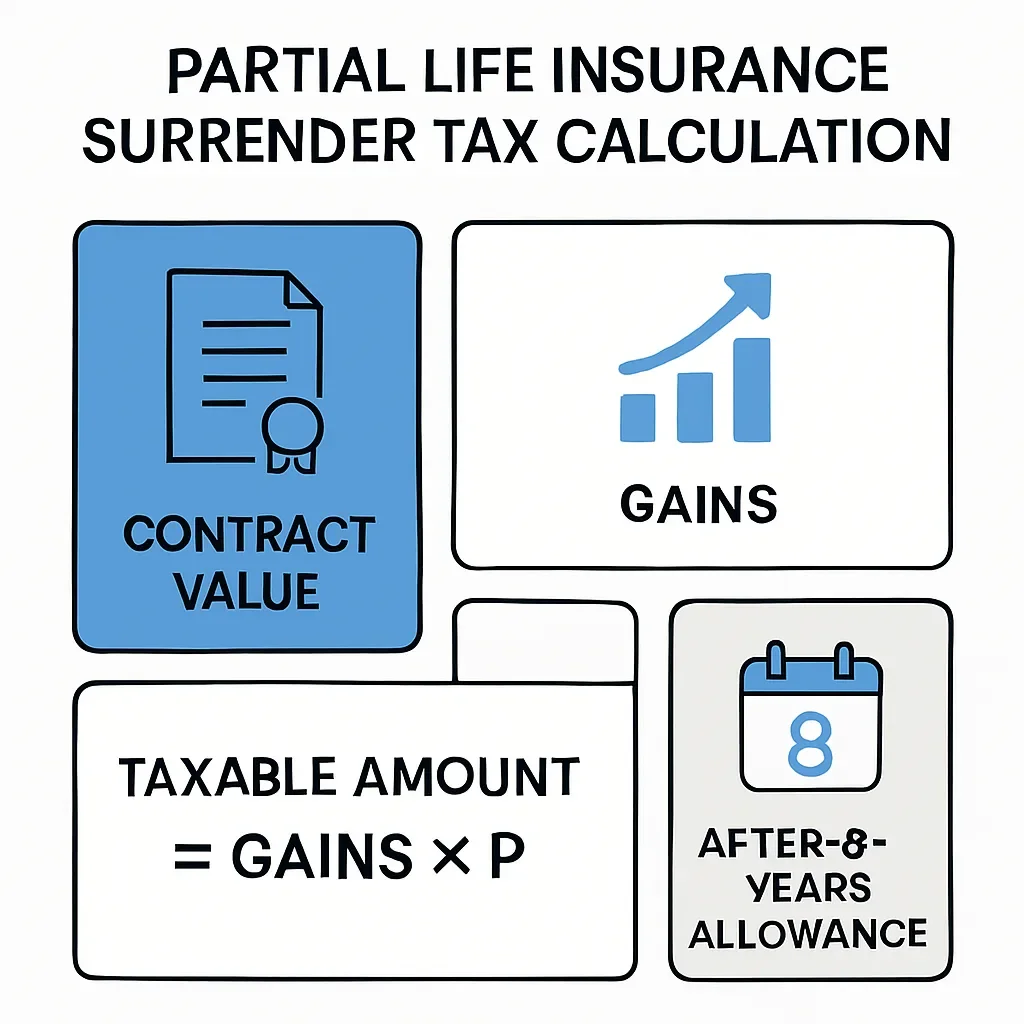
Then, the correct rate is applied. In the same example, before 8 years, the €500 of gains may be subject to 12.8% tax, i.e. €64, plus 17.2% social contributions, i.e. €86. Total: €150 tax on the gains portion alone. After 8 years, the result can be much lighter if the annual allowance has not yet been used.
- Step 1: note the value of the contract on the day of withdrawal.
- Step 2: identify the gains portion included in the contract.
- Step 3: calculate the taxable share of the withdrawal on a pro rata basis.
- Step 4: apply the correct tax regime according to seniority and premiums.
It is observed in practice that a scheduled withdrawal of €150 to €300 per month is often chosen by savers close to retirement. The idea is not to empty the contract, but to transform the life insurance into a small annuity without breaking the tax seniority.
A small but important nuance: if the contract is invested in unit-linked funds, the value may fluctuate between the request and the valuation date. The final amount, and thus the taxable gains portion, may then vary slightly. On a euro fund, the calculation is often more stable, which facilitates the clarity of the withdrawal.
What is the difference between partial redemption, advance, and total redemption?
Partial redemption keeps the contract open, the advance works like a loan backed by the savings, and total redemption closes the door behind you. In practice, you choose the advance for a temporary need, partial for a lasting withdrawal, and total when you want to settle.
From a wealth perspective, these three solutions do not follow the same logic at all. Partial redemption withdraws money while leaving the envelope intact. The advance, on the other hand, does not break the contract: the insurer lends you a sum against remuneration, somewhat like a cash credit. Finally, total redemption closes everything and permanently erases the tax seniority.
| Solution | Immediate taxation | Main benefit |
|---|---|---|
| Partial redemption | Yes, on the portion of gains withdrawn | Get cash while keeping the contract |
| Advance | No, because it is not a redemption | Obtain temporary liquidity without selling your investments |
| Total redemption | Yes, on the contract’s portion of gains | Exit the contract definitively |
The right choice is not always fiscal. When the need for money is temporary, the advance can be more elegant than a redemption, even if it is not free.
The real issue is the need behind the operation. If you want to finance a one-time project, partial redemption or advance often do the job. If you want to simplify your wealth, total redemption can be justified. But if you value seniority, inheritance framework, and future flexibility, partial redemption often remains the best compromise.
How to request a partial redemption without making a mistake?
A well-prepared partial redemption request relies on three reflexes: check the contract conditions, specify the desired amount or percentage, then follow up until payment. Complete files move quickly; missing documents cause unnecessary delays.
The simplest way is to start by rereading the general conditions. Some contracts require a minimum to keep, others accept a withdrawal by percentage, others still prefer a precise net amount. For multi-support contracts, also check the disinvestment rules: selling units of account may take a little longer than a simple movement on euro funds.
- Check the contract rules: minimum amount, possible fees, authorized withdrawal method.
- Choose the form of redemption: gross amount, net amount, or percentage depending on the insurer.
- Prepare the documents: ID, bank details, signed form, sometimes additional proof depending on the contracts.
- Send the request: client area, registered mail, or dedicated form.
- Follow up on the payment: verify the amount paid, the value date, and the tax document sent.
In practice, a complete file is often processed within a few business days to two weeks, depending on the insurer and the complexity of the investments. The delay may be longer if the contract contains many units of account, if the signature is missing, or if a particular clause blocks the operation. For the general framework, you can also rely on Service-Public.fr and the individuals section of the Ministry of Economy.
Good to know: if the beneficiary clause was accepted under particular legal conditions, or if the contract was pledged, some operations may be regulated. Before confirming a withdrawal, it is better to reread the contract clauses rather than discover the lock afterward.
What pitfalls should be avoided before validating a partial withdrawal?
The most costly mistakes often come from poor timing or incorrect calculation of the 8-year threshold and the €150,000 premium limit. A poorly calibrated withdrawal can also reduce the annual allowance, especially when multiple contracts are held by the same policyholder.
The number one pitfall is to look only at the amount withdrawn without considering the proportion of gains. The second pitfall is to forget that the allowance after 8 years is shared among all life insurance contracts held by the same person. The third pitfall is to make a withdrawal too quickly when a contract was just about to reach the 8-year mark. Sometimes, a few weeks really make a difference.
- Do not confuse the amount withdrawn with taxable gains.
- Do not forget the annual allowance, especially if other withdrawals have already been made during the year.
- Do not ignore contributions made after September 27, 2017, and the €150,000 threshold.
- Do not neglect the impact of a unit-linked contract, whose value can fluctuate at the time of disinvestment.
- Do not withdraw in full if the goal is only to obtain short-term cash flow.
It is also useful to keep an eye on the wealth management objective. A partial withdrawal sometimes serves to finance a project, sometimes to smooth income, sometimes to rebalance other investments. In all cases, the right reflex is to check whether the simplest solution is not also the most expensive. Joking aside, with life insurance, simplicity sometimes costs a little more than patience.
FAQ
Can a partial withdrawal be made just before 8 years?
Yes, it is possible at any time if the contract allows it. But if you are a few months away from the 8-year deadline and the need is not urgent, waiting can be smart: the annual allowance and the reduced rate after 8 years can change the bill.
Does a partial withdrawal trigger social contributions even if I withdraw a small amount?
Yes, social contributions apply to the portion of gains included in the withdrawal, even if the amount withdrawn is modest. The rate of 17.2% remains the reference in metropolitan France in 2026.
Should I choose the flat tax (PFU) or the income tax scale?
The PFU is generally the default regime, but the scale can become more advantageous if your marginal tax rate is low. The right choice depends on the amount of gains, your other income, and whether an allowance is still available.
Does a partial withdrawal modify the beneficiary clause?
No, a partial withdrawal does not rewrite the beneficiary clause. However, it reduces the value transmitted upon death since it decreases the contract’s outstanding balance. This is sometimes intentional, sometimes not: it is better to do it knowingly.
Can partial withdrawals be scheduled in 2026?
Yes, many contracts allow scheduled partial withdrawals. This is convenient for receiving a regular income supplement, but you must check the minimum amount retained on the contract and the cumulative tax impact over the calendar year.
Is the taxation the same on euro funds and unit-linked funds?
The tax rule remains the same, but the calculation can be more variable on unit-linked funds because the contract’s value fluctuates with the markets. On a euro fund, the withdrawal is often more predictable, which simplifies understanding the taxable amount.