A Choice Driven by Economic and Personal Factors
Turning to compact housing often results from a simple equation: reduce expenses and gain mobility. Rent and charges decrease mechanically, but that’s not all: the effort of sorting and selecting belongings embodies a lifestyle freed from unnecessary accumulation. Psychologically, fewer possessions mean fewer distractions: attention focuses on essentials, from encounters to creative projects. One then glimpses a new balance between financial autonomy and mental serenity.
Maximizing the Perception of Space

Play of Colors and Light
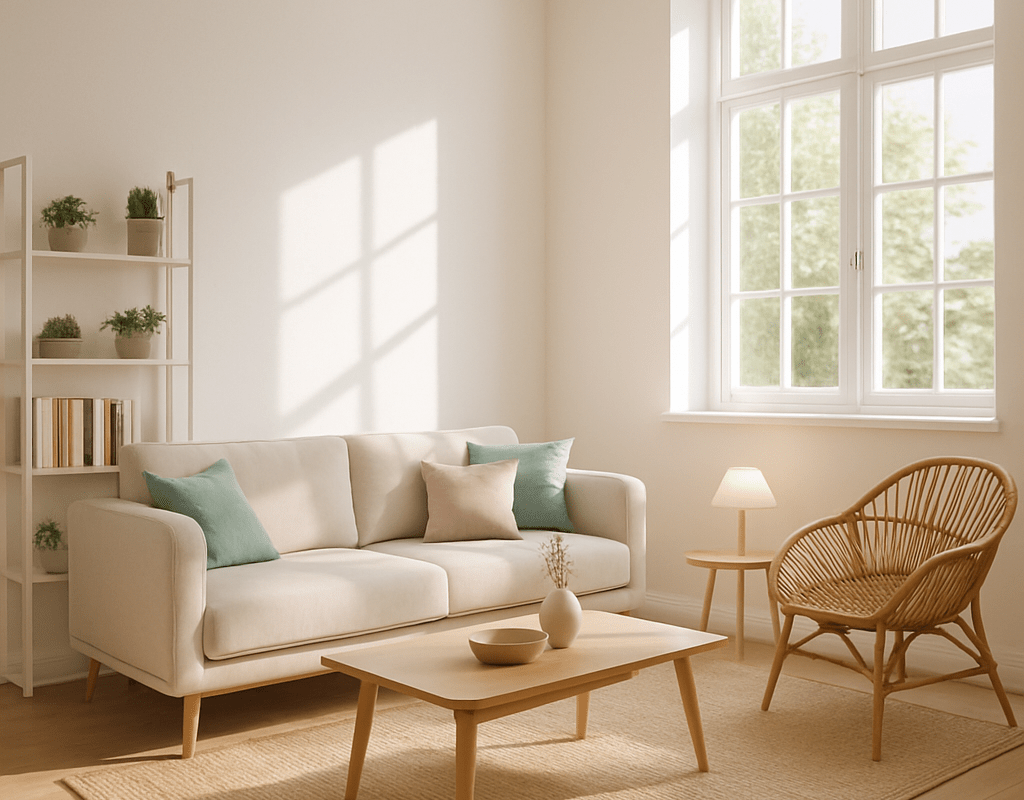
Pastel palettes or warm whites reflect light and visually enlarge a room. By playing with subtle shades on the ceiling and walls, additional volume is created without altering the structure. Strategically placed mirrors reflect natural light and give the impression that boundaries recede. Beyond aesthetics, this approach engages the eye to move freely, without hitting dark areas that could feel narrow.
Modular furniture and space saving
Installing a convertible sofa, a retractable table, or a removable shelf means freeing up space according to needs. A desk that folds against the wall disappears as soon as you switch to relaxation mode. Hanging storage takes advantage of verticality without cluttering the floor. Rather than furnishing every wall, hybrid pieces are selected, capable of playing multiple roles. This flexibility offers a setting adaptable to daily activities, whether it is working, entertaining, or resting.
Smart storage: declutter without deprivation
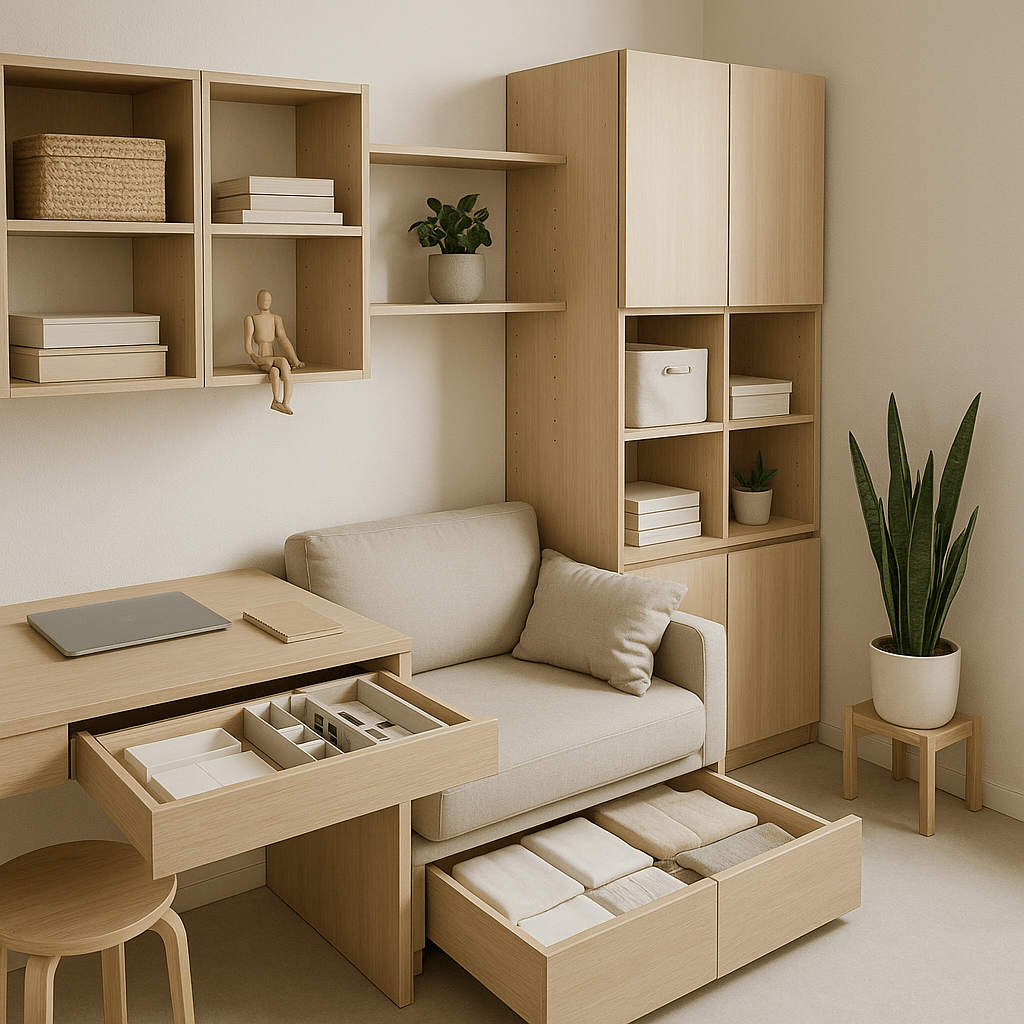
- Hidden drawer boxes under the bed or sofa to store clothes and accessories.
- Modular cube shelves that can be assembled according to evolving needs.
- Wall lockers above doors or in niches to reclaim square centimeters.
- Sliding bars in the kitchen to hang utensils and spices within reach.
- Nesting coffee tables that stack to free up floor space when hosting.
Thinking in terms of storage means anticipating every corner as a potential space rather than an empty void. In a studio, walls are not only for hanging frames but can accommodate deeper storage than one might imagine. In the kitchen, every linear meter of horizontal surface becomes an opportunity to house transparent containers, so you can tell at a glance where everything is. With enough tricks, clutter disappears and makes room for the essentials.
The impact on well-being and creativity
Over the weeks, the absence of material overload frees the mind for more stimulating activities. The minimalism experienced within the home reflects on the state of mind: there are fewer superficial distractions and more time to experiment, draw, write, or garden a balcony. Several studies show that a tidy interior promotes concentration and reduces anxiety. A paradox is then discovered: less space opens the door to a greater inventory of pleasures.
How to start the transition
Step 1: take an uncompromising inventory
The exercise begins with a methodical sorting. Each object is listed and the question is asked: “Do I really use it?” At this stage, the idea is not to throw everything away but to move what is not essential to a temporary storage location. The test of time quickly reveals what returns or not to the living space.
Step 2: define your priorities
Some prefer a cozy reading corner, others a space dedicated to playing a musical instrument. Identifying these key moments allows for reserving permanent zones and equipping the rest with only the bare essentials. A wardrobe corner will tame clothes, a folding desk will meet the urgency of teleworking, and the retractable table will be the precious ally of impromptu dinners.
Step 3: choose flexibility
Furniture on wheels, movable partitions, and sliding curtains replace fixed walls. Depending on the mood, you transform your living room into a gym and then into a reception room. This approach emphasizes mobility and adaptability, two essential virtues when the surface area decreases.
Frequently Asked Questions
Is it necessary to give up having guests in a small space?
Not necessarily: by favoring easily movable furniture (nesting tables, stackable stools), you can quickly free up a living room to accommodate up to eight people. Moving furniture is part of the convivial ritual and can even become a shared activity.
Can family memories be kept without cluttering the home?
Yes, by digitizing photos and keeping only a few cherished objects displayed as key pieces. A frame pinned on a wall or a jewelry box draws the eye and gives more value to each displayed memory.
How to assess the ideal size before moving?
Starting by living a few months in a temporary small space allows you to measure your real needs. Then, making a list of mobility must-haves (work corner, storage space, modular bedding) guides you towards a tissue box-sized space or a real studio depending on habits.