
Amiens, prefecture of the Somme and capital of Picardy, embodies the richness of a city where medieval history harmoniously dialogues with modernity. Dominated by its Notre-Dame cathedral, listed as a UNESCO World Heritage site since 1981, the city unfolds a unique charm made of exceptional architectural heritage, floating gardens unique in the world (the hortillonnages), and a dynamic cultural life. Amiens is also the city of Jules Verne, the writer who spent his last years there. At the heart of the Paris basin, 115 km from the capital, Amiens today breathes a new urban energy, combining ambitious urban renewal, diversified economy, and growing residential attractiveness.
• Amiens has 134,780 inhabitants and stands out as one of the most dynamic cities in Hauts-de-France, with a population density of 2,708 inhabitants/km².
• The Notre-Dame cathedral, the largest cathedral in France by interior volume, remains the undisputed symbol of the city and an unparalleled masterpiece of classical Gothic.
• The hortillonnages, 300 hectares of floating gardens cultivated since the Middle Ages, constitute a unique horticultural heritage in the world, crossed by 60 kilometers of canals.
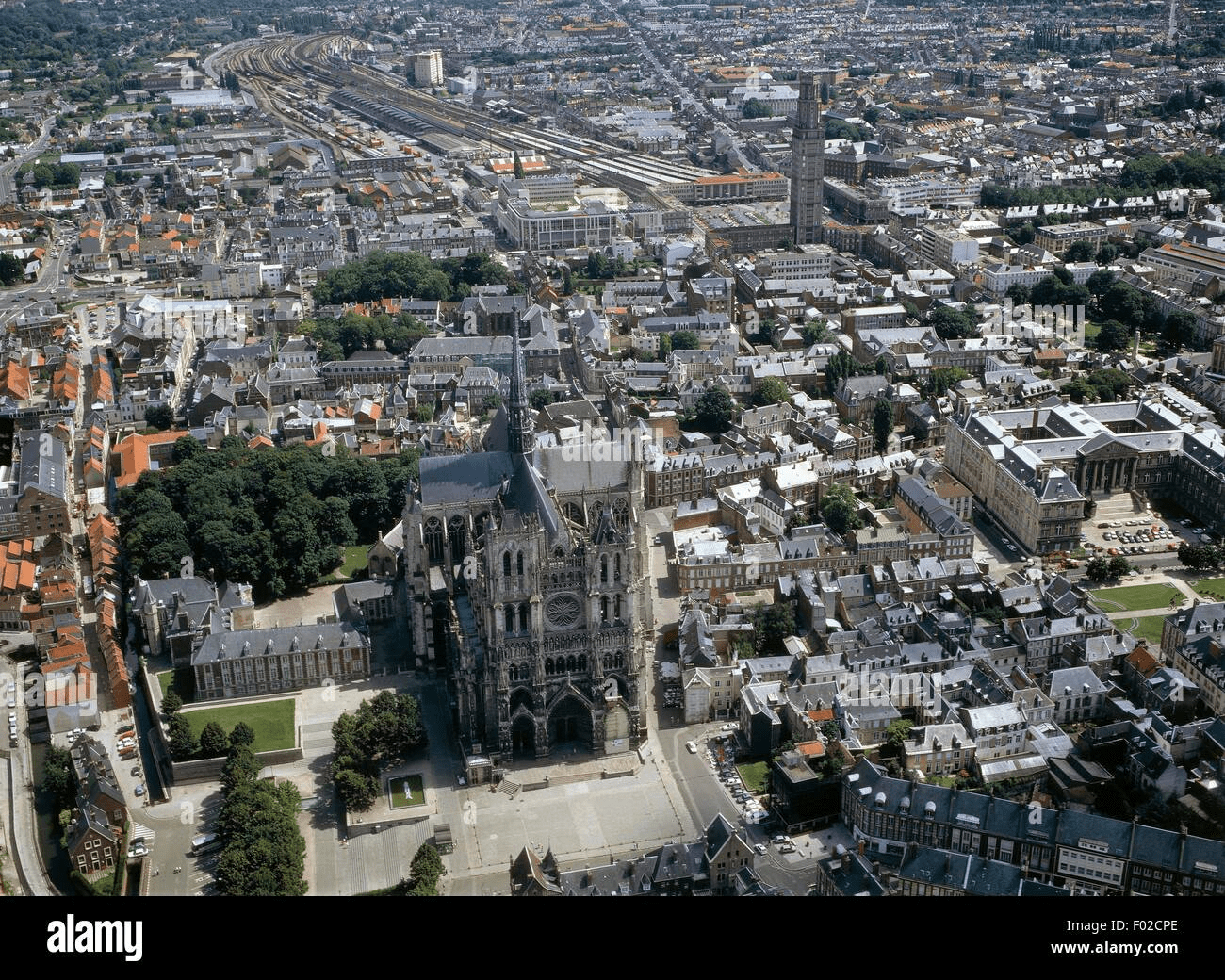
Aerial view of Amiens: the Notre-Dame cathedral dominates the urban landscape, surrounded by historic districts and the train station. © Aerial photo France.
Sommaire
🌍 Geography and location: at the heart of the northern Paris basin
Amiens occupies a strategic geographical position, located 115 km northeast of Paris, 99 km southwest of Lille, and 71 km west of Saint-Quentin, giving it the status of a regional crossroads. The municipality covers an area of 4,946 hectares, making it the third largest municipality in the Somme. The average altitude of the territory is about 55 meters, ranging from a minimum of 9 meters to a maximum of 116 meters, offering a relatively flat topography characteristic of the Paris basin.
The Somme, a generally calm river, crosses the city from east to west, shaping the urban landscape and offering popular relaxation spaces. This river, marked by exceptional floods (the last in spring 2001), has deeply influenced Amiens’ architecture and culture. The Selle, a northwest tributary, and the Avre, joining on the left bank to the southeast, complete this hydrographic system that shapes the identity of the Picard city.
The climate of Amiens, classified as temperate oceanic without dry season (Köppen-Geiger: Cfb), shows an average annual temperature of 10.2°C, with an average summer temperature of 17.2°C in August and winter average of 3.6°C in January. Annual precipitation is about 750.7 mm, distributed more in summer than in winter, creating ideal conditions for floriculture and horticulture that characterize the hortillonnages.
📚 History and heritage: from the Middle Ages to Jules Verne
The medieval era and the splendor of the cathedral
The history of Amiens is intrinsically linked to its Notre-Dame cathedral, a building that marks the pinnacle of French Gothic architecture. Erected from 1220 at the initiative of Bishop Évrard de Fouilloy, the cathedral rises on the ashes of a Romanesque building burned two years earlier. Its construction, undertaken in record time, was completed in less than 70 years, with the laying of the central labyrinth stone in 1288. This remarkable speed of execution for such a large project reflects the exceptional economic prosperity enjoyed by the city in the 13th century.
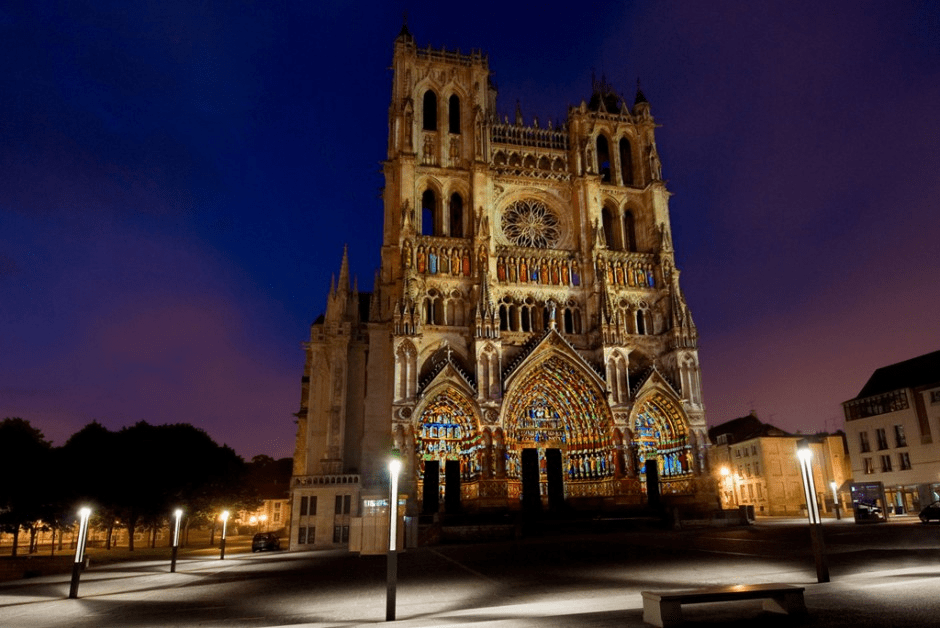
The Notre-Dame Cathedral of Amiens, illuminated with spectacular colors during the Chroma show, illustrates the classical Gothic architecture of the 13th century. © Public collections.
The architecture of the monument, designed by master builder Robert de Luzarches in collaboration with his successors Thomas and Renaud de Cormont, reaches gigantic dimensions: 145 meters long, 42.30 meters high under the vault, and an interior volume estimated at more than 200,000 cubic meters, more than double that of Notre-Dame de Paris. This cathedral, with its 765 statues adorning the façades, constitutes a true “stone book” intended to teach religious faith to the Christian people.
“The Amiens cathedral, by the beauty of its proportions and the unity of its style, represents the absolute paradigm of classical French Gothic architecture.” — UNESCO, inscription report 1981
The blue gold: woad and textile prosperity
The wealth of Amiens in the Middle Ages largely rested on a flourishing trade: that of woad (Isatis tinctoria), also called guède or pastel depending on the region. This dye plant, massively cultivated since the 12th century, produces a unique blue that gradually became the prestigious color of the French royalty. With the advent of Saint Louis and the valorization of blue as a Marian and royal color, demand exploded: woad became the “blue gold” of Picardy.
The Amiens woad merchants, savvy traders and skilled artisans, amassed considerable fortunes. This wealth helped finance a large part of the cathedral works: on the south façade of the cathedral, a commemorative statue represents a couple of woad merchants in recognition of this contribution. Beyond dyeing, Amiens developed a major drapery industry, transforming and marketing dyed wool fabrics throughout Western Europe. This economic dynamic lasted until the Renaissance, then diversified with the arrival of Flemish workers in the 16th century, allowing the introduction of silk and satin into local production.
The modern era: velvet, Jules Verne, and urban renewal
In the 17th century, a new material revolutionized Amiens’ textile industry: velvet. In 1755, Alexandre Bonvallet founded the royal manufacture of Amiens, establishing the city as a European center for luxury velvet production. This prestigious fabric consolidated Amiens’ reputation for several centuries. The know-how is so deeply ingrained in the local identity that Amiens velvet remains an internationally known name today.
The 19th century saw the arrival of Amiens’ most famous resident: Jules Verne. Born in Nantes in 1828 and trained in Paris, the novelist settled in Amiens in 1871, where he lived until his death on March 24, 1905. It was in this city that Jules Verne wrote most of his monumental work, notably while living at 2 rue Charles-Dubois in his famous “house with the tower”. The house, transformed into a museum, remains a pilgrimage site for admirers of the author of Twenty Thousand Leagues Under the Sea and Around the World in Eighty Days.
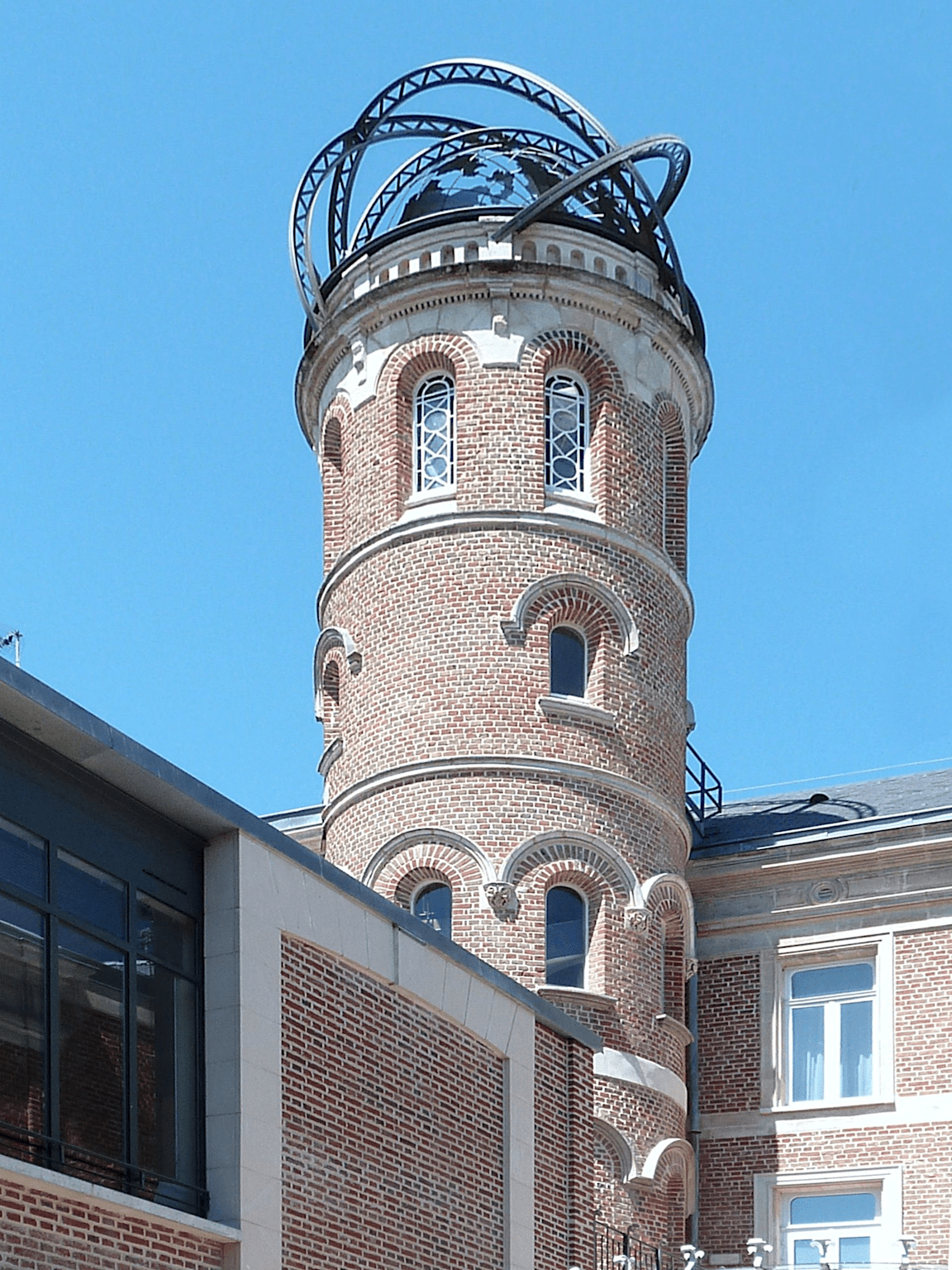
Jules Verne’s house in Amiens, recognizable by its brick tower topped with a globe symbolizing exploration and literary imagination. © Public collections.
Verne was not content to be a resident writer: he became a municipal councilor (1888-1904), in charge of cultural affairs. He directed the construction of the municipal circus, inaugurated in 1889, whose plans he himself designed. This civic involvement testifies to his deep attachment to Amiens, which provided him with indirect inspiration: the topography, dynamic industrial life, and local scientific personalities nourished his creative imagination. The Aronnax Trail, a 16-step itinerary, allows visitors to walk in Verne’s footsteps throughout the city.
👥 Demographics: a young and dense population
Amiens records a population of 134,780 inhabitants according to INSEE 2022 figures. This high concentration gives the city a density of 2,708.6 inhabitants/km², well above the national average (107.1 hab/km²), ranking it among the most densely populated municipalities in northern France. At the metropolitan scale, Amiens Métropole counts 182,854 inhabitants and the Amiens living area reaches 213,631 inhabitants.
| Demographic indicator | Amiens 2022 | Average of French cities |
|---|---|---|
| Total population | 134,780 | N/A |
| Number of households | 68,964 | 886 |
| Inhabitants per household | 1.9 | 2.3 |
| Under 15 years (%) | 16.4% | 16.8% |
| 15-29 years (%) | 29.3% | 13.1% |
| 60-74 years (%) | 13.2% | 21.3% |
One of Amiens’ distinctive features is its abnormally young demographic structure: nearly 29.3% of the population is between 15 and 29 years old, more than double the national average. This overrepresentation of young adults is explained by the massive presence of students: Amiens hosts more than 31,500 students, attracted by the University of Picardie Jules-Verne (UPJV) and various higher education schools. The 15-29 age group represents a major economic and cultural force, energizing neighborhoods like Saint-Leu and contributing to a very active nightlife and commercial life.
In terms of composition, women make up 52.5% of the population compared to 47.5% men, reflecting French demographic trends. The number of births (1,414 in 2024) slightly exceeds the number of deaths (1,080), generating a positive natural balance of about 363 net births annually.
💼 Economy: sectors of excellence and regional dynamics
The Amiens economy rests on a diversified and solid base, articulated around key sectors that radiate well beyond municipal borders. The Amiens district concentrates 127,700 jobs in 2022, or 58.6% of the Somme’s jobs, including 99,900 in the Amiens Métropole CA. This concentration reflects Amiens’ status as a major regional hub in Hauts-de-France.
Dominant tertiary sector and public services
The tertiary sector reigns supreme, encompassing 81.4% of jobs (104,200 employees). The three main employers belong to the non-commercial tertiary sector: the CHU Amiens-Picardie, the Amiens Métropole Agglomeration Community, and the Somme Department, which together employ more than 15,000 workers. The public sector, education, and health thus constitute the city’s economic foundation.
Industry, mechanics, and chemistry
Although less represented than the Picardy average, the industrial sector still accounts for 10% of jobs (13,400 employees). Amiens has held the label “Territory of Industry” since 2018, in partnership with Albert. Chemistry and pharmaceuticals are overrepresented, notably thanks to the presence of the giant Procter & Gamble (5th local employer with more than 1,100 employees). The agglomeration counts about 28,000 direct jobs in industry and logistics combined.
Health and bio-economy: the Amiens Health Quarter ecosystem
Amiens Health Quarter represents an emerging center of excellence, bringing together more than 90 structures and 10,000 jobs (including 1,000 in B2B). This ecosystem links industries (Unither, leader in sterile unit doses), innovative companies (MIPIH, Orthorobs, Evolucare), start-ups (Open Stent, Posos), research structures (UPJV, CHU, GRECO), and specialized training. This dynamic positions Amiens as a major player in medical innovation in France.
Energy transition and batteries: cutting-edge innovation
Amiens Métropole actively participates in the national re-industrialization dynamic. The energy hub, fundamental research laboratory RS2E (leading point of the European network), federates actors around the batteries of tomorrow. Pioneering start-ups like Tiamat (Sodium-Ion batteries) and G+lyte (photovoltaic cells) have chosen Amiens. The Boréalia business park (56 hectares) is dedicated to industrial projects linked to ecological and energy transitions.
Cultural and creative industries: 680 establishments
The territory counts 680 establishments related to cultural and creative industries (CCI), indicating significant artistic vitality. The municipal circus, theaters, the FRAC (Regional Contemporary Art Fund), and art galleries contribute to positioning Amiens as a noteworthy cultural life center.
🎭 Tourism and culture: must-sees and major attractions
The Notre-Dame cathedral: unparalleled masterpiece
The Notre-Dame cathedral of Amiens remains the number one attraction, listed by UNESCO since 1981 under criteria (i) and (ii). A masterpiece of classical and radiant Gothic architecture, it fascinates by the harmony of its proportions, the richness of its sculpted decoration, and the brightness of its stained glass. Access to the cathedral is free for interior visits, with the possibility to climb to the top of the nave to admire the urban view (150 steps). Night light shows “Chroma” restore the original colors of the monument, a spectacular immersive experience regularly offered in the summer season.
The hortillonnages: floating gardens of the world
The hortillonnages cover 300 hectares of canals and floating gardens continuously cultivated since the Middle Ages. This unique system, punctuated by 60 kilometers of canals (the “rieux”), constitutes a true horticultural oasis in the urban heart. Accessible only by electric boat (April to mid-October), the hortillonnages offer a peaceful break where local fauna and flora flourish under foliage vaults. The hortillons, these traditional Amiens cultivators, maintain colorful vegetable plots, picturesque cottages, and ephemeral artistic installations. Some garden islands transform into lodgings for an unforgettable night in the urban nature (“From one island to another”).
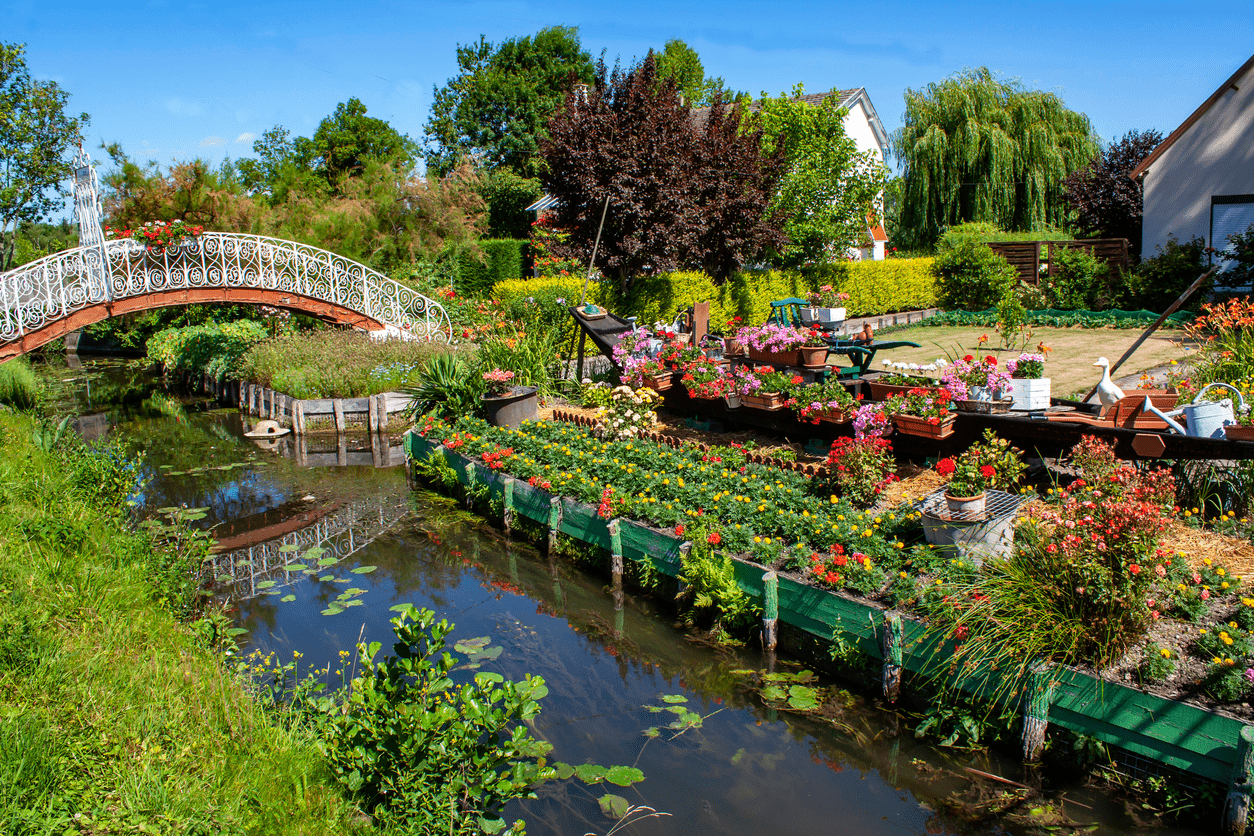
The hortillonnages of Amiens, this unique labyrinth of floating gardens crossed by canals, offer an experience of preserved nature in the heart of the city. © Public Wikimedia collections.
Saint-Leu district: the Little Venice of the North
Nicknamed the “Little Venice of the North”, the Saint-Leu district enchants with its houses with colorful façades, picturesque canals, and bohemian atmosphere. Former working-class district of shoemakers and dyers, Saint-Leu has transformed into a creative and tourist hub favored by students, artists, and young professionals. The cobbled streets house art galleries, trendy restaurants, friendly bars, and unusual shops. The floating market (when held), the 15th-century Saint-Leu church, and terraces along the Somme make it a must-see place to stroll and enjoy Amiens specialties.
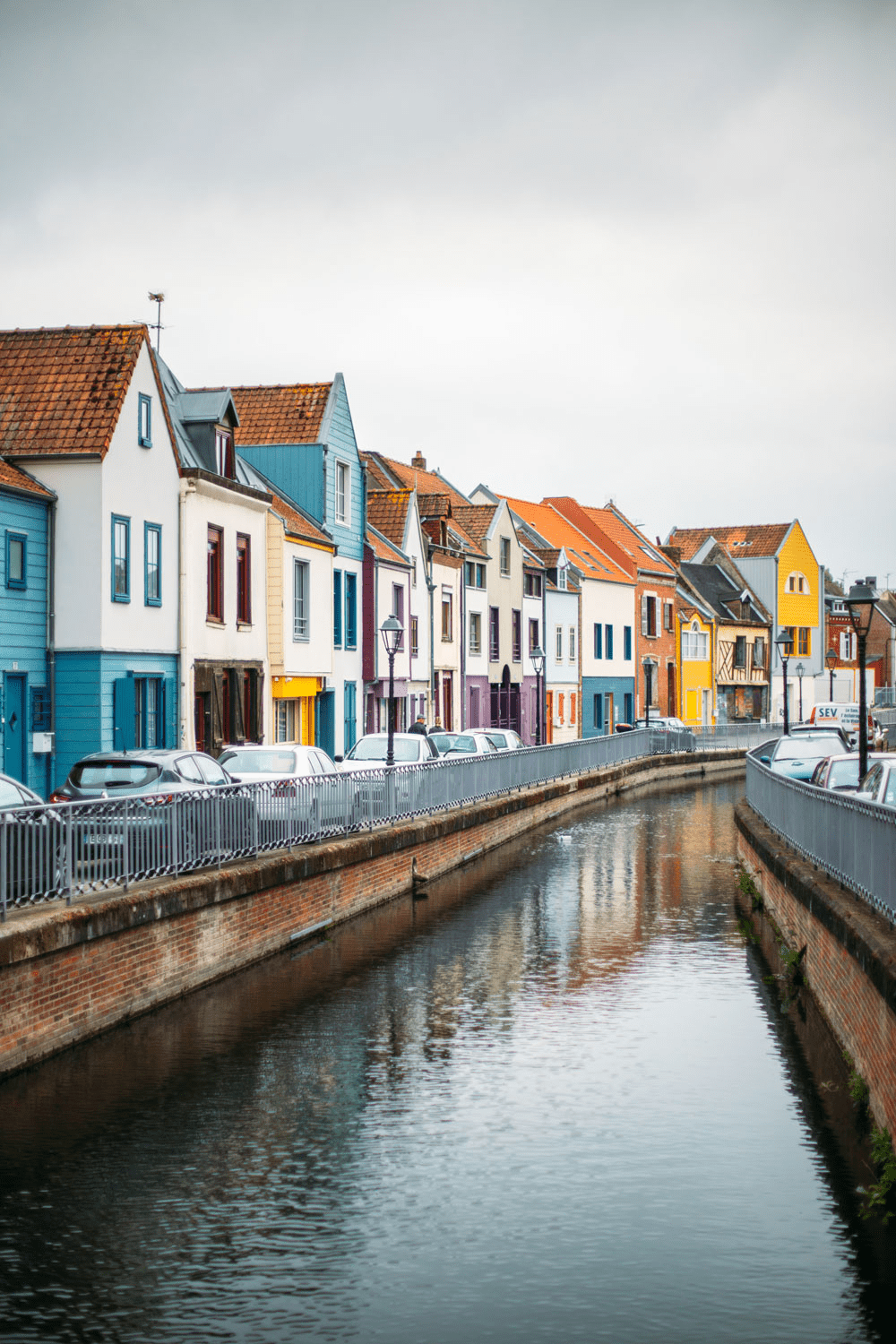
The Saint-Leu district, nicknamed the “Little Venice of the North,” with its brightly colored houses reflected in the Somme canals. © Public collections.
Jules Verne’s house: museum and literary heritage
The Jules Verne house (2 rue Charles-Dubois), transformed into a museum, retraces the writer’s universe. Preserving the period aesthetic (19th-century furniture, period decor), it houses more than 700 objects, documents, and original editions allowing the reconstruction of Verne’s creative life. The desk where the author wrote his manuscripts, the collection of first editions, and period furniture offer an authentic immersion into the daily life of a visionary novelist whom Amiens discreetly inspired in some literary passages.
Picardy Museum: art and archaeology collections
The Picardy Museum, inaugurated in 1867, asserts itself as one of the first French art museums. Its collections include archaeology (from the Paleolithic to today), Gothic sculptures, art objects, and paintings by old masters. Recent renovations have restored period decorations and expanded educational and reception spaces, consolidating its role as a temple of regional art and history.
Other attractions and must-see places
- Saint-Pierre Park: 26-hectare green space offering relaxation, children’s playgrounds, and a clear view of the urban center.
- Amiens Zoo: modern establishment dedicated to animal preservation with educational trails.
- Jules Verne Circus: national circus hub hosting shows, concerts, and major cultural events.
- Picardy Comedy Theater: prestigious stage for dance, theater, and concerts.
- Amiens House of Culture (MCA): complex with Orson Welles cinema, two theaters, and artistic gardens.
- FRAC Picardy / TOTEM Gallery: contemporary art and innovative creation space.
- Madeleine Cemetery: unexpected destination, this romantic cemetery houses the spectacular tomb of Jules Verne (sculpture of an outstretched arm towards eternity).
🚂 Transport and accessibility: a well-connected city
Amiens benefits from enviable regional connectivity. Amiens train station, served by SNCF, offers direct connections to Paris-Nord (TGV in 1h15, TER in 45-60 minutes), Lille (2h30), Rouen (1h45), and regional destinations. The new Omneo trains (33 units since 2024), locally manufactured in Crespin, offer more comfort (reclining seats, USB ports, improved accessibility) on the Amiens-Paris and Maubeuge/Cambrai/Saint-Quentin-Paris lines.
The urban network TAMIS (Transports d’Amiens Métropole) manages local public transport by bus and tramway. In terms of pedestrian and bicycle accessibility, Amiens city center stands out with its extensive pedestrian zones (notably rue des 3 Cailloux, main shopping street) and growing bike lane facilities, facilitating soft mobility.
🏘️ Local life, neighborhoods, and urban life
Amiens is divided into neighborhoods with distinct charm. Beyond the city center and Saint-Leu, mention:
Henriville: upscale residential neighborhood, favored by executives and wealthy families, characterized by beautiful 19th-century bourgeois houses and a calm, secure atmosphere.
Saint-Acheul: rapidly growing eastern area, offering good value for money and a stock of character houses undergoing gradual modernization. Several urban development projects revitalize this attractive neighborhood for first-time buyers and young couples.
Vallée des Vignes: modern southeast zone with new housing, contemporary infrastructure, parks, and sports facilities, appealing to rental investors and modern families.
City center: focusing commerce, culture, and services, the center remains very dynamic with local shopping centers competing with the three large peripheral zones (Leclerc, Carrefour, Géant). Neighborhood life revolves around terraces, cafés, gourmet restaurants, and cultural venues concentrated on rue de la République and adjacent squares.
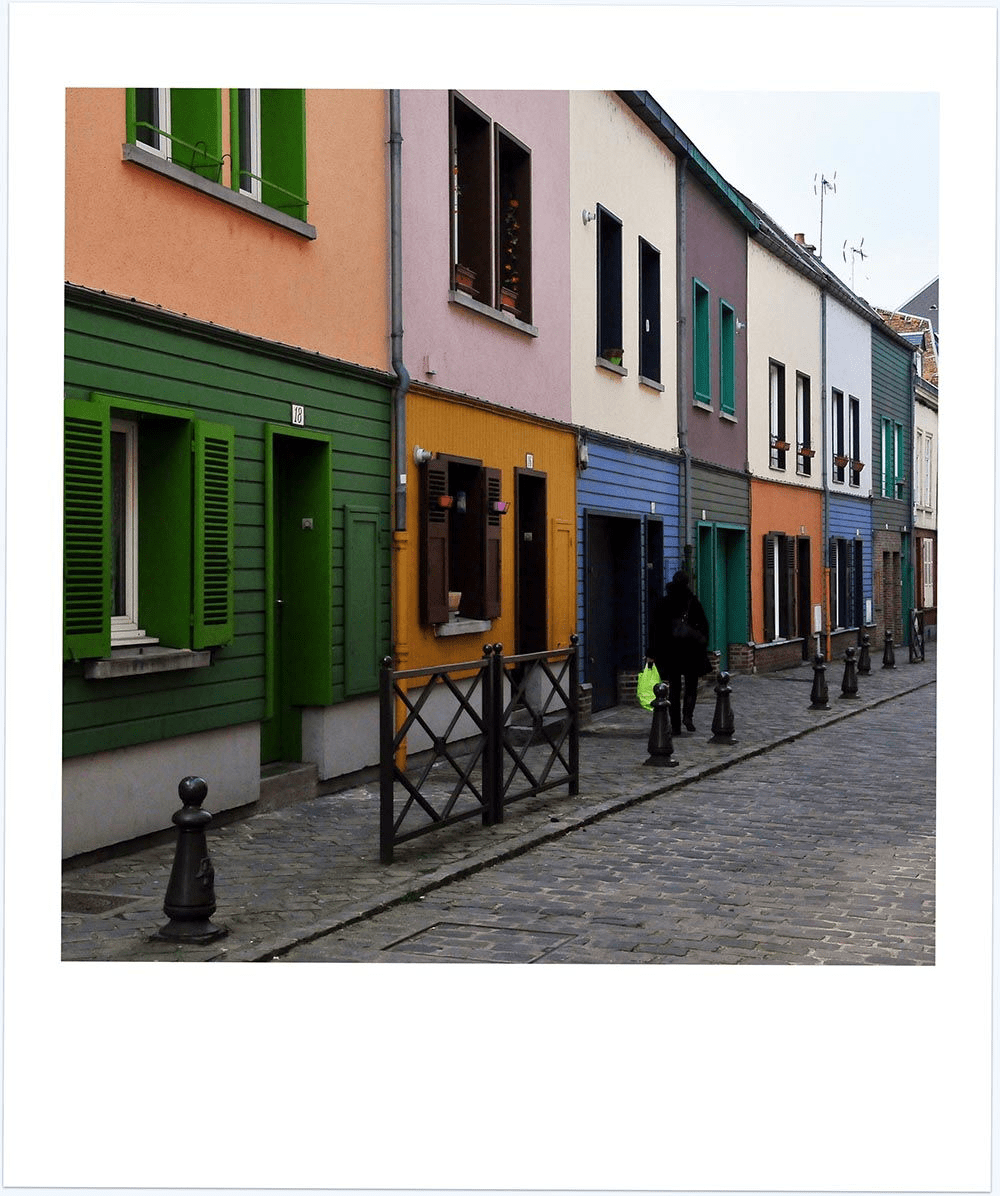
Typical cobbled street of the Saint-Leu district: multicolored façades, friendly atmosphere, and traditional Amiens architecture. © Public collections.
🏠 Real estate and urban planning: dynamic market and ambitious projects
The Amiens real estate market is dynamic in 2025, with an average price of €2,431/m² according to July 2025 data. Apartments trade at €2,628/m² (up 9.4% in one year), while houses are negotiated around €2,260/m² (up 3.5%). The market has recorded a 10.3% increase over 5 years, consolidating Amiens as a reliable investment destination.
The average selling time has lengthened to 95 days in February 2025 (compared to 64 days a year earlier), reflecting a more thoughtful market where buyers and sellers take more time. The rental market, by contrast, shows remarkable stability with rents practically unchanged: about €13.80/m² for apartments and €10.70/m² for houses.
Major urban renewal projects
Urban renewal is a major strategic axis for Amiens Métropole. The New National Urban Renewal Program (NPNRU) 2019-2024 mobilizes more than €360 million for the transformation of three priority neighborhoods: Amiens Nord, Étouvie, and Pierre-Rollin. The ANRU provides more than €78 million in subsidies, supplemented by major contributions from the City of Amiens (€42M), Amiens Métropole (€16M), and social landlords (Amsom Habitat €58M, SIP €33M). This program, the third generated in 20 years, continues correcting urban dysfunctions and revives economic dynamics in the neighborhoods.
The City Policy 2024-2030, a formal contract between partners, aims to reduce development gaps between priority neighborhoods and the rest of the agglomeration. Seven priority neighborhoods concentrate about 31,500 inhabitants, including the new ones: Amiens Nord, Étouvie, Pierre-Rollin, Marcel Paul–Salamandre, Condorcet–Phileas Lebesgue, Les Parcheminiers, and Elbeuf–Lescouvé.
❓ Frequently Asked Questions (FAQ)
Must-sees: the Notre-Dame cathedral (UNESCO masterpiece, allows ascent for panoramic view), the hortillonnages by boat (April to October, unique experience), the Saint-Leu district with its colorful houses and terraces, Jules Verne’s house (immersive museum), the Picardy Museum (art and history). One full day: morning cathedral + hortillonnages, midday-afternoon Saint-Leu and Somme walk, evening Chroma show (summer). Two days allow adding Picardy Museum, Saint-Pierre park, zoo, and local culinary discoveries.
Recommended seasons: April to October for access to hortillonnages by boat (seasonality April to mid-October). Spring (April-May) offers spectacular hortillonnages bloom + mild temperatures (15-18°C). Summer (June-August) guarantees pleasant weather (17-18°C) and Chroma evening shows, but larger crowds. Autumn (September-October) combines still favorable weather and reduced tourist influx. Winter (November-March) limits hortillonnages access but offers affordable prices and intimate atmosphere.
Transport options: SNCF TGV (115 km, 1h15 direct, fastest and most comfortable), regular TER (40-60 min depending on services), long-distance bus (Flixbus, BlaBlaCar, 2h-2h30), personal car (115 km via A1 then A16 highway, approx. 1h30). Amiens station is well served by urban transport (TAMIS) for access to city center or attractions. Accessibility for disabled persons: PMR accessible station, adapted urban transport.
Average budget per person/night: Accommodation: €60-100 (2-3 star hotel), €40-60 (Airbnb/cottage), €20-30 (youth hostel). Meals: €12-18 (quick lunch), €25-40 (classic restaurant dinner), €50+ (gourmet restaurant). Visits: cathedral free, Picardy Museum €5-8, Jules Verne house €6, hortillonnages boat €10-15. Overall budget 2-3 days: €150-250 budget economy, €250-400 average comfort, €400-700 premium stay.
Recommendations by profile: Students: Saint-Leu (intense life, proximity to university, youth shops). Young professionals: city center (dynamism, services, cultural life nearby). Families: Henriville (calm, quality schools, safety), Saint-Acheul (good price/quality ratio, parks), Vallée des Vignes (modern, child facilities). Retirees: city center (services accessible on foot, culture, social life) or quiet neighborhoods on the outskirts (Henriville, Longueau). First-time buyers: Saint-Acheul, Vallée des Vignes (better emerging price ratio). Rental investors: Saint-Leu (strong student profitability), city center (continuous demand), Vallée des Vignes (growth prospects).
Growing sectors: Health (nurses, doctors, nursing assistants CHU), pharmaceutical industry (Unither, P&G, MIPIH), energy technologies (battery/energy engineers, Tiamat, RS2E), public administration services, higher education. Innovative fields (biotech start-ups, creative industries) create high qualification job niches. The tertiary sector (commerce, distribution) remains dominant for quantitative opportunities. Amiens salaries: slightly below national average, but housing costs more moderate than large metropolises (price/salary difference partially compensates).
🎯 Conclusion: Amiens, crossroads between tradition and modernity
Amiens embodies the millennial French heritage in perpetual renewal. From the Notre-Dame cathedral, Gothic masterpiece built in the 13th century by the wealth of medieval woad, to the hortillonnages unique in the world, up to the creative cities and energy innovations of the 21st century, Amiens weaves an extraordinary narrative thread where history and modernity converse. The presence of Jules Verne, thinker of futurologies, symbolically fits into this continuity: author of anticipation novels written in a city itself anticipating its own future.
Capital of Picardy and prefecture of the Somme, Amiens is progressively asserting itself as a must-see destination in Hauts-de-France. Its dynamic real estate market, growing attractiveness for young workers and students (29.3% of the population aged 15-29), massive urban renewal efforts (€360M invested), and innovative ecosystem (health, renewable energies, start-ups) position the city for sustainable acceleration. Amiens is not just an open-air museum: it is a living city where 134,780 inhabitants forge the future every day, where the hortillons have cultivated perennial floating gardens for a thousand years, where new inhabitants find quality of life, price accessibility, and vital proximity to Paris/Lille.
Amiens awaits you. Come discover this city where the royal blue of medieval woad gives way to the blue of Saint-Leu façades and the blues of cathedral skies once painted by Amiens dyers. 🏰
📌 Essential practical information
Postal code: 80000
Region: Hauts-de-France
Department: Somme (80)
Demonym: Amiénois, Amiénoise
SNCF station: Amiens-Picardie, connections Paris-Nord (TGV 1h15), Lille, Rouen
Airport: Amiens-Glisy Airport (regional flights), main airports Paris CDG (130 km), Orly, Lille (99 km)
Population (2022): 134,780 inhabitants intra-muros, 182,854 Amiens Métropole
Density: 2,708.6 hab/km²
Area: 49.8 km²
Official website: www.amiens.fr