Why take an interest in flies?
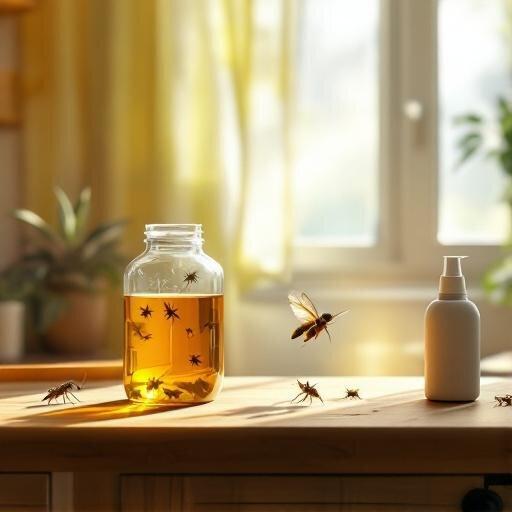
Beyond the auditory and visual nuisance, these insects represent a health issue. Carriers of germs, they contaminate food and surfaces. Their ultra-fast life cycle turns a simple problem into a real plague in a few days. Understanding this adversary is already gaining ground. We mainly distinguish the Housefly (Musca domestica) and the Fruit fly (Drosophila melanogaster), each with its own habits.
DIY Traps: operation and variations
Classic vinegar trap recipe
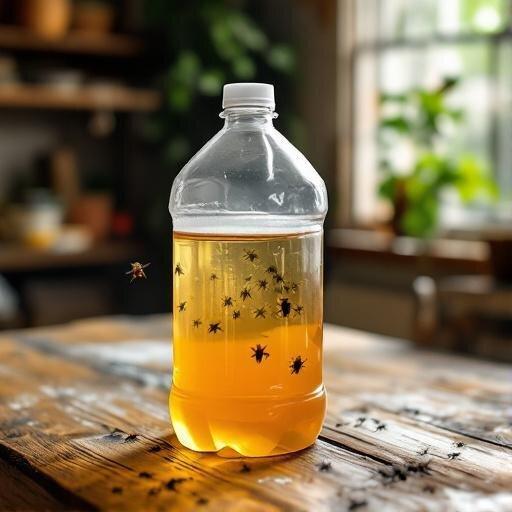
The ancestral version is prepared in three minutes flat: a bottom of cider vinegar or white wine vinegar in a bottle, a little dish soap, and an inverted paper cone. The trick? The vinegar attracts the flies, the soap film breaks the surface tension and prevents them from escaping. To optimize, you can add a pinch of brown sugar or decomposing fruit peels.
Variations and personalized tips
Depending on the context, it is adapted: a small jar of jam outside, a jar closed with cling film to avoid attracting other insects again, sometimes a simple piece of sticky paper coated with honey for a dry habitat. Some add pepper or peppermint to repel unwanted third-party actors (gnats, wasps). This modularity makes DIY a flexible, eco-friendly, and inexpensive solution.
Chemical solutions: overview of products
Insecticide sprays
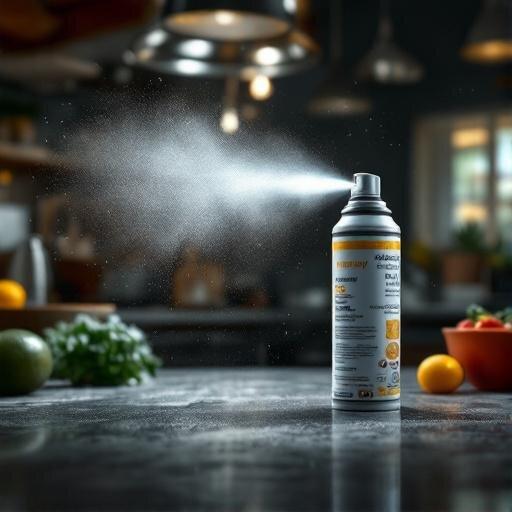
Sprays remain the reference for an almost immediate result. Formulated with pyrethrum or neonicotinoids, they quickly paralyze the insect. In return, the aerosol releases particles sometimes irritating to humans and pets. Targeted spraying, away from food preparation surfaces, is essential.
Baits and diffusers
In the form of gel plates, granules, or electric diffusers, these formulations gradually release active molecules. The cost is higher at purchase, but maintenance can be reduced if the infestation is long-lasting. These devices are especially suitable for enclosed spaces (pantry, warehouse) and require precise dosing to avoid creating tolerance in insects.
Shock comparison: effectiveness, cost, and impact
Effectiveness
- DIY: often removes 60% to 80% of flies in the targeted area, depending on the recipe and renewal.
- Chemical: kills up to 95% of specimens within a few hours, but requires repeating the operation.
Cost
- Homemade traps: almost free if using ingredients already present in the kitchen.
- Commercial products: between €10 and €30 per spray or diffuser pack for 2 to 4 weeks of use.
Safety and environment
| Method | Human risk | Ecological footprint |
|---|---|---|
| DIY | Minimal (vinegar, soap) | Low (recyclable materials) |
| Chemical | Moderate (inhalation, contact) | Medium to high (persistent substances) |
How to choose according to your needs?
The choice is based on three questions: what is the scale of infestation? what sensitivity to chemical products? what budget? For an apartment occasionally invaded, DIY is often sufficient and safer. In a professional space or facing a recurring invasion, insecticide provides longer peace of mind, provided usage instructions are followed.
Practical tips for lasting control
- Maintain entry points (mosquito nets, window seals) to limit entry.
- Regularly clean bins and damp areas where larvae develop.
- Combine traps and diffusers to target different phases of the life cycle.
- Renew DIY recipes every two days and empty traps before resetting them.
FAQ
1. Do DIY traps attract other insects?
Yes, fruit flies, wasps, or sometimes ants can also be trapped. To limit this, adjust the scent (less sugar) or filter the trap entrance with cotton.
2. How long does the effect of an insecticide spray last?
Most formulas remain active up to 24 hours on treated surfaces. This is the time during which residual flies come into contact with the product residue.
3. Can DIY and chemical methods be combined?
Absolutely. Manual trapping reduces the active population, then a targeted chemical treatment aims at hidden individuals. This duo optimizes effectiveness.