How to choose your holiday destination in France according to your budget: practical grid and concrete examples
Choosing your holiday destination in France according to your budget becomes easier with a practical grid, examples by profile, and the right trade-offs between transport, accommodation, and activities.
💡 The destination follows the budget: first choose the budget, then the setting.
🚆 Transport weighs heavily: because train, car, or rental do not create the same final cost.
🏠 Accommodation remains decisive: residence, cottage, bed and breakfast, or camping shape the entire stay.
🗓️ Booking early helps: tickets and accommodations booked in advance are more advantageous.
How to choose your holiday destination in France according to your budget?
Start by setting an overall ceiling, then allocate it between transport, accommodation, meals, and activities. A holiday destination in France is truly suitable only if it allows you to stay within this framework without giving up outings or unexpected expenses. The right trade-off is made before booking, not after.
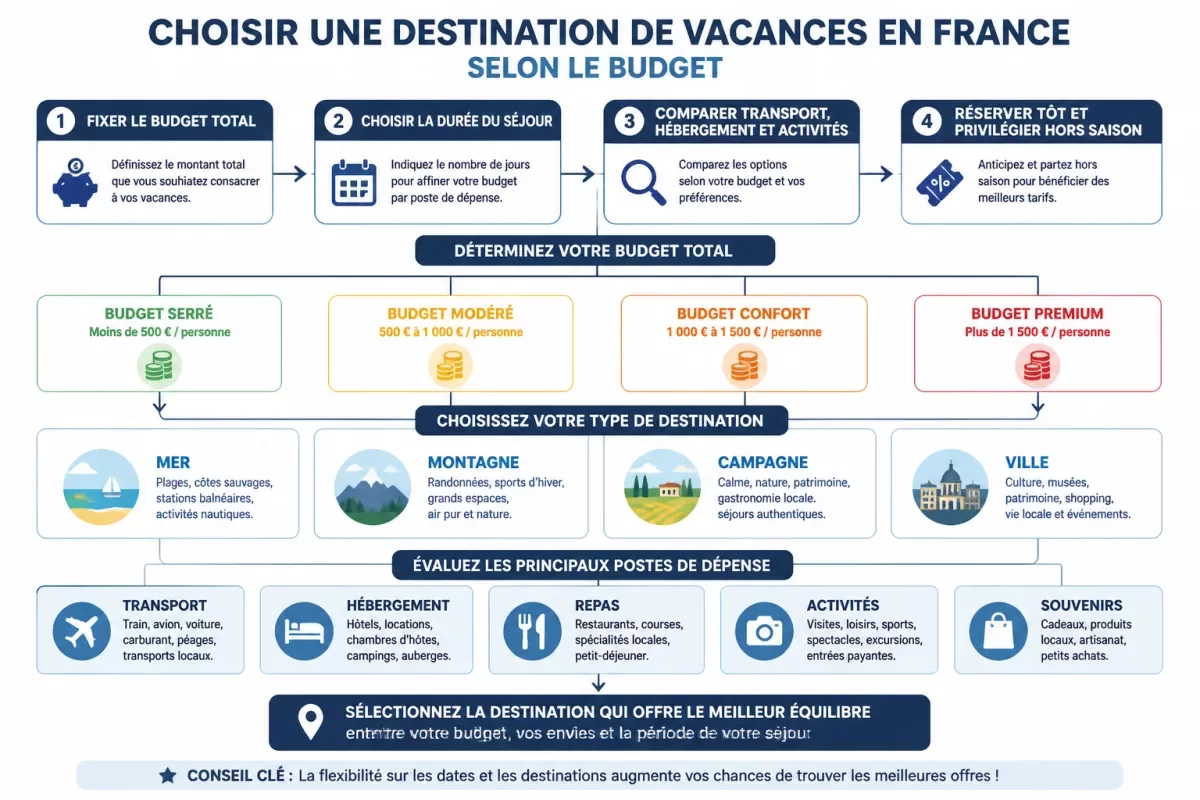
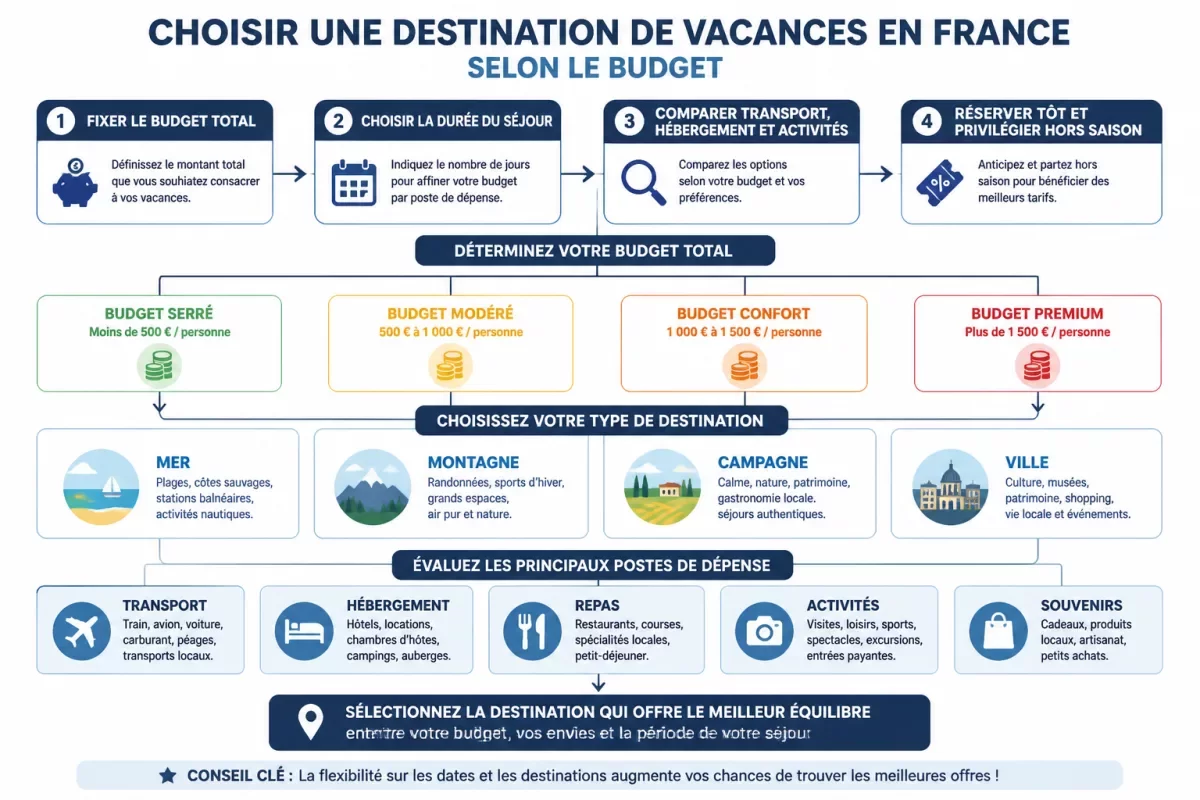
The method consists of 4 steps: total budget, duration, transport, then accommodation and expenses on site.
This logic avoids the classic mistake: choosing a place first, then trying to fit it into the holiday budget. The Belambra guide also reminds that the reflection must include desires, duration, the people traveling, and the level of comfort sought.
The reading grid in 4 criteria
Evaluate the access cost even before comparing accommodations.
Check if the destination allows a one-week stay without major extra costs.
Choose the type of setting that corresponds to your actual budget.
Book as soon as possible if your dates are fixed.
The best holiday budget is not the lowest: it is the one that remains consistent from departure to return.
Which expense items really weigh on the holiday budget?
The short answer is simple: accommodation often weighs the most, but transport can tip the entire holiday budget. If you are traveling far, start early on comparison sites; if you are traveling close, focus on the right lodging and daily expenses.
Item
What it changes
How to optimize it
Transport
It can significantly increase or decrease the vacation budget.
Compare bus, train, car, and rental before choosing the destination.
Accommodation
It is often the main expense item of the stay.
Look at mobile homes, cottages, bed and breakfasts, or residences.
Activities
They quickly add up if there are many.
Favor included or low-cost activities.
Food and souvenirs
These are expenses easy to underestimate.
Set a daily limit and keep some for unforeseen expenses.
The cost of transport varies depending on the chosen mode. The advice from MyPCS reminds that bus transport is often cheaper than plane or train, while the car adds fuel, tolls, and sometimes rental. The right choice is therefore not just a matter of comfort, but of budget structure.
The most effective sequence to compare
Set your total vacation budget.
Distribute it between transport, accommodation, meals, and activities.
Identify destinations compatible with your budget.
Book early if the destination is attractive.
When transport is controlled, the vacation budget becomes much clearer: the rest can be negotiated more easily.
Which destination to prioritize according to your budget and profile?
The right criterion is not just the region, but the combination of budget + usage. A vacation destination in France must correspond to your way of traveling: family, city getaway, nature stay, or more comfortable break. This is where cost differences become truly useful.
A departure close to home often simplifies the trade-off between transport, accommodation, and duration.
For a small budget, closer regions, rural areas, and less touristy destinations are often more flexible, especially off-season. The guide from Globe-Trotting reminds that France offers very different landscapes: Jura, Vosges, Aveyron, Brittany, Corsica, or the major mountain ranges like the Alps, the Pyrénées, and the Massif Central.
For a family stay
Families benefit from targeting accommodations with children’s activity clubs and, when possible, babysitting. The choice of destination then comes after the choice of the package, as the real budget gain comes from the quality of included services and the time children can spend on site.
For a city getaway
If you are looking for a city, favor a place rich in cultural heritage rather than just a famous name. This reduces the need for long paid activities while maintaining an offer of visits, walks, and local discoveries suitable for a short stay.
For a comfort stay
With a larger budget, France allows aiming for more sought-after or more spectacular areas, without losing control if you book early. Belambra offers more than 50 destinations in France for summer, spring, and long weekends: variety exists, provided you link it to your budget.
Family: prioritize a destination with child services.
Nature: target countryside, mountains, or coast outside peak season.
City: choose a center rich in heritage and soft mobility.
Long stay: check that the accommodation can support a week without excessive transport.
Why does France often remain the best compromise?
Because it combines diversity of landscapes, accommodation options, and possibilities for short departures. In 2025, Vacancéole observes that 63% of French people traveled within France, while the average vacation budget rises to €2,035. In other words, France is not just a practical choice: it is also a rational response to rising costs.
The Clés de la banque recommend favoring off-season periods and less touristy regions. This logic works particularly well in France, where you can change scenery in a few hours and adjust the bill without giving up the experience.
France allows better control of a vacation budget because it offers a wide choice of routes, rhythms, and types of stays.
The real advantage is therefore strategic: you can adapt the vacation destination in France to the budget, not the other way around. This explains the rise of shorter stays, often one week, and the success of packages that simplify the trade-off between transport, accommodation, and activities.
Key takeaways
🧭 First choose the total budget, then only the destination.
🚆 Transport can tip the entire vacation budget.
🏠 Accommodation remains the most structuring item for the final bill.
🌿 Off-season, France becomes much more accessible.
📅 One week is often the right unit to compare offers.
FAQ
Which vacation destination in France costs the least?
There is no single answer, but the most flexible options are often the countryside, certain medium-sized cities, and less touristy areas. The right criterion is not only the region but the cost of access, accommodation, and expenses on site.
Should you favor train, car, or coach?
The choice depends on your departure and length of stay. The coach is often cheaper than plane or train, while the car adds fuel, tolls, and sometimes rental. Always compare the full cost, not just the ticket.
When to book to pay less?
As early as possible if your dates are fixed. Train tickets and accommodation bookings are more advantageous when anticipated, especially off-season. This is one of the most effective levers to control a vacation budget.
How to reduce the budget without changing destination?
Reduce variable items: dining, souvenirs, and non-essential activities. You can also slightly shorten the stay, choose a simpler accommodation package, or take advantage of a promotion, without giving up the chosen place.