Quick verdict: what really protects
If you do only one thing to secure your home before vacation: put the entrance and water “under control.” On the access side, a lock that turns smoothly and a suitable cylinder reduce last-minute hassles. On the plumbing side, a tested water shut-off and two targeted checks prevent leaks that settle in while you are on the road.
When you prefer to delegate a quick check before leaving, a craftsman identified as Etienne Services can intervene on concrete points (door adjustment, cylinder, usage advice), with a “prevention” rather than “emergency” approach.
Note: 8.9/10 — effective, fast, applicable in houses as well as apartments, without turning the home into a bunker.
Recommended for: families on a “big departure,” owners of second homes, hosts of vacation rentals, travelers who leave their home empty for more than a week.
Transparency: content created in partnership, with a practical angle “pre-departure preparation,” designed to limit unpleasant surprises upon return.
Strengths (and limits) of the checklist
- Prioritized: first access, then water, then details.
- Quick: simple actions, no complex tools.
- Insurance compatible: photos, evidence, smoother procedures.
- Trap-proof: concrete markers against vague estimates.
- Adaptable: apartment, house, secondary residence, rental.
The limits are mainly contextual: prices vary greatly depending on city and hours, condominium constraints, and certain equipment (specific water heater, gas) requiring a qualified professional. The goal remains realistic: secure your home before vacation without spending a whole weekend on it.
On the lock side: 9 checks that change everything
Before a city break or a long car trip, we think tickets, chargers, reservations… then slam the door saying “we’ll see.” Bad bet: a lock that sticks or a poorly adjusted door can jam at the worst moment. And regarding intrusion, common sense prevails: the fewer obvious weak points, the less your home looks like an “opportunity.”

1) “Rotation” test in 30 seconds
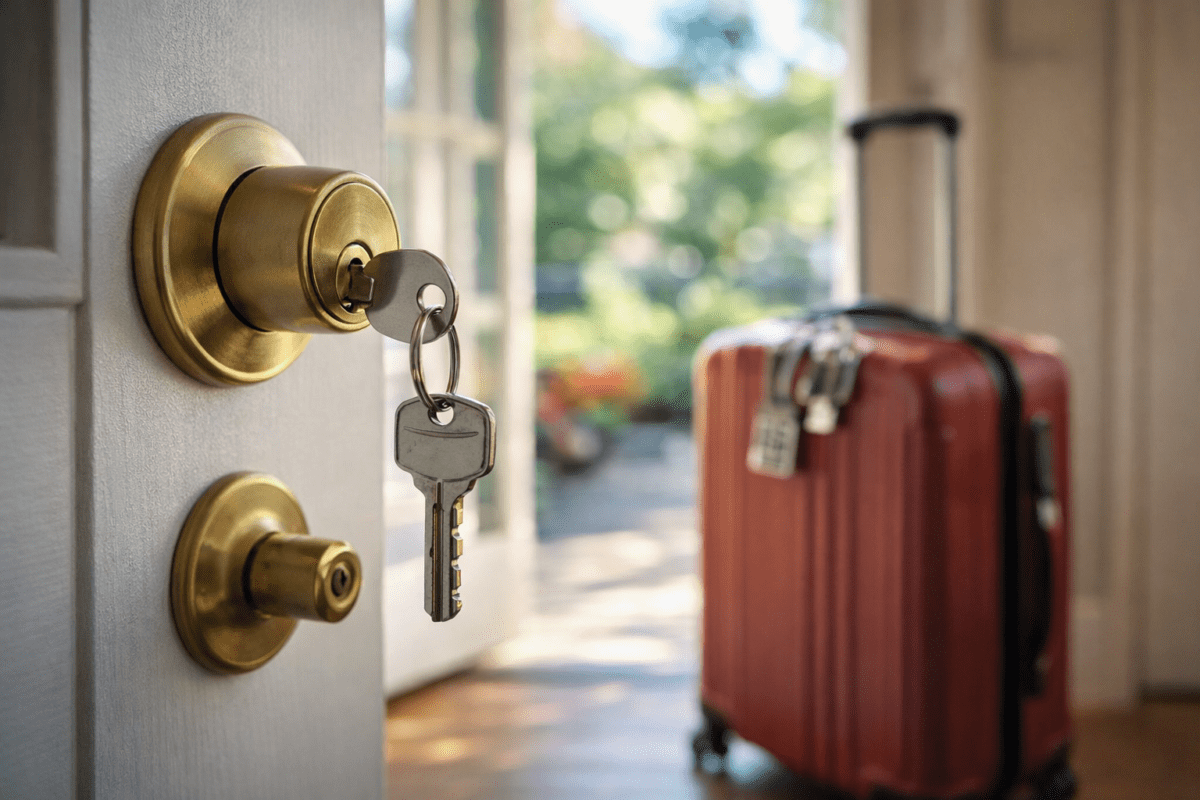
Insert the key, turn slowly, then turn faster: the rotation must remain smooth. If it sticks, identify whether the problem comes from the key (wear) or the European cylinder (hard spots). A cylinder that resists before departure doesn’t “heal” by itself.
2) Check door/lock alignment
A door that rubs or requires “lifting the handle” puts the mechanism under strain. Look at the edge: latch bolt, deadbolt, and if you have one, multipoint lock must enter the strike plate effortlessly. If it forces, adjustment is often more useful than a gadget.
3) Identify your setup (to act correctly)
Recessed or surface-mounted lock, handle on plate, rosette, cylinder… each installation has vulnerabilities. In practice, we look for consistency: a good door poorly adjusted remains an “easy” door. Conversely, a decent door with a suitable cylinder and clean installation gains a lot.
4) Armored door: think “whole system”
A high-performance armored door is a door block + a lock + an installation, not just “an expensive cylinder.” To guide you, the A2P certification (laboratory tests) serves as a reference on many security devices and residential door blocks. Source: CNPP documentation (A2P).
5) Cylinder: watch the protrusion
A cylinder sticking out too much on the outside offers a grip. Without disassembly, check if the cylinder clearly protrudes from the rosette. If yes, this is typically the kind of detail corrected to secure your home before vacation, especially on the ground floor or isolated house.
6) Handle, lever, plate: everything must be “firm”
A handle that moves, a loose plate, a “wobbly” lever: these are cumulative micro-weaknesses. Tighten if accessible, otherwise note it for planned intervention. The idea is not to tinker randomly, but to avoid an obvious entry point.
7) Key duplicates: plan A, plan B
Avoid the “key hidden outside.” Prefer a duplicate entrusted to a trusted person (neighbor, relative) with clear instructions. For a secondary residence or vacation rental, plan who opens if the lock jams during your absence.
8) Useful photos (without paranoia)
Keep a photo of your key (without publishing it), the cylinder, and the closed door. In case of trouble, it helps explain the situation and avoid “blind” diagnoses over the phone.
9) The “peace of mind” option: a check before departure
If you feel the lock has already “scraped” or the door closes poorly, the most effective remains an upstream check. It’s rarely spectacular, but it’s exactly the kind of detail that makes a difference on D-day.
To secure your home before vacation, the right reflex is not to pile up products. The goal is mainly to reduce easy opportunities: poorly adjusted door, cylinder too protruding, sticking lock. Effective prevention looks like a short checklist, not a gadget store. Source: prevention markers and CNPP technical documentation (A2P)
On the plumbing side: preventing leaks and water damage
Water damage is the silent disaster. A micro-leak can become a real project if it settles in for a whole week. The “travel” logic applies here: just as you check your papers the day before, review two or three risk areas. Source: summaries and claims barometers for “housing” published by insurance organizations (France Assureurs).
1) Locate the water shut-off (and test it)
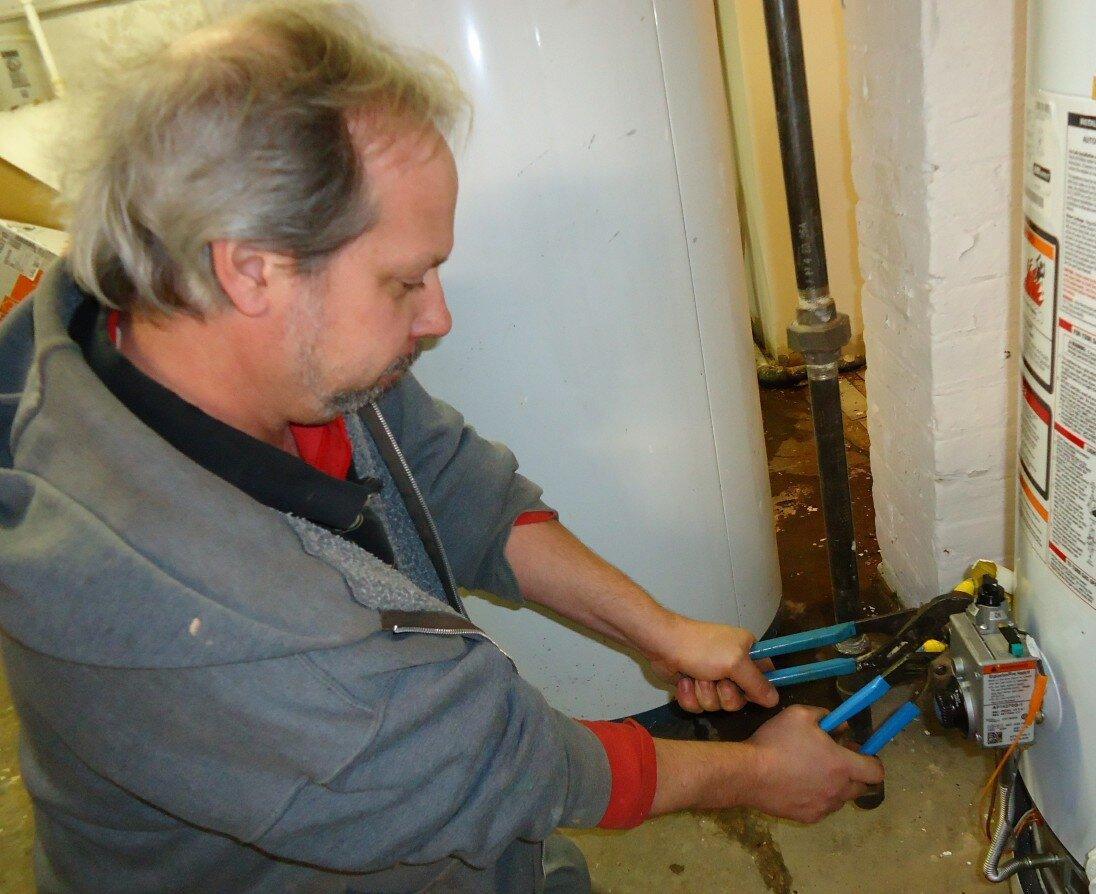
Locate the main shut-off valve and test it: close it, open a tap, check that the water stops properly. In an apartment, the shut-off valve may be in a technical closet, near the meter, or in a duct. A stuck shut-off valve always appears at the worst moment.
2) Long absence: shut off or not?
For several days, shutting off the water reduces risk, especially with a washing machine or dishwasher. If you have specific constraints (special equipment, complex installation), adapt with a pro: sometimes you shut off certain appliances rather than the whole network.
3) The 5 zones to check (in 10 minutes)
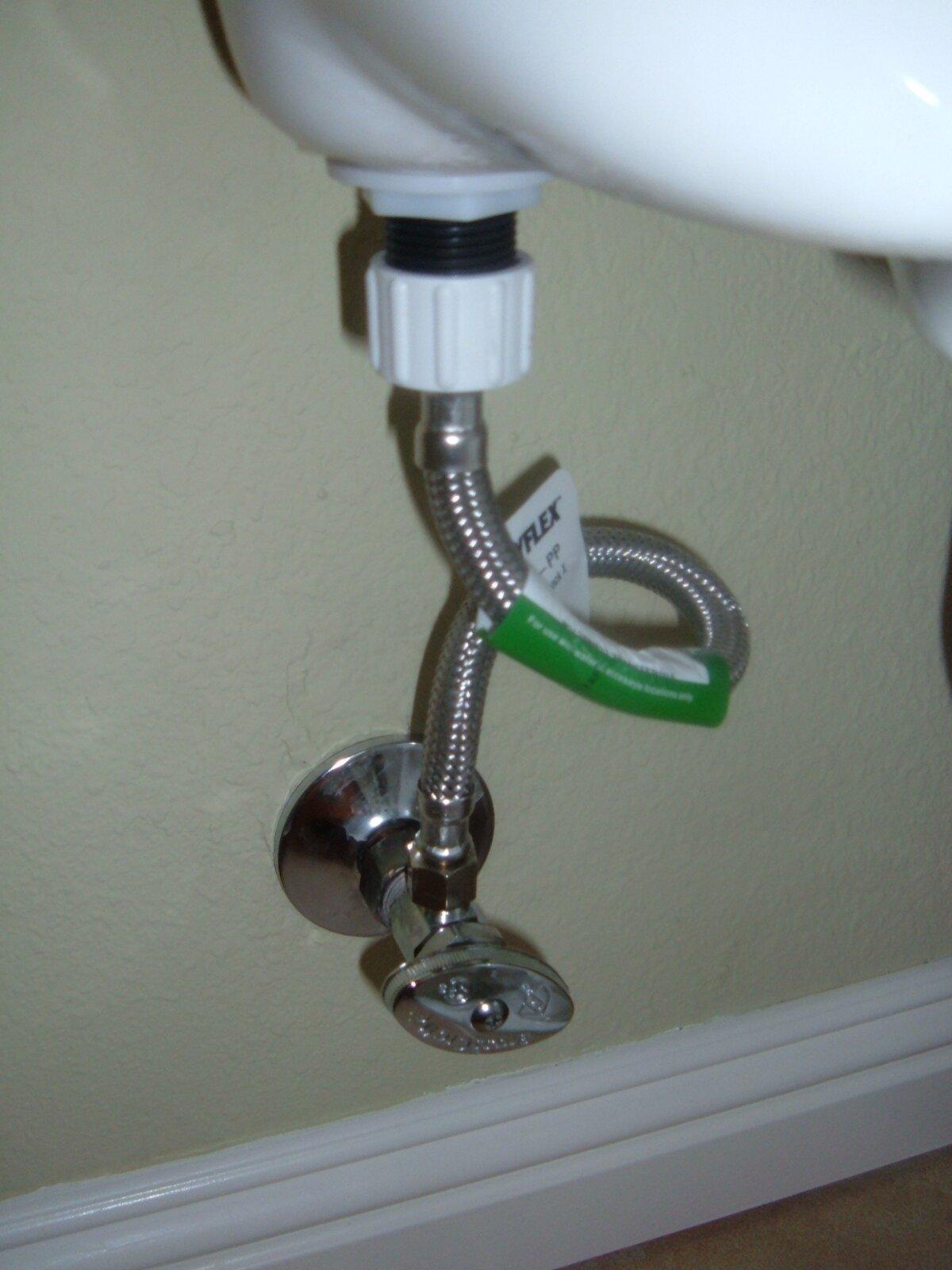
- Under sink: marks, damp smell, siphon.
- Washing machine: hose, tightening, water supply.
- Toilet: filling noise, micro-leak.
- Water heater: abnormal drainage, floor marks.
- Radiators: seepage, suspicious bleeding.
4) Simple signs of a slow water leak
Warped baseboards, ceiling stains, persistent odor, unusual condensation, faint noise near a flush: these are weak signals. If you spot a doubt, don’t “cross your fingers” before leaving: a small planned water leak search is better than returning to damage.
5) “Before closing”: the gesture that avoids 80% of regrets
Just before leaving the home, do one last check: look under the sink, glance at the toilet, and verify nothing has been moved (trash can pressing on a hose, cleaning product pushing a pipe). It’s silly, but very common after a rushed departure preparation.
Insurers observe that water damage is among the most frequent home claims. During absence, the goal is not to “redo everything,” but to make the home stable: tested water shut-off, monitored hoses, controlled wet zones. Source: France Assureurs publications and summaries on home claims

Avoiding scams in repairs: the anti-bad-surprises kit
Stress (slammed door, leak) is the ideal ground for abusive practices. The DGCCRF regularly publishes reminders and control campaigns on home repairs, notably on vague estimates, unannounced prices, and pressure to decide. Source: DGCCRF communications on home repairs.
The 5 “estimate” reflexes (even in emergencies)
- Separate prices: travel, labor, parts, each announced.
- Written before work: signed estimate or intervention form.
- No pressure: “change everything” without explanation is a no.
- Proofs: photos of the part before replacement.
- Trace: detailed invoice + saved exchanges.
Choosing a locksmith or plumber: what really matters
To secure your home before vacation, the ideal remains to anticipate: a planned visit is clearer than a panicked call. If your need is locksmith-related (slammed door, locking, replacement), the approach of Best Locksmith in France fits well into departure preparation: we check the existing, fix what sticks, and avoid emergencies while you are away.
And on the plumbing side, a targeted check-up (shut-off valve, hoses, fittings) like Best Plumber in France is often the most “silent” expense: the one you don’t see, because nothing happens during your absence.
A good quote is not a luxury: it is your seatbelt. Even if you are in a hurry, you must understand what is being charged (travel, labor, parts), and approve a written document before any intervention. It is the simplest way to reduce disputes over home repairs. Source: DGCCRF reminders on consumer protection
Indicative prices and deadlines: finding your way without mistakes
A calm departure also depends on planning. A small planned intervention (door adjustment, hose replacement) is more predictable than a repair on a weekend evening. The ranges below serve as a guide: emergency, evening/weekend, access, and parts affect the final bill.
| Intervention | Common range | What causes variation |
|---|---|---|
| Door adjustment | €80–180 | Hinges, constraints, time on site |
| Cylinder replacement | €120–350 | Brand, level, installation, urgency |
| Opening slammed door | €90–250 | Time, lock type, damage |
| Hose replacement | €80–220 | Access, supply, sealing |
| Leak detection/mini-leak | €120–400 | Diagnosis, disassembly, time |
The right timing before departure
To secure your home before vacation without stress, aim for 7 to 10 days before: a margin to order a part, redo an adjustment, or ask for a second opinion. The last 48 hours are for validation (water shut-off OK, door closes without forcing), not for starting work.
“48 hours before departure” checklist (short version)
This version is designed “mobile-first”: 5 actions, not an endless to-do list. The principle: test, don’t just look.
| Action | Why | Time |
|---|---|---|
| Test the lock | Detect a stiff point before it jams | 2 min |
| Check alignment | Avoid stress on bolts and cylinder | 3 min |
| Test the water shut-off | Be able to stop a leak | 5 min |
| Check wet areas | Limit water leaks and damage | 10 min |
| Prepare a spare key | Have a plan B remotely | 5 min |
Methodology: how this checklist was created
This checklist was designed as a preparation guide, like a “pre-departure” in tourism: prioritizing what avoids major unexpected issues. It is based on technical benchmarks (lock, cylinder, armored door, A2P certification), plumbing reflexes (main shut-off valve, stop valve, wet areas), and consumer protection recommendations (repair quotes, scam prevention).
Limitations: it does not replace a complete diagnosis if your home has already experienced water damage, if the door is very old, or if the installation is atypical. In these cases, the best strategy remains a planned intervention, before departure.
Next step before closing the door
If you are leaving this weekend: lock test, water shut-off test, quick inspection under the sink and around the toilets, then validation of “door closes without forcing.” If you are leaving in two weeks: schedule an adjustment if the lock sticks, and secure your sensitive water points (hoses, fittings). This is the simplest combination to secure your home before vacation without complicating your life.
FAQ: frequently asked questions before leaving
Should I always turn off the water when leaving?
For an absence of several days, turning off the water reduces the risk of prolonged leaks. If your installation has particular constraints, adapt with a professional (partial shut-off, enhanced control).
How do I know if my lock needs to be “replaced”?
When the key often sticks, the rotation is jerky, or you have to force to close, the lock deserves at least an adjustment. A cylinder that protrudes too much on the outside is also a signal.
Is a multipoint lock enough?
It helps, but the effectiveness depends on the whole: door, installation, alignment, cylinder. A multipoint lock on a poorly adjusted door loses part of its usefulness.
What is the purpose of the A2P certification?
A2P is a performance benchmark based on laboratory tests, often cited on security equipment and door blocks. It helps to compare, without replacing installation quality. Source: CNPP (A2P).
Which plumbing parts should be monitored first?
Hoses (washing machine/dishwasher), fittings under the sink, toilet flush, water heater, radiators. A recent trace of moisture deserves a check before departure.
What should I do if I receive a “surprise” bill after repair?
Keep the estimate, detailed invoice, communications, and photos. Request explanations in writing from the professional, then rely on mediation/consumer channels if necessary.
Does my home insurance cover water damage in my absence?
Often yes, depending on coverage and deductibles. Declare quickly, document, and limit worsening. Preventive actions (water shut-off, checking wet areas) also help demonstrate your caution.
Should I notify a neighbor when I leave?
Yes if possible: a trusted contact can check an alert (water noise, shutter left open) and prevent an incident from lasting several days.
How to prepare a secondary residence differently?
Multiply plan Bs: spare key, local contact, identification of shut-offs, control routine at each closing. The less you occupy it, the more you anticipate.
What to remember if I only have 15 minutes?
Test the lock, test the main shut-off valve, inspect under the sink and around the toilets, then validate that the door closes without forcing. This is the most cost-effective foundation.