In brief
- Strasbourg is first chosen by neighborhood, as budget and atmosphere vary greatly from one area to another.
- The tram, biking, and walking allow comfortable living without a car in many cases.
- Neudorf, Krutenau, Robertsau, and Esplanade often appear in comparisons, but for different profiles.
- The rental market is tight: it’s best to prepare your application before moving to Strasbourg.
- The procedures benefit from being done in order: before departure, on moving day, and within the first month.
“In Strasbourg, the right neighborhood is not just the one that looks good on a map: it’s the one that saves you time every day.”
Practical moving advice
Why settle in Strasbourg?
Strasbourg appeals with its balance between a dense city, nature, soft mobility, and European roots. If you want to live in Strasbourg without suffering long commutes, the city is particularly interesting: tram, biking, local services, and contrasting neighborhoods allow for a fairly smooth daily life, provided you choose your area well.
A green and pleasant city to live in
Strasbourg highlights a true urban quality of life. The city notably has 344 hectares of parks and gardens according to local communications, making it a favored setting for families, teleworkers, and those who want quick access to green spaces. This asset is especially visible around Robertsau, Orangerie, or the banks of the Rhine.
A practical mobility network for daily life
The Strasbourg tram remains a strong selling point for newcomers. It structures home-to-work commutes, student travel, and evening outings, while fitting into a logic of intermodal mobility: tram, bike, and walking are often combined. In many neighborhoods, living near a tram line matters more than owning a car.
A European and cross-border anchor
Strasbourg also benefits from its position as a European capital and its proximity to Germany. For workers, cross-border commuters, and mobile profiles, this can be a game changer: a larger employment basin, trips to Kehl, cross-border culture, and access to metropolitan services. It’s a real plus if you’re looking for a well-connected city without sacrificing a human scale.
“Strasbourg is often chosen for its quality of life, but people stay for its ease of travel.”
Editorial summary
Key points: Strasbourg is an attractive city if you value trams, cycling, lively neighborhoods, and proximity to Germany. The right choice mainly depends on your profile and the budget level you are willing to allocate to housing.
How to estimate your monthly budget in Strasbourg?
The monthly budget in Strasbourg depends first on housing, then on your transportation and consumption habits. In practice, rental pressure is higher in the city center and the most sought-after neighborhoods, which drives up rents. For a successful move, plan a realistic budget from the start rather than an overly optimistic estimate.
Useful ballpark figures to prepare your budget
| Profile | Indicative monthly budget | What it covers |
|---|---|---|
| Student in a studio or shared apartment | 900 to 1,300 € | Rent, utilities, transport, food, small daily expenses |
| Young single professional | 1,300 to 1,900 € | More comfortable rent, mobility, outings, daily expenses |
| Couple | 1,900 to 2,700 € | 1- or 2-bedroom apartment depending on the neighborhood, utilities and daily life |
| Family | 2,700 to 4,000 € | Larger housing, transport, school, food, unforeseen expenses |
What makes the bill go up or down
- The neighborhood: downtown, Krutenau, and very central areas are more expensive.
- Proximity to the tram: it often increases attractiveness, thus the price.
- The size and condition of the property: a renovated home rents quickly and costs more.
- Lifestyle: car, parking, leisure, and dining out strongly affect the budget.
Key points: to settle in Strasbourg, the housing budget must be calibrated first. If your budget is tight, be willing to move slightly away from the city center to gain space or comfort.
Which neighborhood to choose in Strasbourg according to your profile?
The right neighborhood depends on your lifestyle, budget, and need for calm or liveliness. In Strasbourg, the differences are clear between a student area, a residential neighborhood, and the historic center. To make the right choice, first compare the atmosphere, tram access, and housing price before being guided solely by reputation.
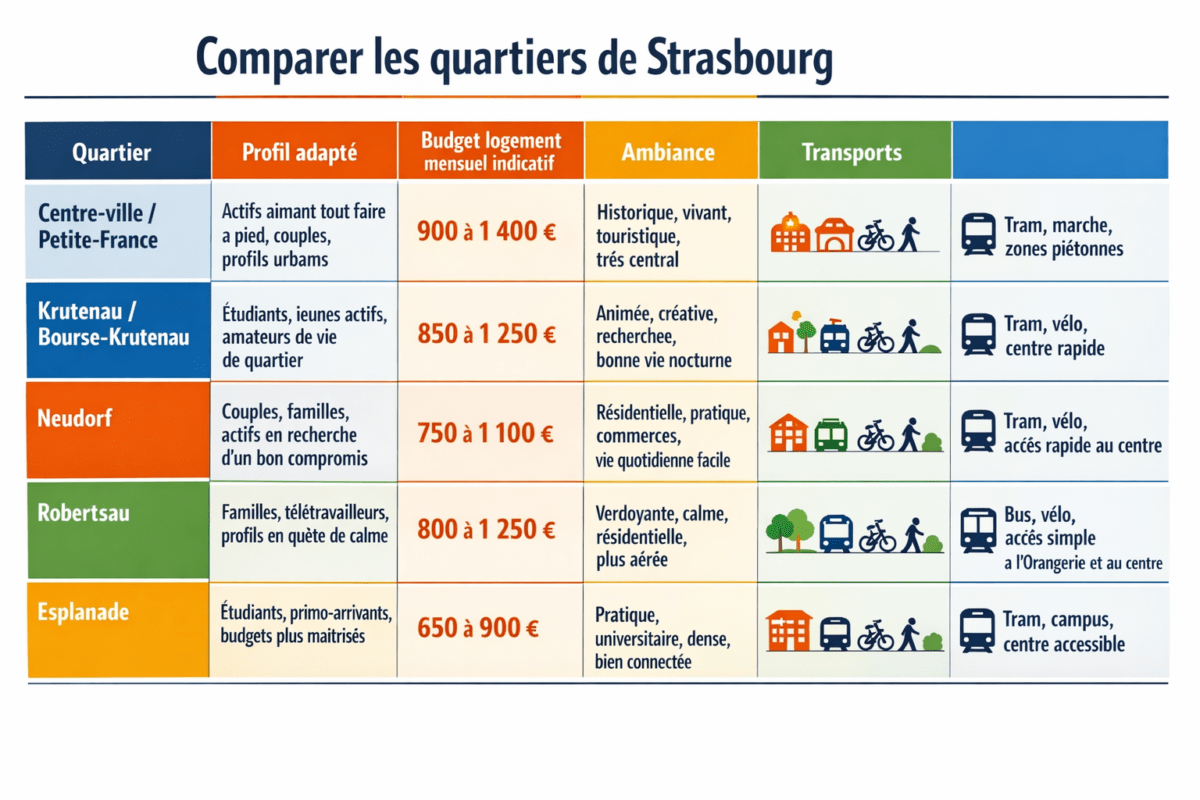
| Neighborhood | Suitable profile | Indicative monthly housing budget | Atmosphere | Transport |
|---|---|---|---|---|
| City center / Petite-France | Active people who like to do everything on foot, couples, urban profiles | 900 to 1,400 € | Historic, lively, touristy, very central | Tram, walking, pedestrian zones |
| Krutenau / Bourse-Krutenau | Students, young professionals, neighborhood life enthusiasts | 850 to 1,250 € | Lively, creative, sought-after, good nightlife | Tram, bike, quick access to center |
| Neudorf | Couples, families, professionals looking for a good compromise | 750 to 1,100 € | Residential, practical, shops, easy daily life | Tram, bike, quick access to center |
| Robertsau | Families, teleworkers, profiles seeking calm | 800 to 1,250 € | Green, calm, residential, more spacious | Bus, bike, easy access to Orangerie and center |
| Esplanade | Students, first-time arrivals, more controlled budgets | 650 to 900 € | Practical, university area, dense, well connected | Tram, campus, accessible center |
Downtown and Petite-France: living in the heart of Strasbourg
Downtown is suitable for those who want a car-free daily life, with immediate access to shops, restaurants, and cultural venues. It is the most obvious neighborhood if you are looking for an intense urban life and maximum convenience, but it is also one of the most expensive and one of the most exposed to rental pressure.
Krutenau: for a lively and sought-after setting
Krutenau attracts many students and young professionals. The atmosphere is lively, getting around by bike is easy, and the center remains very close. On the downside, demand is strong, which makes the search for housing sometimes quick and competitive. It’s better to have a complete file before visits.
Neudorf: the often recommended compromise
Neudorf often comes up in recommendations because it combines accessibility, shops, facilities, and a residential atmosphere. It’s a good choice if you want to move to Strasbourg without paying the price of the center, while staying well connected to the tram. For many couples and families, it is a very balanced area.
Robertsau: calm, greenery, and neighborhood life
Robertsau appeals to those looking for more space, greenery, and tranquility. It offers a more residential setting, appreciated by families and those who work remotely. The downside is simple: demand remains strong, and some addresses can be farther from the most central routes.
Esplanade: a practical option for tighter budgets
Esplanade remains an interesting option if your priority is to control the budget without isolating yourself. The neighborhood is well served, practical for students and for people who want a functional solution during the first month of settling in. It should not be chosen for its charm alone, but for its daily efficiency.
To remember: if you are still hesitating, keep this simple rule in mind: downtown and Krutenau for liveliness, Neudorf for balance, Robertsau for calm, Esplanade for a more contained budget.
“The best neighborhood is often the one that reduces your most frequent trips: work, school, shopping, childcare.”
Practical advice
What steps to take after moving in?
The steps after moving in should be handled in a simple order: secure the address, activate essential services, then update official organizations. In Strasbourg as elsewhere, the most important thing is not to leave anything pending during the first month, especially if you have just signed a lease, changed an energy contract, or settled in a pedestrian zone.
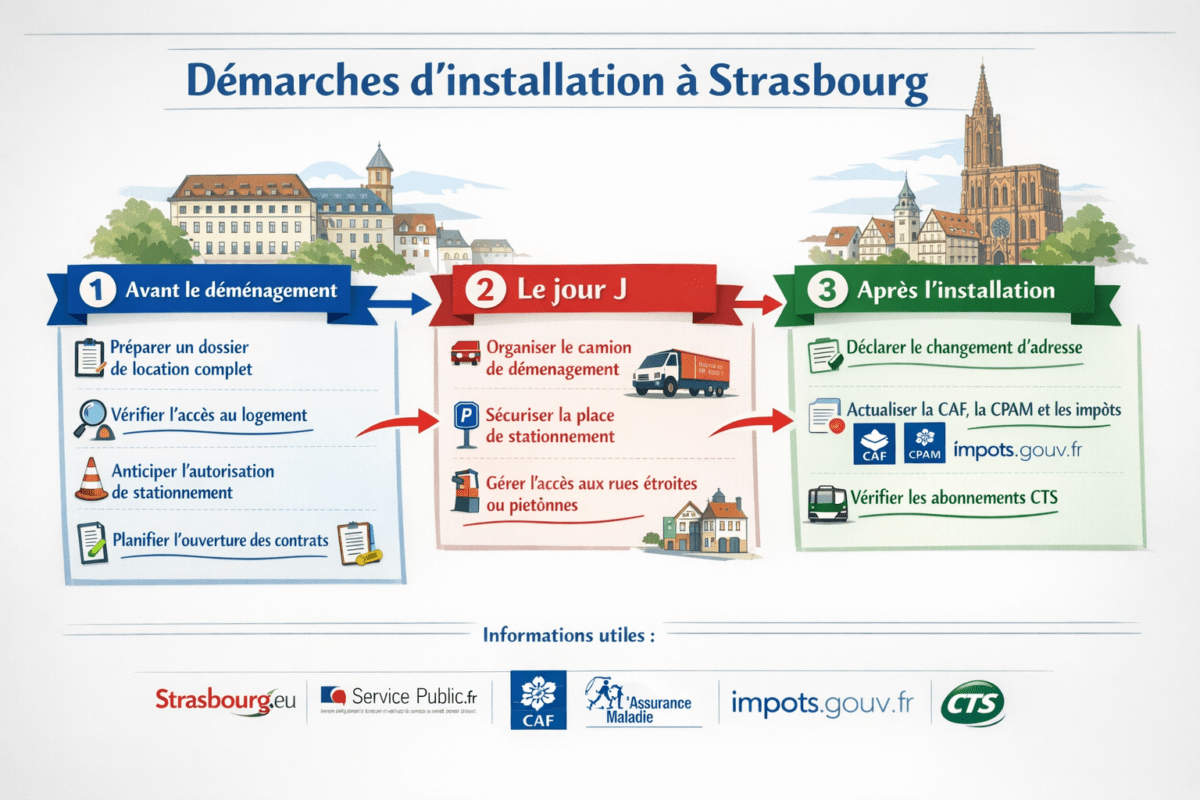
Before moving: secure the file
- Prepare a complete rental file: ID, proof of income, guarantor, last tax or tax notice if requested.
- Check access to the housing: elevator, courtyard, narrow street, pedestrian zone, or need for a temporary spot.
- Anticipate parking authorization if the truck needs to park near the home.
- Plan the opening of contracts: electricity, water, internet, home insurance.
On moving day: avoid blockages
On moving day, the parking issue can quickly become critical, especially in central areas or narrow streets. In Strasbourg, it is sometimes necessary to reserve or request authorization in advance from the competent city services. This step avoids wasting time, fines, or moving at a distance from the home.
After moving in: essential updates
- Declare your change of address with the relevant services via online procedures.
- Update your files with the CAF, CPAM, tax authorities, and employers’ services if necessary.
- Check Strasbourg.eu for useful local information for newcomers.
- Verify CTS subscriptions for the Strasbourg tram and buses if you plan to get around without a car.
To remember: the procedures are not complicated, but they must be done in the right order. The official sources to keep handy are Service-Public.fr, Strasbourg.eu, CAF, CPAM, impots.gouv.fr, and CTS.
“A successful move starts with the address, but is mainly played out in the procedures of the first 30 days.”
Practical moving-in service
How to live daily life in Strasbourg?
Living in Strasbourg daily often means optimizing your routes and simplifying your organization. The city lends itself well to neighborhood life, soft mobility, and short trips. This is especially true if you live near a tram line or in an area where shops, schools, and services are within walking distance.
Transport: tram, bike, and intermodal mobility
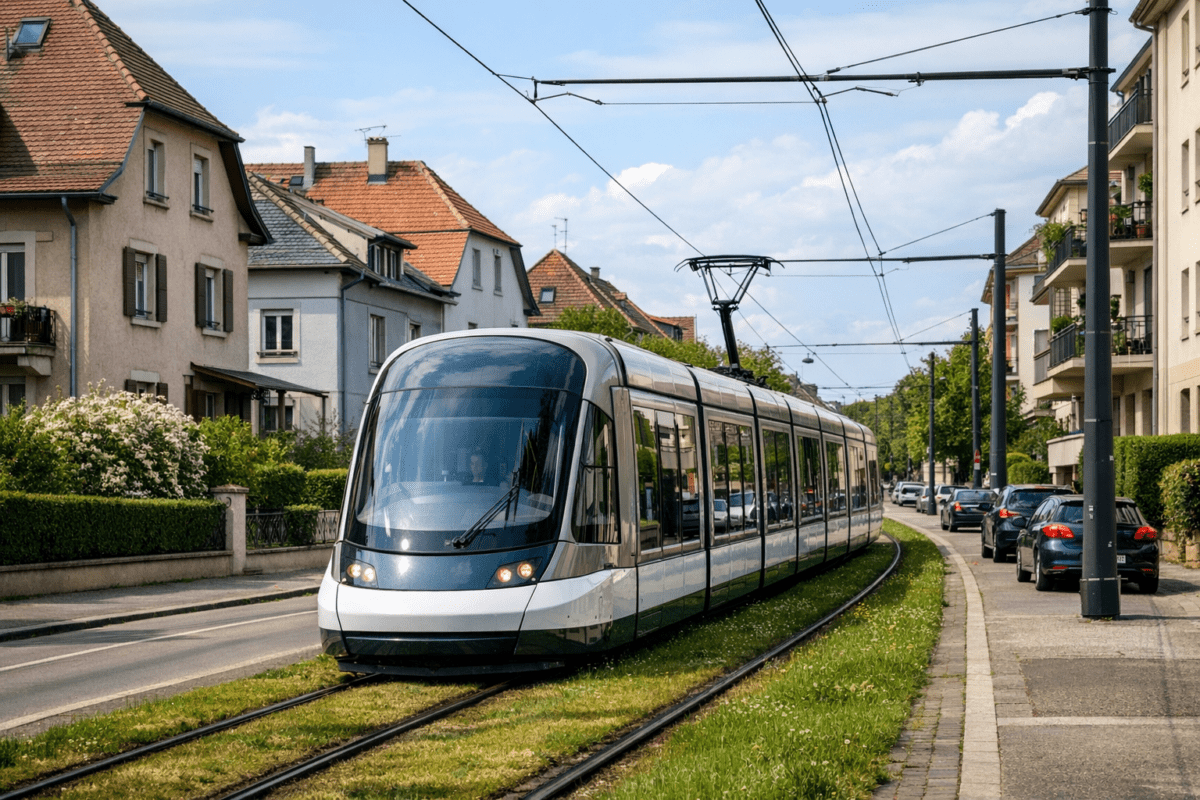
The tram is the backbone of urban travel, but Strasbourg also works very well with bikes and walking. This logic of intermodal mobility is one of the reasons why the city appeals to newcomers. In practice, the closer your home is to the tram, the simpler your daily life becomes, even if you occasionally need to supplement with a bus or regional train.
- Tram: ideal for regular trips.
- Bike: perfect for short trips and central neighborhoods.
- Walking: very useful in the center and pedestrian zones.
- Car: useful mainly if you live on the outskirts or if your activity requires it.
Health, school, and local services
Before settling in Strasbourg, you also need to think about daily services: general practitioner, pharmacy, school, daycare, bank, and shops. Residential areas like Neudorf or Robertsau often offer better living comfort if you are looking for a stable and family-friendly environment. In any case, it is useful to identify services before finalizing the rental.
Discovering the city to better integrate
The first few months are often the most important to feel at home. Strasbourg is very well explored on foot or by bike: Grande-Île, Petite-France, quays, parks, student neighborhoods, European institutions. Going beyond your immediate residential area helps to understand the logic of the neighborhoods and to identify the best connections for your actual habits.
To remember: to live well in Strasbourg, think less in kilometers and more in travel time. The proximity of the tram, shops, and green spaces truly changes the quality of life.
“In Strasbourg, you first choose a travel time, then a home.”
Urban mobility principle
Settling in Strasbourg according to your profile
The right neighborhood is not the same if you are a student, a couple, a family, or a cross-border worker. To settle in Strasbourg sustainably, you need to link the housing to your actual use: campus, work, school, cross-border trips, need for calm or neighborhood life. The practical cases below show how to reason concretely.
Student: priority to access and budget
Practical case: Lina, a student, prioritized Esplanade to stay close to the campus and the tram. She gained simplicity in daily life, even if the accommodation was smaller. For a student, the goal is not to have the most prestigious neighborhood, but a well-connected apartment and an affordable rent.
Young couple: balance between price and comfort
Case study: a young working couple chose Neudorf to find a T3 apartment more affordable than in the center, while staying close to the Strasbourg tram. This compromise works well if you want a lively neighborhood without paying the maximum for the city center. It is often the right balance between space and accessibility.
Family: calm, services, and practical living
Case study: a family with two children turned to Robertsau to enjoy a more residential setting, a green environment, and easier access to schools and open spaces. For families, the logic is simple: prioritize stability, services, and short trips to essential living places.
Cross-border worker or mobile professional: fluidity above all
Case study: a cross-border employee living in Strasbourg chose an area well connected to the tram and exit routes to limit friction between city, work, and travel to Germany. If you are in this situation, think about intermodal mobility, parking, and connection times, not just the size of the accommodation.
To remember: profiles do not look for the same things. Student = accessibility, couple = compromise, family = calm and services, cross-border worker = fluidity of travel.
Checklist for the first 30 days
- Finalize the move-in inventory and keep all documents.
- Activate electricity, water, internet, and home insurance.
- Request or verify parking authorization if necessary.
- Declare the new address to the relevant administrations.
- Update CAF, CPAM, and tax authorities if your situation changes.
- Identify the train station, tram stop, shops, and nearby health services.
- Choose your CTS subscription or your daily transportation solution.
- Note local parking rules and pedestrian zones.
- Test your home-to-work or home-to-campus routes for a week.
- Take time to discover 2 or 3 neighborhoods to confirm your choice.
Key points to remember
- The neighborhood is the first decision when you want to settle in Strasbourg.
- The Strasbourg tram and cycling make the city very convenient without a car.
- Neudorf is often the best compromise between budget, accessibility, and comfort.
- Krutenau and the center suit profiles who want urban life and everything within walking distance.
- Robertsau attracts more families and people seeking calm and greenery.
- Procedures must be handled in order: before departure, on the moving day, then within the first month.
Useful official sources
- Strasbourg.eu: local information, parking, practical life, newcomers.
- Service-Public.fr: administrative procedures, address change, rights and obligations.
- CAF: housing aid and rights simulation.
- CPAM / Ameli: affiliation, Vitale card, health procedures.
- impots.gouv.fr: tax address and household updates.
- CTS: tram, bus, subscriptions, and schedules.
- INSEE: population data, housing, and urban structure.
FAQ: settling in Strasbourg
What is the best neighborhood to settle in Strasbourg?
There is no universal best neighborhood. Neudorf is often the most balanced for a first move, while Krutenau appeals to young profiles and Robertsau suits those seeking calm. The right choice mainly depends on your budget and daily routes.
How much should you budget to live in Strasbourg?
For a single person, a monthly budget of €1,300 to €1,900 is a cautious base, including housing. A couple is often between €1,900 and €2,700, and a family between €2,700 and €4,000. These amounts vary depending on the neighborhood, size, and lifestyle.
Is a car necessary to live in Strasbourg?
Not necessarily. Many newcomers live very well without a car thanks to the tram, cycling, and walking. A car becomes especially useful if you live on the outskirts, have a very mobile job, or if your family has specific transportation needs.
What steps should be taken right after moving in?
Start with home insurance, energy and internet contracts, then check your address change with the relevant administrations. Also think about the CAF, CPAM, and taxes. If your street is pedestrian-only or narrow, plan ahead for parking the moving vehicle.
Which neighborhood to choose in Strasbourg for a student?
Esplanade and Krutenau are often the most sought after by students, as they combine tram access, proximity to campuses, and neighborhood life. If the budget is tight, it’s better to aim for a functional, well-connected accommodation rather than a very central but too expensive area.
Conclusion
To settle in Strasbourg under good conditions, remember a simple rule: first choose the neighborhood based on your routes and budget, then lock in administrative and logistical steps within the first 30 days. The city offers an excellent quality of life, provided you find the right balance between location, budget, and mobility.