An empire in pieces: political backdrop
When Charlemagne died in 814, his son Louis the Pious inherited an empire as vast as it was heterogeneous. Mountains, plains, and coastlines stretched from the Atlantic to the Elbe, mixing Frankish, Saxon, Lombard, and Bavarian populations. Stability quickly cracked: family rivalries, local rebellions, and external pressures, notably Vikings and Avars, weakened central authority.
Family divisions
Louis the Pious spared no effort: successive divisions among his sons, pastoral visits, monastic reforms… Despite everything, the spirit of succession did not reconcile with the notion of imperial unity. Each son dreamed of his own “kingdom” to govern without sharing. The father’s hesitation to make a lasting decision generated a series of latent conflicts that eventually broke out openly after his death in 840.
External pressures and territorial realities
- Viking raids on the western coasts stressed the counties of Neustria and Burgundy.
- The threat of Magyar invasions in Eastern Europe pushed Louis the German to strengthen his borders.
- The Mediterranean, a theater of piracy and Byzantine influences, made Provence a strategic stake.
In this turbulent context, how could one imagine a reasonable division without plunging the empire back into widespread civil war?
The three emperors and their ambitions
The direct heirs of Louis the Pious were far from sharing the same vision for the future of the empire. Behind somewhat Manichean portraits lie nuanced characters, shifting alliances, and subtle negotiations.
Charles the Bald
The youngest, he inherited the western territories. In his mind, the West, with its port cities and flourishing monasteries, represented the Carolingian Eden. Very early on, he forged strong ties with the Breton aristocracy and the great abbots of the Loire to consolidate his power.
Louis the German
Solid and reserved, he aimed more for border stability: dense forests, Rhine frontiers, learned bishoprics… The East was for him a natural shield against Slavic peoples and newcomers on the eastern shores. His role as “emperor-war chief” took on full meaning when Slavic groups crossed into Saxony.
Lothair I
Crowned in 817, Lothair defended the idea of a cross-border empire, federating Italy, Burgundy, and the Rhine basin. Ambitious, he dreamed of a Carolingian world extended to the edges of the Adriatic, following in Charlemagne’s footsteps.
The negotiation: not just a map division
Forget the image of a simple finger gesture on a map. The Verdun talks combined marital strategies, military pressures, and papal support. Every clause of the treaty reflects a specific issue, sometimes seemingly trivial but heavy with consequences.
The role of the pope and the Church
The papacy, long linked to the Carolingians, acted as mediator. Obtaining the moral support of the Holy See gave the brothers additional legitimacy. Without this papal agreement, the division risked having only ephemeral significance, with each party legitimately contesting power derived purely from force.
Maps, messengers, and advisors
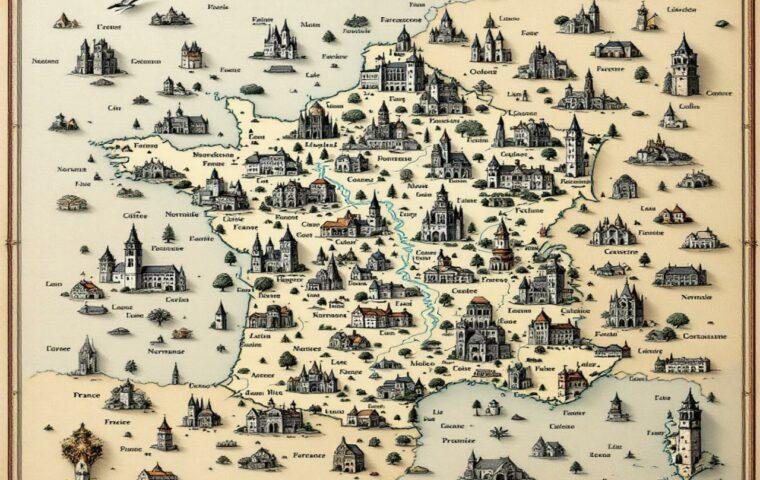
- Monk cartographers drafted rudimentary portolans, indicating key cities and monasteries.
- Vascon and Aquitanian ambassadors, accustomed to border diplomacy, moved from camp to camp to collect opinions and promises.
- Scholars versed in Roman law translated orally agreed accords into written clauses.
After weeks of back-and-forth, the treaty was refined: every city, every watercourse, every mountain pass had to be included in the articles. Such precision was unprecedented for the time.
Detailed content of the treaty
Three main zones are distinguished, with borders that, even when sharply drawn, leave room for buffer zones and enclaves. The final agreement contains several articles, but the essentials can be retained:
| Heir | Key Territories | Main Cities |
|---|---|---|
| Charles the Bald | West Francia | Paris, Tours, Reims |
| Lothair I | Middle Francia | Metz, Vienne, Milan |
| Louis the German | East Francia | Würzburg, Mainz, Salzburg |
The division is not limited to a simple boundary: clauses are added concerning the free use of trade routes, the right of worship in surplus monasteries, and even the organization of military alliances to counter Viking or Slavic incursions.
Immediate Consequences and Distant Legacies
The swords are sheathed… for a time. Each returns to their castles, tournaments, and tax collection. However, the “three kingdoms” model soon begins to produce its first tensions.
Fragmentation and Shifting Alliances
- Charles the Bald briefly allies with the Vikings, in exchange for ransoms paid to secure the tranquility of the coasts.
- Louis the German organizes “itinerant schools” to educate the sons of Slavic chiefs in Frankish culture.
- Lothair negotiates with Byzantium to support his imperial project, without lasting success.
Over the decades, each kingdom develops its own administration, currency, customary laws. These changes, more logical than ideological, foreshadow the future European nations.
The Cultural Imprint
“The Treaty of Verdun not only reshaped political landscapes, it engraved dividing lines in collective memories.”
Languages, liturgies, monastic arts spread along axes established as early as 843. Would Normandy today escape Frankish influence without this medieval division? Hard to imagine.
Modern Interpretations: Between Myth and Realities
Renaissance historians considered Verdun a family tragedy, a political fratricide. In the 20th century, some saw in this treaty the beginning of Franco-German conflicts, using 843 as a quasi-mythological trigger. Today, it is preferred to speak of a historical process in negative: sometimes, the absence of a strong central power is more structuring than its presence.
Verdun in School Textbooks
The most common primer presents Verdun as the starting point of France and Germany. In reality, borders continued to evolve for two more centuries, depending on feudal rebellions and princely marriages.
Heritage and Commemorations
- Verdun, today famous for the 1916 battle, often forgets its fundamental treaty.
- Historical reenactments, sometimes kitschy, attempt to revive the event, between jousting tournaments and medieval fairs.
- A few researchers — passionate about paleography — continue to decipher the original manuscripts hidden in the papal archives of Rome.
FAQ on the Treaty of Verdun
- What triggered the Verdun negotiation? Mainly the death of Louis the Pious and the rise of succession disputes among his sons.
- Why Verdun and not another place? At the borders of Middle and West Francia, Verdun offered river access and was considered relatively neutral.
- Was the treaty really respected? In its letter, yes. In spirit, the kings constantly eyed their neighbor’s fief, causing raids and diplomatic uncertainties.
- What archaeological traces remain? Few direct remains of the treaty itself, but many 9th-century defensive works in the three kingdoms reflect the new strategic priorities.
- How does this division influence present-day Europe? Linguistic and cultural borders became deeply rooted; the divisions born in 843 still resonate, sometimes subtly, in contemporary geopolitics.