The Causes of the 1848 Revolution
Social and Economic Tensions
On the eve of 1848, France was going through a severe agricultural crisis: poor harvests, soaring bread prices, and growing misery in the countryside. In the cities, industrial growth did not keep pace with demographic expansion: unemployed and precarious workers crowded into unhealthy neighborhoods. One might think that the emergence of small factories and factory chimneys symbolized progress, but for many, it only heightened vulnerability to cyclical crises. The “subsistence revolts,” anecdotal a few years earlier, now became massive and coordinated.
Political and Institutional Crisis
The July Monarchy, established in 1830, had lost its initial momentum. Under Louis-Philippe, the administration remained narrow-minded: the censitary suffrage limited political participation to a wealthy elite, while attacks on the opposition press multiplied. Reform banquets – meetings disguised as public dinners – became the last space for free speech, but with each new speaker, censorship tightened. The result: a widespread feeling that the system no longer listened to anyone outside a small circle of financiers and notables.
Influence of European Ideas and Movements
We must not forget the continental context: liberalism, emerging socialism, and nationalism conspired to sweep away the old dynasties. In Germany, Austria, and Hungary, clandestine clubs flourished and vigorously debated political rights and social issues. Newspapers, plastered with slogans and caricatures, crossed borders, fueling impatience in France. The revolutionary wind blew from Berlin to Vienna and found its echo in the streets of the capital.
The Outbreak of February 1848
The Role of Political Banquets
These banquets, a sort of defiance of the regime, were originally festive meals where journalists and parliamentarians gathered to demand the extension of suffrage. The last one, scheduled for February 22, 1848, was banned at the last moment. Imagine the boomerang effect: thousands of frustrated guests, tongues running wild, and above all, a call to take to the streets. The scent of revolt then spread faster than an underground leaflet: the spark was ready to ignite the capital.
Insurrection and Fall of the July Monarchy
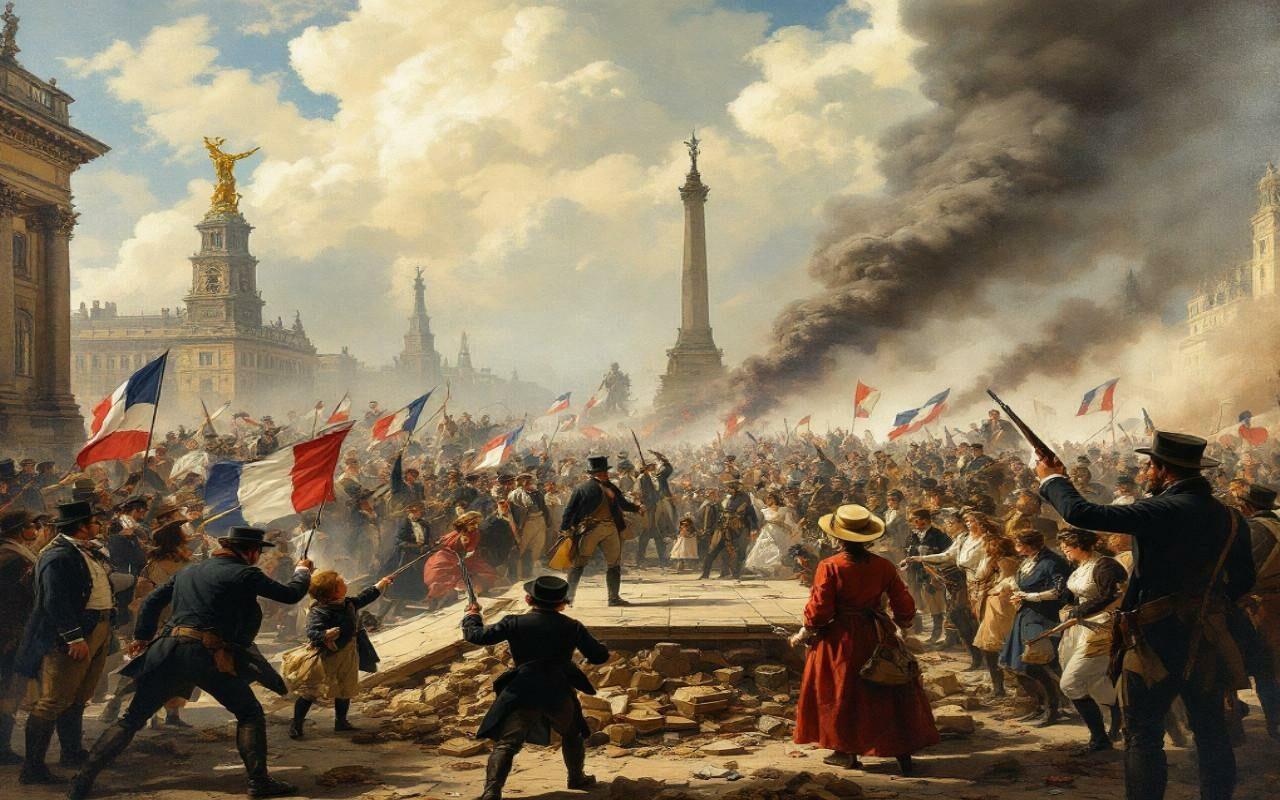
The sidewalks were covered with torn-up cobblestones, cannons pointed from windows, and artisans alongside students threw themselves into the fray. In twenty-four hours, the July Monarchy wavered: Louis-Philippe, nicknamed the “citizen king,” abdicated on the night of February 24. Surprise? Not entirely: he who dreamed of a “bourgeois kingdom” ended up being overwhelmed by a crowd determined to write its own page of history.
The Immediate Consequences
Social and Political Reforms
The universalization of male suffrage became an urgent necessity: every adult citizen, regardless of wealth, was granted the right to vote. It was an unprecedented democratic revolution in Western Europe. At the same time, the abolition of slavery in the French colonies was voted in April 1848, ending a human trade that the previous regime had maintained due to insufficient popular pressure. For workers, the National Workshops – subsidized work workshops – promised relief from unemployment. Provided these projects could be financed…
Turbulence and Reaction
The surge of enthusiasm did not last. As early as June, the provisional government, overwhelmed by budget management, abruptly closed the National Workshops. The uprising of the “June Days” ended with a fierce repression, marking the split between moderate republicans and radical socialists. This discord foretold chronic political instability, a prelude to the arrival of Louis-Napoléon Bonaparte in 1852.
The Long-Term Legacy
Towards the Second Republic and Beyond
The Second Republic (1848-1852) did not last, but it etched three principles in stone: freedom of the press, the right of association, and payment of voters for parliamentary duties. Louis-Napoléon Bonaparte, elected under the republican label, overturned the table in 1851 but kept an eye on the public opinion shaped by those months of euphoria: universal suffrage would never again be called into question.
The Revolutionary Spirit Across Europe
The movements of 1848-1849 in Austria, Hungary, the German states, or Italy did not produce lasting revolutions, but they sowed the seeds of nationalism and liberalism. It is sometimes called the “Springtime of the Peoples,” so widespread was the cry for constitutions inspired by the French model. In some states, the abolition of corvée labor and feudal privileges was hastily adopted, even if reversals were frequent once the pressure subsided.
| Country | Movement | Immediate Outcome |
|---|---|---|
| France | Urban Insurrection | Second Republic, universal suffrage |
| Austria | Vienna Revolt | Failed reforms, authoritarian rollback |
| Germany | Frankfurt Parliament | Failure of liberal unification |
| Hungary | National Movement | Military repression |
- Universal male suffrage generalized for the first time in Western Europe.
- Abolition of slavery in French colonies (April 1848).
- Freedom of the press and right of association enshrined in law.
- Ephemeral National Workshops, a precursor to public employment policies.
“France will never become what it was again, for the people have tasted freedom”
— Parisian observer, spring 1848
FAQ
What were the main causes of the 1848 Revolution?
Agricultural crisis, worker impoverishment, and lack of political reforms converged to ignite the powder keg. Added to this were liberal and socialist ideas circulating throughout Europe.
Why is it called the “June Days”?
After the euphoria of February, the closure of the National Workshops triggered a popular uprising from June 23 to 26, 1848, which was severely repressed and highlighted the Republic’s powerlessness in the face of social issues.
How did 1848 inspire other countries?
The revolutionary wave, called the “Springtime of the Peoples,” produced a first attempt at liberal constitutions and political rights in Austria, Germany, Hungary, and Italy, even though most were suppressed in bloodshed.
What legacy remains today?
Universal male suffrage, freedom of the press, and recognition of associative rights remain three lasting achievements of this period, often overshadowed by the 1851 coup d’état.