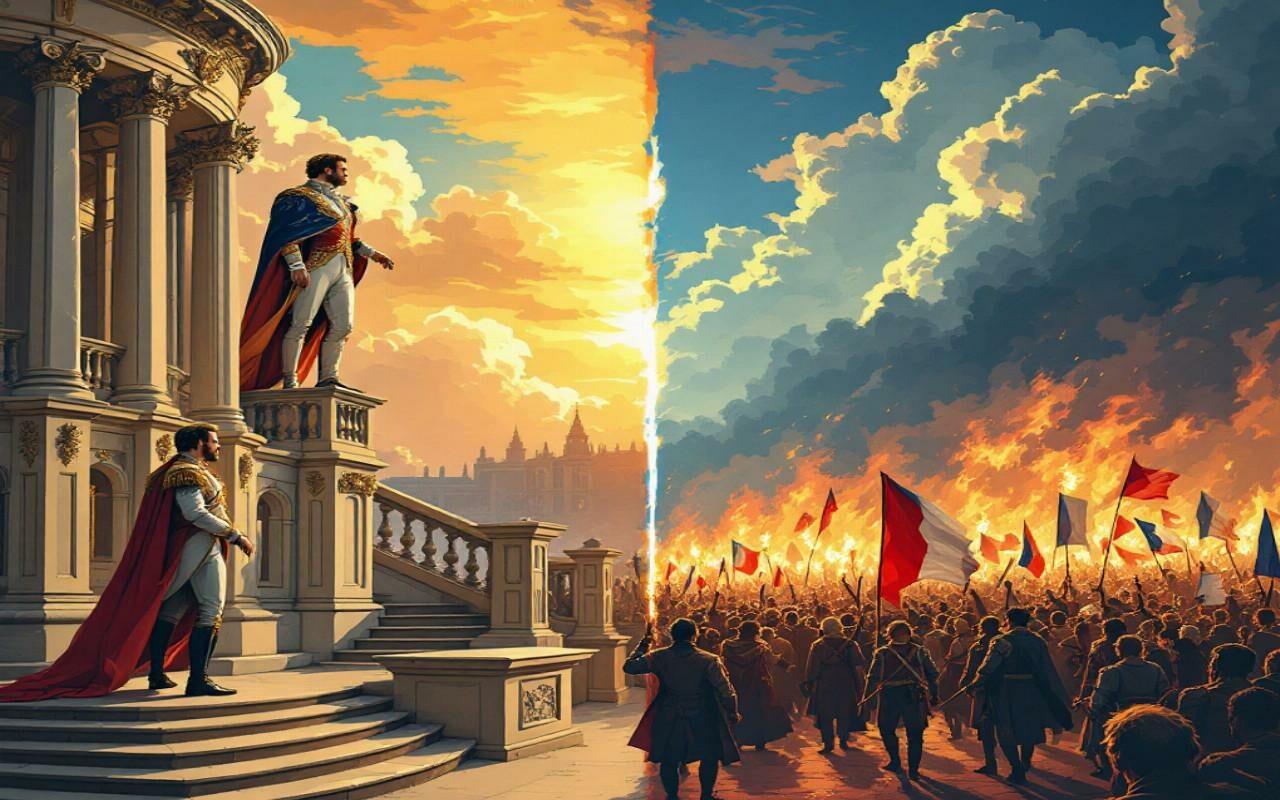
In February 1848, the July Monarchy, established for twenty years under the reign of Louis-Philippe, collapsed in a few days, shaken by an explosive social situation and an uncontrollable street movement. How did this junior branch of the Bourbons, which was predicted to have a stable future, end up swept away by a revolution that would open the Second Republic? Let’s dive into the mechanisms, tensions, and upheavals that precipitated the fall of this regime sometimes described as “bourgeois”.
Sommaire
Golden decade or paper tiger? The context of the July Monarchy
When Louis-Philippe ascended the throne in 1830, hope was palpable: the “Citizen King” was supposed to embody the balance between a tempered monarchy and the liberal aspirations born of 1789. However, this compromise quickly turned into a system where the interests of the upper bourgeoisie, finance, and industry took precedence over those of the people. Beneath its stable and moderate appearance, the July Monarchy relied on a limited electorate (fewer than 200,000 registered voters), maintained a muted dialogue with the Chamber, and gradually neglected the working classes.
A cautious diplomacy and relative prosperity
While staying away from major colonial adventures, Louis-Philippe favored peace and commercial exchanges – the affairs of the East India Company or the trade treaty with England illustrate this caution. Railways developed, banks flourished, and the Parisian bourgeoisie grew wealthy. Certainly, opulence mingled with misery: the national workshops closed, the Parisian worker barely survived, camped in the suburbs. This contrast exacerbated resentments that a state insensitive to social demands only worsened.
Half-hearted reforms
For political convenience, the July government granted some reforms: controlled freedom of the press, improvement of road networks, reorganization of the university system. Like a craftsman who lingers on decoration while neglecting the foundations, the Monarchy sprinkled a good dusting of powder on fragile bases. The popular classes retained a bitter taste: they perceived these advances as cosmetic, far from their immediate concerns, such as work, housing, or social security (even in its embryonic form).
The economic and social detonator (1846-1847)
By the mid-1840s, crisis loomed. Famine in Ireland, speculation on wheat, rising prices of goods: all contributed to widening the gap between rich and poor. In Paris, anxiety began to surface when the price of flour tripled. Swept away by the cost of living, workers mobilized, pamphlets inflamed salons, and the streets rumbled.
- Tax increases to cover a growing deficit;
- Agricultural speculation benefiting traders, leaving peasants drained;
- Urban poverty exacerbated by a stock of unhealthy and overcrowded housing;
- Police repression of demonstrations that fueled popular anger.
“You cannot govern on a simmering volcano without risking an eruption,” wrote an editor of the National in 1847.
The credit crisis and industrial slowdown
Banks failing, dubious loans, and massive withdrawals shook confidence. Workshops closed for lack of capital; a disheartened working class found itself left to its own devices. In Lyon, the silk workers recalled the aborted industrial revolution of 1834: machines displaced men, technology ruled, and class struggle intensified. While the student youth awakened to the republican ideal, the middle class worried about their savings. Everything converged toward a unanimous feeling: the system was faltering.
The revolutionary spiral of February 1848
The Banquets, these political meetings forbidden under the Old Regime, became the opposition’s meeting place. Suddenly banned in January 1848, they ignited the powder keg. There was talk of a meeting at the Foy hotel, tents were set up on the Boulevard des Italiens, and suddenly, the street exploded.
From Banquet to Riot
On February 22, a peaceful demonstration turns into a confrontation when the royal troops use bayonets. Within a few hours, hundreds are injured. Barricades spontaneously rise at the Bastille, the Opera, in the Saint-Marceau suburb… Paris transforms into an urban battlefield.
The Contagion Effect
From the provinces, news arrives exaggerated: “Paris is ablaze!” insurrectionary days are announced. With emojis to support, telegraphic messages carry a scent of panic reaching Bordeaux, Rouen, or Lille. From then on, the July Monarchy is nothing but a paper empire, unable to impose order.
Abdication and Hastening of Royal Power
On the morning of February 24, Louis-Philippe, frightened, abdicates in favor of his grandson, the Count of Paris. He hopes to neutralize the rebels and allow a smooth transition. Bad luck: his supporters scatter, the National Guard sides with the people, the Chamber divides, and the monarchy’s legitimacy implodes.
| Date | Event | Immediate Consequence |
|---|---|---|
| February 22, 1848 | Banquet at the Foy Hotel banned | Triggering of the first clashes |
| February 23, 1848 | First barricades | Loss of control of the police prefecture |
| February 24, 1848 | Louis-Philippe’s abdication | Formation of a provisional government |
In less than 48 hours, the structure collapses and the Second Republic is born from the ruins of the Orleans branch. Without resistance, freedom of the press is proclaimed, slavery in the colonies is abolished, and universal male suffrage shakes up the political landscape.
The Immediate Consequences of the Fall
At the moment, revolutionary jubilation is tempered by fears: who will finally govern? The word “republican” resonates in every bar, but the absence of an undisputed leader leaves a void. Figures like Lamartine, Ledru-Rollin, or Louis Blanc emerge, each carrying a different vision of the society to come. National workshops are created to organize work, commissions are set up to fight urban misery, and a new relationship between the State and the citizen is developed.
- Adoption of universal male suffrage;
- Abolition of slavery in the colonies (decree of April 27, 1848);
- Creation of national workshops for employment;
- Emergence of a fierce social and economic debate.
Cherry on top, the “Labor Day” of May 1, 1848, is celebrated for the first time, laying the foundations of modern workers’ demands. Yet behind the scenes, tensions persist: socialists and moderates clash, the question of the right to work bumps against insufficient public funds, rebellions break out in Lyon or Marseille…
FAQ
1. Why is this period called the July Monarchy?
Because the regime was established following the Three Glorious Days, the revolutionary days of July 27, 28, and 29, 1830, which led to the exile of Charles X and the rise of Louis-Philippe.
2. What role did the Banquets play in the fall of the regime?
These political meetings, disguised as dinners, served as a platform for the opposition. Their sudden ban in February 1848 was the last straw, pushing the population to express themselves in the streets.
3. Who were the main figures of the provisional government of 1848?
They included Alphonse de Lamartine, François Arago, Alexandre Ledru-Rollin, Louis Blanc, and other personalities from the liberal or republican opposition. Their mission: to establish the first laws of the Second Republic before the election of a Constituent Assembly.
4. Was the fall of the July Monarchy violent?
Very: hundreds of injured and even dozens of deaths are counted during the clashes of February 23 and 24. Barricades multiplied throughout Paris; the capital experienced a true climate of insurrection.
5. Did the Second Republic fulfill its social promises?
Partly. Universal suffrage and the abolition of slavery were major advances. Unfortunately, internal tensions and lack of financial resources quickly limited the “national workshops” and the sustainable implementation of social reforms.