1. Clovis and the advent of a Christianized power
1.1 The genesis of a Frankish kingdom
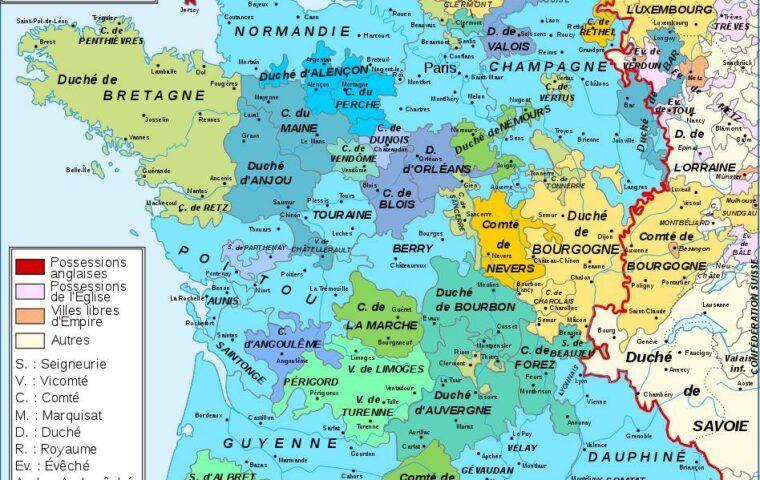
When Clovis overcame the boredom of the Merovingian chiefs, it was less to revolutionize war than to create political unity. Coming from a warrior lineage, he conquered the Gallo-Roman cities, gradually forged a unified kingdom around Paris and Metz, and built the first foundations of a “royal” administration by allying with the Gallo-Roman elites.
1.2 The baptism: spiritual pact and legitimacy
The major turning point? His baptism in Reims in 496. Minister supplanted by the Church, Clovis crystallizes a lasting alliance: the throne of the Franks is now inscribed in a “divine right” logic, where the king holds his power from God and not exclusively from his sword. This sacred dimension will endure until Louis XVI.
2. From the Merovingians to the Carolingians: between symbols and realities of power
2.1 The decline of the “do-nothing kings”
The successors of Clovis, overwhelmed by the multiplication of heirs and partitions, see their authority reduced to a mere figurehead role, while the mayors of the palace concentrate the real decisions. This dynastic fragmentation erodes governmental efficiency and lays the groundwork for the Carolingian “coup”: Pepin the Short ends Merovingian legitimacy in 751.
2.2 Charlemagne and the imperial renaissance
Under Charlemagne, the concept of power takes a step further. King of the Franks and Emperor of the West, he organizes a network of missi dominici, reforms the administration, and lays the foundations of an intellectual culture by supporting schools and scriptoria. Through both his sword and his laws, he embodies the model of a universal sovereign while protecting the papacy — an unprecedented political and spiritual alliance.
3. The Capetian assertion: dynastic stability and customs
3.1 Primogeniture and continuity
When Hugh Capet ascended the throne in 987, he inaugurated a tradition of inheritance by male primogeniture, designed to avoid the kingdom’s disintegration. The idea is simple: concentrate all rights and the crown on a single son, guarantor of uninterrupted continuity. Gradually, this practice becomes the core of French customary law, anticipating the future Salic law.
3.2 The king as lord and administrator
Unlike the do-nothing kings, Capetians and Plantagenets compete to show that the king is both a feudal lord and the “father” of his people. William the Conqueror, even though he remains Duke of Normandy, highlights this dual role in England and France. The Capetians, for their part, work to institutionalize royal justice, multiplying itineraries to establish their presence.
4. Valois and Bourbons: centralization, absolutism, and challenges
4.1 Francis I, the humanist and warrior prince
At the dawn of the Renaissance, Francis I gives the King of France a European aura. Passionate about the arts and obsessed with the Italian wars, he reorganizes the royal administration, creates the first permanent courts (the parliaments), and encourages printing. His alliance with Leo X, cemented by the Concordat of 1516, strengthens his authority over the French clergy: a decisive step towards autonomous power vis-à-vis the pope.
4.2 Louis XIV, the embodiment of a “state” all by himself
The legend is well known: “I am the State.” Behind the phrase, Louis XIV concentrates all levers of power in his person. Distance from the great princes, development of a unified administration, permanent royal army, centralized finances by Colbert… The Palace of Versailles becomes the stage of a court monarchy where every gesture of the king is a political spectacle. At the same time, the assertion of absolutism nevertheless struggles over the question of religions and parliamentary challenges.
4.3 Louis XVI, the Hesitant Heir
Louis XVI inherits a half-empty treasury and a government machine whose gears creak: feudal privileges, abyssal debts, frustration of the bourgeoisie and the parliaments. His reign wavers between ambitious reforms (abolition of torture, financial cleanup) and renunciations in the face of resistance. It is in this tension that the Revolution explodes, carrying away the last king of the Ancien Régime.
5. Dynastic Legacies and Bequests
5.1 An Institutional Heritage
Between the royal justice of the Capetians, the Carolingian administration, and the absolutism of Louis XIV, the modern state takes shape. The courts, the intendants, and the parliamentarians all bear the mark of these successive evolutions.
5.2 The Salic Law and the Succession Question
Long considered the alpha and omega of succession, the Salic law forbids inheritance by women, ensuring an uninterrupted transfer of the crown. Introduced in the 10th century, it fought until the Revolution to guarantee the predominance of the male line.
5.3 Imperishable Symbols
- The coronation at Reims: a ritual ceremony always associated with the legitimacy of the king.
- The royal seal: guarantor of the authenticity of diplomas and ordinances.
- The royal domain: over time, the heritage is structured to become national heritage.
| Monarch | Reign | Key Points of Power | Legacy |
|---|---|---|---|
| Clovis | 481-511 | Baptism and Church alliance | Union of the political and the religious |
| Charlemagne | 768-814 | Administrative organization, Empire | Emergence of a unified political culture |
| Hugh Capet | 987-996 | Primogeniture, itinerant justice | Dynastic stability |
| Francis I | 1515-1547 | Renaissance, Concordat | Assertion of an autonomous king |
| Louis XIV | 1643-1715 | Absolutism, Versailles | Model of centralized monarchy |
| Louis XVI | 1774-1792 | Half-hearted reforms | Transition toward the Revolution |
FAQ
- Why is Clovis considered the first king of France?
His baptism marks the definitive alliance between the Frankish throne and the Catholic Church, a sacred foundation that lasted until the Revolution. - What does primogeniture really bring to the Capetians?
By concentrating the inheritance on the eldest, it limits the division of the kingdom, which stabilizes the dynasty and strengthens royal authority. - What impact did Francis I’s Concordat have?
It places the French clergy under the direct authority of the king while maintaining a link with Rome, creating a model of political Gallicanism. - Did Louis XIV really say “I am the State”?
Without absolute proof, this phrase nevertheless symbolizes the extreme centralization of royal power under his reign. - Is the Salic law still applied?
Abolished during the Revolution, it reappeared under the Restoration but disappeared definitively in the 19th century with the advent of a constitutional monarchy in Europe. - What traces of these kings can we still see today?
The coronation at Reims, judicial institutions, and certain civil law codes draw their roots from these medieval and modern evolutions.