
The medieval history of Strasbourg is full of fascinating facts and surprising anecdotes. This Alsatian city, now listed as a UNESCO World Heritage site, experienced remarkable development during the Middle Ages. From architectural remains to significant events, let’s dive into the rich past of this iconic city.
Sommaire
Strasbourg in the Middle Ages: a free city in full expansion
In the heart of the Middle Ages, Strasbourg established itself as a prosperous free imperial city. This relative autonomy allowed it to develop its own municipal institutions and experience spectacular economic growth. Its strategic position on major trade routes and its river port played a crucial role in this rise.
Strasbourg’s economic activity was notably concentrated around the Petite France district. This picturesque area still bears witness today to the bustling activity of the time, with its half-timbered houses and canals. It was here that tanners and millers were active, contributing to the city’s wealth.
But Strasbourg was not content to be just a commercial center. It also became a major cultural and intellectual hub. Printing developed there as early as the 15th century, making the city an important center for the dissemination of knowledge. Johannes Gutenberg himself stayed there, perfecting his revolutionary technique that would change the course of history.
This intellectual effervescence reached its peak with the founding of the University of Strasbourg in 1538. This institution, still active today, has trained many brilliant minds over the centuries.
Cathedral and astronomical clock: jewels of Strasbourg’s heritage
At the heart of the city stands the majestic cathedral Notre-Dame de Strasbourg. Completed in 1439, it rises to 142 meters high, making it the tallest cathedral in the world at the time. Its construction, which spanned several centuries, reflects the evolution of architectural styles, from Romanesque to flamboyant Gothic.
The cathedral nearly disappeared in 1793, during the French Revolution. A surprising anecdote tells how it was saved from destruction:
- A master locksmith had the ingenious idea to place a Phrygian cap made of sheet metal at the top of the spire
- This revolutionary symbol convinced the authorities of the time to spare the building
- Thanks to this bold gesture, the cathedral has survived through the centuries to the present day
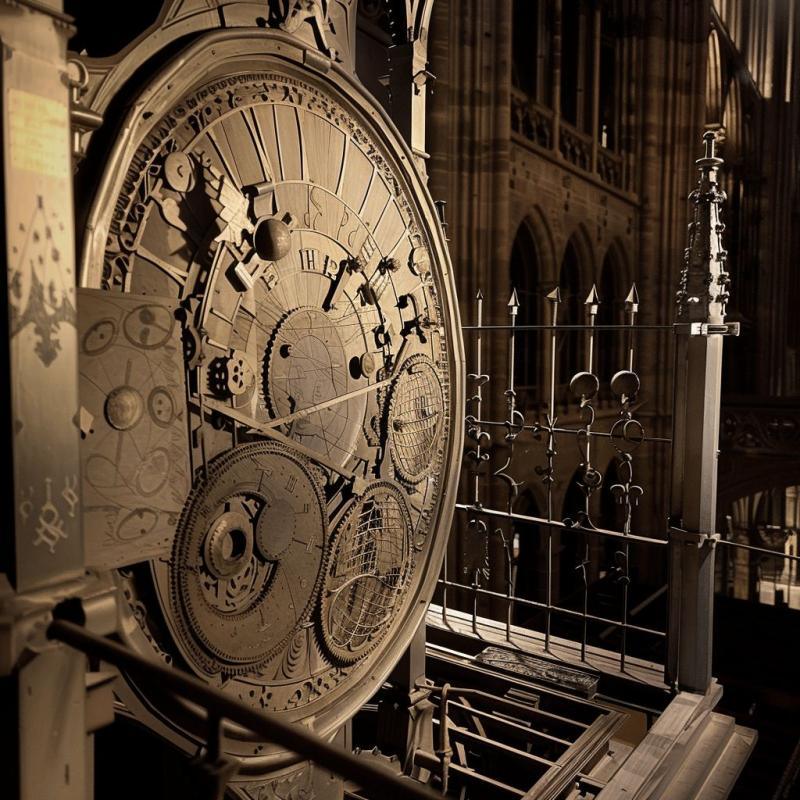
Inside the cathedral hides another treasure: the astronomical clock. Dating from the 16th century, this masterpiece of mechanics and art has enchanted visitors for generations. Its complex gears indicate not only the time but also the positions of the planets, the phases of the moon, and many other astronomical details.
| Element | Description |
|---|---|
| Automata | Procession of the apostles at noon |
| Perpetual calendar | Indicates dates up to 2044 |
| Ecclesiastical computus | Calculates the date of Easter |
Medieval remains: witnesses to a rich and tumultuous past
Although many medieval buildings have disappeared over time, Strasbourg still preserves precious remains of its medieval past. The Covered Bridges, for example, recall the importance of the fortifications that once protected the city. These three towers and their bridges offered an effective defense system against potential attackers.
The Maison Kammerzell, dating from the 15th century, is a gem of half-timbered architecture. Its richly carved facades and oriel windows bear witness to the craftsmanship of artisans of the time. Today converted into a restaurant, it allows visitors to immerse themselves in the atmosphere of medieval Strasbourg.
Another remarkable relic is the Civil Hospital of Strasbourg. Founded in the Middle Ages, it is one of the oldest hospitals in Europe still in operation. Its history illustrates the evolution of medical practices and patient care through the centuries.
The Protestant Reformation also left its mark on Strasbourg. In the 16th century, the city played an important role in the spread of reformed ideas. This tumultuous period saw the sometimes difficult coexistence of Catholic and Protestant communities, shaping the city’s unique identity.
Rediscovering the medieval history of Strasbourg
Exploring the medieval history of Strasbourg is an exciting adventure that never ceases to surprise. From unusual anecdotes to major historical facts, every corner of the city holds secrets to discover. For history enthusiasts and the curious, several options are available to deepen this knowledge:
- Themed guided tours in the old town
- Temporary exhibitions at the Strasbourg Historical Museum
- Lectures and workshops organized by the university
- Medieval festivals recreating the atmosphere of the era
These different approaches allow one to live history rather than simply read it. They offer an immersion into medieval Strasbourg, making the stories and historical facts tangible.
The medieval history of Strasbourg continues to attract researchers and enthusiasts. New archaeological discoveries and reinterpretations of ancient documents regularly enrich our understanding of this period. This city, which has managed to preserve its heritage while evolving, remains a living testimony to the importance of the Middle Ages in the construction of European identity.