
In brief
🚗 Third party mainly covers damage caused to others. If your car is damaged, the bill may be yours to pay.
🛡️ Comprehensive adds coverage for your own vehicle, but it is still limited by deductibles, limits, and exclusions.
💡 The right balance often depends on the market value, parking situation, annual mileage, and whether the car is financed or not.
📉 In practice, many drivers switch to third party when the annual premium becomes too close to the amount they could recover in the event of a claim.
What is the real difference between third party and comprehensive?
Short answer: third party insurance primarily covers your civil liability, meaning damage caused to others. Comprehensive insurance builds on this foundation and adds protection for your own car in many situations, including if you are at fault. But “comprehensive” does not mean “zero out-of-pocket expenses.”
In plain terms: third party protects others, comprehensive also protects your car. The difference mainly lies in the material damage suffered by your vehicle, accidental events, acts of vandalism, theft or fire depending on the contract. And the deductible remains the small detail that changes everything.
The legal foundation remains civil liability, recalled by article L211-1 of the Insurance Code and summarized on Service-Public.fr. For monitoring insured vehicles, authorities also rely on the insured vehicles database, published on data.gouv.fr.
In practice, third party does not cover your own repairs if you hit a pole, slip on a wet road, or collide with a bollard when leaving a parking lot. Comprehensive insurance can cover these cases, but depending on the deductible level and contract exclusions. That is why two “comprehensive” offers can be very different in practice.
How to choose between third-party or comprehensive insurance based on your car’s value?
Short answer: the more value the car retains, the more comprehensive insurance remains justifiable. As soon as the valuation drops significantly and the annual premium starts to resemble the potential compensation payout, third-party or extended third-party insurance often takes the lead. The right threshold mainly depends on your actual usage, not a magic rule.
A simple reasoning helps a lot: if your car is still worth €12,000 to €15,000, comprehensive insurance can remain coherent, especially if it is recent, low mileage, or parked in a closed garage. Conversely, for a car valued around €5,000 to €8,000, paying a high premium to recover, at worst, compensation close to that value does not always make sense.
Mileage also plays a role. A car that drives 6,000 km per year does not expose its driver to the same risk as a vehicle used daily for trips around the outskirts, ring roads, and supermarket parking lots. The moment usage becomes intensive, the interest in comprehensive insurance rises, even if the car is no longer brand new.
Another decisive criterion: financing. With LOA or LLD, the institution very often requires a protective plan, generally comprehensive, for the entire duration of the contract. This is not a commercial whim: as long as the car is not yours, the financier wants to limit its own exposure to total loss.
Can extended third-party be the right compromise?
Yes, and it is often the real balance point. The extended third-party, sometimes called intermediate, adds several useful guarantees without reaching the cost of a full comprehensive plan. For a car already depreciated but still exposed to theft, glass breakage, or fire, it avoids the false dilemma of “all or nothing.”
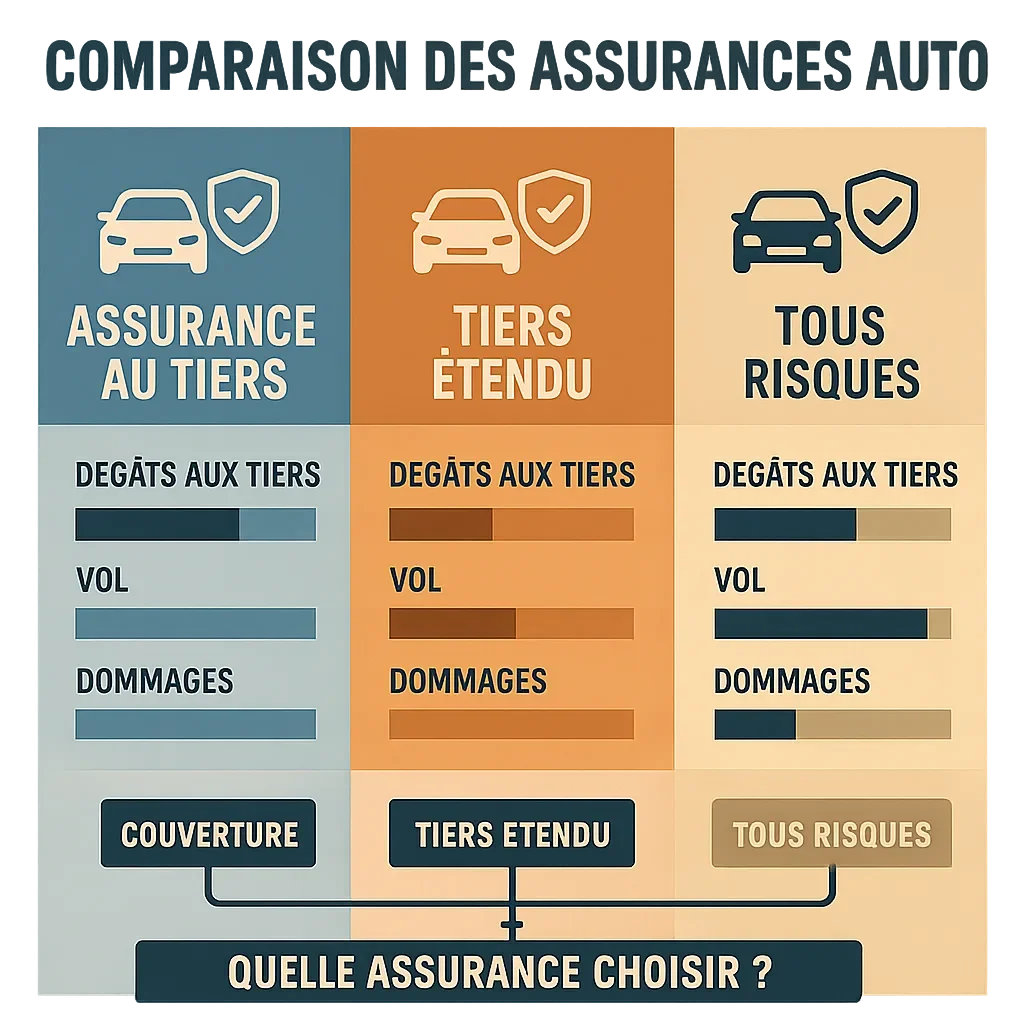
Here is the most useful reading, without unnecessary jargon:
| Plan | What it covers | To favor if… | Weak point |
|---|---|---|---|
| Third-party | Civil liability, sometimes defense and recourse | Your car has a low value and the budget is tight | Your own damages often remain your responsibility |
| Extended third-party | Third-party + theft, fire, glass breakage, sometimes weather events | The car sleeps outside, but you want to avoid major setbacks | At-fault accidents remain insufficiently covered |
| Comprehensive | Third-party base + damage to your vehicle, often even in case of fault | The car is recent, financed, or still well valued | Higher premium, sometimes steep deductible |
The table is useful, but you must keep an eye on the details. Two “extended third-party” contracts can differ completely: one may include glass breakage without deductible, another may charge it with a fixed contribution; one may cover natural disasters, another not. Cherry on the cake, some guarantees seem present in the brochure but become very limited at the time of the claim.
When does comprehensive insurance become cost-effective… and when should you switch to third-party?
Short answer: comprehensive insurance becomes cost-effective when the annual premium remains consistent with the replacement value of the vehicle and your risk tolerance. As soon as the gap between the premium, deductible, and probable compensation becomes too large, switching to third-party or extended third-party coverage becomes rational.
The good benchmark: if the annual cost of comprehensive insurance approaches several percent of your car’s value, the plan starts to lose its effectiveness. In many cases, switching to third-party is considered when the car ages, is driven little, and is kept in a relatively safe environment.
A concrete example helps to decide. A 2022 Peugeot 208 on a lease-to-own contract in Nantes, still well valued and likely to be returned in good condition, often deserves comprehensive insurance until the end of the contract. Conversely, a 2014 Renault Clio in Lille, parked on the street and whose market value has already significantly dropped, often switches to extended third-party when the premium no longer matches the value.
In practice, it is observed that a family arriving with a recent car in 2023 accepts comprehensive insurance without question for two or three years, then reconsiders as soon as the value drops. An agent notes that the real turning point is not the vehicle’s age alone, but the moment when the annual premium no longer “fits” within the household’s budget.
The right decision is not emotional. It is made when the annual premium ceases to be consistent with the probable compensation.
It is also useful to look at the absolute deductible and the new-for-old value. A car protected by “comprehensive” insurance with a €500 deductible and a quickly depreciated compensation value does not follow the same logic as a contract offering a true new-for-old replacement over 12 or 24 months. In other words, the word “comprehensive” alone is never enough.
What mistakes cost the most when comparing plans?
The first mistake is believing that comprehensive = everything is covered. False, and this is where many disappointments begin. There are almost always exclusions, limits, deductibles, and cases where coverage is partial, especially if the driver has not respected the contract clauses or if the claim concerns undeclared usage.
The second very common mistake is looking only at the monthly price. A low-budget contract may hide a high deductible, limited assistance, or insufficient driver coverage. Conversely, a slightly more expensive plan can become more interesting if it significantly reduces your out-of-pocket expenses in case of collision, theft, or glass breakage.
You also need to check the technical points that make all the difference daily:
- driver coverage, essential if you want to be compensated for your own injuries;
- 0 km assistance, useful if you break down right outside your home;
- parking exclusions, especially if the car is parked on the street;
- reimbursement limits for theft, accessories, or transported contents;
- applied depreciation on parts, which can reduce compensation faster than expected.
In dense urban areas, small claims multiply: scratched door, rubbed bumper, broken mirror. A comprehensive plan may then seem reassuring, but only if the deductible does not eat up the advantage. In other words, you need to compare what you pay each year with what you could actually recover in case of trouble.
FAQ: third-party or comprehensive, the cases that cause hesitation
Is extended third-party enough for a car that sleeps outside?
Often yes, especially if the car is worth less than at the time of purchase and the main risks remain theft, glass breakage, or fire. However, if you drive a lot in a dense urban area, comprehensive insurance remains worthwhile when collisions become likely.
Is it mandatory to take comprehensive insurance in a lease with option to buy (LOA) or long-term lease (LLD)?
Very often, yes, or at least a very protective plan. The lessor wants to preserve the value of the vehicle until the end of the contract, especially during the first years when depreciation is the fastest. The reading of the rental contract always takes precedence over the general idea.
From what car value does third-party insurance become logical again?
There is no universal threshold, but many drivers start reconsidering comprehensive insurance when the car falls around 5,000 to 8,000 €. A good benchmark remains the ratio between the annual premium and the maximum truly plausible compensation.
Does the bonus-malus system change the choice between third-party and comprehensive insurance?
Yes, because it directly affects the final price. A driver with a solid bonus can sometimes keep comprehensive insurance at a reasonable cost, while a young insured or a driver with a malus will see the plan rise very quickly. The profile matters as much as the car itself.
Is glass breakage always included in comprehensive insurance?
No, not automatically. Even in a comprehensive contract, glass breakage may be subject to a deductible, a ceiling, or exclusions on certain optics, panoramic roofs, or mirrors. Therefore, the coverage must be read line by line, not just the name of the plan.
Can one switch from comprehensive to third-party insurance during the year?
Yes, depending on the termination conditions and the contract expiration date. The change is often prepared at the old annual deadline, especially if the car has lost value or if its use has changed. The simplest is still to recalculate the premium/value ratio before signing again.