
In brief
🚗 The price of young driver car insurance mainly depends on the car, parking, annual mileage, and history.
📉 The clearest savings often come from a fuel-efficient city car, a suitable plan, and a realistic profile declaration. No need to try to outsmart the system to pay less.
🛡️ Too little coverage can hurt badly at the first claim. The smart move is to aim for the right level of protection, not the lowest price down to the last cent.
How is the price of young driver car insurance calculated?
The premium mainly depends on the driver’s profile, the car, and actual use. For a young license holder, the insurer looks at the no-claims bonus/malus, parking location, annual mileage, fiscal horsepower, and previous claims. In other words, a small detail can increase or decrease the rate.
The rate is built like a mille-feuille: age, license seniority, vehicle type, traffic zone, parking location, private or professional use, deductible, and chosen coverage. A novice driver in Paris with a 150 hp compact car will not be charged like a student in Rennes with a small city car parked in a secured lot. The insurer tries to anticipate the frequency of claims, then their average cost.
According to the ONISR (2024), 18-24 year olds remain more exposed than average on the road, which explains insurers’ caution with this profile. This is not a punishment, but a risk logic. When the file is still “young,” the company often applies a wider safety margin.
In practice, this means that a first quote may seem steep, but there is also real room for optimization. If you reduce the vehicle’s power, limit mileage, and choose the right plan, the bill can drop significantly without sacrificing essentials. That’s why you need to look at the entire contract, not just the headline price.
Which tips really lower the young driver car insurance premium?
The most effective levers are simple: choose a fuel-efficient car, aim for a plan suited to the real need, limit kilometers, secure parking, compare deductibles, and correctly declare the main driver. These parameters, more than the advertised “cheap” price, make the difference.
The most profitable savings are rarely found in marketing slogans. They are hidden in the file details, those that seem insignificant at first but really change the final price. Joking aside, a young driver who prepares their subscription well often has more room for maneuver than they imagine.
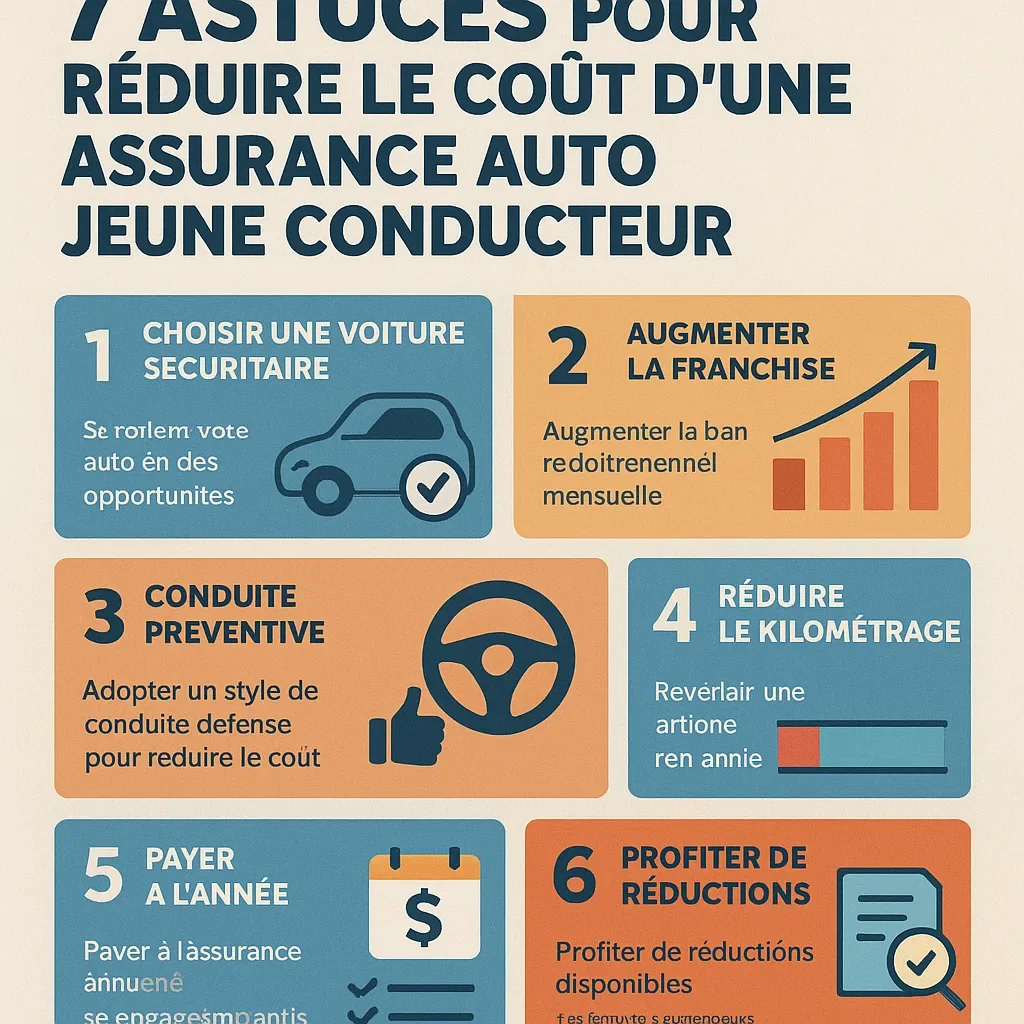
1. Choose a low-powered and easy-to-repair car. A city car with 70 to 90 hp, such as an entry-level Renault Clio, Peugeot 208, or Toyota Yaris, often costs less to insure than a more powerful compact. It’s not just about horsepower: parts, new value, and risk of claims also come into play.
2. Secure parking. A garage, a closed garage, or a covered collective parking lot is more reassuring than permanent street parking, especially in Paris, Lyon, or Marseille. The insurer sees less risk of theft, vandalism, or minor collisions. This lever is often underestimated, even though it really weighs in the balance.
3. Declare a realistic mileage. If you drive little, don’t opt for too large a package “just in case.” Low mileage offers, sometimes set around 8,000 km/year, are often more relevant for a student or a worker who mainly uses the car on weekends. Under-declaring is a bad idea; it’s better to be precise from the start.
4. Choose a truly adapted formula. A low-value used car does not necessarily need full comprehensive coverage. Conversely, a recent car bought on credit sometimes deserves more than just third-party insurance. The idea is not to overprotect an old car, nor to underinsure a vehicle still expensive to replace.
5. Use accompanied driving when possible. Accompanied driving improves learning, reassures the insurer, and can reduce the initial surcharge. Road safety also reminds that the probationary period is generally 2 years instead of 3 in this case. When you can anticipate, you often win on both fronts: driving and budget.
6. Correctly declare a second driver. If the car is shared with a parent or spouse, declaring it properly avoids unpleasant surprises in case of a claim. However, you must be honest about who really drives the most. The insurer quickly spots shaky setups, and a false declaration can be very costly.
7. Look at deductibles and options one by one. A low price with a huge deductible is not a good deal if the slightest scratch comes out of your pocket. The same logic applies to “comfort” options: loaner vehicle, 0 km assistance, glass breakage, legal protection. They can be useful, but not all at once, especially on a first car.
In practice, an agent observes that the clearest files are often those where the young driver immediately announces a simple use: home-school commute, low-powered car, parking in a garage. Conversely, a vague declaration often triggers questions… and sometimes a higher premium.
Which formula to choose to avoid paying too much?
The right reflex is not to take the cheapest formula down to the last cent, but the one that fits the value of the car. A small used city car can remain with third-party coverage, while a recent car financed on credit often deserves better. The right trade-off is between value, deductible, and risk of damage.
The formula is a major lever because it changes the structure of the contract. A young driver insuring a 2015 Renault Clio on a small budget does not have the same needs as a driver who drives a new Peugeot 208 or a compact SUV. The first can sometimes favor third-party or third-party +; the second should seriously consider full comprehensive coverage, especially if they park their car outside at night.
| Formula | For whom? | Advantage | Limit |
|---|---|---|---|
| Third party | Old car, low value | Lowest premium | Minimal protection |
| Third party + | Used city car still in decent condition | Good price/coverage compromise | Does not cover everything |
| All risks | Recent or financed car | Widest coverage | Higher cost |
| Pay-per-kilometer | Low mileage driver | Rate adjusted to usage | Not cost-effective if you drive a lot |
In many cases, the third party + represents a middle ground. It allows protection against frequent damages without making the premium explode. Conversely, the all risks option is not “too expensive” by principle; it becomes reasonable as soon as the replacement value of the vehicle, the deductible, and daily use justify a real safety net.
The cheapest at signing is not always the most economical over the year. A deductible that is too high or coverage that is too low can cost much more at the first real mishap.
Should you declare a second driver or opt for accompanied driving?
Yes, in certain cases, and not just to look good on the quote. If the car is truly shared within the household, the second driver can simplify risk assessment. And if the subscription starts before obtaining the license, accompanied driving remains one of the best levers to smooth out the initial cost. All this, of course, provided the actual usage is declared.
The Road Safety authority reminds, in its section dedicated to young drivers, that accompanied driving reduces the probationary period. Its article on the post-license course also specifies that a course taken between 6 and 12 months after obtaining the license can further shorten this period by one year.
What matters here is the cumulative effect. Well-conducted accompanied driving, a vehicle easy to insure, and a clearly declared secondary driver can reassure the insurer. This is not magic, but a logic of a clearer profile, therefore often better priced.
How to avoid unpleasant surprises before signing?
Before validating a contract, check the deductibles, exclusions, compensation limits, and conditions for loaning the steering wheel. An attractive rate can hide too limited coverage, paid options, or a deductible that hurts at the first claim. The real good reflex is to read the contract as if you had to use it tomorrow morning.
You also need to prepare the right documents: license, registration certificate, information statement if you have one, parking address, estimated annual mileage, and vehicle usage. The cleaner your file, the more reliable the comparison. And above all, avoid vague declarations about the number of kilometers or the main driver: these are small gray areas that quickly become big problems.
- Damage deductible: see what you will actually have to pay in case of a collision.
- Assistance: check if it works from 0 km or only from a certain distance.
- Glass breakage: useful, but not always included in entry-level formulas.
- Loaning the steering wheel: important if the vehicle can be occasionally used by a parent or close person.
- Declared usage: private, work, home-school trips, carpooling… every detail counts.
By comparing equivalent coverage, you avoid the “false good deal” effect. A cheaper offer by €80 per year but with a €500 deductible does not always win out. If you hesitate between two similar contracts, choose the one that better protects against the real risks of your daily life, not the one that displays the biggest discount in the window.
FAQ — young driver car insurance
Is third-party insurance enough for a first car?
Yes, if the car is worth little and you accept minimal protection. For an old city car bought second-hand, third-party can be reasonable. However, if the vehicle still has significant resale value or is financed, third-party + or comprehensive insurance may be more logical.
Is annual payment cheaper than monthly payment?
Often, yes, because some insurers apply installment fees on monthly payments. The difference is not always huge, but it exists. If your budget allows, an annual or semi-annual payment can reduce the overall bill by a few percent.
Can a young driver insure a powerful car?
Yes, but the premium rises quickly, and some companies may refuse or limit coverage. High power increases the risk of claims and the potential cost of repairs. For a first car, a reasonable engine size is generally easier to insure.
Does the post-license training automatically reduce the premium?
Not automatically. However, it can reduce the probationary period if done within the right timeframe, which improves the driver’s profile in the eyes of some insurers. The benefit then depends on the company, the vehicle, and the claim history.
Should all options offered in the quote be taken?
No, and this is often the classic trap. Some options are useful, such as 0 km assistance or glass breakage, but others duplicate coverage already present elsewhere. The right approach is to compare options one by one, not to check the entire basket.
Does a penalized young driver still have options?
Yes, even if the rate becomes harder to absorb. It is often necessary to aim for a simpler contract, accept a higher deductible, or go through an insurer more flexible on the profile. The essential thing is to remain properly insured, without trying to hide past records.