
In brief
🛋️ For primary rentals, the baseline is the same for a furnished and an unfurnished property: the tenant must at least cover the rental risks.
📄 The real difference mainly concerns the furniture, the inventory, and the landlord’s share of responsibility, especially when the property is already equipped.
🔎 To avoid gaps, you need to look at liability insurance, deductibles, the value of the belongings, and the exact status of the lease: primary residence, short-term, shared rental, or mobility lease.
Furnished or unfurnished home insurance: what really changes?
The real difference is not about the “basic” insurance, but about what must be protected around the property. In furnished rentals, the contract must include the provided furniture, the inventory, and sometimes broader guarantees on the landlord’s belongings.
In practice, furnished rentals are not a different world: the same major insurance mechanisms apply as in unfurnished housing, especially when it is a primary residence. The nuance comes from the contents of the property. A furnished rental is already equipped, so the material risk is denser, more fragmented, and sometimes more costly to replace in case of damage.
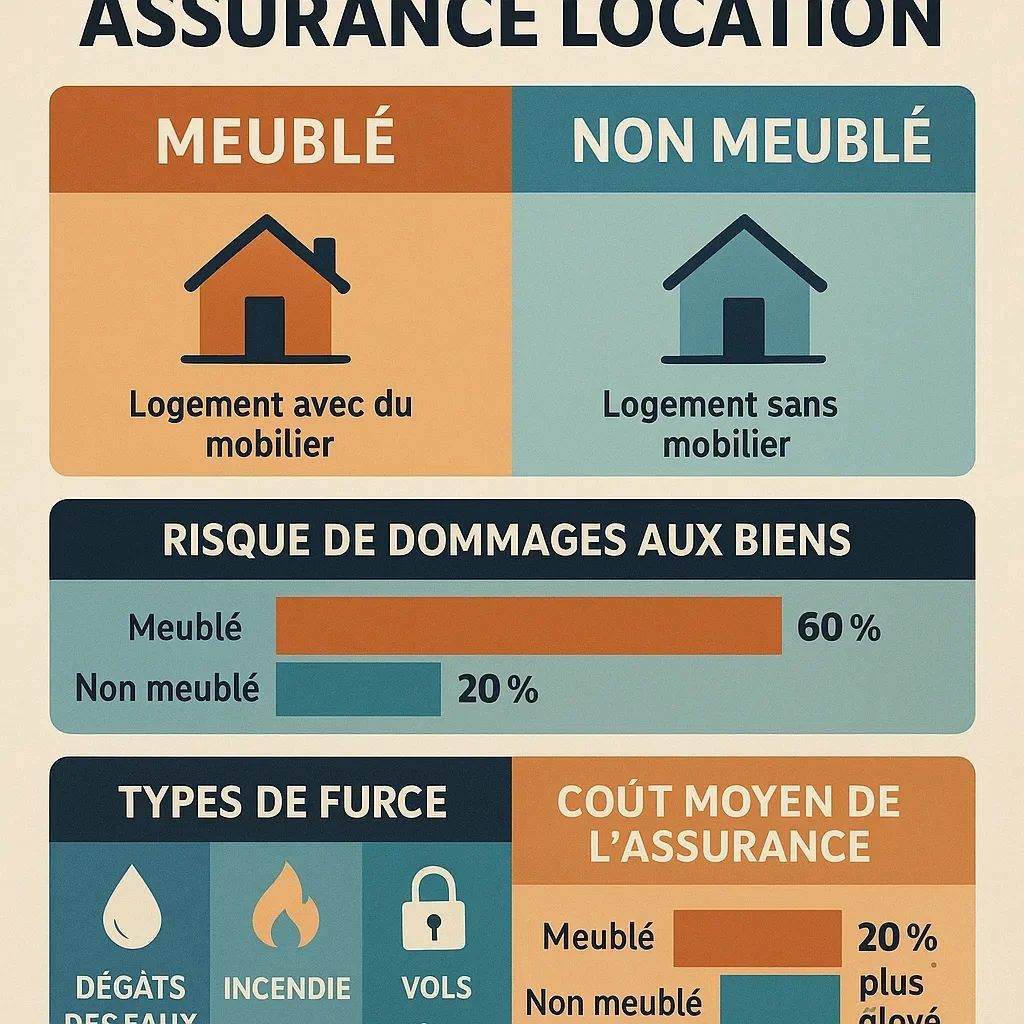
In other words, the issue is not just “insured or not insured.” You have to distinguish what belongs to the tenant, what belongs to the landlord, and what falls under additional coverage. This is precisely where many contracts become shaky: everything seems covered until the day water damage affects a sofa, a built-in oven, or a wardrobe declared too hastily.
| Compared point | Furnished rental | Unfurnished rental |
|---|---|---|
| Tenant’s insurance base | Rental risks if the property is the primary residence | Rental risks if the property is the primary residence |
| Items to protect | Tenant’s belongings + furniture provided by the landlord | Mainly the tenant’s belongings |
| Inventory | Very important, because the property is equipped | Less extensive, but the condition report remains useful |
| Risk of confusion | Who insures the landlord’s furniture? | Who insures the furniture bought by the tenant? |
Who must have insurance in a furnished rental?
In a furnished rental used as a primary residence, the tenant must at least cover rental risks. If the property is not their primary residence, the legal obligation often disappears, but the lease may still require a certificate.
The basic rule is well known, but it deserves to be read without bias: a tenant in a primary residence must be insured, whether the accommodation is empty or furnished. The primary residence practically corresponds to a dwelling occupied at least 8 months per year, except for professional obligation, health reasons, or force majeure. Here, the legal framework leaves little room for interpretation.
In furnished rentals, the landlord therefore almost always requests a certificate upon moving in, then at each useful renewal. This is even more true when the lease is short, such as in a mobility lease or transitional occupation. For an official overview of the subject, Service-Public.fr details the tenant’s insurance obligation, and the ANIL also reminds of the good practices regarding lease and occupation.
To summarize without getting lost in the details: primary residence = mandatory minimum insurance, secondary residence = often contractual obligation but not always legal, short-term rental = the contract and context prevail. That is why it is always necessary to verify the exact status of the accommodation before signing, especially if renting for only a few months.
What does a furnished home insurance really cover?
The core of the contract, from the tenant’s side, remains the rental risk guarantee: fire, explosion, and water damage. But a well-thought-out furnished home insurance does not stop there. In real life, what costs a lot is not always the wall blackened by smoke; it is often the contents, the neighbors, the repairs, and the small damages that add up.
- Tenant’s civil liability, for damages caused to others.
- Tenant’s personal belongings, depending on the chosen plan.
- Claims from neighbors and third parties, useful in buildings or condominiums.
- Theft, vandalism, glass breakage or assistance, depending on options.
The point to watch is that the minimum guarantee does not cover everything. It does not replace a comprehensive multi-risk home insurance, and it does not automatically protect the tenant’s belongings nor, depending on the contracts, the furniture that belongs to the landlord. In other words, one can be “legally compliant” yet still somewhat exposed in case of trouble.
In practice, disputes do not arise from spectacular claims, but from a common water damage on a sofa, an appliance, or a poorly declared piece of furniture. A family arriving in a furnished rental often says they believed the contents were “necessarily covered,” whereas the contract only covered the legal minimum.
The best practice is therefore to reread the inventory of the accommodation, then align the value of the insured goods with reality. No need to exaggerate, but avoid making a rough estimate. Otherwise, on the day of the claim, the bill can be very unpleasant.
Does the owner have to protect the provided furniture?
Yes, and it is even one of the most common blind spots. In a furnished rental, the owner is not just renting out square meters: they are also renting out a set of furniture and equipment. Depending on their situation, they can rely on a non-occupant owner insurance (PNO), a co-owner civil liability guarantee, or a broader contract if the property is truly exposed.
The PNO does not replace the tenant’s insurance. It mainly serves to protect the owner when the dwelling is empty, poorly insured, or when a claim involves their liability. In co-ownership, the owner must at least be covered for their co-owner civil liability, which has changed the game since the ALUR law of 2014. In furnished rentals, this vigilance is even more important because the provided furniture has a real replacement value.
Practically, the owner should check three things: the value of the furniture, the contract exclusions, and the vacancy period. Between two tenants, this is often when the risk increases, as the dwelling can be partially exposed without anyone having the right update reflex. This is the kind of detail that costs little annually but very much when things go wrong.
How to choose the right formula without paying for nothing?
The right contract is not the most expensive one. It is the one that cleanly separates the owner’s furniture, the tenant’s belongings, and each party’s responsibilities, without gaps.
To make a proper choice, you have to look at the contract as a tool, not as a formality. A furnished home insurance must fit the profile of the dwelling: downtown apartment, house with complete furniture, shared rental, mobility lease, or longer occupancy. The needs are not the same, nor are the guarantees.
- Check the inventory and the declared value of the furniture.
- Compare deductibles: a low premium with a huge deductible is sometimes a false good deal.
- Look at the compensation limits, especially for theft and recent equipment.
- Verify civil liability, essential in buildings and shared rentals.
- Request the certificate before handing over the keys to avoid repeated follow-ups.
The healthiest reflex remains to ask what is excluded in black and white. An oven, a bed, a television, a portable air conditioner, or a sofa bed are not always treated the same way. And in a contract, what is unclear often ends up costing more than the premium itself.
What traps to avoid before signing?
First classic trap: confusing furnished housing and empty housing when declaring the risk. If the lease mentions furniture and equipment, but the insurance contract is calibrated like an unfurnished studio, compensation may be less comfortable than expected. The second trap is underestimating the value of the contents. A well-equipped furnished rental can contain several thousand euros worth of equipment without one realizing it.
Another point to watch: special cases. A shared rental must be properly named in the contract, otherwise responsibilities get mixed up. A seasonal rental is not treated like a primary residence, and the vacation guarantee can become relevant for a temporary stay. Finally, if the property is in co-ownership, the owner’s liability must not remain out of scope, even when the dwelling seems “quiet.”
The right method is simple: read the lease, check the inventory, reread the general conditions, then compare at least two quotes. It’s not glamorous, but it’s exactly what avoids unpleasant surprises the day a claim arrives unannounced, like a badly behaved guest.
FAQ — Furnished or unfurnished home insurance
Does a furnished secondary residence have to be insured?
Not necessarily by law, but the lease may require it. In practice, a serious owner will often ask for minimal coverage to avoid ending up with an uncovered claim. The contract therefore remains to be read very carefully.
Is vacation insurance sufficient for a seasonal rental?
It can be sufficient for a one-time stay, but only if its coverage truly matches the use of the accommodation. You need to check the covered duration, liability insurance, and limits. A common mistake with vacation rentals is believing that a bank card or travel insurance covers everything.
Does the owner need to insure the provided furniture separately?
Often yes, at least through a well-calibrated PNO (Non-Occupant Owner insurance) or an appropriate multi-risk contract. The landlord’s furniture is not the tenant’s property, so its value must be included in the insurance strategy. Otherwise, the furniture may fall outside the coverage at the worst moment.
Can a single contract be shared in a furnished shared rental?
Yes, provided that all tenants are properly mentioned in the contract or correctly declared to the insurer. Otherwise, an unnamed tenant may find themselves poorly covered. The simplest solution remains to require a certificate that clearly lists the occupants.
What happens if the insurance certificate does not arrive on time?
The landlord can send a formal notice. Without a response within the legal deadline, they can take out insurance on behalf of the tenant and charge them the premium, increased by up to 10%. This mechanism prevents the accommodation from being without coverage, but it is better to avoid it.
Does furnished accommodation change anything for the security deposit?
Indirectly, yes, because the inventory is more detailed and the risks of damage more visible. The security deposit is not insurance, but it is often used to cover minor losses or repairs. The more furniture there is, the more the restoration can quickly become expensive.