
In brief
🧾 Yes, tenant insurance is mandatory in the majority of primary residence rentals, at least to cover rental risks.
🔎 The legal basis mainly targets fire, explosion, and water damage. For your belongings and your civil liability, a broader multi-risk home insurance (MRH) is often necessary.
⚠️ In case of omission, the landlord can request a certificate, then issue a one-month formal notice before taking out insurance on your behalf.
💡 The real good reflex: compare the deductible, the compensation limits, and the exclusions, not just the introductory price.
Is tenant home insurance really mandatory?
Yes, in the vast majority of cases, the tenant must provide proof of minimal coverage. The legal framework mainly targets unfurnished or furnished rentals occupied as a primary residence. This is notably recalled by the Service-Public dossier on the tenant’s insurance obligation as well as the ANIL. In short: no certificate, no peace of mind.
Short answer: for a primary residence rental, the tenant must at least be insured against rental risks. Without a certificate, the landlord can request proof, then start a formal notice procedure. After one month, they can act to protect the property.
The point not to miss is the distinction between insurance obligation and coverage level. The law imposes a minimum, but not necessarily an “all-inclusive” formula. In other words, you can be compliant while still being quite poorly protected if your contract is limited to damage to the rented dwelling.
What exactly does the legal minimum cover, and what should be added?
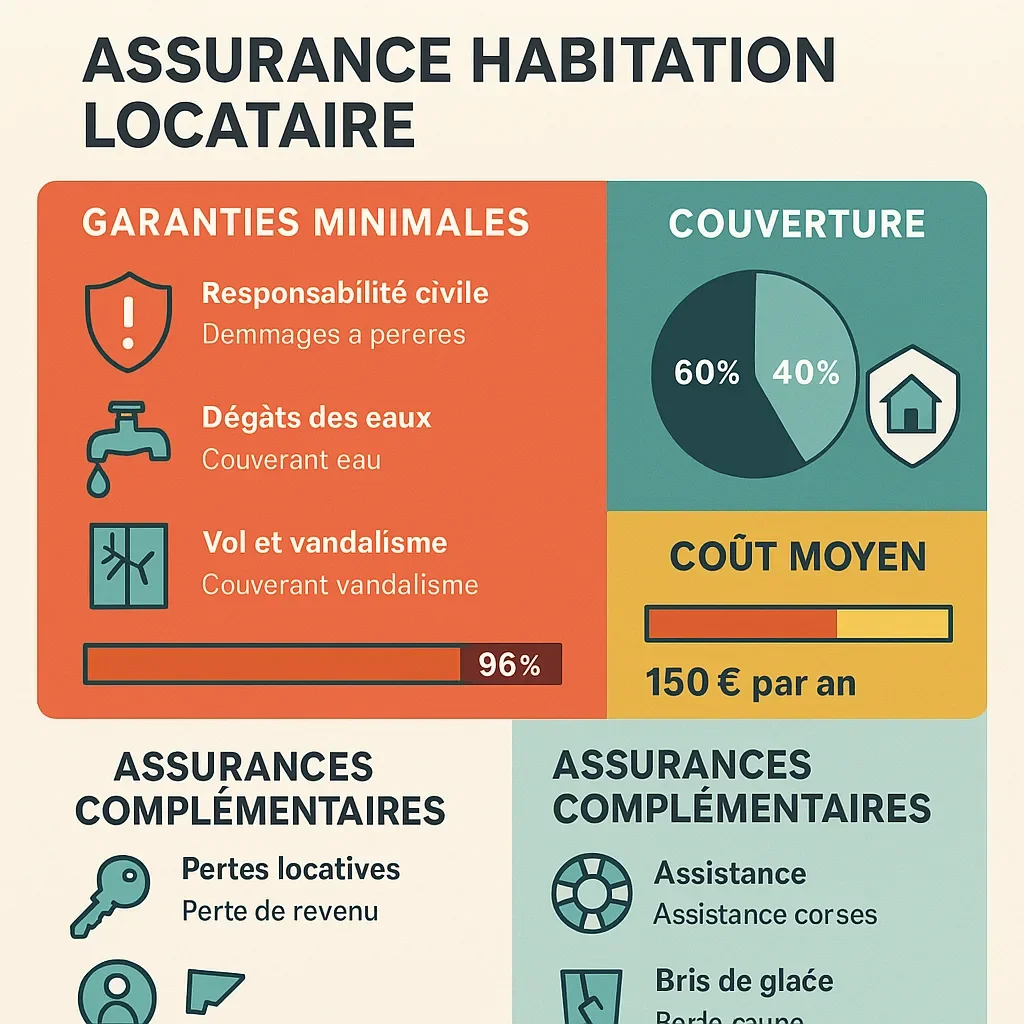
The legal minimum mainly covers damage you may cause to the rented dwelling: fire, explosion, and water damage. It is useful but frankly limited. To also protect your furniture, computer, or clothes, you often need to opt for a more comprehensive multi-risk home insurance.
| Plan | What it covers | Main limitation |
|---|---|---|
| Rental risks | Fire, explosion, water damage in the rented accommodation | Does not really protect your belongings |
| Homeowners insurance (MRH) | Housing, furniture, civil liability, sometimes theft and assistance | More expensive, variable deductibles |
| Rental liability only | Damage caused to third parties | Insufficient alone to satisfy the lease obligation |
| Options | Glass breakage, new replacement, rehousing, valuables | To be adjusted according to your lifestyle |
In practice, the right question is not “how many guarantees at most?”, but “which risks are actually plausible for me?”. A studio in the city center, a student shared apartment, and a three-room flat with teleworking do not present the same stakes. That is why you need to look at the limits, the deductible, and the exclusions before signing.
How to choose tenant home insurance without paying for nothing?
The right tenant home insurance contract primarily protects what matters to you: the housing, your civil liability, and your most exposed belongings. To avoid paying for unnecessary options, compare the value of your furniture, the deductible level, the compensation limits, and the exclusions related to theft, DIY, or teleworking.
- Start with the size and the actual use of the accommodation: a furnished studio does not have the same needs as a large apartment.
- Check the civil liability: it is often included in the MRH, but not always at the same level.
- Control the deductible: a low premium with a very high deductible can hurt on the day of the claim.
- Look at the replacement value: useful if your equipment is recent or expensive.
- Keep the certificate handy: the landlord may request it upon entry and then every year.
On the ground, it is observed that many tenants take the cheapest offer, then discover a deductible of several hundred euros or a limit too low for their furniture. A real estate agent in an urban area also notes that the smoothest files are those where dated photos and invoices are kept from the start.
It should be noted that home insurance contracts are very rarely “bad” in themselves. The problem is mainly the gap between the contract and the reality of the housing. A well-thought-out plan avoids paying for gimmicky guarantees while keeping enough to face water damage or a fire starting in the kitchen, which is far from a textbook case.
How much does tenant home insurance cost?
The price depends on the city, the size, the value of the furniture, the deductible level, and the options chosen. For a small accommodation, rates often remain within a dozen euros per month, while a larger or better-covered apartment easily climbs. The right reflex is to compare with equivalent guarantees, not just the displayed price.
The rate also varies with options. A rehousing guarantee, a valuables package, or enhanced theft protection can quickly raise the bill, but it is not necessarily a luxury. If you have a laptop, a bike, or photo equipment, the small extra premium can be largely amortized at the first mishap.
The right contract is not the one that promises everything, but the one that avoids holes in the net. A solid tenant insurance protects the housing, your belongings, and your liability without turning the monthly premium into a punishment.
What to do in case of a claim to be compensated quickly?
In the event of a claim, speed and evidence make all the difference. Notify the insurer as soon as possible, limit the damage, take photos, keep damaged items if necessary, and gather invoices. Most contracts require a quick declaration, often within 5 working days, with shorter deadlines for theft depending on the general conditions.
The useful reflex: declare quickly, document everything, do not throw anything away too soon. A file with dated photos, inventory, and invoices often speeds up compensation and avoids endless discussions about the origin of the damage.
If the damage comes from a neighbor, a shared water column, or a defective appliance, don’t rush in headlong. The right approach is to notify the insurer, report the claim to the property manager or landlord if necessary, then let the responsibilities be divided among insurers. It’s less romantic than an action movie, but much more effective.
And in special cases, shared housing, furnished rental, or mobility lease?
Special cases require a bit more finesse. In shared housing, a common contract may suffice if all occupants are properly named, but the exact clause must be checked. In furnished accommodation, the primary residence generally follows the same logic as unfurnished. For the mobility lease, it’s better to reread the lease and ask in writing what is required.
- Shared housing: a single contract can work if each roommate is properly covered.
- Student: small budgets should watch the deductible before the premium amount.
- Furnished: beware of items provided by the owner, which also require clear protection.
- Temporary rental: rules vary more depending on the type of lease.
In these setups, the idea is not to look for the most obscure settlement clause, but to secure daily life. A missing certificate in shared housing or ambiguity about occupants can complicate a claim much faster than one might imagine. In other words: better a clear contract than a superficial saving.
FAQ
Can you rent a home without renter’s insurance?
In a primary residence rental, the answer is generally no. The landlord can request a certificate when handing over the keys, then throughout the lease. If they do not receive one, they can initiate proceedings and, if necessary, insure the property on your behalf.
Can the landlord impose their insurer on me?
Not freely at the start. However, if they must take out insurance on your behalf after a missing certificate, they can charge you back the premium, with a surcharge capped at 10%. The simplest is still to choose your own contract before moving in.
How long does it take to obtain the certificate?
Often, the certificate is available within minutes after subscribing online. At an agency, it may take a little longer but generally remains quick. The document must remain accessible, as it can be requested when entering the premises or at each annual renewal.
Should each roommate be insured separately?
Not necessarily. A common insurance can suffice if it properly covers all roommates named in the lease. The sensitive point is forgetting an occupant or an undeclared room. In case of doubt, it’s better to ask the insurer for a written confirmation before signing.
Does tenant insurance cover my personal belongings?
Not with the simple legal minimum. For personal belongings, a multi-risk home insurance is generally required. It protects furniture, electronics, and often everyday items, with limits and exclusions to read before validating the contract.
What changes when switching insurers during a lease?
Nothing dramatic if the new contract is active before the old one ends. The important thing is never to leave a coverage gap, even for one day. Keep the new certificate and notify the landlord if necessary to stay compliant.