
In Brief
📌 For occasional remote work, a classic multi-risk home insurance often covers the essentials, especially for your private belongings and civil liability.
🖥️ If the workstation becomes permanent, if you store professional equipment, or if you receive the public, a remote work extension or a professional insurance becomes more relevant.
💶 On the market, a dedicated extension is often priced around 20 to 50 € per year, but the real issue remains the compensation ceiling and the exclusions.
📄 In case of trouble, keep the evidence: equipment invoice, photo of the desk, email of provision, and claim declaration within deadlines.
When Should You Really Adapt Your Home Insurance for Remote Work?
You especially need to review the contract if remote work becomes regular, if valuable equipment is installed at your home, or if you receive third parties. For occasional use, classic home insurance is often sufficient, but it primarily protects the dwelling and private belongings, not always professional equipment.
The tipping point is not simply working with a laptop at home. It’s rather the frequency, the nature of the equipment, and the actual use of the dwelling. An employee who teleworks two days a week does not pose the same issue as a freelancer who transforms a room into a mini-office with printer, dual screens, stock, and archives.
The Labor Code, via article L1222-9, regulates remote work, but it does not replace insurance rules. In other words, the professional framework does not automatically dictate what your home insurance contract covers. For practical rules, one can also cross-reference the guidelines from Service-Public.fr, Légifrance, and data published by INSEE on remote work usage.
According to INSEE (2024), remote work remains highly concentrated in certain tertiary sector jobs, especially among executives. This detail matters because insurers often reason based on the actual risk: an occasional office does not have the same scope as a workspace used several days a week, with costly equipment.
What Does Home Insurance Really Cover for Teleworking?
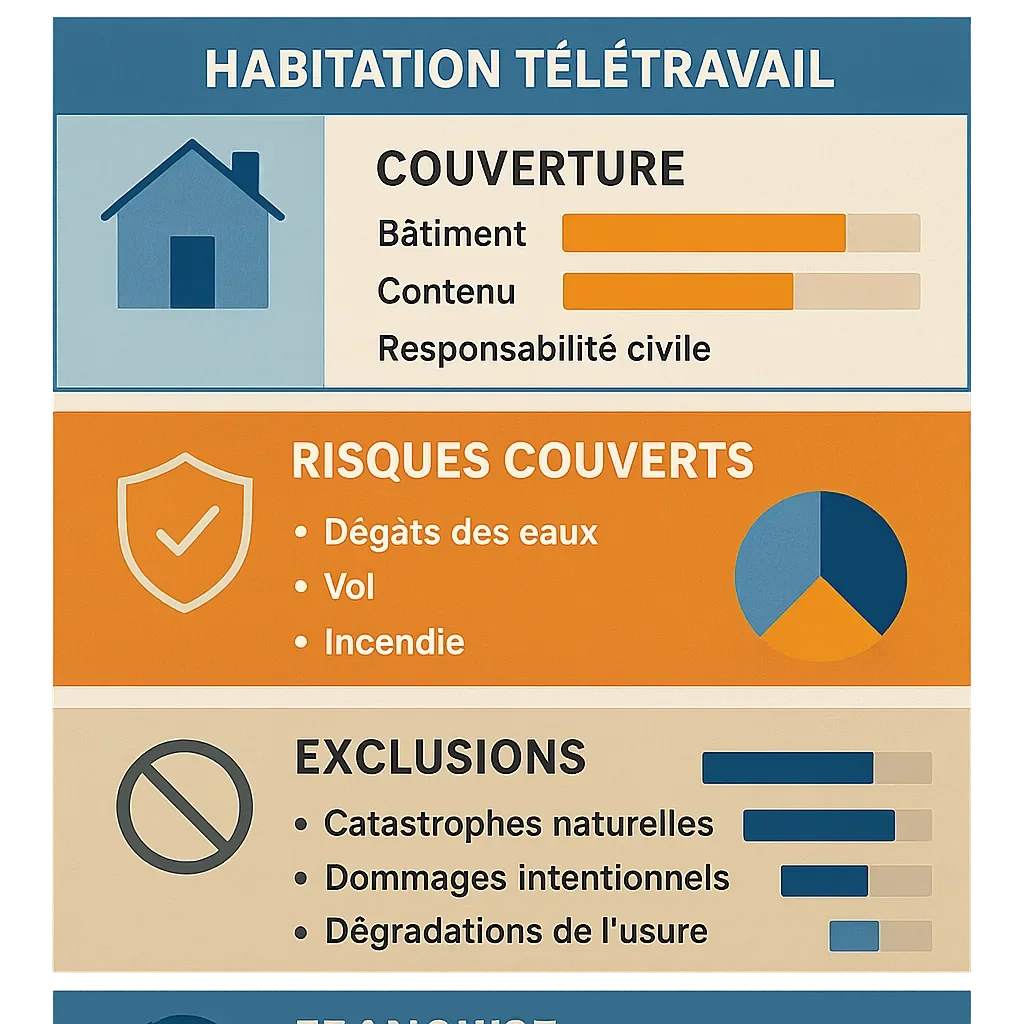
A multi-risk home insurance generally covers fire, water damage, theft, and civil liability. When teleworking, it mainly protects your personal belongings and the insured home; professional equipment, client visits, or intensive use may require an extension or a specific contract.
In practice, telework home insurance does not rewrite the entire contract. It often continues to cover the home itself, your furniture, your appliances, and damages caused to third parties within the scope of private life. The issue arises when the equipment used belongs to the employer, when its value is high, or when the activity already resembles a professional activity in a broad sense.
Here are the points that come up most often:
- Fire, water damage, theft: generally covered, but with limits that should be checked closely.
- Civil liability: useful if damage is caused to a neighbor, a third party, or the building.
- Personal equipment: often covered, but not always up to the true replacement value.
- Loaned professional equipment: to be read in black and white, as some guarantees exclude “professional” equipment or impose conditions.
- Client visits: a frequent gray area, especially if the home also serves as a meeting place.
The classic trap is to confuse domestic use with professional use. A home office remains a private office as long as there is no client reception, no significant storage, nor notable change in activity. As soon as it shifts towards a semi-professional logic, exclusions become more significant than marketing promises.
Employee, Freelancer, Employer: Who Insures What?
The right approach is to separate responsibilities. An employee does not insure the workstation in the same way as a freelancer, and the employer often retains some responsibility for the equipment they provide. In teleworking, the most common mistake is to expect the same protection from a home insurance contract, a professional contract, and the company’s internal policy.
| Profile | What home insurance often covers | To check first |
|---|---|---|
| Employee teleworking occasionally | Private belongings, civil liability, damage to the home | Loaned equipment, electronics limits, notification to insurer |
| Employee teleworking regularly | Similar basic coverage, depending on the contract | Telework extension, use of a dedicated room, theft risks |
| Freelancer / independent | Often insufficient for professional activity | Professional multi-risk insurance or dedicated extension |
| Employer | Responsible for equipment entrusted depending on the case | Internal procedure, inventory, proof of loan, cybersecurity |
In an apartment in Paris, an employee teleworking two days a week with their laptop does not necessarily trigger a major adaptation. In Lyon, however, a freelancer who stores a printer, graphic tablet, and client documents often has an interest in moving beyond the “classic home” framework. The context changes everything.
In my opinion, the right reflex is not to pay more, but to clarify better. In teleworking, unpleasant surprises rarely come from a total lack of coverage; they mostly come from a contract read too quickly.
How to check your contract without making mistakes?
Proper checking does not take an hour, but it must be methodical. The idea is not to hunt down every comma in the contract, but rather to spot the clauses that change everything: declaration of teleworking, limits on equipment, exclusions related to professional activity, and conditions for storing equipment at home.
Here is the useful checklist, the one that avoids unpleasant surprises:
- Frequency of teleworking: occasional, regular, almost permanent.
- Ownership of equipment: personal, loaned by the employer, rented, mixed.
- Value of the IT equipment: an 800 € laptop is not treated the same as a complete workstation worth 2,500 €.
- Compensation ceiling: often the real crux of the matter.
- Theft and break-in: some guarantees require specific locks or strengthened proof.
- Use of the home: simple workstation, dedicated room, client reception, storage.
It is observed in practice that the smoothest cases are those where the employee keeps the PC invoice, the email of provision, and some photos of the workstation. Conversely, when the equipment was “loaned orally,” the insurer asks for more proof and the coverage becomes complicated. In Nantes, for example, a family sharing a flat reported having to have the clause on occupants corrected before declaring a simple teleworking extension.
How to react in case of a claim during teleworking?
The reflex to have is simple: secure, prove, declare. In case of fire, water damage, or theft, you must protect the goods, keep the evidence, and notify the insurer within the deadlines. For theft, the declaration deadline is often 2 working days; for other claims, it is generally 5 working days.
Timing matters, because a well-prepared file speeds everything up: photos of the damage, purchase invoice, inventory of equipment, serial number, email assigning the professional equipment, police report if necessary. If the claim also affects the company’s equipment, inform the employer quickly; they can activate their own guarantees or request a more precise report.
In practice, an insurance agent observes that the fastest cases are often those where the insured took three photos before touching anything. Another family said they gained several days because they had kept the equipment inventory and the delivery slip for the screen. It’s not glamorous, but it’s extremely effective.
It is useful to keep in mind a nuance: home insurance generally covers the home and the insured goods, not necessarily the indirect consequences of a computer failure, data loss, or delivery delay related to teleworking. For these issues, the employer’s protection, regular backups, and cybersecurity take over.
Remote work at home, in shared housing, or elsewhere: the borderline cases to know
Borderline cases are often the ones that trip up contracts. Remote work in a second home, at a relative’s place, in a shared apartment, or from a coworking space near the home is not always read as simple “working from home.” The insured address, declared occupants, and actual use of the place can change the coverage.
If you work from a second home a few weeks a year, check that the contract properly covers this address and not just the main residence. In shared housing, the issue of declared roommates and the sharing of belongings becomes central. And if you receive clients at home, it may sometimes be necessary to switch to a professional liability logic, even without a storefront or signage.
Remote work abroad requires even more caution. As soon as the place of work is outside the French framework, home insurance guarantees can become limited or unsuitable. It is better to ask the insurer before departure, especially if the computer, files, or valuables must follow. This quick call avoids major cold sweats.
FAQ
Can my employer ask me for a home insurance certificate?
Yes, this is common when remote work is organized at home, especially to verify that you have civil liability and minimum housing coverage. It is not always an “automatic” legal obligation, but in practice, many companies request this proof to secure their own organization.
Is a specific insurance needed if I only telework one or two days per month?
Not necessarily. For very occasional remote work, a standard home insurance policy is often sufficient, provided the contract does not include unusual exclusions. However, if you handle expensive equipment or if the situation repeats for a long time, a check is still necessary.
Is the equipment provided by the company covered by my home insurance contract?
Sometimes yes, but not always in the same way as your personal belongings. Some contracts cover entrusted goods, others exclude them or impose a low limit. The simplest is to ask the employer for the exact status of the equipment and to verify the corresponding clause with the insurer.
Is home insurance enough if I am a freelancer?
Often no, or at least not completely. A freelancer carries out a real professional activity at home, which goes beyond simple private use. A professional multi-risk insurance or an adapted extension is generally more coherent, especially if you store equipment, receive clients, or invoice from home.
What should I do if my rhythm has changed and I telework much more than before?
It is better to notify the insurer as soon as the rhythm changes significantly. Going from a few days per month to several days per week can change the risk exposure, the value of the equipment to be covered, and sometimes the applicable exclusions. A simple endorsement often costs less than a bad surprise at the time of a claim.
Is the theft of a laptop from my car covered?
Sometimes, but with strict conditions: break-in, locked vehicle, appropriate parking, and sometimes limited compensation ceiling. This type of coverage varies greatly from one contract to another. If you regularly transport equipment, you must check precisely the exclusions on items left in a vehicle.