
Home insurance: what are the coverage exclusions?
A leak behind a piece of furniture, a theft during a long absence, or a poorly declared water damage: in home insurance, the real trap is not always the claim, but the exclusion. Behind the term home insurance exclusions, there are very concrete rules, often written in black and white, that can completely nullify compensation. Good news: you can spot them, understand them, and avoid unpleasant surprises.
Sommaire
In brief
😅 An exclusion means: the contract does not pay for this type of claim, even if the damage is real.
🧾 The trio not to confuse: exclusion, deductible, and forfeiture. Their effects are not the same at all.
✅ Before signing, especially check the clauses on prolonged absence, shared housing, subletting, professional use, and outbuildings.
🔎 The contract must remain readable: a valid exclusion is generally formal and limited, not vague or hidden deep in an annex.
What is a coverage exclusion in home insurance?
A coverage exclusion is a situation that the contract designates as non-compensable. In other words, the insurer considers that the risk is not covered from the outset. In home insurance, this mainly concerns intentional acts, certain maintenance failures, undeclared uses, and some exceptional risks.
In practice, an exclusion draws a clear boundary: if the claim falls within it, the insurer pays nothing. The right reflex is to spot clauses in bold or capital letters, then check if they really apply to your home, your use, and your lifestyle.
The Insurance Code regulates this logic: an exclusion must not be vague, otherwise it can be challenged. This is an important point because a poorly drafted contract can give the impression of broader coverage than it actually provides. And there, the cold shower often comes after the claim, not before.
Which exclusions occur most frequently according to the guarantees?
The most frequent exclusions almost always affect the same sensitive areas: civil liability, theft, water damage, and, to a lesser extent, fire. The contract mainly targets avoidable claims, intentional faults, or situations that the insured could control. This is where many disputes begin.
- Civil liability: damages caused intentionally, damages between members of the same family, damages related to undeclared professional activity.
- Theft and vandalism: absence of break-in, prolonged absence without minimal supervision, insufficiently protected premises, undeclared goods or goods left in an uncovered outbuilding.
- Water damage: slow infiltrations due to lack of maintenance, freezing if the protective measures provided in the contract were not taken, leaks caused by hastily done DIY work.
- Fire: intentional fault, non-compliant installation, dangerous use of an appliance, storage of hazardous products.
- Exceptional risks: war, nuclear event or ionizing radiation, which almost always fall under principle exclusions.
It is observed in practice that the most frustrating refusals occur when the insured believes they are covered “by default.” A family returning from a 6-week stay sometimes discovered that the contract required regular visits, mail collection, or an active alarm. Result: the claim is real, but the coverage is void.
For somewhat specific profiles, the devil is often in the details: a shared apartment in Lyon, a secondary residence in Brittany, or an apartment partly rented to a student are not interpreted the same way as a classic main residence. Again, the contract does not forgive improvisation.
How to distinguish exclusion, deductible, forfeiture, and lack of insurance?
These four concepts are similar, but they do not play the same role. Exclusion means the risk is never covered. The deductible reduces the indemnity. Forfeiture penalizes a breach after a claim. Lack of insurance, finally, means that the property or use simply was not insured.
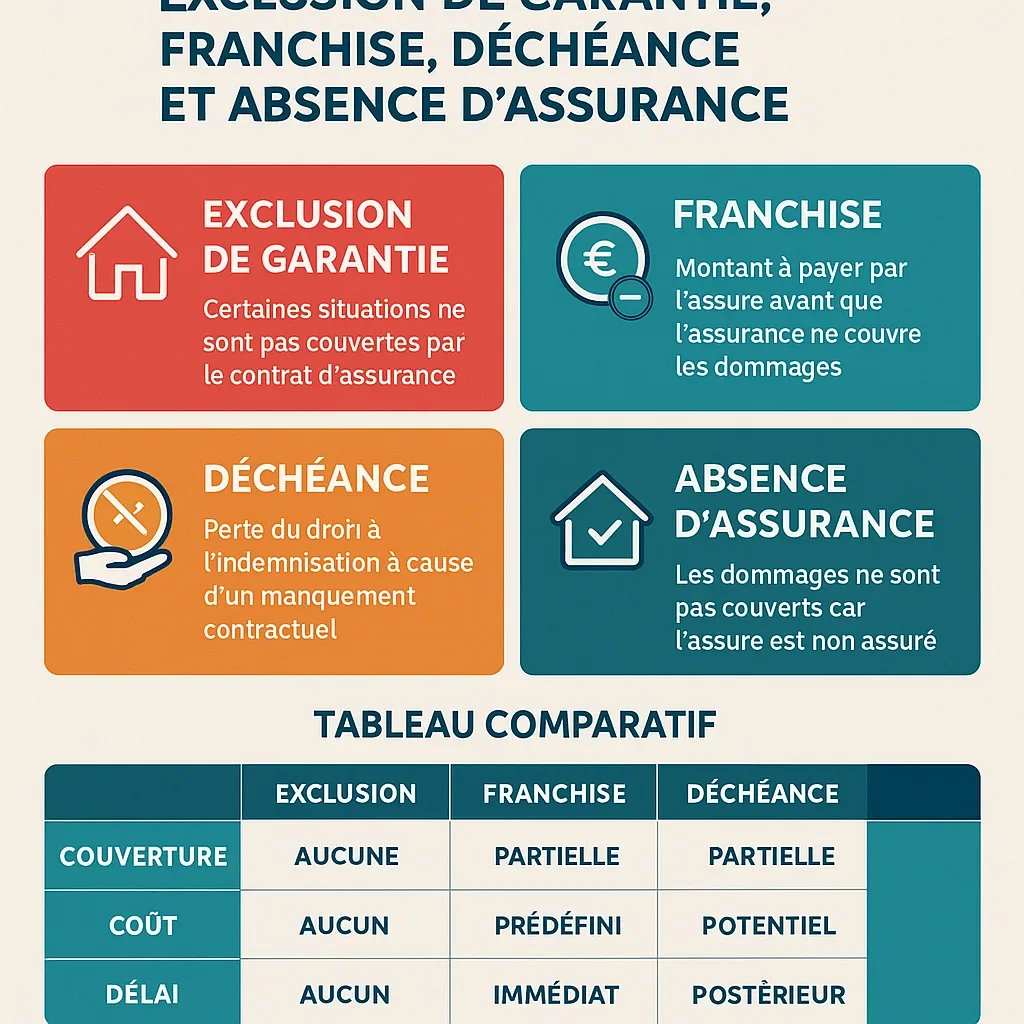
| Concept | Effect | Concrete example |
|---|---|---|
| Exclusion | The claim is never covered | Theft in a room or outbuilding not declared in the contract |
| Deductible | A part of the amount remains your responsibility | €800 damage, €150 deductible |
| Forfeiture | The insurer refuses after a breach of your obligations | Late declaration or incomplete file after the claim |
| Lack of insurance | The risk was not subscribed | Professional use never declared at signing |
The real trap is not the word “not covered.” It is not knowing whether it is an exclusion, a deductible, or a forfeiture, because the recourse is not the same.
Can an exclusion of coverage be negotiated or bought back?
Sometimes yes, but not for everything. So-called principle exclusions — war, nuclear, intentional fault — are almost never negotiable. However, certain contractual limits can be reduced, adjusted, or bought back: better coverage for outbuildings, valuables, swimming pools, solar panels, or occasional professional use.
The key point is the degree of risk for the insurer. The easier the risk is to assess, the more discussion is possible. The harder it is to control, the more the insurer locks down their position. In plain terms: a secondary residence that is rarely occupied or a home with a professional workshop will often require specific guarantees, sometimes with an additional premium.
- What is sometimes negotiable: extension to an outbuilding, coverage of a computer used for teleworking, enhanced protection for a valuable item.
- What is rarely negotiable: deliberate acts, nuclear risks, war, obvious fraud.
- The right reflex: ask for written confirmation before signing, not after the mishap.
What to do if the insurer refuses to compensate?
A refusal is not always to be accepted passively. The first thing to do is to ask the insurer for the precise reason, the clause applied, and how they interpret the facts. Then, compare the refusal letter to the contract, gather useful evidence, and if necessary, contest in writing following proper procedures.
A refusal to compensate is handled in 3 steps: ask for the exact clause, send a reasoned contestation with evidence, then contact the mediator if the deadlock persists. The statute of limitations is generally 2 years, so it’s best not to delay.
In practice, the most influential documents are often very simple: dated photos, invoices, police reports if theft, email exchanges, artisan intervention certificates, alarm records, or condition reports. A neat contestation is better than a long angry message. Joking aside, a clear file puts the insurer face to face with their own writings.
To check the legal framework, you can consult the Insurance Code on Légifrance, the home insurance fact sheet on Service-Public.fr, and the housing advice from ANIL.
How to spot exclusions before signing?
The best time to manage exclusions is before signing. Once the claim has occurred, it is too late to discover that a cellar, a veranda, regular teleworking, or a shared rental were not declared. The contract should be read like a roadmap: what is crossed out counts as much as what is covered.
- Check the use of the dwelling: primary residence, secondary, rental, shared rental, subletting, or mixed occupation.
- Look at the outbuildings: cellar, garage, garden shed, box, bike storage, workshop.
- Declare teleworking if professional equipment, goods, or client reception are involved.
- Reread the absence clause if the dwelling remains empty for several weeks.
- Check valuables: jewelry, photographic equipment, instruments, artworks, high-end computer equipment.
- Verify protection measures: locks, alarm, shutters, detectors, gate.
- Examine exclusions by coverage: theft, water damage, fire, civil liability.
- Look at the limits: a covered guarantee can still be very limited in amount.
- Watch initial declarations: surface area, number of rooms, floor, outbuildings, actual use.
- Keep a copy of the complete contract: special conditions, general conditions, and endorsements.
This check in 10 points takes a little time but avoids refusals that cost much more. It is especially useful for somewhat “non-standard” dwellings: shared apartment in Lille, house with an office, student studio, or family home occupied only in summer.
FAQ: practical home insurance exclusions
Are the exclusions the same with all insurers?
No, the main principles are similar, but the limits vary from one contract to another. Two insurers may cover theft, for example, while imposing different conditions on prolonged absence, the presence of an alarm, or the nature of outbuildings. That is why it is necessary to compare the general conditions, not just the price.
Can a lack of maintenance really void the guarantee?
Yes, especially when the insurer can demonstrate that the claim is not accidental but results from insufficient maintenance or progressive deterioration. A slow infiltration, a clogged gutter, or poorly maintained equipment are classic cases. Proof of the link between the defect and the damage is decisive.
Does home insurance cover an undeclared shared rental?
Not necessarily, and this is a real point of caution. If the contract was taken out for individual occupancy while the dwelling is shared, the insurer may consider that the risk has changed. In a shared rental, it is necessary to check who is insured, who declares what, and if personal belongings are properly listed.
What happens to a secondary residence left empty?
The risk increases, especially for theft, vandalism, and certain damages not detected quickly. Many contracts impose particular conditions: regular visits, alarm, water shut-off, or minimal surveillance. Without these precautions, the guarantee may be reduced. This is a very common case in seaside or countryside houses.
Does teleworking change anything about the exclusions?
Yes, especially if the dwelling is also used for professional activity. A simple personal computer does not have the same status as work equipment, stock, or client reception. If the contract has not been adjusted, the insurer may invoke an exclusion related to undeclared professional use.
Can an overly vague exclusion be contested?
Yes, because an exclusion must be drafted clearly, narrowly, and understandably. If the clause is ambiguous or too general, it can be contested. In practice, one must first request a written justification, then compare the contract wording with the rules of the Insurance Code and, if necessary, contact the mediator.