
In Brief
🕒 The right timing is to act immediately: protect the premises, preserve evidence, and notify the insurer without waiting to have a perfect file.
📌 Reference deadlines remain short: 5 business days for most claims, 2 business days in case of theft, and 10 days after the official decree for a natural disaster.
📂 A solid file relies on dated photos, invoices, a friendly report of water damage if needed, and for a burglary, a police report.
How to Report a Home Insurance Claim Without Mistakes?
In practice, an effective declaration looks less like a long emotional letter and more like a mini investigation file. You need to recount the facts, not interpret them: when the claim was noticed, where it happened, what was affected, and what has already been done to limit the damage. A water leak, for example, is not handled like a theft or fire; yet the logic remains the same: notify, prove, transmit.
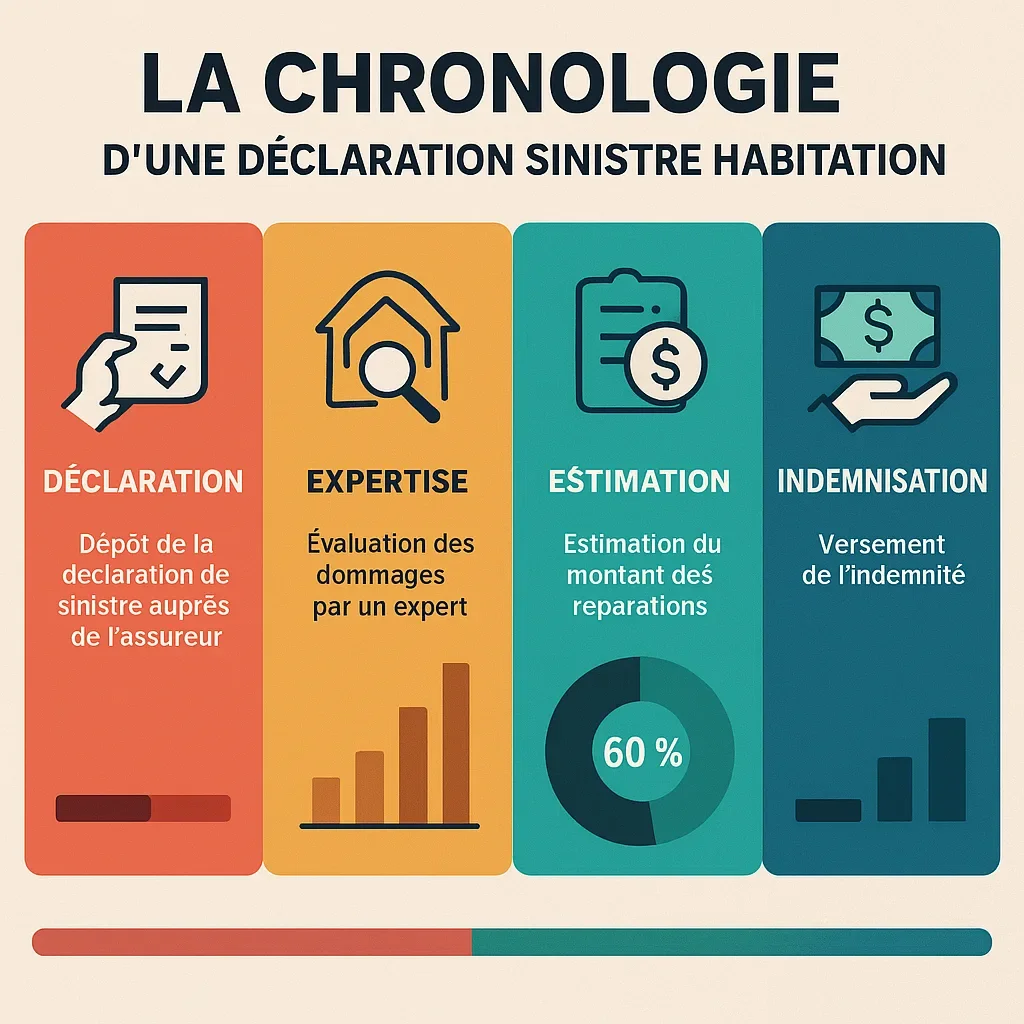
The simplest approach is to proceed in four steps. First, secure the home: turn off water, electricity, or gas if necessary, move what can be moved, and prevent the situation from worsening. Next, take photos, videos, and if possible, note the circumstances with the time, the affected room, and the items concerned. Then report by phone, online, email, or by registered mail with acknowledgment of receipt. Finally, send the requested supporting documents without letting the file gather dust.
Joking aside, the friendly water damage report remains one of the most useful documents when there are multiple homes or parties involved. It allows setting common grounds for the claim, especially in condominiums where a problem in the upstairs neighbor’s unit can end up affecting three apartments at once. It’s not glamorous, but it’s incredibly practical.
What deadlines must be respected for the home insurance claim declaration?
The key point is that the deadline does not always start at the exact moment of the event, but when you become aware of it, especially for damage discovered late. Water damage in a false ceiling, infiltration behind furniture, or an electrical fire starting at night can be detected with delay. This does not exempt you from acting quickly; on the contrary: the longer you wait, the more the insurer can contest the link between the claim and the observed damages.
To check the official rules and special cases, keep handy Service-Public.fr, Légifrance, and ANIL for rental or co-ownership situations. In somewhat tricky cases, this trio prevents navigating blindly.
It is also important to remember a key distinction: the declaration deadline and the expert assessment deadline are not the same thing. Declaring quickly does not oblige you to repair everything immediately; quite the opposite. The insurer must be able to observe the damages, especially if the value of the property, the origin of the claim, or the extent of repairs are disputed.
What proofs and documents should you attach to your file?
A well-prepared file often speeds up processing because it reduces requests for additional information. The goal is not to overwhelm the insurer with twenty documents, but to provide elements that prove the reality of the claim, the extent of the damages, and the value of the affected goods. This is where dated photos, invoices, and exchanges with third parties make all the difference.
Here are the most useful documents, depending on the situation:
- Photos and videos of the damage before any cleaning or major repair;
- Purchase invoices, bank statements, or warranties to justify the value of the goods;
- Mutual water damage report if a neighbor, property manager, or co-ownership is involved;
- Complaint receipt in case of theft, attempted theft, or vandalism;
- Inventory report at entry or furniture inventory, especially useful for tenants and furnished rentals;
- Contact details of witnesses or technical personnel if a contradictory expert assessment is anticipated.
In practice, it is often observed that the best-accepted files are not the “prettiest” but the most coherent. One photo, one invoice, and a simple timeline are better than a long story without proof. Conversely, insured parties who discard damaged items too early sometimes find themselves stuck: the expert has nothing left to examine, and the exchange becomes more technical.
Who should make the declaration according to the housing?
The right person to initiate the declaration depends on the occupant’s status, the type of damage, and the guarantees provided in the contract. In co-ownership or rental situations, it is often necessary to declare to one’s insurer while informing the other concerned parties. In other words, the chain of contact is as important as the claim itself.
| Profile | Who declares? | Point of attention |
|---|---|---|
| Tenant | The tenant declares their claim to their insurer, even if the cause comes from the neighbor or common areas. | Also notify the landlord and, in co-ownership, the property manager if the housing is affected. |
| Owner-occupant | The owner-occupant declares directly to their home insurance. | Check the water damage, fire, theft, or glass breakage coverage depending on the case. |
| Landlord owner | The landlord declares if their property is affected or if their liability is engaged. | Do not confuse the housing insurance with the tenant’s insurance: both can coexist. |
| Co-ownership | The property manager intervenes if the common areas are affected or if collective claim management is necessary. | A friendly report and written exchanges avoid unclear areas between neighbors. |
In a building, the classic mistake is to believe that a single call is enough to resolve everything. In reality, a claim can have several layers: your insurer, the neighbor’s insurer, the property manager’s insurance, and sometimes the civil liability of a third party. This is not a headache for pleasure; it is the normal mechanism of compensation.
What mistakes can block compensation?
Refusals or delays often come from details that seem trivial at the time. A file sent too late, damages altered before inspection, a version of the facts that changes from one message to another: the insurer does not like that, and we understand why. Consistency matters almost as much as the nature of the damage.
- Declaring late, especially for theft or a natural disaster;
- Discarding damaged goods before the expert’s visit;
- Repairing too quickly without keeping usable proof;
- Forgetting to file a complaint in case of burglary or vandalism;
- Minimizing or exaggerating the facts in the declaration;
- Not rereading the contract to check deductibles, exclusions, and limits.
It is also important to keep in mind a less pleasant reality: some guarantees are conditioned on the precise respect of formalities. If the insurer considers that the delay or absence of documents has worsened their inability to verify the claim, the discussion can become tense. That is why it is better to notify early and complete later, rather than the opposite.
What happens after the claim is filed?
Once the claim is received, the insurer opens the file, checks the coverage, and decides whether an expert assessment is needed. Most often, a simple claim is handled based on documents, but as soon as the amount rises, the cause is disputed, or several parties are involved, the expert intervenes. They are not a judge, but their report carries significant weight in assessing the damage.
Next come three very concrete topics: the deductible, the compensable amount, and the payment deadline. The deductible remains your responsibility if the contract provides for it, even in the case of a well-covered claim. Compensation can be paid all at once, in several installments, or after submitting estimates and invoices, depending on the contract and the nature of the work. For a simple file, exchanges can be quick; for a complex file, it’s better to count in weeks rather than days.
If the offer seems too low, don’t go to war right away: ask for the calculation details, compare with your estimates, check the items considered, and if necessary, contest in writing. A good contestation file is based on objective elements, not on momentary anger. It’s less spectacular but much more effective.
FAQ — home insurance claim
Can a home insurance claim be made by phone only?
Yes, in many cases, but it’s better to keep a written record immediately afterward. The phone is used to notify quickly, not to replace the file. An email, a message in the client area, or a registered letter allows you to fix the date and content of the claim.
Is it necessary to file a police report for a theft in the home?
Yes, it is strongly recommended and often essential for processing the file. The receipt of the police report serves as official proof, especially for burglaries and acts of vandalism. Without it, the insurer may block or limit the study of the theft coverage.
What should be done if the damage is discovered several days later?
You must declare it as soon as it is discovered, clearly specifying when you noticed the damage and why it was not seen earlier. For hidden damages, the timeline is very important. Keep everything that can prove the date of discovery: photos, messages, estimates, or a professional’s intervention.
Can repairs be made before the expert’s visit?
Only for urgent measures that prevent worsening the situation, such as turning off the water or securing a window. For the rest, it’s better to wait or at least take as many photos as possible and keep the damaged items. Otherwise, the expertise loses strength and the discussion can become complicated.
Who should be notified first in a condominium: the insurer, the neighbor, or the property manager?
Ideally all three, but not necessarily in the same order. First, you must limit the damage, then notify your insurer, and finally inform the neighbor or the property manager if common areas or another unit are involved. An amicable report often helps avoid misunderstandings.
What should be done if the insurer refuses to compensate?
First ask for the precise reason for the refusal and reread the contract, especially the exclusions, deductibles, and deadlines. Then contest in writing with the missing documents or elements that contradict the decision. If the blockage persists, you can contact the insurer’s complaints department, then the competent mediator.