
Home Liability Insurance: Coverage, Exclusions, and Covered Cases
A water leak that damages the neighbor’s ceiling, a vase knocked over at a friend’s house, a child breaking a window in the building: home liability insurance is precisely designed to prevent such accidents from costing you a small fortune. The principle seems simple, but the contract’s limits are much less so.
And this is where the topic becomes interesting: between what is compensated, what is excluded, and what depends on the occupant’s profile, there are some well-known pitfalls. Here’s how to read this coverage without getting misled by the fine print.
Sommaire
In Brief
🛡️ Home liability insurance covers damages caused to a third party accidentally, not your own property or intentional acts.
📌 The most common cases involve water damage, fire, explosion, a falling object, a child or an animal under your care.
⚠️ Exclusions to watch closely: intentional fault, professional use, motor vehicles, and sometimes property entrusted to or borrowed by you.
🔎 In practice, the contract matters as much as the general definition: deductibles, limits, and reporting deadlines can change the outcome.
What Does Home Liability Insurance Really Cover?
Home liability insurance compensates for damages accidentally caused to a third party from your home or by people and objects under your care. It does not cover your own property or intentional acts, and the contract almost always sets limits, deductibles, and exclusions.
Legally, the foundation remains the logic of the Civil Code: damage caused to others is repaired when there is a triggering event, harm, and a link between the two. In other words, the coverage applies if your liability is engaged, not if you yourself suffer the damage. The general framework is recalled by Service-Public.fr and by articles 1240 and 1241 of the Civil Code on Légifrance.
In practice, this coverage applies when the damage affects a third party: neighbor, landlord, visitor, condominium, sometimes even a business located below your apartment. We then talk about compensation for material damages — a partition wall, flooring, an appliance — but also bodily injuries, for example a wound caused by a falling object.
What Damages Does the Coverage Actually Include?
In practice, the coverage mainly targets material and bodily damages caused to a neighbor, guest, or landlord. Non-material damages can also be covered if they directly result from the incident, but only within the limits set by the contract.
The simplest way to understand is to divide the damages into three categories. First, material, when an object or dwelling is damaged. Then bodily, when a person is injured. Finally, non-material, when financial damage results from the incident, such as a hotel night or loss of business related to the event. Not all contracts treat these with the same generosity.
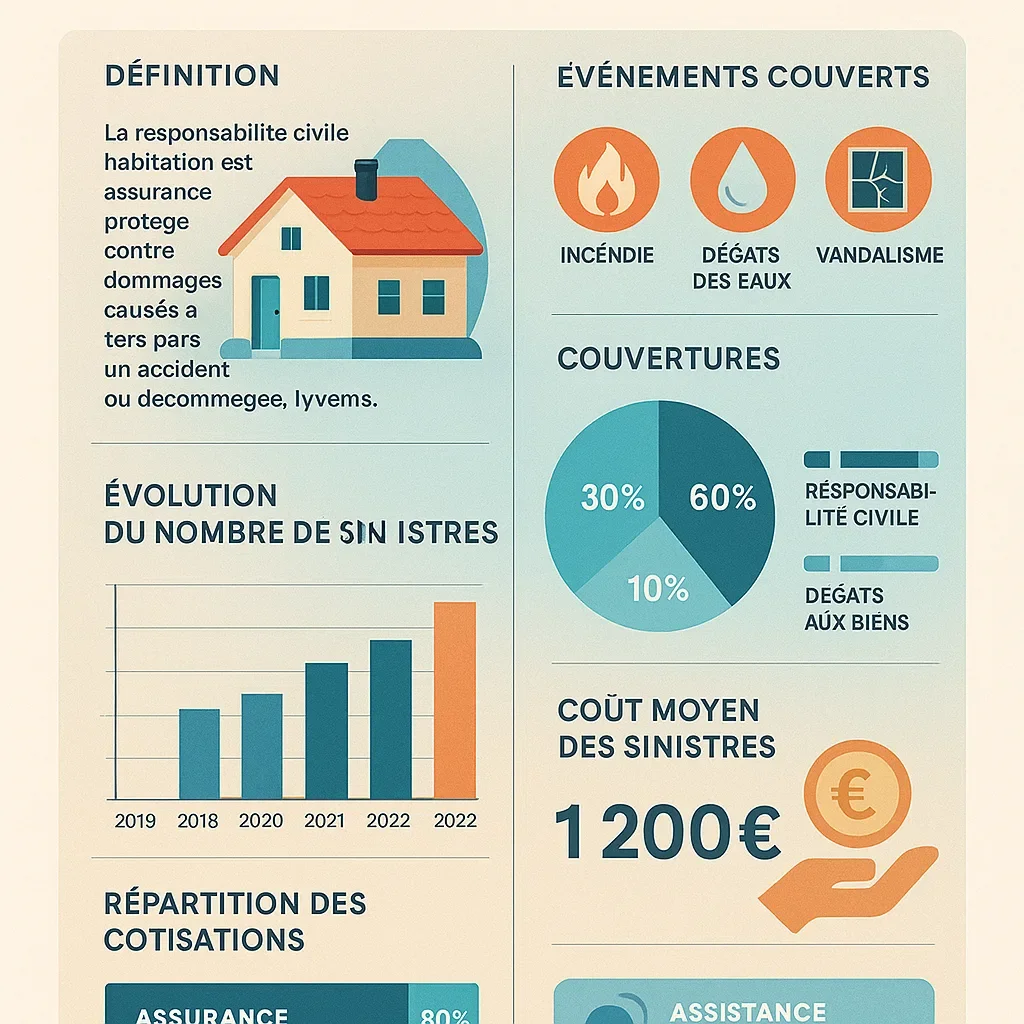
Here are the most common cases, the ones insurers see all the time:
- Water damage: a washing machine hose breaks and the apartment below is affected.
- Fire or explosion: a mishap in the kitchen causes damage to the neighbor or common areas.
- Falling object: a flower pot falls from a balcony in Lille and damages a parked car.
- Person injured at your home: a guest slips on a wet floor in Nantes and fractures their wrist.
- Child or pet: an incident occurs while you are caring for them.
On the ground, property managers often find that a well-documented file moves much faster than one recounted over the phone, three weeks after the event. Dated photos, invoices, amicable reports, and contact details of third parties save a lot of time. Joking aside, the quality of the file often changes the speed of compensation.
What exclusions can cause compensation to be denied?
The short answer: as soon as the claim is no longer accidental, or it falls outside the scope provided by the contract, the coverage can be blocked. This is where many insured people are caught off guard, because they confuse “general” coverage with unlimited protection. In reality, exclusions are just as important as guarantees.
Almost always, the same limits are found. Some are obvious, others much less so. That is precisely why you need to read the special conditions, not just the commercial summary. The Ministry of the Interior also reminds, in its fact sheet on everyday procedures, that civil liability corresponds to the obligation to repair damage caused to others unintentionally.
- Intentional act: if the damage is deliberate, the insurer does not cover it.
- Professional use: equipment used for an independent activity may fall under another contract.
- Motor vehicle: car, motorcycle, scooter, all follow their own insurance regime.
- Entrusted or borrowed property: loaned computer, keys, rented or kept equipment, depending on the contracts.
- Obvious lack of maintenance: serious negligence can complicate coverage.
You also have to look at the issue of limits and deductibles. A contract can be very broad on paper, but become less interesting if the coverage limit is low or the deductible is high. This is the kind of detail that turns a good promise into a somewhat meager compensation.
The real trap is not the basic coverage, it is the misreading of exclusions. A good liability policy is useless if the claim is misclassified.
How does compensation work after a claim?
Once the damage is identified, the right reflex is to notify your insurer without delay, gather evidence, then let the file follow its expert review process. Most home insurance contracts require a declaration within about 5 working days, sometimes 2 working days for theft, and up to 10 days after the publication of the decree for a natural disaster.
Practically, you have to keep it simple and straightforward: describe the facts, attach photos, keep invoices, notify the neighbor or the property manager if needed, then send all the elements requested by the insurer. If an expert is appointed, they will verify the reality of the damage, its cause, and the amount of repairs. This is where the chronology of events matters a lot.
It should also be noted that compensation does not always go directly to you. Depending on the case, the insurer compensates the injured third party, reimburses repairs, or appoints a repairer. The important point is that civil liability is not a blank check: it follows the logic of the contract, common law, and the available supporting documents.
What is the difference between home liability insurance and private liability insurance?
The difference is simple in principle, but often unclear in contracts. Home liability insurance covers damages related to the home and domestic life; private liability insurance more broadly covers everyday accidents, sometimes outside the home. The two often overlap, which is why it is important to check what is already included.
| Coverage | Scope | Examples |
|---|---|---|
| Home liability | Housing, neighborhood, co-ownership, occupants | Water leak, fire outbreak, falling object |
| Private liability | Daily life, sometimes outside the home | Bicycle knocking over a pedestrian, damage at a friend’s place |
| Liability included in home insurance contract | Often integrated, but not always identical depending on the insurer | Merged coverage, options, extensions |
The best practice is to read the “liability” section of the contract line by line. Some insurances mix everything under the same label, others clearly separate private life, school life, housing, or leisure. Result: two contracts at a similar price can offer very different protection.
Which profiles should check their contract very carefully?
Tenant, roommate, student, owner-occupier, non-occupying owner: each has a slightly different situation, and this is often where oversights occur. The contract must match the reality of the housing, otherwise the coverage seems solid… until the day you really need it.
For a tenant, liability related to the housing is generally essential, and proof of insurance is requested upon entry and then annually. For a co-ownership owner, protection against damages caused to neighbors or common areas deserves serious verification. For a landlord owner, vacancy and damages caused by an underinsured tenant may require specific coverage.
A property manager notes that a water damage claim reported the same day, with photos and neighbors’ contact details, is often resolved much faster than a file started “when one remembers”. In old buildings in Lyon or Bordeaux, this difference can avoid weeks of deadlock between insurers.
It is also necessary to consider less obvious cases:
- Shared housing: a single policy can cover several occupants, but it is necessary to check the names and the list of insured persons.
- Student: coverage included in the parents’ contract is not always sufficient if the housing is independent.
- Secondary residence: coverage may exist, but not with the same options as the main residence.
- Furnished rental or Airbnb: the framework is often more technical and requires an adapted contract.
Ultimately, home liability insurance is not an abstract promise. It is a very concrete repair tool that works well when the contract aligns with real life. And this is often where the difference lies between comfortable protection and an unpleasant surprise.
FAQ — Home liability insurance
Does home liability insurance cover my children?
Most often, yes, if they are children living in the household and covered by the contract. It is important to check the definition of insured persons, as some contracts distinguish between minor children, adult dependents, and persons linked to the household.
Is my dog covered if it causes damage at a neighbor’s place?
Often, yes, if the animal is mentioned or implicitly included in the household coverage. However, dogs subject to specific regulations or damages related to professional activity may require specific verification.
What should I do if my neighbor asks me to pay directly?
Do not pay blindly without reporting the claim. Notify your insurer, gather evidence, and forward the neighbor’s request. The insurer will check if liability is engaged and if the damages are covered under the contract.
Does the deductible always apply?
No. Some contracts include a deductible, others do not, and its amount varies depending on the plan. This is a point to verify even before signing, as a high deductible can greatly reduce the benefit of compensation for minor claims.
Does an Airbnb rental change anything?
Yes, often. A short-term rental may require an extension of coverage or a specific contract, especially if the property is occupied by transient third parties. You need to check the clause related to secondary residence, temporary occupancy, or seasonal rental.
Can one be covered twice without knowing it?
Yes, this can happen with home insurance, a bank card, a school contract, or private life protection already included elsewhere. It is not necessarily serious, but it can create unnecessary duplicates. The best is to compare the exact coverage scopes.