In Brief
🔎 The theft guarantee is not always automatic in home insurance. You need to check the contract, the limits, the deductible, and the exclusions related to the absence of forced entry.
⏱️ For a theft, the declaration to the insurer must generally be made within 2 working days, according to the Insurance Code. The faster you are, the easier the claim is to defend.
📁 Photos, police report, invoices, serial numbers, inventory: these are the documents that make the difference between a fair reimbursement and a reduced or even contested compensation.
What Does Home Insurance Really Cover in Case of Burglary?
Burglary home insurance mainly reimburses stolen, destroyed, or damaged goods during a break-in, an attempted theft, or an intrusion covered by the contract. However, coverage almost always depends on specific conditions: method of entry, proof of the incident, category limits, and deductible. In other words, the devil is in the details.
In practice, multi-risk home insurance contracts often distinguish several cases: theft with forced entry, attempted theft, assault at home, or theft committed in certain outbuildings such as a garage or cellar. This means that simply having a contract is not enough; the incident scenario must match the contractual definition. That is why reading the specific conditions remains essential, especially if you keep valuables or computer equipment.
| Situation | Often Covered? | Point of Caution |
|---|---|---|
| Theft with forced entry | Yes | Proof of forced entry trace and precise inventory |
| Attempted theft | Yes, if it damaged the home | Immediate photos and police report useful |
| Theft without trace of forced entry | Sometimes, depending on the contract | Often more difficult to get compensated |
| Valuables | Yes, but capped | Specific limit and strengthened proof required |
| Goods stored in cellar or garage | Variable | Often subject to security conditions |
What to do in the first 24 hours after a burglary?
The first hours matter more than you might think. You need to secure the home, avoid touching useful traces, file a complaint, notify the insurer, and gather the first pieces of evidence. The more dated, photographed, and coherent the file is, the simpler the assessment will be and the quicker the compensation.
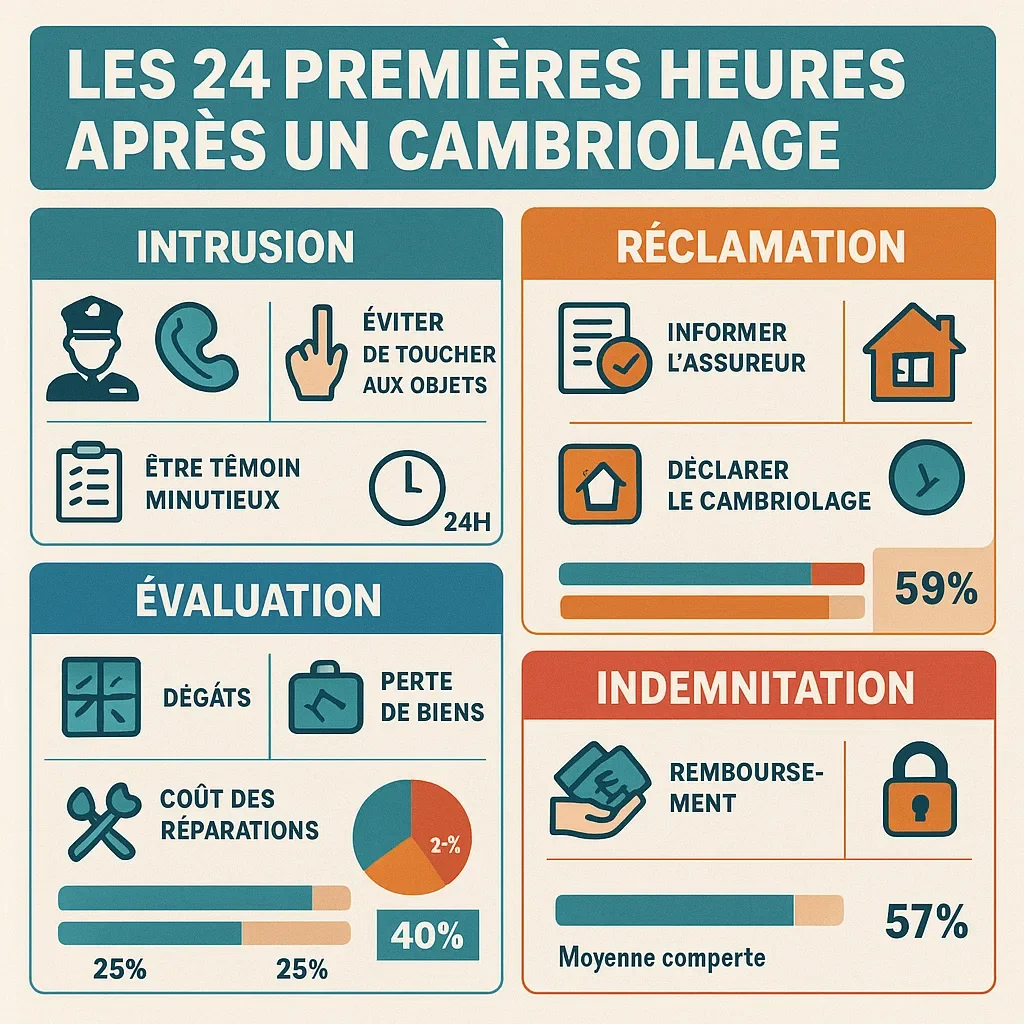
Practically, the proper sequence looks like this:
- secure the home and call law enforcement in case of immediate risk;
- photograph the doors, windows, rooms, and moved objects before any tidying up;
- file a complaint or make a pre-complaint online on Service-Public.fr if it helps save time;
- notify the insurer as soon as possible, then send the complete file within the prescribed deadline;
- keep the damaged goods as long as the insurer has not told you to dispose of them.
Filing a complaint is not just a formality. It serves to date the theft, describe the circumstances, and strengthen the coherence of the file. On the other hand, the insurer often compares the timeline, physical traces, and initial statements. If everything matches, the process goes faster. If there are contradictions, back-and-forths begin, and then, it’s a real hassle.
What documents to send to be compensated quickly?
For solid compensation, you need to prove both the claim and the value of the goods. Filing a complaint alone is not enough: the insurer expects a coherent set of clues. Invoices, photos, serial numbers, warranty statements, inventory, and repair estimates are your best allies.
Here are the documents to gather without delay:
- the complaint receipt or a copy of the complaint filing;
- photos of the home and damages, taken before restoring order;
- purchase invoices, receipts, or order confirmations;
- serial numbers for electronics, cameras, consoles, or computers;
- an inventory of stolen items with purchase date, brand, model, and estimate;
- estimates for doors, locks, windows, joinery, or repairs.
If you no longer have the invoice, not all is lost. A bank statement, an old photo, a confirmation email, or a manual with reference can sometimes help. However, the more expensive the item, the more the insurer will require solid proof. For jewelry, watches, and valuables, the absence of proof weighs heavily in the balance.
How does the insurer calculate compensation after a burglary?
The calculation depends on three factors: the value retained for the item, the deductible, and the limits provided in the contract. In practice, the insurer can reimburse at the current value, replacement value, or with depreciation deducted. The same burglary can therefore lead to two very different reimbursements depending on the signed contract.
The deductible is the portion that remains your responsibility. Depreciation corresponds to the reduction in value related to the age and use of the item. Finally, the limit caps the reimbursement for certain categories: jewelry, IT equipment, portable devices, multimedia. A television purchased six years ago will therefore not be reimbursed as if it were new, even if you kept the original receipt.
| Element | Effect on reimbursement | Concrete example |
|---|---|---|
| Deductible | Deducted from the final amount | Compensation of €1,200 – deductible of €200 = €1,000 |
| Depreciation | Reduces the value of the item | Old computer reimbursed on a basis lower than new |
| Contractual limit | Caps the reimbursement at the maximum provided | Valuable item limited by a specific category |
The real trap is not the theft itself, but the gap between what the contract promises and what the claimant can prove. In a well-prepared file, the difference often comes down to a few pieces of evidence.
It is also necessary to distinguish replacement value from current value. Some premium contracts provide more favorable reimbursement for recent devices, sometimes under conditions related to the time elapsed after purchase. Others apply rapid depreciation, especially on electronics. This is where comparing contracts makes all the difference, as the premium price does not tell the whole story.
What mistakes reduce or cancel the reimbursement?
Most often, unpleasant surprises come from a simple detail: missing proof, expired deadline, incomplete declaration, or a poorly read contract. Most refusals do not come out of nowhere. They rely on a specific clause, often related to home security or the nature of the theft.
The most frequent mistakes are easy to avoid:
- cleaning or discarding evidence before taking photos;
- forgetting to report a valuable item or an item stored in an outbuilding;
- declaring an approximate amount without a detailed inventory;
- waiting too long before alerting the insurer;
- not respecting the security measures required by the contract, such as a locked door or a certified lock;
- confusing theft, attempted theft, and vandalism, whereas the contract does not always treat them the same way.
The case of theft without forced entry deserves special attention. Some contracts cover it, others do not, and many impose strict conditions: signs of entry, assault, clear trickery, or damaged access. In other words, if a window was left open and the contract requires forced entry, the compensation may be denied. It’s harsh, but that’s how it is.
What to do if the insurer refuses or undervalues your claim?
A refusal is not necessarily the end of the story. You should request a written explanation, verify the clause invoked, compare it with the evidence already submitted, and, if necessary, contest it point by point. In home burglary insurance, disagreements often concern the value of the goods, depreciation, or the actual existence of a break-in.
The first step is to send a clear complaint, with the missing documents or elements that correct the evaluation. If the deadlock persists, a counter-expertise can be useful, especially for expensive goods or structural damage. At the same time, keep an eye on the limitation period: the action arising from the insurance contract is generally prescribed by two years, according to the Insurance Code on Légifrance.
When the discussion stalls, you can go through the insurer’s complaint service and, as a last resort, through a mediator. The goal is not to inflame the case, but to refocus it on verifiable facts: dates, photos, inventory, invoices, contractual clauses. It is often this return to concrete facts that unlocks the situation.
FAQ – Home Insurance and Burglary
Is theft without break-in always compensated?
No, not always. Some contracts require evidence of a break-in or forced entry, while others also cover theft by trickery or assault. You need to read the specific conditions, as the definition of the claim changes everything.
Should you wait for the expert before replacing the door or lock?
If possible, yes, at least to preserve traces and take photos. In case of a security emergency, you can have a temporary closure installed, but keep the invoices and document each repair. The locksmith can also indicate the damage observed.
Are jewelry and valuables well reimbursed?
They can be, but often within the limit of a specific ceiling. Without an invoice, certificate, or dated photo, compensation becomes more difficult. Contracts also sometimes provide conditions for storage, such as a safe or a locked room.
Is filing a complaint online sufficient for the insurer?
It helps, but it does not always replace the complete complaint if the insurer requests the final document. The online pre-complaint can save time, especially to start the file, then sometimes you will have to sign or complete the procedure depending on the police or gendarmerie services.
Can compensation be imposed if I no longer have the invoices?
Yes, sometimes, but the insurer may apply a more cautious estimate. Alternative proofs such as bank statements, order emails, photos, or serial numbers can help. The higher the value of the item, the stronger the proof must be.
What happens to the deductible if the theft is partially reimbursed?
The deductible generally remains your responsibility on the total claim or on the portion concerned, depending on the contract. Even with good compensation, it can significantly reduce the final check. This is a clause to check before even signing the home insurance.