
Natural disaster: how to get quick compensation?
A flood, cracks after drought, or a roof damaged by a mudslide, and the same question arises very quickly: how to obtain natural disaster compensation without getting lost in deadlines, supporting documents, and back-and-forth with the insurer? The subject seems technical, but it is mainly based on a simple rule: the cleaner the file is from the start, the faster the processing will be.
The problem is that many victims discover the rules of the Cat Nat regime at the worst possible moment. Between the interministerial decree, the declaration to be made on time, the deductible, and the assessment, a forgotten detail can delay the reimbursement by several weeks. Here is the most effective method to save time without skipping steps. ⏱️
Sommaire
In brief
🧾 Speed depends first on a reflex: declare the claim as soon as the natural disaster decree is published, then send a readable, dated, and complete file.
📸 Evidence makes the difference: photos, videos, invoices, quotes, and an inventory of affected goods prevent blockages during the assessment.
💶 Reimbursement is never “full”: you must account for the Cat Nat deductible, usually €380 for a dwelling, or €1,520 for certain drought-related damages.
⚖️ The official framework is recalled by Service-Public, Géorisques, and the CCR.
How to speed up natural disaster compensation?
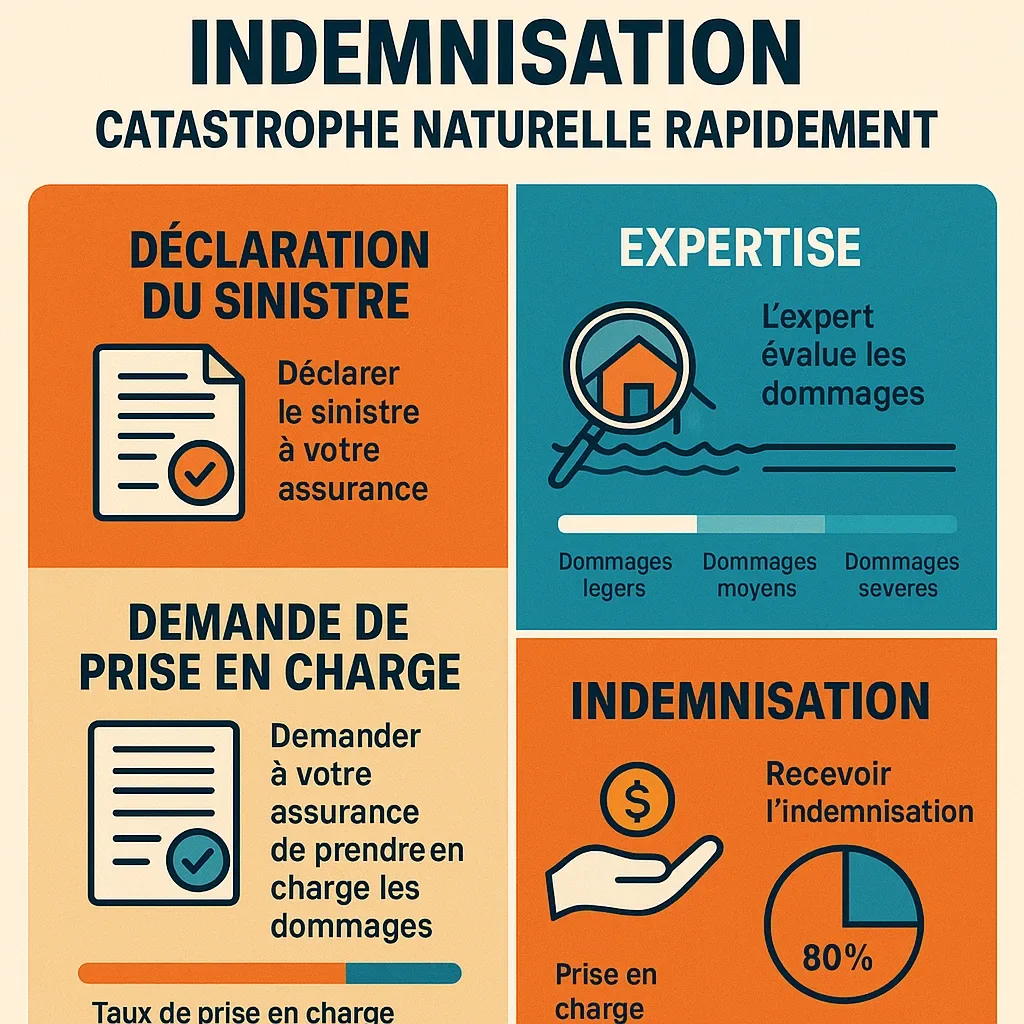
To go fast, you must declare the claim as soon as the decree is published, gather dated evidence, leave damaged goods visible for the assessment, then submit a clear file with quotes and invoices. The more complete the file, the more the insurer can estimate without back-and-forth.
The natural disaster regime does not work like a simple water damage claim. There is a legal trigger, the interministerial decree published in the Official Journal, which recognizes the state of natural disaster for a municipality and a given period. Without this recognition, the Cat Nat guarantee does not activate, even if the damages are very real.
Once the decree is published, the clock starts. Since January 1, 2023, you generally have 30 days to declare the claim to the insurer. This deadline is more comfortable than before, but it should not be taken as an invitation to wait: in practice, files sent early, with clear documents, progress faster.
The best reflex is to think “evidence” before thinking “cleaning.” Photograph the rooms, furniture, exteriors, water levels if relevant, then keep invoices, repair quotes, and, if possible, a summary inventory of affected goods. In short, avoid a file in Sunday night draft mode. Joking aside, an insurer does not reimburse what it cannot verify.
What are the deadlines and deductibles to know before submitting the claim?
The most important thing is to distinguish three phases: the declaration of the claim, the insurer’s investigation, and the payment. In natural disaster cases, the legal deductible generally remains €380 for a dwelling, with a special case of €1,520 for drought or soil rehydration.
On paper, natural disaster compensation must arrive within a timeframe set by the contract and insurance law. In practice, insurers process claims faster when there are no questions: recognized municipality, visible damages, complete documents, consistent estimates. As soon as an invoice is missing or an item is discarded too early, the assessment is delayed.
You also need to factor the deductible into your calculation. According to the framework recalled by the Ministry of Economy and Géorisques, the legal deductible is generally €380 for residential or non-professional use properties. It rises to €1,520 for land movement related to drought or soil rehydration.
In other words, a “good” quick compensation is not necessarily a full compensation, but one that arrives without delay. This is where many claimants make a mistake: they want to go fast, whereas they should focus on being straightforward.
How to prepare a claim that passes on the first try?
A solid claim relies on three pillars: proof, consistency, and clarity. If you send blurry photos, a rough estimate, and expense lines without dates, the insurer will definitely respond. Conversely, if you present the claim as a simple timeline, with documents organized in the correct order, the process becomes much smoother.
Here are the documents to prepare without delay, even if you have not yet received the expert:
- photos and videos taken immediately after the disaster, with a visible date if possible;
- a list of affected items, room by room or area by area;
- invoices for purchase, repair, or maintenance when still available;
- estimates for restoration to help the insurer assess the cost;
- any useful contextual information: water height, newly appeared cracks, subsidence, mudslide, etc.
Field observations show that after a flood, the quickest claims are often those where the insured photographed each room before major cleaning, then submitted a simple list of affected objects. Conversely, when everything has been discarded too early, the assessment becomes a guessing game. And in a guessing game, the insurer does not like to play for long.
Field observations show that the smoothest claims are rarely the most “perfect,” but the most organized. An insurance agent notes that a chronological inventory, even very simple, often speeds up the initial estimate, especially after a flood where rooms are numerous and material urgencies are very real.
What damages are really covered in a natural disaster?
The Cat Nat guarantee does not cover “everything that was damaged during the storm,” and this is where the confusion begins. It covers direct material damage caused by a recognized natural event: flooding, runoff, drought, clay shrinkage-swelling, avalanche, earthquake, marine submersion, landslide… Phenomena such as hail, snow, or wind often fall under other guarantees, notably the storm guarantee.
| Situation | Most likely guarantee | Useful reflex |
|---|---|---|
| House flooded after a flood | Cat Nat | Photos, inventory, repair estimate |
| Cracks after recognized drought | Cat Nat | Report of cracks, geotechnical monitoring if necessary |
| Roof torn off by strong wind | Storm / climatic event | Check contract guarantees before opening the file |
| Water damage after backflow | Cat Nat or water damage depending on the cause | Identify the exact origin of the claim |
The covered property can also go beyond just a cracked wall or soaked furniture. The official system, detailed by Géorisques, may include depending on the case demolition costs, debris removal, cleaning, certain geotechnical study costs, or even loss of use. Again, it all depends on the contract and the direct link with the claim.
In other words, the reimbursed amount is not limited to “purchase value minus deductible.” The insurer looks at the actual damage, depreciation, the use of the property, and supporting documents. It’s less spectacular than an advertising slogan, but much closer to what really happens.
Tenant, co-ownership, car or professional premises: who must do what?
In special cases, the real question is not just “am I covered?”, but “who triggers what, and with which insurer?”. A tenant, an owner occupant, a non-occupant owner, or a property manager do not handle the claim in the same way. And if a vehicle or professional premises are affected, the reflexes change again.
- Tenant: they declare to their home insurer for the belongings that belong to them, then notify the owner for the building if necessary.
- Owner occupant: they open the file on their multi-risk home insurance contract and centralize the evidence.
- Co-ownership: the property manager handles the common areas, while each co-owner takes care of their unit.
- Vehicle: coverage depends on the auto contract, often with a damage guarantee if it exists.
- Professional premises: it is necessary to check the guarantees for property damage, business interruption, and ancillary costs.
The case of the non-occupant owner deserves special attention. If they rent out a dwelling affected by a natural disaster, they may have to coordinate their insurer, the tenant’s insurer, and sometimes the property manager if the claim affects a co-ownership. In such arrangements, the clearer the communication, the less the story ends in administrative ping-pong.
Also note: if your contract includes a replacement or temporary accommodation guarantee, it can help limit the impact of the first days. It is not systematic, but when it exists, it really eases the situation, especially after a flood or a dwelling that has become uninhabitable.
What to do if the insurer delays or refuses to pay?
The real urgency is not to send a file “quickly,” but to send a readable file. An insurer can process a clear claim much faster than a messy file full of missing documents.
If the insurer delays, start by asking where the file is stuck: missing document, insufficient estimate, expertise to be scheduled, or simply waiting for internal validation. In many cases, a written reminder with the missing documents unlocks the situation. Keep a record of all exchanges, as a clean history is better than a long forgotten phone call.
In case of refusal, you must verify the exact reason. Sometimes, the problem comes from a claim not recognized as a Natural Disaster (Cat Nat) during the relevant period or municipality. Sometimes, another scheme applies: water damage, storm, third-party liability, maintenance defect, or contractual exclusion. If your insurer outright refuses the mandatory guarantee on an insurable property, the Central Tariff Office can intervene, as reminded by Service-Public.
It is also useful to reread the exact nature of the damages. An old crack worsened by drought is not always treated like a crack that appeared suddenly after the decree. Likewise, wind, rain, or hail damage may fall under another guarantee. In short, the right recourse depends first on the correct diagnosis.
Should you wait for the expert before starting repairs?
Not necessarily, and it is often a bad idea to wait without doing anything. If there is a danger, you must secure the premises immediately: cut the electricity if necessary, cover with tarps, dry out, put what can be sheltered away. However, avoid major repairs before the expert’s visit, except in a safety emergency. The smart compromise is protection without erasing evidence.
The right reflex is to separate actions into two categories: what protects and what modifies. Protecting the home is acceptable. Erasing all traces before the expertise, much less so. If you must discard an irreparable piece of furniture, first take detailed photos and keep proof if possible.
FAQ — Natural Disaster Compensation
When does the 30-day period start?
The period starts from the publication of the interministerial decree recognizing the state of natural disaster, not from the day of the claim. This is a key point, as many files drag on simply because the start date was misunderstood.
Can damaged furniture be thrown away immediately?
Only if they pose a health or safety risk, and after photographing them. Otherwise, it is better to keep them until the expert’s visit or until the insurer’s agreement. Without proof, the evaluation can become very approximate.
Tenant or owner, who declares the claim?
The tenant declares to their insurer for their own belongings, while the owner manages the real estate part according to their contract. In co-ownership, the property manager intervenes for common areas. The right reflex is to notify everyone quickly to avoid duplicates or gaps.
What happens if my municipality is not recognized as a natural disaster area?
The Cat Nat guarantee does not activate automatically. You must then look at other guarantees in the contract: water damage, storm, fire, or possibly third-party liability. If the municipality and period are not listed in the decree, the insurer cannot switch the claim to Cat Nat on its own initiative.
Is drought treated differently today?
Yes, drought-related files receive special attention because cracks can appear late and evolve over time. The framework was relaxed in 2024 on certain recognition criteria, but the insured must still precisely document the appearance and evolution of the defects.
Can the amount proposed by the insurer be contested?
Yes, especially if the estimate seems to undervalue the restoration or ignore certain direct damages. You must then provide comparative estimates, invoices, and if necessary, request a counter-expertise. The idea is not to contest for the sake of contesting, but to objectify the dispute with concrete documents.