
Luxembourg Life Insurance: Benefits, Taxation, and Security
Luxembourg life insurance is especially attractive when wealth begins to grow: one then looks for a more flexible, more protective, and more portable wrapper than a standard contract. Between the security triangle, tax neutrality, and access to certain more sophisticated investment options, the product has real advantages… but also very real limits. Here’s what you need to know to judge whether this contract is worthwhile or not.
Sommaire
In Brief
🛡️ Luxembourg life insurance is not a universal “super contract”: it becomes interesting mainly for already established wealth, expatriates, and savers seeking more legal protection.
💶 Its taxation does not add a magical layer. For a French resident, withdrawals practically follow French rules; the real advantage is the portability when the tax residence changes.
📦 Luxembourg contracts often require a high entry ticket, solid documentation, and a bit more time to open. In exchange, they often offer more flexibility on currencies and investment options.
How Does Luxembourg Life Insurance Work?
The principle is simple: the contract is issued by a Luxembourg insurer, the assets are held by a custodian bank, and the framework is overseen by the country’s regulator. This setup mainly interests savers who want to protect already significant wealth without locking their money into a rigid wrapper.
The Luxembourg life insurance contract works like a cross-border wealth wrapper: the insurer issues the contract, the custodian bank holds the assets, and the Luxembourg regulator oversees everything. In other words, you don’t just put money “into life insurance,” you circulate it within a legally segregated structure.
In practice, there are often three clearly distinct components: the insurer, who carries the contract; the custodian bank, which holds the assets; and the prudential supervision, ensured by the Luxembourg authorities. This separation changes the risk perspective. You no longer look only at returns but also at the legal architecture.
Another important point: depending on the case, the contract may provide access to an open architecture, different currencies, and more varied investment options than a standard French life insurance policy. This can range from classic mutual funds to more wealth-oriented portfolios, or even certain discretionary mandates. Of course, everything depends on the insurer, the distributor, and the amount invested.
What concrete benefits for a French saver?
For a French saver, the interest is not only to “do better” than a classic life insurance. It is above all to access a more flexible envelope, potentially multi-currency and designed for international mobility, provided one accepts higher fees and a higher entry ticket.
On the ground, a wealth advisor in Strasbourg mainly observes cases of expatriates and cross-border workers who want to consolidate their assets in euros and dollars. The most frequent sticking point is not the contract, but the proof of the origin of the funds, often underestimated.
The first advantage is portability. When an executive moves from Paris to Geneva, from Lyon to Luxembourg City or from Nice to Madrid, the contract does not have to be dismantled with each move. This is valuable because it avoids “breaking” one’s savings with every change of tax residence.
The second advantage is diversification. Some contracts allow alternating between euro, dollar, pound sterling or other currencies, which can make sense if your income, expenses or assets are already international. Cherry on the cake, this flexibility sometimes comes with a wider selection of funds and wealth management tools.
The third advantage, more discreet but highly sought after, concerns transmission. Luxembourg life insurance allows for fine-tuned beneficiary clauses, especially when heirs live in several countries. In Franco-Belgian or Franco-Swiss families, this aspect often matters as much as the return itself.
What taxation really applies?
The taxation of Luxembourg life insurance follows, in practice, the tax residence of the subscriber. For a French resident, redemptions are therefore taxed according to French rules; for an expatriate, the contract mainly gains in portability and avoids having to reconfigure savings with each departure.
The taxation of Luxembourg life insurance is not “magical”: for a French resident, the contract follows French rules in practice at the time of redemption. The main advantage appears especially in international mobility, as the tax neutrality avoids breaking the contract with each move.
Concretely, a French tax resident finds the main benchmarks of French life insurance: annual allowance after 8 years of €4,600 for a single person and €9,200 for a couple, then a taxation of gains which often combines 17.2% social contributions and, depending on the case, 7.5% or 12.8% tax. Large payments can also modify the tax treatment, especially beyond certain thresholds.
For a non-resident or expatriate, the interest lies elsewhere: the contract does not force changing the envelope with each move. This is where tax neutrality takes on its full meaning. In other words, Luxembourg does not reinvent the tax; it mainly avoids the contract becoming a headache with every change of residence.
For French rules, the reference remains impots.gouv.fr. On the Luxembourg side, the market framework and client protection are overseen by the CSSF and the Insurance Commissariat.
Why is security so attractive?
Security is based on a mechanism less visible than a simple return: asset segregation, custodian bank, prudential supervision, and a special rank for the saver in case of default. This is what fuels its reputation as a wealth safe, even though no investment eliminates market risk.
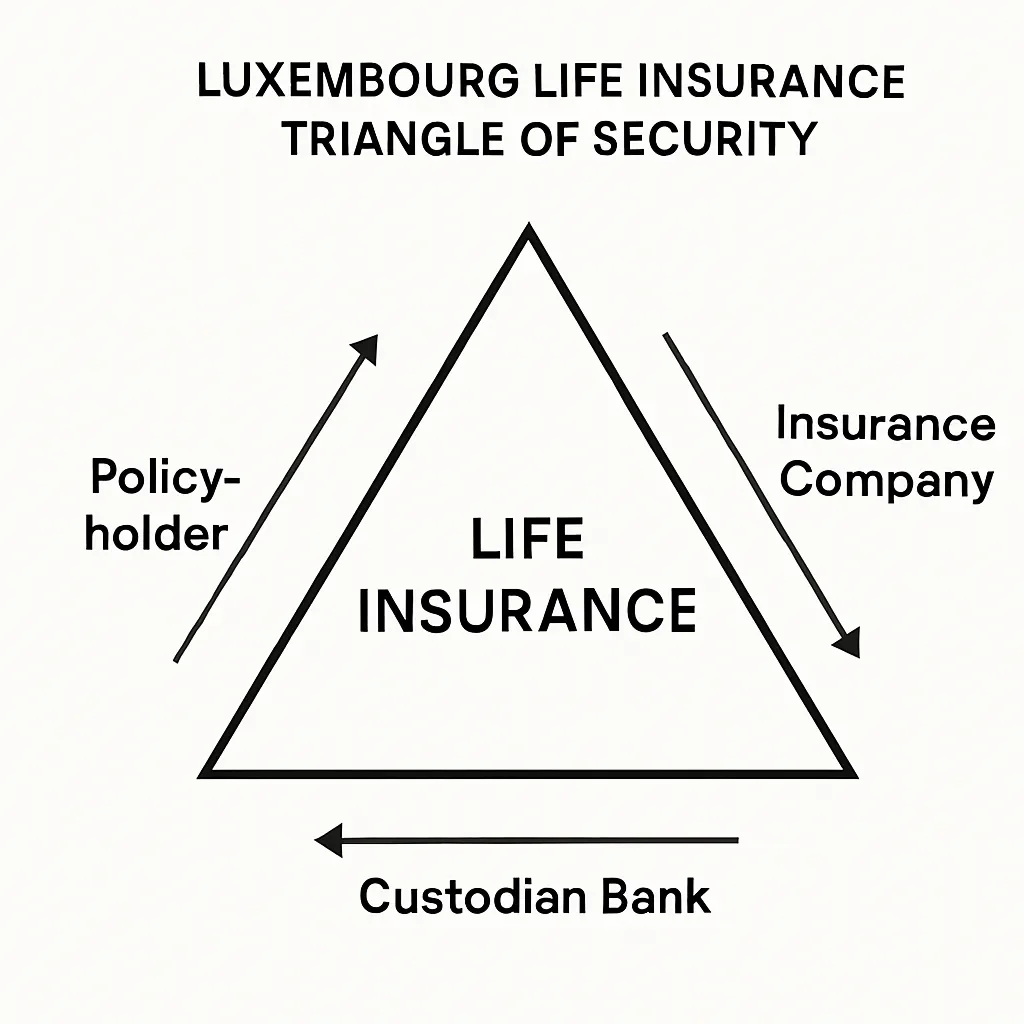
The famous security triangle is based on a simple logic: clients’ assets are separated from the insurer’s own assets, then held by a custodian bank. In case of trouble, this separation limits the risk of mixing assets. The super-priority also gives the saver a priority position over these segregated assets.
The comparison with France often comes up. The French protection mechanism for insured parties, via the FGAP, is capped at €70,000 per person and per company for life insurance. This is not “better” or “worse” in itself; it is simply a different logic. In Luxembourg, the focus is not on a single cap but on asset segregation and the subscriber’s priority rank.
It is also important to recall a point often mentioned lightly: the Sapin II law, which can regulate certain French contracts in case of systemic tension, does not apply as is to a Luxembourg law contract. This is precisely why this product reassures wealth holders who want to reduce French regulatory risk. To follow local rules, Luxembourg’s institutional documentation remains the right reflex.
For whom does Luxembourg life insurance make sense?
The contract makes sense when the wealth is already structured, when the tax residence may change, or when inheritance matters as much as performance. For a small capital, the extra cost and technical complexity may eat up the product’s benefit.
Here is the most useful test: if your contract must survive a departure from France, an arrival in Switzerland, retirement in Portugal, or diversification in currencies, Luxembourg can become relevant. Otherwise, a good French life insurance often remains simpler, cheaper, and already very effective.
| Profile | Main interest | Point of caution |
|---|---|---|
| French resident | Wealth protection and open architecture | French taxation on withdrawal |
| Expatriate | International portability of the contract | Tax residence to document |
| Business owner | Inheritance and wealth cash management | Long investment horizon required |
| Very large wealth | Multi-currency, diversification, and asset segregation | Higher fees and entry ticket |
The most wealth management-oriented contracts often have an entry ticket ranging between €100,000 and €250,000, depending on the insurer, the custodian bank, and the level of service. Beyond this threshold, the question becomes less “how much do I contribute?” and more “which structure do I choose?”. And here, the quality of advice really matters.
It should also be noted that some contracts only reveal their full value with a genuine long-term logic. If you are just looking for a wrapper to test, it is not always worth the effort. However, if you want a robust, multi-jurisdictional, and durable wealth management tool, the option deserves to be considered.
Luxembourg is not a magic shortcut. It is a more demanding wealth management tool that becomes truly relevant when legal protection and mobility matter as much as gross performance.
How to subscribe without making a mistake?
The right approach is to start from the need, not the commercial brochure. Before signing, you must check the total cost, liquidity, available supports, and the quality of the documentation. Otherwise, you may end up with a contract that looks great on paper but is painful to live with.
In practice, opening a Luxembourg life insurance policy resembles more a wealth management file than a simple online subscription. You have to accept a bit more formality, but this formality also serves to secure the whole process.
- Define the objective: inheritance, expatriation, diversification, or enhanced protection.
- Verify the tax residence: it guides much of the tax treatment.
- Prepare the supporting documents: identity, domicile, source of funds, wealth situation.
- Compare the structure: insurer, custodian bank, investment universe, fees, management options.
- Test the exit: partial redemption, processing time, multi-currency flexibility, inheritance.
The same mistakes are often seen: signing for “prestige,” neglecting recurring fees, or forgetting that performance depends primarily on the chosen supports. Conversely, a well-prepared file gains fluidity, and deadlines become much more reasonable. In short, the more serious the project is from the start, the less it turns into a bureaucratic nightmare later.
FAQ on Luxembourg life insurance
Can you open a Luxembourg life insurance policy with an average wealth?
Yes, but it all depends on the insurer and the distributor. In real life, many wealth management contracts require €100,000 to €250,000 at entry, which reserves the product for already well-established savers. Below that, the economic interest often becomes weaker.
What happens if I return to live in France after opening the policy?
The contract does not disappear, but its taxation will generally follow your new tax residence. This is precisely where Luxembourg is useful: it better supports country changes than a contract designed only for a national framework. However, the strategy must be recalibrated with an advisor.
Can you invest in multiple currencies within a single contract?
Often yes, but not automatically. Some contracts offer a true multi-currency logic, others are more limited. The benefit is real if your income, projects, or future place of residence are not confined to the euro.
Do euro funds exist in Luxembourg?
Depending on the contracts, you can find capital-guaranteed supports or similar solutions, but this is not the most natural norm of the Luxembourg market. The local universe is often more oriented towards unit-linked funds and open wealth management structures.
What is the main trap to avoid?
The number one trap is choosing the contract for its image instead of looking at its mechanics. Fees, custodian bank, liquidity, tax treatment of the country of residence, and quality of supports are far more important than a simple marketing pitch. Without that, Luxembourg life insurance can quickly become expensive for limited gain.
Does Luxembourg protect against all risks?
No, obviously not. The contract provides better protection against certain legal and counterparty risks, but it does not eliminate market risk, currency risk, or the risk of poor investment choices. It is a structural tool, not a magic wand.