
In brief
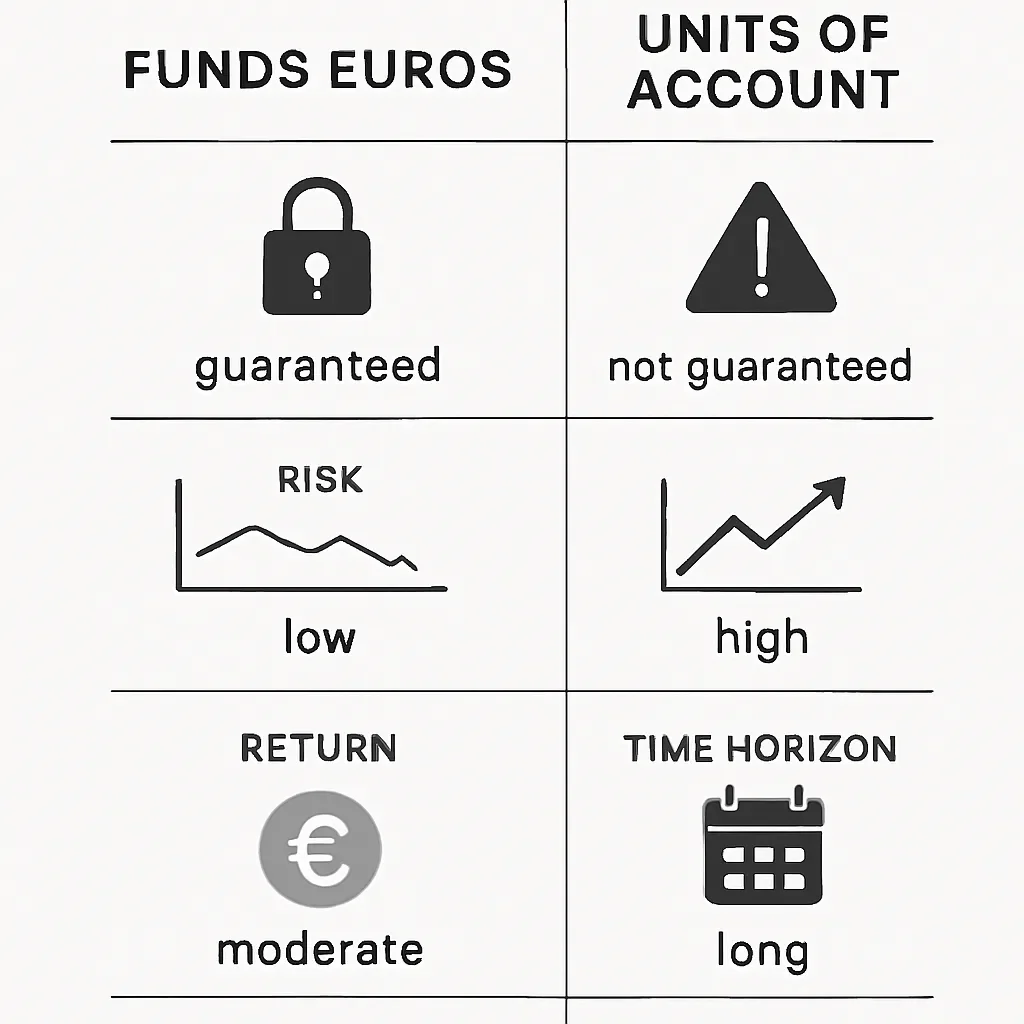
🛡️ The euro fund aims for stability: capital guaranteed by the insurer, more regular returns, but often limited potential.
📈 The unit-linked funds can better energize a life insurance policy, especially over 8 to 10 years or more, but the capital fluctuates both up and down.
⚖️ In practice, the smartest approach is often to combine both: a secure portion for peace of mind, a dynamic portion to try to beat inflation over time.
What are the real differences between euro funds and unit-linked funds?
The euro fund serves as a cautious base: the capital net of management fees is guaranteed by the insurer, and gains are consolidated each year. Unit-linked funds do not offer this guarantee, as their value depends on financial markets, real estate, or other assets.
The euro fund acts as a shock absorber. It is generally composed of bonds and low-volatility assets, which explains its reassuring profile. Conversely, a unit-linked fund can invest in equity ETFs, REITs (SCPI), bond funds, or diversified funds. In other words, the engine is not the same, nor is the road.
The tax framework does not change the nature of the vehicle, but it changes the way of thinking. On gains from a euro fund, social contributions of 17.2% are deducted progressively as interest is credited. On unit-linked funds, gains are only taxed upon redemption, which can allow more leeway over the long term.
| Criterion | Euro funds | Unit-linked funds |
|---|---|---|
| Capital | Guaranteed by the insurer | Not guaranteed |
| Return | More regular, often moderate | Variable, potentially higher |
| Risk | Low to moderate | From moderate to high depending on the vehicle |
| Recommended horizon | Short to medium term | Medium to long term |
| Liquidity | Good | Good, but fluctuating value |
| Use | Reserve, security, stability pocket | Retirement, growth, diversification |
For the regulatory framework of life insurance, Service-Public.fr usefully recalls the basic rules, while the AMF emphasizes that a unit-linked vehicle can go up as well as down.
Euro funds or unit-linked funds: which choice according to your profile?
The right vehicle mainly depends on your risk tolerance and your horizon. If you want to preserve available savings without cold sweats, the euro fund dominates. If you want to grow capital over several years, unit-linked funds take the lead, provided you accept the fluctuations.
In practice, we can simplify without caricaturing: a cautious profile favors euro funds, a balanced profile mixes the two, and a dynamic profile accepts a larger share of unit-linked funds (UC) to aim for a better risk/return ratio. The key point is coherence with your project, not the current trend.
In the field, it is observed that savers who let their contract run for at least a few years handle the ups and downs of UCs much better. Conversely, those who check their contract every week tend to make decisions too quickly, often at the wrong time.
A good habit is also to think in terms of objectives. For a real estate purchase planned in two or three years, caution is necessary. To prepare for retirement or to pass on capital in 10 years or more, it becomes more logical to accept a share of UCs. The timeline changes everything, quite simply.
How to allocate your life insurance between the two?
There is no magic formula, but a simple grid works well: the longer the horizon, the higher the share of UCs can be. Conversely, if you need money quickly, keep more euro funds. The right balance is the one you can maintain without stress or rushed reallocations.
An intelligent allocation often resembles a layered construction. The base of the house serves as a foundation, with the euro fund, while the upper floors aim for growth via UCs. In other words, you don’t put everything on the same support, except in very particular cases.
| Profile / objective | Starting allocation | Practical interpretation |
|---|---|---|
| Cautious | 80% euro funds / 20% UCs | To secure the essential while keeping some potential |
| Balanced | 50% euro funds / 50% UCs | Good compromise to aim for more return without exposing everything |
| Dynamic | 20% euro funds / 80% UCs | For a long horizon and real tolerance to fluctuations |
| Emergency savings | 100% euro funds | UCs are avoided if the money may be needed quickly |
| Long-term retirement | Progressive mix | You can gradually secure as the exit approaches |
The multi-support contract then makes perfect sense: you can reallocate, adjust, smooth exposure over time. This allows your allocation to evolve without starting from scratch, which is much more flexible than a fixed choice at the start.
Which unit-linked funds to choose without making mistakes?
To choose UCs, the right reflex is to start from the role of each support, not from its “sales” name. An equity UC can aim for growth, an SCPI can provide a real estate brick, and a bond fund can calm things down a bit. The idea is to diversify without stacking redundant supports.
The most common categories are quite easy to understand if we simplify a bit:
- Equity ETFs: broad exposure to a market, often with reduced fees, practical for long-term investing.
- SCPI: pooled professional real estate, interesting for diversification, but with value and liquidity risks.
- Bond funds: less volatile than equities, but sensitive to rates and issuer quality.
- Diversified funds: mix of several asset classes, useful to delegate part of the choices.
- Money market funds: more defensive profile, but often limited returns.
On this front, the AMF recommends looking at the KID or PRIIP KID, fees, risk indicator, and recommended investment duration. It’s not very glamorous, but it’s exactly what avoids unpleasant surprises. Joking aside, a support may seem attractive on paper and disappoint as soon as you dig a little.
Does the euro fund still really protect savings?
Yes, but not in the “miracle” sense that some hope for. The euro fund mainly protects against nominal capital loss, which remains valuable. However, it does not automatically protect against the erosion of purchasing power, and that’s where inflation comes to spoil the party.
The key point to watch is the differential with inflation. According to INSEE, the average annual inflation in France was around 2% in 2024. In other words, a euro fund that delivers a yield close to this level can preserve the nominal capital, but it does not necessarily create much real value once taxes and price increases are accounted for.
The real false debate is not “euro funds versus UC”. The right question is: what portion of security should be kept to invest the rest methodically, without turning your life insurance into a nervous gamble?
Some recent contracts offer more dynamic euro funds, sometimes with bonuses conditioned on a share of UCs. This is interesting, but you have to read the rules thoroughly. A better yield may come with allocation constraints, a payment ceiling, or holding conditions. Nothing is free, and that’s normal.
What pitfalls to avoid before reallocating?
The most common mistake is choosing an investment vehicle without considering the real duration of the project. A second classic error: ignoring fees and successive reallocations. Finally, many savers underestimate inflation and remain too cautious for too long, which eventually costs dearly in purchasing power.
The first pitfall is believing that a good investment today will necessarily remain so tomorrow. Markets change, rates move, contracts too. The second, more insidious pitfall is multiplying allocation moves whenever performance weakens. Over time, you sell low and buy high, a combo hardly ideal.
- Do not confuse emergency savings with long-term savings: they are not the same battle.
- Do not neglect fees: subscription fees, management fees, support fees, all count.
- Do not underestimate the taxation on withdrawals: rules vary depending on the contract’s age and the share of gains.
- Do not put all UCs in one theme: real estate, stocks, and bonds do not react the same way.
- Do not forget the secure portion: even a dynamic profile often needs a cushion.
Regarding taxation, Service-Public.fr reminds that after 8 years, gains benefit from an annual allowance of €4,600 for a single person and €9,200 for a couple, excluding social contributions. This is useful information before deciding whether to keep the contract, reallocate, or partially withdraw.
FAQ — Euro funds or units of account
Can you change the investment without closing your life insurance?
Yes, in a multi-support contract, you can generally switch between euro funds and units of account without closing the contract. However, some operations may be subject to delays or specific conditions depending on the insurer.
Are units of account suitable for emergency savings?
Not really, except in very particular cases. Emergency savings must remain available and stable, whereas a UC can drop just when you need money. For this portion, the euro fund remains more consistent.
Should you avoid UCs as retirement approaches?
Not necessarily, but risk should be gradually reduced. Many savers secure part of their capital as the exit date approaches. The idea is not to eliminate UCs but to limit a bad surprise at the time of disbursement.
Can a euro fund lose money?
In principle, the capital net of management fees is guaranteed, which greatly limits the risk of nominal loss. However, the yield can be low, and erosion by inflation can give the impression of “losing” purchasing power over several years.
Are reallocations between supports taxed?
Generally, internal reallocations within the contract are not considered taxable withdrawals. Taxation mainly occurs at the time of withdrawal. That said, you should always check the contract rules and the insurer’s fee conditions.